
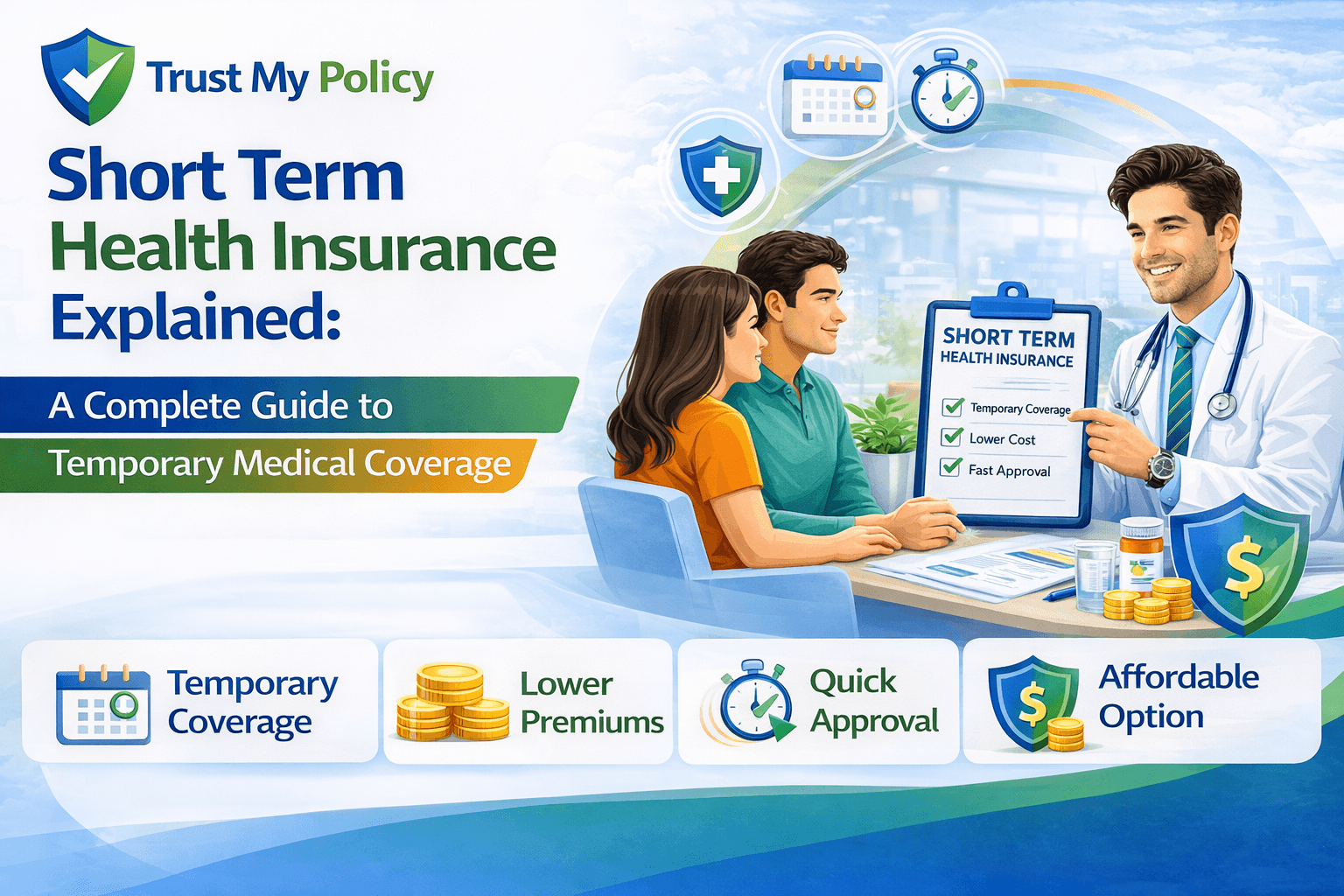
Short-term health insurance is a temporary, limited-benefit health policy typically costing $50–$200 a month for an individual, lasting 30 days to 12 months depending on state rules. It’s significantly cheaper than marketplace plans but excludes pre-existing conditions, doesn’t guarantee essential health benefits, and can be cancelled by the insurer. It’s best used as a genuine short bridge between comprehensive coverage periods, not as a long-term alternative to marketplace coverage.
Craig Turner, 29, left his employer’s health plan in March to start a new job in June and assumed he needed to find a bridge solution for three months. His broker offered two options: a marketplace special enrollment period plan or a short-term health insurance policy at $89 a month compared to $340 for the marketplace option. Craig chose the cheaper short-term plan, then learned in May that his new employer’s start date had been pushed back two months — and that his short-term plan excluded the kidney stone treatment he’d needed in week seven of the gap.
Short Term Health Insurance in 2026 is a temporary, limited-benefit health policy designed to bridge specific coverage gaps, typically lasting 30 days to 12 months depending on state rules. It’s significantly cheaper than marketplace coverage but carries critical differences: pre-existing conditions are excluded in most states, essential health benefits aren’t guaranteed, and coverage can be cancelled or refused. This guide breaks down exactly when it makes sense, when it doesn’t, and what Craig should have known before he signed.
This article covers what short-term health insurance actually includes and excludes, how it compares to marketplace alternatives, real scenarios showing the financial stakes, and a clear decision framework. By the end, you’ll know whether a short-term plan is a sensible bridge or a dangerous gap.
| Feature | Details |
| What it is | A temporary, limited-benefit health policy for specific coverage gaps |
| Typical duration | 30 days to 12 months; some states limit to 3 months |
| Typical cost | $50–$200/month individual; $150–$500/month family |
| Key benefit | Significantly lower premium than marketplace plans for a genuine short gap |
| Key limitation | Excludes pre-existing conditions, doesn’t cover ACA essential health benefits |
| Who it suits | Healthy individuals with a specific, short coverage gap between comprehensive plans |
| Regulator | State insurance departments (US); Financial Conduct Authority (UK) |
Think of short-term health insurance like a temporary rental car while your own car is being repaired. It gets you moving, but it’s not as comfortable, doesn’t have all the features you’re used to, and the rental company can charge you for damage they wouldn’t have to cover on your own policy. You’d use it for a specific, known period — not permanently.
Short-term health insurance is a limited-benefit health policy specifically designed to provide temporary coverage during a defined gap between comprehensive health plans. It’s regulated differently from ACA-compliant marketplace plans, meaning it isn’t required to cover essential health benefits, isn’t guaranteed-issue, and can apply medical underwriting to deny coverage or exclude pre-existing conditions. In most US states, it can run for up to 12 months; some states restrict it to 3 months or prohibit it entirely. Anyone considering a short-term plan needs to understand these distinctions clearly before choosing it over a marketplace alternative.
| Criteria | Short-Term Health Insurance | ACA Marketplace Plan |
| Monthly cost | $50–$200/month individual | $0–$450+/month depending on subsidy |
| Pre-existing conditions | Excluded in most states | Must be covered — guaranteed issue |
| Essential health benefits | Not required | Required by law |
| Enrollment | Year-round, quick | Open enrollment or qualifying life event required |
| Subsidy eligibility | None | Premium tax credits available based on income |
| Best for | Healthy individuals with a specific, short known gap | Anyone with ongoing medical needs or pre-existing conditions |
| Pros | Low cost, fast to start | Comprehensive, protected coverage |
| Cons | Excludes pre-existing conditions, limited benefits | Higher premium without subsidy; enrollment windows apply |
We recommend marketplace coverage over short-term plans for most readers, since the subsidy-adjusted cost of a marketplace plan is often closer to a short-term plan’s price than people expect, while providing genuinely comprehensive protection.
Scenario 1: Craig, 29, covering a 3-month gap between jobs. Craig’s short-term plan excluded kidney stone treatment he’d had within the prior year, leaving him with a $4,800 bill his plan wouldn’t touch. Verdict: a prior medical history makes short-term plans financially dangerous, even for a short gap. Action: Craig should have checked marketplace special enrollment period eligibility first, since losing employer coverage is a qualifying life event that would have opened a marketplace window.
Scenario 2: A healthy 24-year-old recent graduate in Texas covering a 6-week gap between graduation and her first job’s insurance start date. She had no pre-existing conditions, needed no prescription medications, and chose a short-term plan at $74 a month for the exact 6-week period. Verdict: this is the clearest genuine use case for short-term coverage — healthy, specific short gap, no pre-existing conditions. Action: she confirmed her job’s plan start date in writing before purchasing the short-term policy.
Scenario 3: A self-employed freelancer in Ohio using a short-term plan as an ongoing “health insurance substitute” for over a year. She developed a new condition during this period, which her plan excluded as a pre-existing condition on her renewal application. Verdict: short-term plans are not a safe long-term substitute for marketplace coverage, particularly as health circumstances can change. Action: she switched to a marketplace plan at the next open enrollment.
Scenario 4: A UK contractor between contracts considering a short-term “cash plan.” UK short-term health cash plans are a different product — they pay fixed cash amounts toward specific treatments rather than covering costs outright, and sit alongside NHS access rather than replacing it. Verdict: the UK equivalent is structurally different from US short-term health insurance and is usually a supplement, not a bridge product. Action: the contractor confirmed his NHS access remained fully in place and assessed whether the cash plan’s fixed benefits justified its cost.
| Pros | Cons |
| Significantly lower monthly premium than most marketplace plans. | Excludes pre-existing conditions in most US states. |
| Available year-round without a qualifying life event or enrollment window. | Not required to cover ACA essential health benefits. |
| Coverage typically starts within 24–48 hours of application approval. | The insurer can decline your application based on health history. |
| Useful genuine bridge for healthy people with a specific, short coverage gap. | Not eligible for any government premium tax credits or subsidies. |
| Provides some protection against catastrophic unexpected illness or accident. | Can be cancelled or non-renewed by the insurer, unlike marketplace plans. |
⚠️ WARNING: Never use a short-term health insurance plan if you have any pre-existing condition or ongoing medication, since most plans exclude these entirely. A denied claim after a major medical event can leave you with the full cost of treatment despite having paid premiums throughout the coverage period.
| Your Situation | Our Recommendation |
| You’re healthy with no pre-existing conditions and a gap under 3 months | Yes — a short-term plan may be a reasonable bridge |
| You have any pre-existing condition or ongoing medication | No — use a marketplace special enrollment period plan instead |
| You’re unsure whether your next job’s start date is confirmed | No — confirm in writing before committing to a short-term plan |
| You haven’t checked your marketplace subsidy eligibility | Yes — check it first; the cost difference may be smaller than expected |
| You’re planning to use a short-term plan for more than 6 months | No — switch to marketplace coverage at the next open enrollment |
| You live in a state that restricts or prohibits short-term plans | No — check your state’s rules, as short-term plans may not be available |
| You’re a UK contractor between contracts | No — NHS access continues regardless; assess a cash plan as a supplement only |
💡 TIP: The single golden rule for short-term health insurance: always check your marketplace special enrollment eligibility first, since losing employer coverage is itself a qualifying life event that opens a marketplace window without waiting for open enrollment.
| Scenario | Short-Term Plan Cost | Marketplace Equivalent Cost | Notes |
| Healthy 25-year-old, 2-month gap | $70–$100/month | $0–$150/month subsidised | Subsidy may narrow the gap significantly |
| Healthy 35-year-old, 3-month gap | $90–$140/month | $50–$200/month subsidised | Depends on income level |
| 35-year-old with prior kidney stone treatment | $70–$140/month (excluding kidney stones) | $100–$300/month (full coverage) | Short-term excludes the exact condition most likely to recur |
| Family of three, 3-month gap | $200–$450/month | $150–$600/month subsidised | Subsidy often makes marketplace competitive for families |
| Short-term plan claim for excluded pre-existing condition | $0 from insurer | Full bill paid by the individual | The most financially dangerous outcome of choosing the wrong plan |
| UK health cash plan (short-term supplement) | £15–£40/month | N/A — sits alongside free NHS access | Different product from US short-term health insurance |
HealthCare.gov (US) — The definitive source for confirming your marketplace special enrollment eligibility when a coverage gap occurs. Cost range: free. Best for: US residents checking whether a qualifying life event opens a marketplace window. Rating: federal government marketplace.
Your state insurance department (US) — Can confirm whether short-term plans are permitted in your state and for how long. Cost range: free. Best for: US residents checking state-specific short-term plan rules. Rating: government regulatory body.
eHealth or Health Markets (US) — Short-term plan comparison platforms that show available options, exclusions, and costs side by side. Cost range: free to compare. Best for: US residents comparing specific short-term plan options. Rating: licensed insurance comparison brokers.
Independent insurance brokers — Can present both marketplace and short-term options alongside your subsidy eligibility, helping you make a fully informed comparison. Cost range: typically free for the consumer. Best for: anyone wanting a side-by-side comparison of their actual options. Rating: varies by broker, check state licensing.
NAIC consumer resources (US) — Publishes plain-language guidance on short-term plan rules and consumer rights across US states. Cost range: free public resource. Best for: US consumers researching their rights under short-term health plans. Rating: regulatory standards body.
We recommend checking HealthCare.gov first as best overall, since confirming your marketplace special enrollment eligibility takes five minutes and may reveal that a full-coverage plan costs far less than expected after any applicable subsidy.
Short-term health insurance is a temporary, limited-benefit health policy designed to bridge specific coverage gaps, typically lasting 30 days to 12 months depending on state rules.
Individual short-term plans typically cost $50–$200 a month, significantly less than most unsubsidised marketplace plans, though also significantly less comprehensive.
In most US states, no. Short-term plans typically exclude pre-existing conditions, unlike ACA marketplace plans which must cover them.
Yes. Unlike marketplace plans, short-term health insurance is not guaranteed issue and can decline your application based on your health history.
In most US states, up to 12 months, though some states restrict the duration to 3 months or prohibit short-term plans entirely.
Yes. Losing employer-sponsored health coverage is a qualifying life event that opens a special enrollment period on the marketplace, typically lasting 60 days from the date of loss.
Only if you’re healthy with no pre-existing conditions, have a specific short confirmed gap, and have already checked that your marketplace subsidy doesn’t make a marketplace plan comparably affordable.
Yes. Short-term plans can be cancelled or non-renewed by the insurer, unlike ACA marketplace plans which must be renewed.
No. Some states prohibit or significantly restrict short-term plans, so confirming your state’s specific rules before purchasing is essential.
UK health cash plans are the closest equivalent — they pay fixed cash amounts toward specific treatments and sit alongside NHS access rather than replacing it.
This article is for informational purposes only. Always consult a licensed insurance professional before making coverage decisions. Trust My Policy does not sell insurance products or represent any insurer.

Jagadeesh Gutha is the founder of TrustMyPolicy.com, an independent insurance information platform covering life, health, car, home, and business insurance for US and UK readers. He researches insurance products, policy structures, and consumer rights to help everyday people make informed coverage decisions without the jargon. All content on TrustMyPolicy is independently researched, fact-checked, and written to educate — not to sell.
[…] Short-term insurance is designed to provide temporary coverage for a defined period, commonly used to bridge a gap between jobs or enrollment periods, and it typically excludes pre-existing conditions and caps total benefits. Long-term insurance is designed for comprehensive, ongoing protection, like ACA major medical health plans or long-term disability insurance that can pay benefits until retirement age. Anyone facing a coverage gap, or deciding on permanent protection, needs to understand this distinction clearly. […]


Insurance Guides for UK, USA & Worldwide We are not an insurer or broker.
Reader Comments (2)
[…] — consider a short-term plan as a […]