
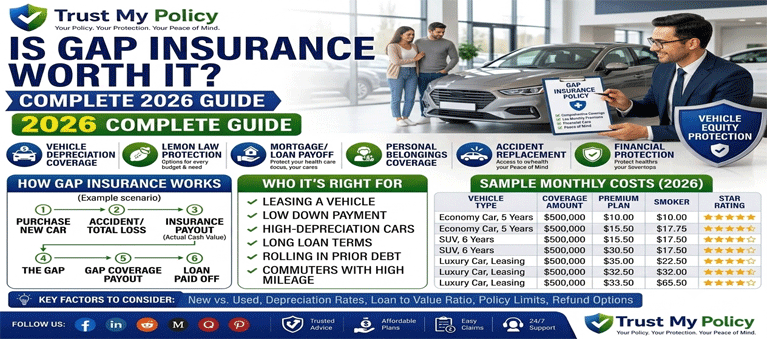
Gap insurance is worth it if you owe more on your car loan or lease than your vehicle is currently worth — a situation called being “underwater” or “upside-down” on your loan. This is most common in the first one to three years of a new car loan, especially with a small or no down payment. Gap insurance typically costs $20–$40 a year through your auto insurer, making it an extremely cost-effective protection when the math justifies it.
Devon Harper, 27, financed a new $38,000 SUV in Atlanta with a $2,000 down payment on a 72-month loan. Five months later, a rear-end collision totaled the vehicle. His insurer paid out $34,000 — the car’s actual cash value at the time. His loan balance was $36,800. Devon owed $2,800 to the lender for a car he no longer had and couldn’t drive. He had no gap insurance.
Is Gap Insurance Worth It in 2026 depends on one key calculation: whether you owe more on your vehicle loan or lease than the car is currently worth. If the answer is yes — and it almost always is for the first two to three years of a new vehicle loan or lease — gap insurance is one of the most cost-effective protections available. If the answer is no, you can likely skip it. This guide walks through the exact calculation so you can answer the question for your specific situation.
This article covers exactly how gap insurance works, when the math justifies it, how much it costs from different sources, what it excludes, and a clear framework for deciding. By the end, you’ll know whether Devon’s situation applies to you.
| Feature | Details |
| What it is | Coverage that pays the difference between your car’s actual cash value and your loan or lease balance |
| Who needs it | Anyone who owes more on their vehicle than it’s currently worth |
| Typical cost from auto insurer | $20–$40/year added to an existing comprehensive policy |
| Typical cost from dealer | $400–$900 rolled into the loan (significantly more expensive) |
| Key benefit | Eliminates the risk of owing thousands on a car you can no longer drive |
| Key limitation | Does not pay your deductible, past-due loan payments, or rollover balance from a previous loan |
| Regulator | State insurance departments |
Think of gap insurance like a bridge between two numbers — the amount your insurer pays (your car’s depreciated market value) and the amount you still owe your lender. Without gap insurance, you pay for that bridge yourself. With it, the insurer does.
Gap insurance, which stands for Guaranteed Asset Protection, pays the difference between your vehicle’s actual cash value at the time of a total loss and the remaining balance on your loan or lease. Auto insurance pays what your car is worth on the day it’s totaled, not what you originally paid for it or what you still owe on it. Since new vehicles depreciate quickly — often 15%–25% in the first year according to Edmunds — most financed buyers are underwater on their loan from the moment they drive off the lot.
| Criteria | Auto Insurer Gap Coverage | Dealer-Provided GAP |
| Typical cost | $20–$40/year | $400–$900 rolled into the loan |
| When paid | Added to your existing policy | Financed into the loan, accruing interest |
| Flexibility | Cancelable anytime | Often harder to remove from loan structure |
| Pros | By far the cheaper option | Convenient at the point of sale |
| Cons | Must be added while vehicle is new (within certain mileage limits) | Significantly more expensive over the loan term |
We recommend purchasing gap coverage through your auto insurer rather than the dealer for most readers, since the cost difference is substantial and the coverage is functionally identical.
Scenario 1: Devon, 27, financed SUV in Atlanta. Devon owed $2,800 on a totaled vehicle his insurer had already paid off at actual cash value. Gap insurance would have cost him approximately $35/year, totalling roughly $175 over the 5 months before the accident. Verdict: gap insurance would have eliminated Devon’s $2,800 out-of-pocket exposure for around $15 in premium. Action: Devon now adds gap coverage to any vehicle he finances within the first days of the loan.
Scenario 2: A buyer in Dallas who put 20% down on a new $35,000 truck on a 48-month loan. With a $7,000 down payment and a shorter loan term, her loan balance stayed close to or below the vehicle’s actual cash value from the start. Verdict: a large down payment and shorter loan term significantly reduce the period of being underwater — gap insurance was less urgent here. Action: she confirmed she was above water within 12 months and dropped gap coverage at her next renewal.
Scenario 3: A lease customer in Houston leasing a $42,000 vehicle with no cap cost reduction (down payment). Lease customers are almost always underwater throughout the lease term because the lease payoff includes future payments and residual obligations. Verdict: gap insurance is nearly always worthwhile for lease customers with no down payment. Action: her lease agreement included GAP automatically, but she confirmed this in writing before signing.
Scenario 4: A buyer who rolled $3,000 of negative equity from a previous loan into a new car purchase. His gap insurance excluded the rolled-over negative equity from his prior loan. Verdict: gap insurance only covers the gap on the current vehicle — not prior loan balances rolled into the new loan. Action: he took out the loan knowing the $3,000 rollover was his personal financial exposure regardless of gap coverage.
| Pros | Cons |
| Eliminates one of the most common, underestimated risks of vehicle financing. | Has no value once your loan balance falls below your vehicle’s actual cash value. |
| Extremely cost-effective at $20–$40/year through your auto insurer. | Does not cover your deductible, past-due payments, or negative equity from a previous loan. |
| Provides complete peace of mind during the most financially vulnerable period of a car loan. | Some buyers pay dealer-priced GAP ($400–$900) when insurer-priced coverage is identical. |
| Cancellable at any time once no longer needed. | Not available for vehicles above a certain age or mileage at the time of application. |
| Often included automatically in some lease agreements. | Requires comprehensive and collision coverage to be active — gap alone isn’t valid without it. |
⚠️ WARNING: Never assume gap insurance covers every dollar you owe on your vehicle. It specifically excludes your deductible, past-due loan payments, finance charges beyond your loan balance, and any negative equity rolled over from a previous vehicle loan.
| Your Situation | Our Recommendation |
| You financed a new vehicle with less than 20% down | Yes — you’re almost certainly underwater; buy gap coverage through your auto insurer |
| You’re leasing a vehicle | Yes — gap is nearly always worthwhile for lease customers; check if it’s already included |
| You put 20%+ down on a shorter 36-month loan | No — run the calculation first; you may already be at or below the car’s value |
| You’re being offered dealer GAP at point of sale | No — decline it and add coverage through your auto insurer at a fraction of the cost |
| Your loan is in its final 12 months | No — check your current balance vs. value; you’re likely no longer underwater |
| You rolled negative equity from a prior loan into this purchase | Yes — but understand the rollover amount is not covered; only the current vehicle’s gap is |
| You own the vehicle outright | No — gap insurance only applies to financed or leased vehicles |
💡 TIP: The single golden rule for gap insurance: buy it through your auto insurer, not the dealer — the coverage is identical and the cost difference can be $400 to $800 over the loan term.
| Scenario | Gap Insurance Cost | Potential Payout Without Gap Insurance |
| Through auto insurer, first 2 years | $20–$40/year | Eliminates any gap between ACV payout and loan balance |
| Through dealer, rolled into loan | $400–$900 total | Same coverage as insurer version |
| New $35,000 car, 5% down, totaled at month 6 | ~$15–$20 in premium | Potential gap of $3,000–$5,000 without coverage |
| New $42,000 leased vehicle, no cap reduction, totaled at month 8 | Typically included in lease | Potential gap of $4,000–$7,000 without coverage |
| Vehicle owned outright or loan paid below current value | N/A — gap not needed | $0 gap; no financial exposure to total loss |
| Buyer who forgot to cancel gap after loan paid down | Wasted $20–$40/year | Coverage no longer provides any financial value |
| Vehicle with rolled negative equity, $3,000 from prior loan | Gap covers current vehicle gap only | $3,000 rollover remains personal financial exposure |
Your existing auto insurer — The fastest and cheapest way to add gap coverage is to call your current insurer and add it to your existing policy. Most major US insurers offer this. Cost range: $20–$40/year. Best for: any buyer who has just financed a new vehicle. Rating: not applicable, primary service channel.
GEICO — Offers gap coverage as an affordable add-on to existing auto policies with a straightforward online or phone application. Cost range: competitive gap pricing. Best for: existing GEICO customers who have just financed a vehicle. Rating: AM Best A++.
Progressive — Offers gap insurance as a loan/lease payoff coverage add-on, available for new and recent vehicle purchases. Cost range: competitive gap pricing. Best for: existing Progressive customers wanting easy same-policy addition. Rating: AM Best A+.
State Farm — Offers loan/lease payoff coverage as an add-on for financed or leased vehicles. Cost range: competitive gap pricing. Best for: existing State Farm customers with an agent to confirm specific terms. Rating: AM Best A++.
Allstate — Provides gap coverage as an endorsement on existing auto policies, cancelable at any time. Cost range: competitive gap pricing. Best for: existing Allstate customers wanting to add and cancel gap as needed. Rating: AM Best A+.
We recommend your existing auto insurer as best overall because adding gap to an existing policy takes minutes, costs a fraction of dealer pricing, and the coverage is functionally identical.
Gap insurance pays the difference between your vehicle’s actual cash value at the time of a total loss and the remaining balance on your auto loan or lease.
Generally less so on a used vehicle, since depreciation has already occurred and the gap between loan balance and actual cash value is typically smaller. Run the specific calculation for your situation.
Through your auto insurer, gap insurance typically costs $20–$40 a year. Through a dealer, it’s typically $400–$900 rolled into the loan.
No. Gap insurance does not cover your collision or comprehensive deductible — that remains your personal out-of-pocket expense.
Cancel gap insurance when your loan balance falls below your vehicle’s current market value — at that point, the insurance no longer provides any financial benefit.
Many manufacturers and lenders include GAP automatically in their lease products, but you should confirm this in writing in your specific lease agreement.
Yes, but there are typically mileage and age restrictions. Most insurers require the vehicle to be relatively new and under a certain mileage threshold when gap is added.
Gap insurance does not cover your deductible, past-due loan payments, finance charges beyond the loan balance, or negative equity rolled over from a prior vehicle loan.
Yes, for most buyers. The coverage is functionally identical and the insurer version typically costs far less than the dealer-financed version.
Being underwater means you owe more on your auto loan than your vehicle is currently worth — the exact situation gap insurance is designed to address.
This guide reflects the latest 2026 insurance data.
This article is for informational purposes only. Always consult a licensed insurance professional before making coverage decisions. Trust My Policy does not sell insurance products or represent any insurer.

Jagadeesh Gutha is the founder of TrustMyPolicy.com, an independent insurance information platform covering life, health, car, home, and business insurance for US and UK readers. He researches insurance products, policy structures, and consumer rights to help everyday people make informed coverage decisions without the jargon. All content on TrustMyPolicy is independently researched, fact-checked, and written to educate — not to sell.


Insurance Guides for UK, USA & Worldwide We are not an insurer or broker.
Reader Comments (0)