
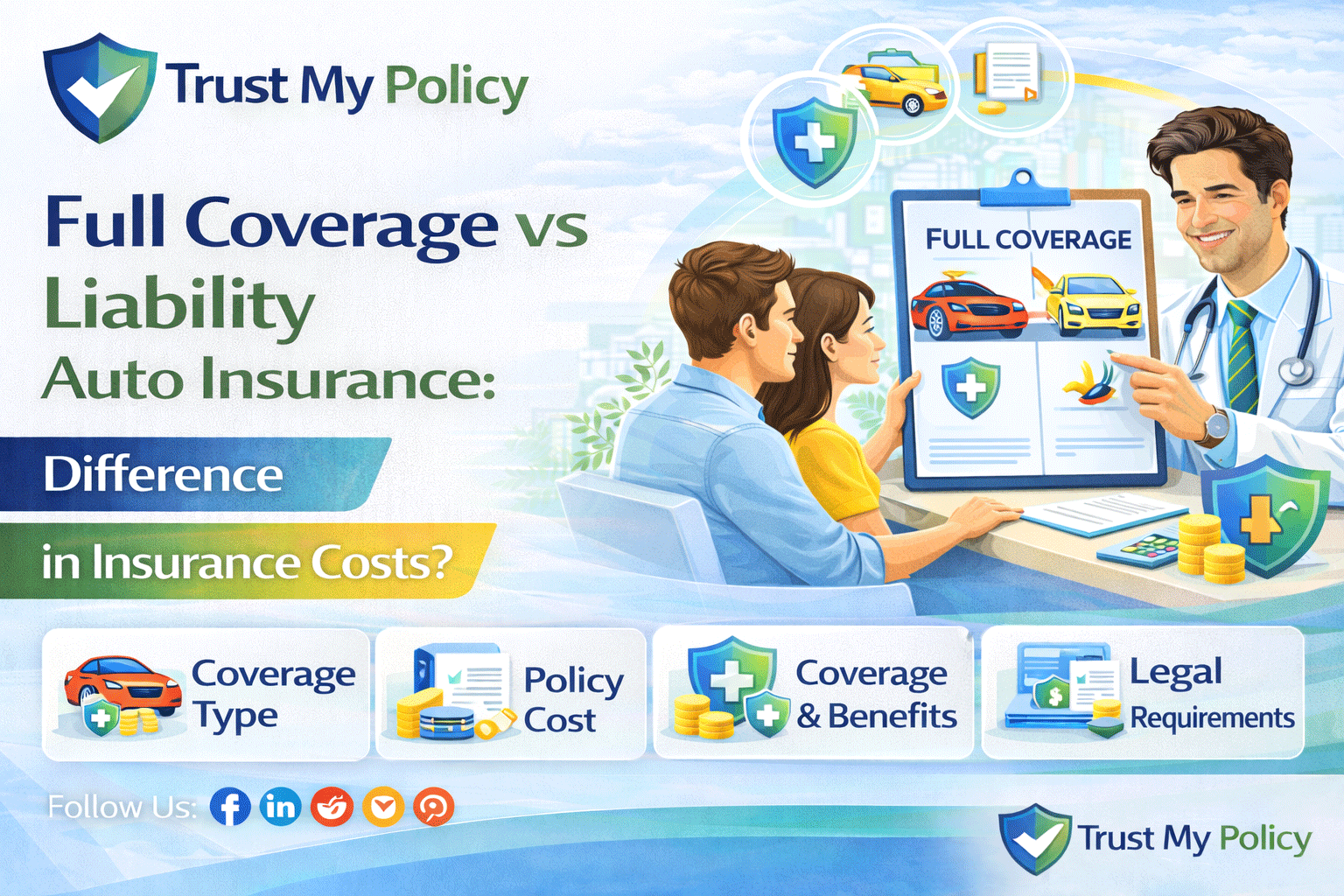
Liability car insurance covers damage or injuries you cause to other people and their property. Full coverage adds collision (damage to your own car in a crash) and comprehensive (theft, weather, vandalism). In 2026, full coverage costs $136/month on average versus $67/month for liability only, per MoneyGeek 2026. Liability is the legal minimum in most US states. Full coverage is required if you finance or lease your vehicle. Drop full coverage only when your car’s value falls below 10 times your annual full coverage premium.
Sophie, a 31-year-old nurse from Florida, drove a 2019 Honda CR-V worth $18,000. She had been paying $194/month for full coverage car insurance for three years. Her friend Marcus told her to switch to liability only — “your car is getting old, you’re wasting money.” Sophie dropped to liability at $67/month, saving $127/month. Two months later a distracted driver ran a red light and totalled her CR-V. Sophie was not at fault, but her liability-only policy paid zero toward her car. She lost $18,000 in vehicle value because she switched too soon.
Full coverage vs liability car insurance in 2026 is one of the most consequential decisions any driver makes. According to MoneyGeek’s 2026 analysis, full coverage costs $136/month on average compared to $67/month for liability only — a 102% difference of $69/month. That $69/month saving is real. But losing $18,000 in vehicle value in one accident, as Sophie did, is also real. Knowing exactly when each option makes sense — based on your vehicle value, financial position, and driving environment — can save you thousands.
In this guide you will learn exactly what full coverage and liability insurance include and exclude, the 10x Rule for deciding when to drop full coverage, state-by-state legal requirements, real cost data from MoneyGeek 2026 and NerdWallet 2026, four driver scenarios showing which choice wins, and the five most expensive mistakes drivers make when switching between coverage levels.
| Feature | Liability Only | Full Coverage |
| Covers damage you cause to others | ✅ Yes | ✅ Yes |
| Covers damage to your own car (collision) | ❌ No | ✅ Yes |
| Covers theft, weather, vandalism (comprehensive) | ❌ No | ✅ Yes |
| Required by law | ✅ Yes (most US states) | ❌ No (unless financed/leased) |
| Required by lender / leasing company | ❌ No | ✅ Yes |
| Average monthly cost 2026 | $67/month (MoneyGeek 2026) | $136/month (MoneyGeek 2026) |
| Cheapest available 2026 | GEICO: $41/month (NerdWallet Feb 2026) | Travelers: $122/month (The Zebra 2026) |
| Regulated by | State DOI (US); FCA (UK) | State DOI (US); FCA (UK) |
Liability car insurance is the legal minimum coverage required in 49 US states (New Hampshire is the exception, though it requires proof of financial responsibility). It covers two things only: bodily injury liability (medical expenses, lost wages, and legal costs for people you injure) and property damage liability (repair or replacement of other people’s vehicles or property you damage).
What liability does NOT cover: any damage to your own vehicle in any scenario, your own medical expenses in a crash you cause, theft of your vehicle, weather damage (hail, flood, fallen trees), vandalism, hitting an animal, or fires. If you cause a $30,000 accident, liability pays the other driver. Your own car sits damaged and uninsured.
Think of it like this: liability insurance is a legal promise to the state and other road users that if you cause damage, you can pay for it. It protects everyone else on the road. It does not protect you or your car. For a full breakdown of all coverage types, see our guide [INTERNAL LINK: types of car insurance coverage explained — what each one covers in 2026].
Full coverage is not a single policy type — it is a bundle of three coverage types: liability (required), collision (damage to your car from any crash), and comprehensive (everything else: theft, weather, vandalism, fire, animal strikes). Together these three provide 360-degree protection for you, your car, and others.
“Full coverage” is an industry shorthand. No policy covers literally everything — business use, intentional damage, normal wear and tear, and custom equipment are typically excluded even on full coverage policies. But for the vast majority of daily driving risks, full coverage handles them.
Lenders require full coverage on financed or leased vehicles because they have a financial interest in the car. If you total a $25,000 car with liability only, the lender still expects their loan repaid — even if the car is gone. Full coverage ensures the car is protected so the lender’s collateral remains intact. For GAP insurance — which covers the difference between the car’s value and your outstanding loan — see our guide [INTERNAL LINK: what is GAP insurance and when do you need it].
| Criteria | Liability Only | Full Coverage |
| Average monthly cost 2026 | $67/month (MoneyGeek) | $136/month (MoneyGeek) |
| Annual cost 2026 | $804/year | $1,632/year |
| Cheapest option 2026 | GEICO: $41/month | Travelers: $122/month |
| Covers your vehicle damage | ❌ No | ✅ Yes (collision) |
| Covers theft and weather | ❌ No | ✅ Yes (comprehensive) |
| Required by law | ✅ Most states | ❌ No |
| Required for financed/leased car | ❌ No | ✅ Yes (lender requirement) |
| Best for | Older cars worth under $4,000; paid-off vehicles | Cars worth over $10,000; financed or leased vehicles |
| Worst for | Anyone who cannot afford to replace their car | Very old, low-value cars ($2,000–$4,000) |
| Annual saving vs full coverage | — | Full coverage costs $828/yr more on average |
We recommend full coverage for most drivers in 2026 because the average car value ($28,400 per Kelley Blue Book 2025) far exceeds the $828 annual cost of adding collision and comprehensive. Liability only makes sense when your car’s value falls below the 10x Rule threshold explained below.
Most competitors mention the vehicle value test — but none explain the precise 10x calculation. Here it is:
Drop full coverage when: Annual full coverage premium x 10 is greater than your car’s current market value.
Example: Your full coverage premium is $1,632/year. Multiply by 10 = $16,320. If your car is worth more than $16,320, keep full coverage. If your car is worth less than $16,320, calculate whether dropping coverage makes financial sense.
Refinement: Also subtract your deductible from the car’s value. If your car is worth $5,000 and your deductible is $1,000, the most you would ever receive from a total loss claim is $4,000. Compare that $4,000 to your annual full coverage premium. If the premium is $900/year, you would recover the premium saving in 4.4 years of claim-free driving. If your car is worth $5,000 and your annual full coverage premium is only $600, the maths are less clear — calculate your specific break-even.
Use our guide on when to drop full coverage car insurance — the vehicle value calculator to run your own numbers.
Scenario 1: Sophie, 31, Nurse — Dropped Full Coverage Too Early (Florida)
Car: 2019 Honda CR-V worth $18,000. Annual full coverage premium: $2,328 ($194/month). Annual liability premium: $804 ($67/month). Annual saving: $1,524. She dropped to liability. Two months later her CR-V was totalled by an at-fault driver with minimum liability limits ($10,000 property damage — Florida minimum). Her car was worth $18,000. She recovered only $10,000 from the other driver’s insurer. She lost $8,000 because she had no collision coverage. Verdict: With a car worth $18,000, full coverage was essential. The 10x Rule confirms this — $2,328 x 10 = $23,280. $18,000 is less than $23,280, so full coverage was clearly correct.
Scenario 2: Marcus, 58, Retired — Right Decision to Keep Liability Only (Ohio)
Car: 2008 Honda Civic worth $4,200. Annual full coverage premium would be $980 ($82/month). Annual liability premium: $420 ($35/month). Annual saving: $560. Deductible on full coverage: $1,000. If the car is totalled, maximum claim payout = $4,200 – $1,000 deductible = $3,200. Annual saving ($560) means he recovers premium saving in 5.7 years. The car will likely be worth under $2,000 in 5 years. Marcus correctly kept liability only. Verdict: The 10x Rule confirms: $980 x 10 = $9,800. Car worth $4,200 is well below threshold — liability only is correct.
Scenario 3: Anya, 26, Financed Vehicle — Must Keep Full Coverage (California)
Car: 2023 Toyota Camry worth $26,000. Finance balance outstanding: $19,500. Her lender contractually requires full coverage. Annual full coverage premium: $2,100 ($175/month). Without full coverage, lender can purchase “force-placed” insurance at $3,600–$6,000/year and charge it to her loan. Anya has no choice — and paying $2,100/year is far cheaper than $3,600+ force-placed. Verdict: If your car is financed, full coverage is non-negotiable until the loan is paid off.
Scenario 4: Tom, 44, High-Risk Parking Area (New York City)
Tom owns a paid-off 2020 Subaru Outback worth $19,000. He parks on New York City streets. The NICB 2025 report shows NYC is the #3 city for auto theft in the US. Tom is correctly keeping full coverage despite his car being 5 years old. His comprehensive premium alone is $380/year — and covers $19,000 in theft risk. Verdict: Geography matters. High-theft areas, hurricane zones, and hail-prone regions make comprehensive coverage worth keeping even when the 10x Rule suggests dropping it.
| Pros of Full Coverage | Cons of Full Coverage | Pros of Liability Only | Cons of Liability Only |
| Protects your vehicle in any accident scenario | Costs $69/month more on average vs liability (MoneyGeek 2026) | Legal minimum — meets state requirements | Zero protection for your own vehicle |
| Covers theft, weather, vandalism via comprehensive | May not be cost-effective on older low-value cars | Significantly lower monthly premium ($67 vs $136/month) | Total loss of vehicle leaves you with no replacement funds |
| Required by lenders — keeps finance agreement intact | Deductible still applies before insurer pays | No deductible on liability claims you cause | Cannot use it to repair your own car after theft or weather |
| Peace of mind in high-theft or weather-risk areas | Force-placed insurance if you drop it on a financed car | Ideal for old cars worth under $4,000 | Serious financial risk if car is worth over $10,000 |
| Collision covers uninsured driver damage to your car | Some comprehensive exclusions (business use, modifications) | Right choice when 10x Rule confirms low car value | No coverage for hail, flood, fire, or animal strikes |
Mistake 1: Dropping Full Coverage Based on Age of Car Rather Than Value
Why it happens: “My car is 10 years old — I should drop full coverage.” What to do instead: Check your car’s actual market value (use Kelley Blue Book or Autotrader) regardless of age. A well-maintained 2015 Toyota Land Cruiser may still be worth $28,000 and absolutely warrants full coverage.
Mistake 2: Forgetting That Liability Does Not Cover Uninsured Drivers
Why it happens: “I’m a safe driver — if someone hits me, their insurance covers it.” What to do instead: Add Uninsured Motorist coverage. According to the Insurance Research Council 2025, 14% of US drivers are uninsured. In some states (Florida: 20.4%, Mississippi: 29.4%) the risk is far higher.
Mistake 3: Dropping Full Coverage on a Financed Car
Why it happens: The policyholder wants to save money and forgets the lender requirement. What to do instead: Never drop full coverage while a loan is outstanding. Your lender will purchase force-placed insurance (3–5x more expensive) and add it to your loan balance.
Mistake 4: Not Considering GAP Insurance When Switching
Why it happens: People do not know their loan balance exceeds the car’s current value. What to do instead: Check your loan balance vs your car’s current market value. If you owe $18,000 on a car worth $15,000, GAP insurance covers the $3,000 difference if the car is totalled. Without GAP, you pay the outstanding loan despite having no car.
Mistake 5: Choosing State Minimum Liability Limits
Why it happens: Minimum liability is the cheapest option at quote stage. What to do instead: State minimum liability limits (e.g., $10,000/$20,000 in Florida) are dangerously low. One serious accident with multiple injuries can exceed $100,000 in medical bills. Choose at least 50/100/50 limits ($50,000 bodily injury per person / $100,000 per accident / $50,000 property damage) for meaningful protection.
⚠️ WARNING: Dropping Full Coverage on a Car Worth More Than $10,000
What happens: You save $828/year in premium. Then your car is stolen or totalled by an uninsured driver. Liability pays nothing toward your own vehicle. You lose $10,000–$25,000 in vehicle value with zero insurance recovery. What to do instead: Only drop full coverage when your car’s value falls below 10 times your annual full coverage premium, AND you have savings to self-insure the vehicle loss. Confirm value via Kelley Blue Book before every renewal. If in doubt, keep full coverage.
| Your Situation | Our Recommendation |
| Your car is financed or leased | ✅ Full coverage — lender requires it; force-placed insurance costs 3-5x more |
| Your car is worth more than $10,000 | ✅ Full coverage — the 10x Rule confirms it is cost-effective |
| Your car is worth less than $4,000 | ❌ Liability only — full coverage premium exceeds realistic claim value |
| You live in a high-theft city (NYC, LA, Chicago) | ✅ Full coverage — comprehensive theft protection is worth the cost |
| You live in a hail, hurricane, or flood-prone state | ✅ Full coverage — comprehensive covers weather damage; liability pays nothing |
| You cannot afford to replace your car if totalled | ✅ Full coverage — the financial risk of liability only is too high |
| Your car is paid off and worth under $4,000 | ❌ Consider liability only — use the 10x Rule to confirm |
| You are an uber/rideshare driver | ✅ Commercial or rideshare endorsement required — standard policies exclude business use |
💡 Tip: Run the 10x Rule at every renewal. Multiply your annual full coverage premium by 10. If your car is worth more than that number, keep full coverage. If not, calculate the break-even on dropping it — then decide. Renewal is the right time to review, not mid-policy.
| Driver Profile | Liability Monthly | Full Coverage Monthly | Annual Difference | Recommendation |
| Average US driver 2026 | $67 (MoneyGeek) | $136 (MoneyGeek) | $828/yr | Full coverage if car over $10,000 |
| Cheapest liability available | $41 GEICO (NerdWallet Feb 2026) | $122 Travelers (Zebra 2026) | $972/yr | Cheapest full coverage: Travelers |
| Young driver (under 25) | $150–$200/month | $280–$350/month | $1,560–$1,800/yr | Full coverage if car financed |
| Senior driver (65+) | $55–$80/month | $110–$150/month | $660–$840/yr | Full coverage if car worth over $8,000 |
| High-risk driver (DUI/accident) | $200–$400/month | $350–$600/month | $1,800–$2,400/yr | Consider SR-22 + liability only on older car |
| Florida (highest gap state) | $90–$130/month | $220–$280/month (MoneyGeek) | $1,560/yr gap | Full coverage — PIP required + high uninsured rate |
| Louisiana (highest gap state) | $100–$140/month | $250–$300/month (MoneyGeek) | $1,704/yr gap | Full coverage — highest collision cost state |
Travelers (US) — Best Full Coverage Value
Why recommended: Cheapest full coverage in 2026 at $122/month average (The Zebra 2026). Strong claims satisfaction. Best for: Cost-conscious drivers who want full coverage without overpaying. Rating: A++ AM Best; 3.8/5 JD Power 2025.
GEICO (US) — Best Liability-Only Rate
Why recommended: Cheapest liability coverage at $41/month average (NerdWallet Feb 2026); 97% digital claims filing available. Best for: Drivers choosing liability only on older vehicles. Rating: A++ AM Best; 4.0/5 JD Power 2025.
USAA (US) — Best for Military Families
Why recommended: Liability from $22/month and full coverage from $78/month — lowest rates for eligible members (Clearsurance 2026). Eligibility: active military, veterans, and their families. Rating: A++ AM Best; 4.6/5 JD Power 2025.
State Farm (US) — Best Claims Record
Why recommended: Lowest complaint index of major US insurers — NAIC 2025 complaint ratio 0.53 vs 1.0 industry average. Best for: Drivers who prioritise claims reliability over lowest price. Rating: A++ AM Best; 4.2/5 JD Power 2025.
Admiral (UK) — Best UK Full and Liability Equivalent
Why recommended: UK third-party (liability equivalent) from £22/month; comprehensive from £45/month. Best for: UK drivers comparing third-party, third-party fire and theft, and comprehensive options. Rating: Defaqto 5 stars; 4.3/5 Trustpilot.
We recommend Travelers (US) for full coverage and GEICO (US) for liability only because both offer the lowest 2026 rates in their respective categories with strong regulatory complaint records. UK drivers should consider Admiral for comprehensive or third-party coverage.
Liability car insurance covers the costs you cause to other people and their property when you are at fault in an accident. This includes bodily injury liability (medical bills, lost wages, legal defence costs for injured parties) and property damage liability (repair or replacement of other vehicles or property you damage). It does not cover any damage to your own vehicle, your own medical costs, theft, weather damage, or any scenario where you need your own car repaired.
No. Full coverage is not required by any US state law. Liability insurance is the legal minimum in 49 states. Full coverage is required by lenders and leasing companies — not by the state — when you finance or lease a vehicle. If your car is fully paid off, full coverage is always optional regardless of its value.
Apply the 10x Rule: multiply your annual full coverage premium by 10. If your car’s current market value (check Kelley Blue Book) is less than that number, consider dropping full coverage. Additionally confirm you have savings to self-fund a total vehicle loss. Never drop full coverage on a financed vehicle — your lender will purchase force-placed insurance at 3–5 times the cost and add it to your loan.
According to MoneyGeek’s 2026 analysis, full coverage costs $136/month on average versus $67/month for liability only — a difference of $69/month or $828/year. The cheapest full coverage available in 2026 is Travelers at $122/month (The Zebra 2026). The cheapest liability is GEICO at $41/month (NerdWallet Feb 2026). Rates vary significantly by state, age, and driving record.
Yes, collision coverage within full coverage pays the actual cash value (ACV) of your vehicle at the time of the total loss, minus your deductible. ACV is the market value of your car — not the original purchase price or the outstanding loan balance. If your car is worth $15,000 and your deductible is $1,000, you receive $14,000. If you owe $18,000 on the loan, you still owe the lender $4,000 — which is where GAP insurance helps.
Collision coverage pays for damage to your car resulting from any crash — whether you hit another car, a barrier, or a stationary object. Comprehensive coverage pays for damage from non-collision events: theft, vandalism, hail, floods, fire, fallen trees, and animal strikes. Both have separate deductibles. Together, collision and comprehensive plus liability = “full coverage.” You can also purchase comprehensive without collision — useful in low-crash-risk areas with high theft or weather risk.
If you have liability only and an uninsured driver totals your car, you have no coverage for your vehicle. You can pursue the at-fault driver personally for damages, but if they have no assets, recovery is unlikely. The Insurance Research Council 2025 reports 14% of US drivers are uninsured — in Florida it is 20.4%. Adding Uninsured Motorist Property Damage (UMPD) coverage to a liability policy costs $10–$30/month and covers this exact scenario without requiring full collision coverage.
Both cost significantly more for drivers under 25. According to NerdWallet Feb 2026 data, young drivers pay an average of $313/month for full coverage with Progressive and around $150–$200/month for liability. The premium gap between full and liability is proportionally similar to adult rates. Young drivers with financed vehicles have no choice — full coverage is required. Young drivers with older paid-off cars should apply the 10x Rule before deciding.
Liability is the minimum legal requirement in 49 states. New Hampshire does not mandate insurance but requires drivers to demonstrate financial responsibility. Virginia allows drivers to pay an uninsured motorist fee instead of carrying insurance, though this is changing under 2025 law updates. Every state sets its own minimum liability limits — these vary widely from $10,000/$20,000 (Florida) to $50,000/$100,000 (Alaska). State minimums are the legal floor, not a recommended coverage amount.
No. All lease agreements contractually require full coverage — liability, collision, and comprehensive — for the duration of the lease. If you drop coverage, the leasing company can repossess the vehicle and charge you for force-placed insurance retroactively. Some leases also require specific deductible maximums (typically $500 or $1,000). Check your lease agreement for exact requirements before making any coverage changes.
This guide reflects the latest 2026 car insurance data and state regulatory requirements.
This article is for informational purposes only. Always consult a licensed insurance professional before making coverage decisions. Trust My Policy does not sell insurance products or represent any insurer.

Jagadeesh Gutha is the founder of TrustMyPolicy.com, an independent insurance information platform covering life, health, car, home, and business insurance for US and UK readers. He researches insurance products, policy structures, and consumer rights to help everyday people make informed coverage decisions without the jargon. All content on TrustMyPolicy is independently researched, fact-checked, and written to educate — not to sell.



Insurance Guides for UK, USA & Worldwide We are not an insurer or broker.

Reader Comments (0)