
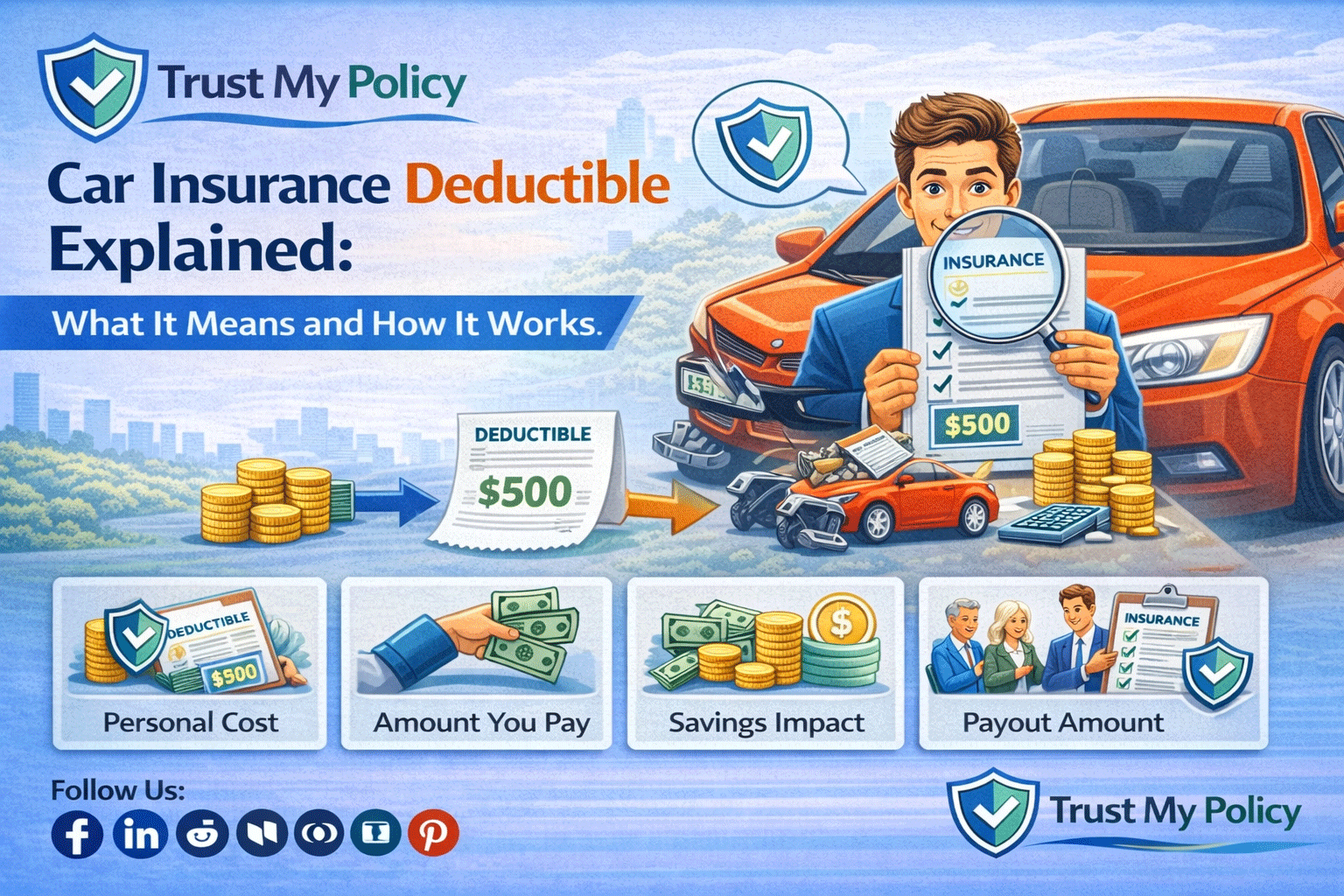
A car insurance deductible is the amount you pay out of pocket on a covered collision or comprehensive claim before your insurer pays the rest. Common deductible options range from $250 to $2,500, with a higher deductible lowering your monthly premium and a lower deductible increasing it. Liability coverage carries no deductible. Choosing the right amount means balancing your monthly savings against your realistic ability to pay that amount in a single event.
Sam Adler, 29, chose a $2,000 deductible on his collision coverage to lower his monthly premium by $38. Three months later, a minor collision caused $1,700 in damage — less than his deductible — meaning his insurer paid nothing and he covered the entire bill out of pocket.
A Car Insurance Deductible in 2026 is the fixed amount you pay out of pocket on a covered claim before your insurer covers the rest. Collision and comprehensive coverage each carry their own separate deductible, typically ranging from $250 to $2,500, while liability coverage has no deductible at all. Choosing the right deductible is a direct trade-off between your monthly premium and the amount you’d need to pay in an emergency — and Sam’s experience shows what happens when that trade-off tips the wrong way.
This article covers exactly how car insurance deductibles work, how to choose the right amount for your financial situation, how different deductibles affect your actual premium, and real scenarios showing the financial stakes. By the end, you’ll know exactly which deductible makes sense for your specific budget.
| Feature | Details |
| What it is | The out-of-pocket amount you pay per collision or comprehensive claim before coverage applies |
| Which coverages have a deductible | Collision and comprehensive; liability does not |
| Typical range | $250–$2,500 per claim |
| Effect on premium | Higher deductible lowers your premium; lower deductible raises it |
| Key benefit | Choosing the right deductible balances monthly cost against realistic out-of-pocket risk |
| Key limitation | A deductible higher than a common small claim amount can mean you pay entirely out of pocket |
| Regulator | State insurance departments (US); Financial Conduct Authority (UK) |
Think of your car insurance deductible like an annual gym joining fee you pay before the gym covers any of your membership benefits. The bigger the joining fee you agree to pay, the lower your ongoing monthly dues. With car insurance, the bigger the deductible you agree to cover if something happens, the lower your ongoing monthly premium.
A car insurance deductible is the specific dollar amount you pay out of pocket when you file a collision or comprehensive claim, before your insurer covers the remainder. This applies per claim, not per year, meaning a driver who files two claims in a year would pay the deductible twice. Liability coverage, which pays for damage or injury you cause to others, has no deductible at all. Anyone choosing or reviewing car insurance coverage needs to understand this distinction clearly, since it directly affects both your monthly cost and your out-of-pocket exposure in any given incident.
| Criteria | Low Deductible ($250–$500) | High Deductible ($1,000–$2,500) |
| Monthly premium | Higher | Lower |
| Out-of-pocket cost at claim time | Lower | Higher |
| Best for | Drivers with limited savings or who worry about affording sudden repairs | Drivers with a strong savings cushion who rarely claim |
| Pros | Predictable, manageable out-of-pocket cost if a claim occurs | Meaningful monthly premium savings |
| Cons | Higher ongoing premium cost in claim-free years | Can result in a claim below your deductible being entirely out of pocket |
We recommend choosing a deductible equal to the highest amount you could comfortably pay in cash within a week for most readers, since this balances real monthly savings against realistic financial exposure.
Scenario 1: Sam, 29, driver in Denver. Sam’s $2,000 deductible meant his $1,700 collision repair was entirely out of pocket, since the claim amount was less than the deductible. Verdict: a deductible set higher than your most common small repair cost can mean filing a claim isn’t even worth considering. Action: Sam lowered his deductible to $750 at his next renewal, saving real money at the cost of a modestly higher premium.
Scenario 2: Maria, 34, driver in Manchester with a £150 excess. Maria’s windshield replacement cost £620, with her insurer covering £470 after the standard £150 excess was applied. Verdict: a low excess meant a manageable out-of-pocket cost on a moderate claim. Action: Maria kept her low excess because she drives frequently and values predictable out-of-pocket exposure.
Scenario 3: A driver in Texas with a $500 deductible and a $4,800 hail damage claim. His insurer paid $4,300 after deducting the $500 deductible, giving him a predictable, manageable out-of-pocket cost. Verdict: for larger, unexpected claims, a lower deductible significantly reduces financial stress at the moment of the claim. Action: the driver confirmed he had adequate savings to cover the deductible even if another large claim arose the same year.
Scenario 4: An experienced, safe driver in California who hasn’t filed a claim in seven years. She chose a $1,500 deductible specifically to lower her premium, saving $55 a month, and kept the equivalent savings in a dedicated emergency fund. Verdict: a high deductible paired with a matching savings buffer is a genuinely cost-effective strategy for low-claim drivers. Action: she reviews her deductible choice annually to ensure the savings buffer remains funded.
| Pros | Cons |
| Higher deductibles meaningfully lower monthly premiums for low-claim drivers. | A claim below your deductible means paying entirely out of pocket with no insurer contribution. |
| Lower deductibles provide predictable, manageable out-of-pocket costs when claims occur. | Lower deductibles result in higher ongoing premiums even in claim-free years. |
| Matching your deductible to a savings buffer maximises cost efficiency over time. | Choosing too high a deductible without a savings buffer creates real financial vulnerability. |
| Reassessing your deductible at each renewal allows it to evolve with your financial situation. | Filing small claims close to the deductible amount can trigger future premium increases. |
| Understanding that liability has no deductible prevents unnecessary confusion after an at-fault accident. | Some drivers don’t realise collision and comprehensive carry separate, individual deductibles. |
⚠️ WARNING: Never choose a deductible amount you couldn’t realistically pay in cash within a few days of an accident. The monthly premium saving from a very high deductible can feel compelling until the moment you need to pay it in a single, unexpected transaction.
| Your Situation | Our Recommendation |
| You have less than $500 in accessible savings | Yes — choose a $250–$500 deductible regardless of the premium difference |
| You have $1,000+ in accessible savings and rarely claim | Yes — consider a $1,000 deductible paired with a matching savings buffer |
| Your car is worth less than $5,000 | Yes — reconsider whether collision coverage itself is still worth carrying at all |
| You filed a small claim last year near your deductible amount | Yes — consider whether paying out of pocket going forward makes more financial sense |
| You’ve never checked your specific deductible amounts on your declarations page | Yes — check them now before any claim arises |
| You’re unsure whether your latest claim amount is above your deductible | Yes — check your declarations page before calling your insurer to file |
| You’ve recently improved your savings position significantly | Yes — consider raising your deductible at the next renewal to lower your premium |
💡 TIP: The single golden rule for choosing a car insurance deductible: pick the highest amount you could comfortably pay in cash within a few days of an unexpected accident — not the highest amount that simply lowers your premium the most.
| Scenario | Deductible | Premium Saving vs. $500 baseline | Out-of-Pocket on a $1,800 Claim |
| $250 deductible, collision coverage | $250 | Premium is higher by $15–$25/month | You pay $250, insurer pays $1,550 |
| $500 deductible, collision coverage | $500 | Baseline | You pay $500, insurer pays $1,300 |
| $1,000 deductible, collision coverage | $1,000 | Save roughly $15–$25/month | You pay $1,000, insurer pays $800 |
| $1,500 deductible, collision coverage | $1,500 | Save roughly $30–$50/month | You pay $1,500, insurer pays $300 |
| $2,000 deductible, collision coverage | $2,000 | Save roughly $35–$60/month | You pay $1,800, insurer pays $0 (claim under deductible) |
| UK £150 excess on £620 windshield claim | £150 | Lower monthly premium | You pay £150, insurer pays £470 |
| UK £350 excess on £620 windshield claim | £350 | Lower monthly premium | You pay £350, insurer pays £270 |
Your insurer’s online quote tool — Most insurers let you compare how different deductible levels change your specific premium in real time, without committing to a change. Cost range: free. Best for: quickly seeing the exact premium saving for each deductible option. Rating: not applicable, primary service channel.
Policygenius and The Zebra (US) — Comparison platforms that show how deductible choices affect quoted premiums across multiple insurers simultaneously. Cost range: free to compare. Best for: US drivers comparing deductible options across multiple insurers at once. Rating: independent comparison services.
Compare the Market and Confused.com (UK) — UK comparison sites where you can adjust the voluntary excess level and see how it affects your quoted premium. Cost range: free to compare. Best for: UK drivers comparing excess levels across multiple insurers. Rating: FCA-regulated comparison services.
Independent insurance brokers — Brokers can advise on the most cost-effective deductible level for your specific car value, savings cushion, and claims history. Cost range: typically free for the consumer. Best for: anyone wanting personalised guidance on the right deductible level. Rating: varies by broker, check state or FCA licensing.
We recommend using your insurer’s own quote tool or a comparison platform first, since these let you see the exact premium trade-off for your specific policy before making any change.
A car insurance deductible is the fixed amount you pay out of pocket on a covered collision or comprehensive claim before your insurer pays the remaining cost.
Collision and comprehensive coverage each carry their own deductible. Liability coverage does not have a deductible, since it pays for damage or injury you cause to others.
Raising your deductible from $500 to $1,000 typically saves $15–$25 a month, while raising it to $2,000 might save $35–$60 a month, though exact savings vary by insurer and risk profile.
Only if you have a savings buffer large enough to comfortably cover that deductible in a single, unexpected payment, otherwise the premium saving isn’t worth the financial risk.
A UK car insurance excess is the equivalent of a US deductible — the amount you pay out of pocket on a collision or comprehensive claim before the insurer covers the rest.
Your insurer pays nothing, since the deductible must be exceeded before any coverage applies, and in this case it may not be worth filing a formal claim at all.
Often not. Filing a small claim that barely exceeds your deductible can trigger a future premium increase that costs more than the small payout received.
Yes, in most cases you can request a deductible change at your next renewal, and some insurers allow mid-term adjustments, though both will affect your premium accordingly.
Yes. Each coverage type has its own independent deductible, so a claim under collision uses your collision deductible, and a claim under comprehensive uses your comprehensive deductible.
Your specific deductible for each coverage type is listed on your declarations page, which is the first page or two of your policy documents.
This article is for informational purposes only. Always consult a licensed insurance professional before making coverage decisions. Trust My Policy does not sell insurance products or represent any insurer.

Jagadeesh Gutha is the founder of TrustMyPolicy.com, an independent insurance information platform covering life, health, car, home, and business insurance for US and UK readers. He researches insurance products, policy structures, and consumer rights to help everyday people make informed coverage decisions without the jargon. All content on TrustMyPolicy is independently researched, fact-checked, and written to educate — not to sell.


[…] into several key sections: the declarations page (your personalised coverage summary with limits, deductible, and premium), the insuring agreement (what the insurer agrees to cover), conditions (your […]



Insurance Guides for UK, USA & Worldwide We are not an insurer or broker.
Reader Comments (2)
[…] pay your chosen deductible before either coverage pays out. Collision and comprehensive each have their own separate […]