
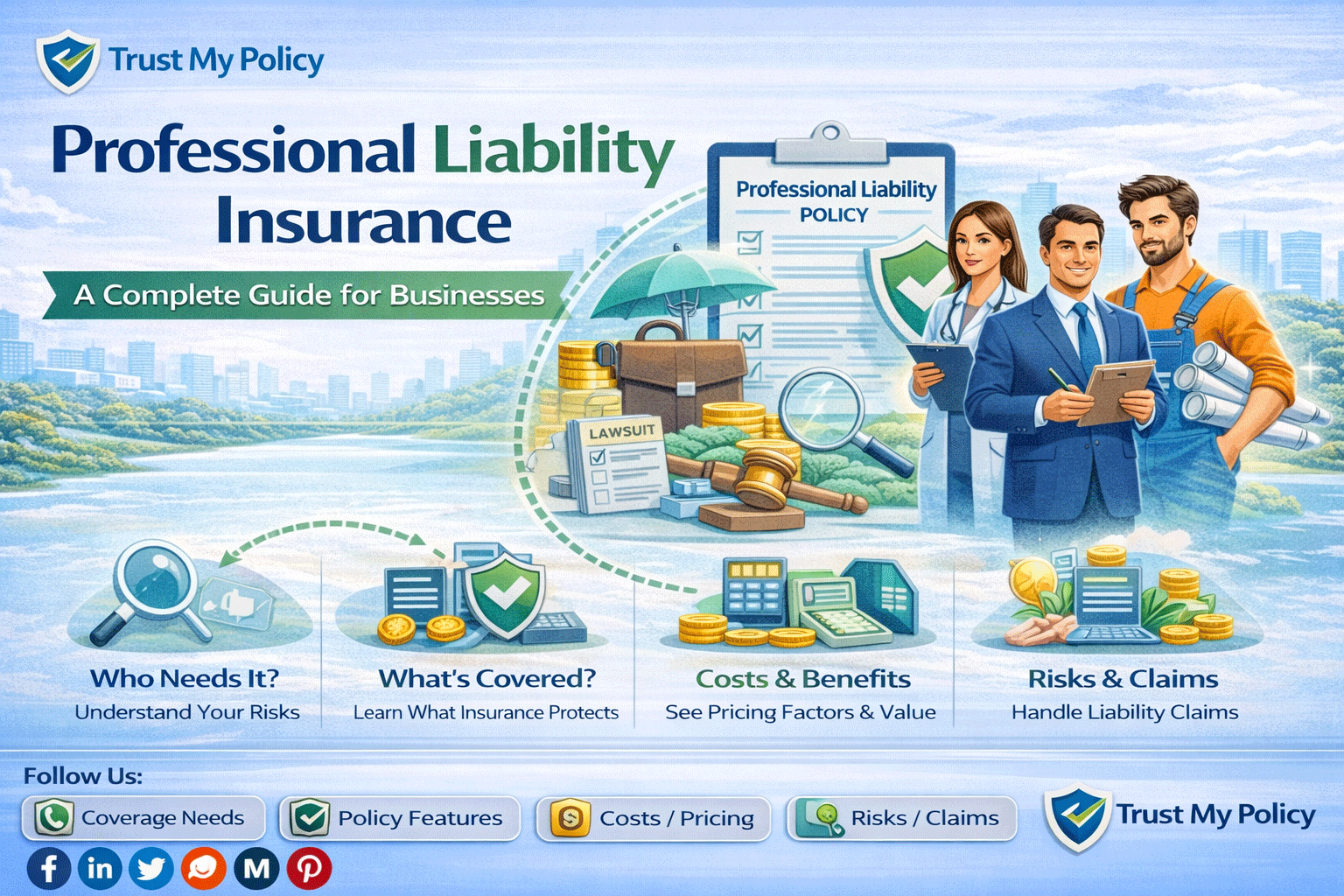
Professional liability insurance, also called errors and omissions (E&O) insurance, covers claims arising from mistakes, missed deadlines, or alleged negligence in the professional services you provide, distinct from the physical injury and property damage covered by general liability. Consultants, accountants, financial advisors, designers, IT professionals, and healthcare providers all commonly need this coverage, typically costing $500–$3,000 a year depending on profession and claims history.
Renee Castellano, 41, ran a small financial planning practice in Denver and assumed her general liability policy would protect her if a client ever disputed her advice. When a client claimed her investment recommendation caused a $60,000 loss and threatened legal action, she learned that general liability specifically excludes this exact type of claim, and only a professional liability policy would have responded.
Professional Liability Insurance in 2026, also called errors and omissions (E&O) insurance, covers claims arising from mistakes, missed deadlines, or alleged negligence in the professional services or advice you provide. Unlike general liability, which covers physical injury and property damage, professional liability covers financial harm caused by your work itself. This guide breaks down exactly who needs it, what it covers by profession, and what it costs.
This article covers what professional liability insurance actually covers, which professions need it most, real scenarios with specific claim amounts, and a clear framework for choosing the right coverage limit. By the end, you’ll know exactly whether your work carries this exposure.
| Feature | Details |
| What it is | Coverage for claims arising from professional errors, omissions, or alleged negligence |
| Who needs it | Consultants, accountants, financial advisors, designers, IT professionals, healthcare providers, and other service-based professionals |
| Typical cost | $500–$3,000/year depending on profession, revenue, and claims history |
| Coverage available | Typically $250,000 to $2,000,000+ in liability limits |
| Key benefit | Covers financial harm claims that general liability specifically excludes |
| Key limitation | Doesn’t cover intentional misconduct or claims arising from before the policy’s retroactive date |
| Regulator | State insurance departments (US); Financial Conduct Authority (UK) |
Think of professional liability insurance like a safety net specifically positioned under your professional judgment, separate from the net positioned under your physical premises. General liability catches you if someone trips over a cord in your office. Professional liability catches you if your actual advice, design, or service delivery is the thing a client claims caused them harm.
Professional liability insurance, also known as errors and omissions (E&O) insurance, covers claims that arise from mistakes, missed deadlines, inadequate work, or alleged negligence in the professional services or advice a business provides. This is fundamentally different from general liability, which addresses physical injury and property damage rather than financial harm caused by the quality or accuracy of your work. Anyone providing professional advice, design, technical services, or specialized expertise to clients needs to seriously consider this coverage.
| Criteria | Professional Liability Insurance | General Liability Insurance |
| What it covers | Financial harm from professional errors, omissions, or negligence | Physical injury and property damage to third parties |
| Common trigger | A client claims your advice or work caused them a financial loss | A customer is injured or their property is damaged at your business |
| Who typically needs it | Consultants, accountants, designers, IT professionals, healthcare providers | Nearly any business with customers or physical premises |
| Pros | Covers the specific financial harm risk of professional service delivery | Covers the most statistically common type of business claim |
| Cons | Doesn’t cover physical injury or property damage | Doesn’t cover financial harm from professional advice or service quality |
We recommend any business providing professional advice or specialized services carry both general liability and professional liability insurance for most readers, since each covers a genuinely different category of risk.
Scenario 1: Renee, 41, financial planner in Denver. Renee’s general liability policy didn’t cover a client’s $60,000 investment loss claim, which specifically required professional liability coverage instead. Verdict: financial advice claims fall squarely outside general liability and require professional liability. Action: Renee secured a $1,000,000 professional liability policy within weeks of this realization.
Scenario 2: A freelance web developer in Manchester whose code error caused a client’s online store to go offline for two days. The client’s claimed lost sales were covered under the developer’s professional liability policy. Verdict: technical service errors are a common, well-recognized professional liability claim type. Action: the developer increased her coverage limit after taking on a larger e-commerce client.
Scenario 3: An architect in Houston whose design oversight led to a costly structural correction during construction. The correction costs were covered under the architect’s professional liability policy, specifically because the claim related to the quality of professional design work. Verdict: design and engineering errors are a textbook professional liability scenario. Action: the architect confirmed her policy’s retroactive date covered all currently active projects.
Scenario 4: A small accounting firm in Leeds that switched insurers and discovered a gap in retroactive coverage. A claim related to work performed under the previous insurer wasn’t covered by the new policy’s retroactive date. Verdict: retroactive date gaps are a commonly overlooked risk when switching professional liability insurers. Action: the firm purchased “tail coverage” to close the gap for work performed before the switch.
| Pros | Cons |
| Covers financial harm claims that general liability specifically excludes. | Doesn’t cover intentional misconduct or claims outside your retroactive date. |
| Legal defense costs are typically covered, often a major expense even without a settlement. | Claims-made policies require careful attention to retroactive dates when switching insurers. |
| Available with coverage limits tailored to higher-risk professions. | Premiums vary significantly by profession and individual claims history. |
| Provides real protection for the exact risk of professional judgment and advice. | Doesn’t address physical injury or property damage, which require separate coverage. |
| “Tail coverage” options exist to close retroactive gaps when switching insurers. | Many professionals underestimate this risk until a dispute actually arises. |
⚠️ WARNING: Never switch professional liability insurers without confirming your retroactive date coverage. A gap between your old policy’s coverage and your new policy’s retroactive date can leave past work completely uninsured if a claim arises later.
| Your Situation | Our Recommendation |
| You provide consulting, financial, legal, or technical advice | Yes — secure professional liability insurance specifically for this risk |
| You’re a designer, architect, or engineer delivering technical work | Yes — this is one of the clearest, most common professional liability use cases |
| You assumed general liability covers your professional advice | No — confirm this directly, since it almost certainly doesn’t |
| You’re switching professional liability insurers | Yes — confirm your retroactive date and consider tail coverage for any gap |
| Your current coverage limit feels low relative to your largest client contracts | Yes — increase your limit to reflect your realistic largest claim exposure |
| You’re a healthcare provider delivering direct patient care | Yes — this typically requires a specific malpractice or professional liability policy |
| You’ve become aware of a potential client dispute | Yes — notify your insurer promptly, even before a formal claim is filed |
💡 TIP: The single golden rule for professional liability insurance: choose a coverage limit that reflects your largest realistic client engagement, not just an arbitrary round number.
| Scenario | Typical Annual Cost | Notes |
| Freelance graphic or web designer, $500,000 limit | $400–$800/year | Reflects relatively lower-risk professional services |
| IT consultant or software developer, $1,000,000 limit | $800–$2,000/year | Reflects higher potential claim severity for technical errors |
| Financial advisor or accountant, $1,000,000 limit | $1,500–$3,500/year | Reflects significant potential financial harm claims |
| Architect or engineer, $1,000,000 limit | $2,000–$5,000/year | Reflects high-severity claims related to structural or design errors |
| Healthcare provider (non-physician), professional liability | $1,000–$4,000/year | Varies significantly by specific healthcare role and state |
| Small consulting firm, $2,000,000 limit | $2,500–$6,000/year | Reflects higher coverage limit and broader client exposure |
| UK professional indemnity insurance, small consultancy | £300–£1,500/year | UK equivalent of US professional liability/E&O coverage |
Hiscox (US and UK) — Specializes in professional liability and errors and omissions coverage for a wide range of professions in both countries. Cost range: competitive professional liability pricing. Best for: consultants, designers, and small professional firms. Rating: AM Best A.
The Hartford (US) — Offers professional liability coverage tailored to specific industries with clear retroactive date guidance. Cost range: competitive small business pricing. Best for: US professionals wanting clearly explained policy terms. Rating: AM Best A.
Markel (US and UK) — Provides specialized professional liability coverage for niche professions, including healthcare-adjacent and technical fields. Cost range: competitive specialty pricing. Best for: professionals in specialized or higher-risk fields. Rating: AM Best A.
Simply Business (UK) — A UK comparison platform specializing in professional indemnity insurance across many professions. Cost range: free to compare. Best for: UK professionals comparing indemnity coverage options. Rating: FCA-regulated comparison service.
Independent insurance brokers — Brokers can help determine the right coverage limit and confirm retroactive date terms when switching insurers. Cost range: typically free for the consumer. Best for: any professional wanting tailored guidance on limits and terms. Rating: varies by broker, check state or FCA licensing.
We recommend Hiscox as best overall because it specializes specifically in professional liability across a wide range of professions in both the US and UK, with clear guidance on retroactive dates and coverage limits.
Professional liability insurance, also called errors and omissions (E&O) insurance, covers claims arising from mistakes, missed deadlines, or alleged negligence in the professional services or advice a business provides.
Consultants, accountants, financial advisors, designers, architects, IT professionals, and healthcare providers are among the professions that most commonly need this coverage.
Professional liability covers financial harm from professional errors or advice, while general liability covers physical injury and property damage to third parties, a fundamentally different category of risk.
The retroactive date determines how far back a claims-made policy will cover past work; claims related to work performed before this date typically aren’t covered.
Tail coverage extends professional liability protection for claims related to past work after you’ve switched insurers or stopped practicing, closing a potential retroactive date gap.
Choose a coverage limit that reflects your largest realistic client engagement or contract value, rather than an arbitrary minimum amount.
No. Professional liability insurance covers errors, omissions, and negligence claims, not intentional wrongdoing, which is typically excluded from coverage.
Costs typically range from $400 to $5,000 or more annually, depending heavily on your specific profession, coverage limit, and claims history.
Yes, in most cases. Many professional liability policies require prompt notification of a potential claim, even before any formal legal action begins.
Yes, and most service-based businesses with physical premises or client-facing operations benefit from carrying both, since each covers a distinct category of risk.
This article is for informational purposes only. Always consult a licensed insurance professional before making coverage decisions. Trust My Policy does not sell insurance products or represent any insurer.

Jagadeesh Gutha is the founder of TrustMyPolicy.com, an independent insurance information platform covering life, health, car, home, and business insurance for US and UK readers. He researches insurance products, policy structures, and consumer rights to help everyday people make informed coverage decisions without the jargon. All content on TrustMyPolicy is independently researched, fact-checked, and written to educate — not to sell.


[…] for online businesses generally needs to cover three specific areas beyond standard liability: product liability, which […]
[…] primarily need professional liability insurance, also called errors and omissions coverage, which protects against claims that your advice, […]



Insurance Guides for UK, USA & Worldwide We are not an insurer or broker.
Reader Comments (3)
[…] for freelancers generally falls into three categories: professional liability insurance, which covers claims related to errors, missed deadlines, or disputes over your actual work […]