
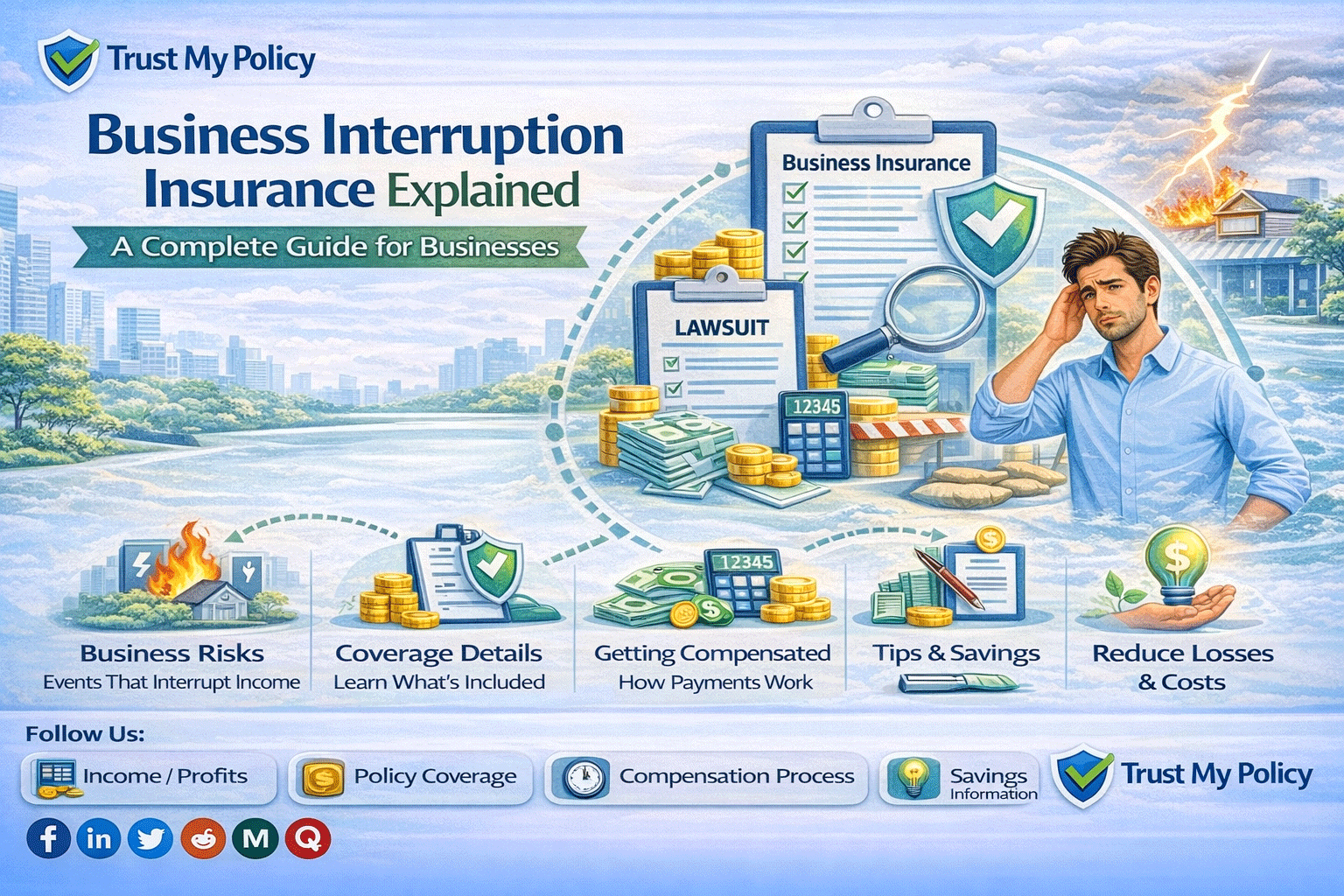
Business interruption insurance replaces lost income and covers ongoing expenses, like rent and payroll, while a business is unable to operate due to a covered property loss such as a fire or storm. It’s separate from property insurance, which only pays for the physical rebuild. Coverage typically requires a specific waiting period (often 24–72 hours) before payments begin and lasts through a defined “period of restoration.”
Renata Souza’s bakery in Manchester, the same one that taught her about public liability insurance after a customer’s slip-and-fall, faced a second lesson eighteen months later when a kitchen fire shut the shop for ten weeks. Her property insurance paid for the rebuild, but it was a separate policy entirely, business interruption insurance, that replaced the income she lost while the bakery couldn’t operate.
Business Interruption Insurance in 2026 covers the income and ongoing expenses a business loses while it can’t operate due to a covered property loss, like a fire, storm, or other physical damage. It’s a separate policy from property insurance, which only covers the physical rebuild, not the lost revenue during that downtime. This guide breaks down exactly what’s covered, what’s excluded, and how to calculate the right coverage amount.
This article covers exactly how business interruption coverage works, what it does and doesn’t include, real scenarios with specific numbers, and how to choose the right coverage amount. By the end, you’ll understand why property insurance alone often isn’t enough.
| Feature | Details |
| What it is | Coverage for lost income and ongoing expenses during a covered business shutdown |
| Who needs it | Any business where a property loss could meaningfully halt operations for days or weeks |
| Typical cost | $300–$1,000+/year as an add-on to a property policy |
| What triggers it | A covered physical property loss, like fire, storm damage, or certain other named perils |
| Key benefit | Replaces lost revenue and ongoing expenses that property insurance alone doesn’t cover |
| Key limitation | Typically requires a physical property loss as the trigger; pure loss of customers doesn’t qualify |
| Regulator | State insurance departments (US); Financial Conduct Authority (UK) |
Think of property insurance and business interruption insurance like two separate repairs after a car accident: one pays to fix your car, while the other pays for the rental car and lost wages while yours is in the shop. Property insurance fixes the building; business interruption insurance covers everything else that goes wrong financially while you can’t use it.
Business interruption insurance covers the income a business would have earned, plus certain ongoing fixed expenses like rent, loan payments, and payroll, during the period a covered property loss prevents normal operations. It’s typically added as an endorsement to a commercial property policy rather than sold as a fully standalone product, and it only activates when triggered by a covered physical loss, not by a general decline in customers or unrelated business slowdowns.
| Criteria | Property Insurance | Business Interruption Insurance |
| What it covers | The physical cost to repair or rebuild damaged property | Lost income and ongoing expenses during the resulting shutdown |
| Trigger | Direct physical damage to covered property | The same physical damage, but specifically the resulting operational interruption |
| Typical cost | Core cost based on property value | $300–$1,000+/year as an add-on |
| Pros | Restores your physical assets to their prior condition | Replaces income that would otherwise be lost entirely during downtime |
| Cons | Doesn’t address any lost revenue during the rebuild | Requires a covered physical loss as the trigger, not general business decline |
We recommend pairing business interruption coverage with your property insurance for most readers, since a rebuilt building with months of lost income in between can still represent a severe financial setback.
Scenario 1: Renata, bakery owner in Manchester. A ten-week closure after a kitchen fire was financially survivable because business interruption insurance replaced her lost income on top of the property policy’s rebuild payout. Verdict: property insurance alone would have left a severe income gap during the closure. Action: Renata reviewed her coverage amount upward after this experience, given how close her initial limit came to being insufficient.
Scenario 2: A small retail shop in Phoenix that lost two weeks of sales after a roof collapse from a severe storm. The waiting period meant the first 48 hours weren’t covered, but the remaining eleven days of lost income were fully reimbursed. Verdict: understanding your specific waiting period matters for accurately estimating your own out-of-pocket exposure. Action: the shop owner now keeps a small reserve specifically to cover the typical waiting period gap.
Scenario 3: A restaurant in Leeds that closed for three months after a fire, but reopened in a temporary location. Business interruption coverage included extra expense coverage, helping fund the temporary relocation costs during the rebuild. Verdict: business interruption policies can include extra expense provisions beyond simple lost income replacement. Action: the restaurant confirmed its extra expense limit was adequate before relying on it during an actual claim.
Scenario 4: A manufacturing business in Texas that lost income due to a supplier’s factory fire, not its own property damage. Standard business interruption coverage didn’t apply, since the physical loss happened at a different location, though a separate contingent business interruption endorsement would have covered this scenario. Verdict: standard coverage doesn’t extend to losses at a supplier’s or customer’s premises without a specific add-on. Action: the manufacturer added contingent business interruption coverage to address this exact gap going forward.
| Pros | Cons |
| Replaces lost income that property insurance alone never covers. | Requires a covered physical property loss as the trigger, not general business decline. |
| Can include extra expense coverage for temporary relocation costs. | A waiting period means the first day or two of interruption typically isn’t covered. |
| Coverage amount is based on your actual business financial history. | Standard coverage doesn’t extend to losses at a supplier’s premises without a specific add-on. |
| Provides a genuine financial bridge during an otherwise severe income gap. | Calculating the right coverage amount requires reasonably accurate financial projections. |
| Often relatively affordable as an add-on to an existing property policy. | The “period of restoration” can be disputed if rebuilding takes longer than expected. |
⚠️ WARNING: Never assume business interruption coverage applies to a general decline in customers or revenue unrelated to physical property damage. This coverage specifically requires a covered physical loss as the trigger, and gradual business decline from unrelated causes typically isn’t covered at all.
| Your Situation | Our Recommendation |
| A property loss could meaningfully halt your business for days or weeks | Yes — add business interruption coverage to your property policy |
| You haven’t reviewed your coverage amount in several years | Yes — update it to reflect your current revenue and expenses |
| Your business depends heavily on a single key supplier or location | Yes — consider adding contingent business interruption coverage |
| You’re unsure of your policy’s specific waiting period | Yes — confirm this detail and plan a small reserve to cover that initial gap |
| You assumed property insurance alone covers your full recovery | No — review your policy, since lost income typically isn’t included automatically |
| You might need to temporarily relocate after a covered loss | Yes — confirm your policy includes adequate extra expense coverage |
| Your business has minimal fixed costs and could pause without major financial strain | No — this coverage may be lower priority, though still worth considering |
💡 TIP: The single golden rule for business interruption insurance: it only activates after a covered physical property loss, so it complements your property policy rather than replacing the need for it.
| Scenario | Typical Annual Cost | Notes |
| Small retail shop, basic business interruption add-on | $300–$600/year | Common starting range for lower-revenue businesses |
| Restaurant or food service business | $500–$1,200/year | Reflects typically higher revenue and rebuild complexity |
| Small manufacturing business | $800–$2,000/year | Varies by equipment complexity and rebuild timeline |
| Contingent business interruption (supplier-dependent business) | $400–$1,500/year | Additional cost for extending coverage to supplier-related losses |
| Extra expense coverage (temporary relocation costs) | $200–$600/year | Often added alongside core business interruption coverage |
| Larger business with significant payroll obligations | $1,500–$4,000+/year | Reflects higher ongoing fixed expenses during an interruption |
| UK equivalent (business interruption add-on to commercial property) | £250–£900/year | Generally comparable structure to the US equivalent |
The Hartford (US) — Offers business interruption coverage as a standard add-on across most of its commercial property policies. Cost range: competitive US pricing. Best for: US small businesses adding interruption coverage to an existing property policy. Rating: AM Best A.
Hiscox (US and UK) — Provides business interruption and extra expense coverage tailored to small and mid-sized businesses. Cost range: competitive small business pricing. Best for: service and retail businesses in either country. Rating: AM Best A.
Simply Business (UK) — A UK comparison platform covering business interruption add-ons across many trades and property policy types. Cost range: free to compare. Best for: UK businesses comparing interruption coverage options. Rating: FCA-regulated comparison service.
Chubb — Offers contingent business interruption coverage for businesses with significant supplier dependency. Cost range: competitive for larger or more complex businesses. Best for: businesses wanting supplier-related interruption coverage. Rating: AM Best A++.
Independent insurance brokers — Brokers can help calculate an accurate coverage amount based on your actual financial history and ongoing obligations. Cost range: typically free for the consumer. Best for: any business unsure how much coverage to purchase. Rating: varies by broker, check licensing.
We recommend an independent broker as best overall because accurately calculating your coverage amount, factoring in lost income, ongoing expenses, and extra expenses, benefits significantly from professional guidance.
Business interruption insurance covers lost income and ongoing expenses, like rent and payroll, while a business is unable to operate due to a covered physical property loss.
No. Property insurance pays to repair or rebuild damaged property, while business interruption insurance separately covers the lost income and expenses during the resulting shutdown.
A covered physical property loss, such as fire or storm damage, that directly prevents your business from operating normally is required to trigger this coverage.
No. This coverage specifically requires a covered physical property loss as the trigger; a general business slowdown unrelated to physical damage typically isn’t covered.
Most policies include an initial waiting period, often 24–72 hours, before coverage payments begin, meaning the very start of an interruption isn’t typically reimbursed.
This is the time reasonably required to repair or rebuild your property and resume normal operations, and it defines how long business interruption coverage continues to apply.
Only if you’ve added contingent business interruption coverage specifically, since standard coverage typically applies only to losses at your own business’s property.
The insurer typically uses your business’s financial history to estimate the income you would have earned during the interruption period, so accurate financial records matter.
Extra expense coverage helps fund additional costs incurred to keep operating, such as a temporary relocation, during the period your primary property is being repaired.
Most small businesses pay $300 to $2,000 or more per year as an add-on to their commercial property policy, depending on revenue, industry, and rebuild complexity.
This article is for informational purposes only. Always consult a licensed insurance professional before making coverage decisions. Trust My Policy does not sell insurance products or represent any insurer.

Jagadeesh Gutha is the founder of TrustMyPolicy.com, an independent insurance information platform covering life, health, car, home, and business insurance for US and UK readers. He researches insurance products, policy structures, and consumer rights to help everyday people make informed coverage decisions without the jargon. All content on TrustMyPolicy is independently researched, fact-checked, and written to educate — not to sell.




Insurance Guides for UK, USA & Worldwide We are not an insurer or broker.


Reader Comments (0)