
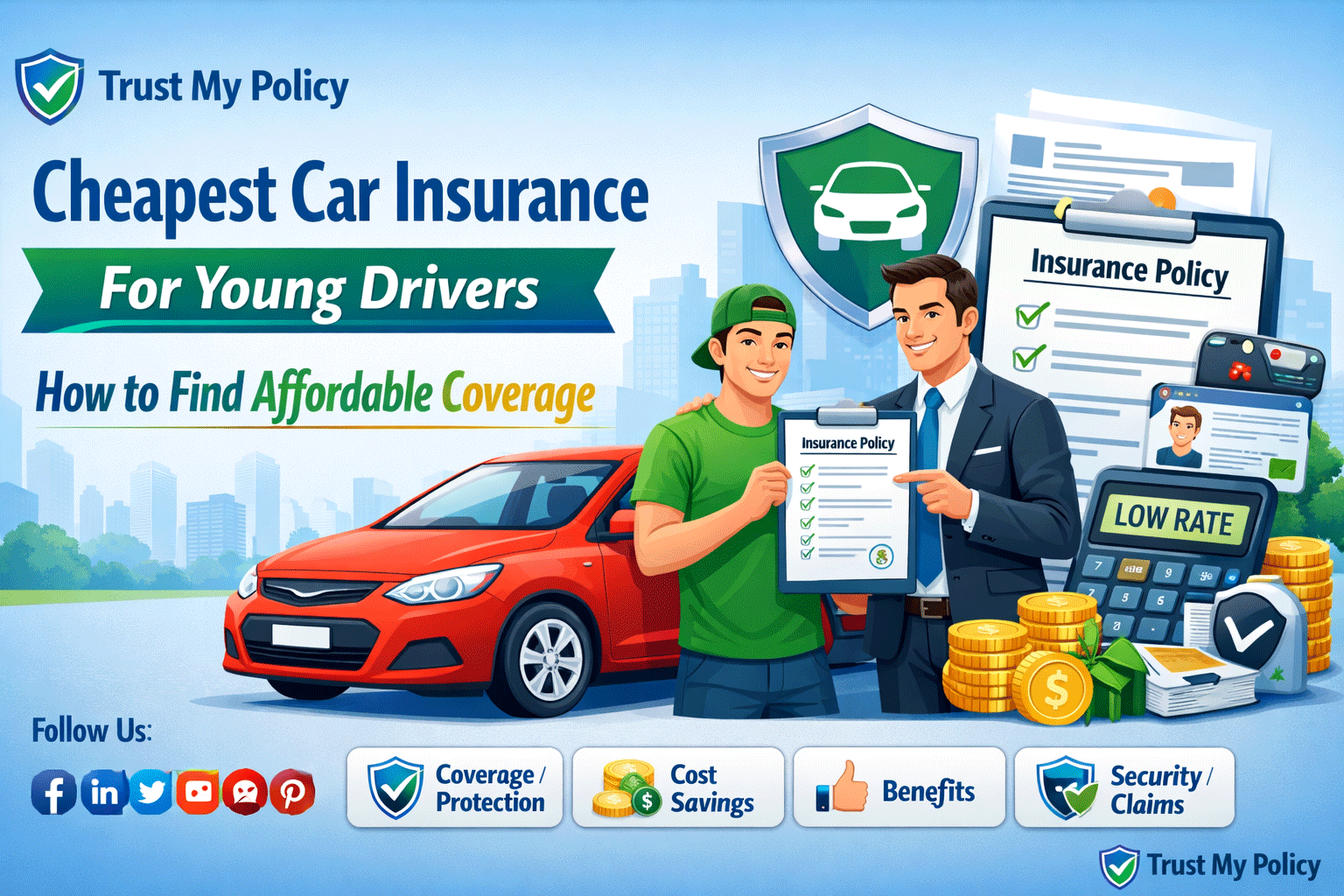
In the US, GEICO and USAA (for military families) are consistently among the cheapest options for teen drivers, with full coverage averaging roughly $340–$615 a month depending on the data source and state. In the UK, telematics or black box policies are typically the single biggest lever, with 17–24 year olds saving an average of around £379 a year compared to standard cover, according to Quotezone’s 2026 data. Adding a teen to a parent’s existing policy is also consistently cheaper than a standalone policy in both countries.
Jake Mercer, 17, in Birmingham was quoted over £2,800 a year for his first car insurance policy until his dad suggested a black box. Within a week of comparing telematics options against standard cover, Jake’s quote dropped by several hundred pounds, and his driving score after three months of safe trips pushed it lower still at renewal.
Cheapest Car Insurance for Young Drivers in 2026 almost always comes down to one lever above all others: telematics, known as a black box in the UK. In the US, full coverage for a 16-year-old averages well over $4,000 a year on a standalone policy, while UK 17-year-olds average roughly £1,900 to £2,800 depending on the data source, with both figures dropping sharply once age, no-claims history, or telematics data come into play. This guide breaks down exactly how to cut that cost on both sides of the Atlantic.
This article covers what young drivers actually pay, the single biggest cost-reduction lever in each country, real scenarios with specific numbers, and the best providers to compare. By the end, you’ll know exactly where to start shopping.
| Feature | Details |
| What it is | Auto liability or full coverage insurance priced for drivers typically aged 16–24 |
| Who needs it | New drivers, teen drivers, and young adults without an extensive driving history |
| Typical US cost | $340–$615/month for full coverage on a standalone teen policy, varying by source and state |
| Typical UK cost | £1,099–£1,932/year average for 17–24 year olds, higher for 17-year-olds specifically |
| Key benefit | Telematics and parental policy add-ons can meaningfully cut the cost in both countries |
| Key limitation | Standalone teen policies are consistently more expensive than joining a parent’s policy |
| Regulator | State insurance departments (US); Financial Conduct Authority (UK) |
Think of a young driver’s premium like a new employee’s starting salary before any performance reviews exist — insurers have no track record to go on, so they price based on the statistical risk of the entire age group rather than your specific habits. That changes quickly once you build a record, which is exactly why the cost drops so sharply with age and experience.
Young driver car insurance costs more because insurers rely heavily on group-level statistics for drivers with limited or no driving history, and those statistics show significantly higher accident rates for younger age bands in both the US and UK. According to MoneyGeek’s 2026 analysis, US teen drivers face notably higher crash rates per mile driven than older age groups, and UK industry data from the Association of British Insurers shows a similar pattern, with young drivers facing some of the highest comprehensive premiums of any age group.
| Criteria | Standalone Young Driver Policy | Added to a Parent’s Policy |
| Typical cost | Higher in both countries | Lower, often by a significant margin |
| Building independent record | Yes, builds the young driver’s own history | Less direct, since the policy is shared |
| Multi-vehicle discounts | Not available | Often available alongside other household vehicles |
| Pros | Independent coverage and claims history | Meaningfully lower cost while young |
| Cons | Highest-cost option for most young drivers | Doesn’t build a fully independent insurance record |
We recommend joining a parent’s or guardian’s policy where possible for most younger readers, since both US and UK data consistently show this as one of the most reliable ways to reduce cost early on.
Scenario 1: Jake, 17, in Birmingham. Jake’s quote dropped meaningfully once he switched to a telematics policy and his driving score improved over his first three months. Verdict: telematics is consistently the single biggest lever for UK 17-year-olds specifically. Action: Jake plans to compare standard policies again once he turns 21 and has built a no-claims record.
Scenario 2: A 16-year-old in Texas added to his parents’ existing policy. According to Insurify’s 2026 data, this approach saved the family roughly $1,000 a year compared to a standalone policy for the same coverage. Verdict: joining a parent’s policy is one of the most reliable savings levers in the US. Action: the family plans to keep him on the shared policy until he’s built several years of clean driving history.
Scenario 3: An 18-year-old in Manchester choosing a car in a low insurance group. Switching from a higher-group hatchback to a group 1–5 city car reduced her quote significantly, according to UK insurance group pricing data. Verdict: vehicle choice is a major, controllable lever independent of age. Action: she kept the lower-group car through her first two years of driving before considering an upgrade.
Scenario 4: A 19-year-old in New York comparing GEICO and a higher-cost competitor. According to MoneyGeek’s 2026 teen insurance analysis, the price difference between the cheapest and most expensive insurer for the same profile exceeded $700 a month. Verdict: shopping multiple insurers matters enormously for young drivers specifically. Action: he switched to the lower-cost insurer and now compares quotes again at every renewal.
| Pros | Cons |
| Telematics programs let safe young drivers prove low risk quickly. | Telematics requires ongoing data sharing and consistent safe driving to see savings. |
| Joining a parent’s policy is one of the most reliable savings levers available. | This approach doesn’t build a fully independent insurance history. |
| Choosing a low-risk vehicle gives young drivers direct control over cost. | Vehicle choice can be a real trade-off against personal preference. |
| Shopping multiple insurers can reveal large price differences for the same profile. | Comparing quotes takes real time and effort at every renewal. |
| Good student and low-mileage discounts are widely available with little downside. | Discount eligibility and amounts vary significantly by insurer. |
⚠️ WARNING: Never let a young driver go uninsured or underinsured to save money short-term. Young drivers face statistically higher accident rates, and the cost of an underinsured at-fault accident can far exceed years of premium savings.
| Your Situation | Our Recommendation |
| You’re a new driver and your parents already have a policy | Yes — compare joining their policy against a standalone quote |
| You’re a safe, low-mileage driver in the UK | Yes — strongly consider a telematics black box policy |
| You’re a US teen driver choosing your first car | Yes — check insurer-specific rate impact before buying |
| You’re tempted to choose minimum liability coverage only | No — weigh the real accident risk before cutting coverage too thin |
| You’ve had your policy for over a year without comparing quotes | Yes — shop at least two or three other insurers at your next renewal |
| You qualify for a good student or low-mileage discount | Yes — ask your insurer directly whether you qualify |
| You’re over 21 with a clean record and still on a telematics policy | Yes — compare against a standard policy, since the gap often narrows by this age |
💡 TIP: The single golden rule for young driver insurance: combine at least two cost-reduction levers at once — like joining a parent’s policy and using telematics — rather than relying on just one.
| Scenario | Typical Cost | Notes |
| US 16-year-old, standalone full coverage policy | ~$4,500–$9,800/year | Wide range across data sources; varies significantly by state and insurer |
| US 16-year-old, added to a parent’s policy | ~$2,800–$4,700/year | Consistently cheaper than a standalone policy across multiple sources |
| US 19-year-old, standalone full coverage policy | ~$4,000–$5,500/year | Drops meaningfully compared to age 16 |
| UK 17-year-old, standard comprehensive policy | ~£1,900–£2,850/year | Wide range across UK pricing sources for this specific age |
| UK 17–24 age band, average comprehensive premium | ~£1,099–£1,561/year | Varies by data source and time period |
| UK 17–20 with a telematics black box policy | ~£379/year average savings | According to Quotezone’s 2026 data compared to standard policies |
| UK national average, all ages | ~£560–£711/year | Useful benchmark showing how much higher young driver pricing sits above the average |
GEICO (US) — Frequently cited as one of the cheapest national carriers for teen drivers across multiple independent rate analyses. Cost range: among the most competitive for ages 16–18 specifically. Best for: US teen drivers seeking a widely available, competitively priced national insurer. Rating: AM Best A++.
USAA (US) — Offers some of the lowest average rates for teen drivers, though eligibility is limited to military families. Cost range: highly competitive where eligible. Best for: military families with a teen driver. Rating: AM Best A++.
State Farm (US) — The largest US auto insurer, often competitive on price with a dedicated young driver telematics program. Cost range: competitive, varies by state. Best for: families wanting bundled coverage with young driver discounts. Rating: AM Best A++.
Hastings Direct YouDrive (UK) — A well-established UK telematics product with strong documented entry-level pricing for drivers under 26. Cost range: competitive for app-based telematics. Best for: UK young drivers wanting an established, highly rated telematics provider. Rating: Defaqto 5 Star.
Marmalade (UK) — A UK insurer built specifically around young and learner drivers, often competitive for low-mileage young driver profiles. Cost range: competitive, particularly for infrequent drivers. Best for: UK students or young drivers with low annual mileage. Rating: varies, check current Defaqto rating.
We recommend GEICO for US readers and a telematics-first comparison for UK readers as best overall starting point, since both consistently appear among the most cost-effective options across independent rate analyses for this age group.
In the US, GEICO and USAA are frequently among the cheapest options for teen drivers, while in the UK, telematics or black box policies typically offer the biggest savings for drivers aged 17–24.
Yes, in both the US and UK. Joining an existing family policy is consistently cheaper than a standalone policy for a young driver with limited or no driving history.
Yes, on average. According to Quotezone’s 2026 data, UK drivers aged 17–20 with a telematics policy save an average of around £379 a year compared to standard policies.
Insurers rely on group-level statistics showing significantly higher accident rates for the youngest, least experienced drivers, which results in the highest premiums of any age group.
Yes, meaningfully. Choosing a car in a lower UK insurance group, or a model with favorable US insurer rate impact, can reduce premiums significantly compared to a higher-performance vehicle.
Telematics policies for young drivers vary by provider, but UK data consistently shows them offering a meaningful average discount compared to standard policies for the same driver profile.
We don’t recommend this. Young drivers face statistically higher accident rates, and an underinsured at-fault accident can cost far more than the premium saved by choosing minimum coverage.
Estimates vary significantly by source and state, but standalone full coverage policies for 16-year-olds commonly range from roughly $4,500 to $9,800 a year across recent industry data.
Yes, in many cases. Several major US insurers offer good student discounts that can meaningfully reduce a young driver’s premium for maintaining a strong GPA.
At every renewal. Price differences between insurers for the same young driver profile can be especially large, making annual comparison particularly valuable for this age group.
This article is for informational purposes only. Always consult a licensed insurance professional before making coverage decisions. Trust My Policy does not sell insurance products or represent any insurer.

Jagadeesh Gutha is the founder of TrustMyPolicy.com, an independent insurance information platform covering life, health, car, home, and business insurance for US and UK readers. He researches insurance products, policy structures, and consumer rights to help everyday people make informed coverage decisions without the jargon. All content on TrustMyPolicy is independently researched, fact-checked, and written to educate — not to sell.




Insurance Guides for UK, USA & Worldwide We are not an insurer or broker.
Reader Comments (0)