
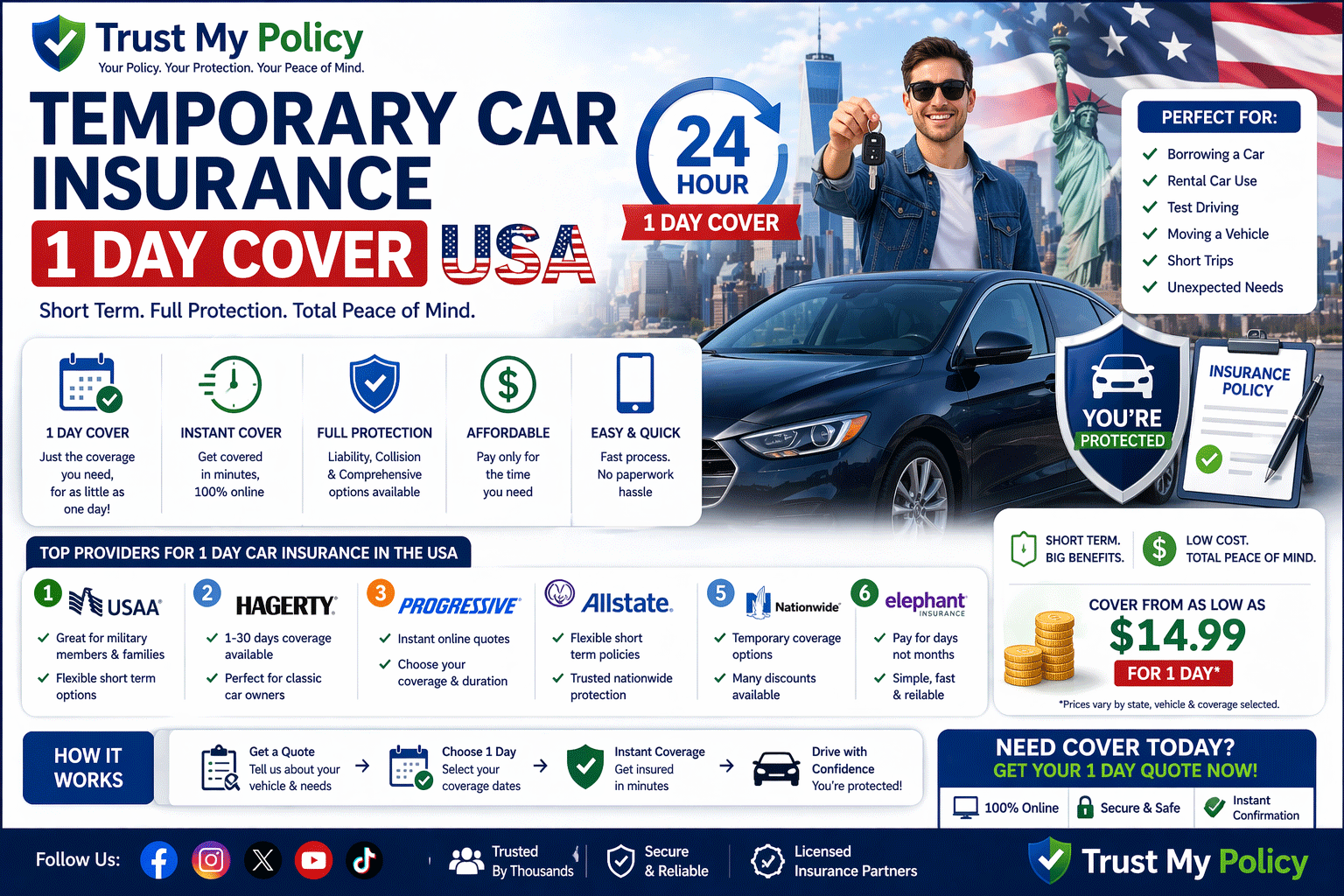
True temporary car insurance for 1 day does not exist from most major US insurers — minimum policy terms are six months. However, five practical alternatives cover you for exactly one day or one week: (1) the car owner’s permissive use clause (free); (2) rental car counter insurance ($15–$30/day); (3) Hugo short-term liability in 13 states (from $10/day); (4) buy and cancel a standard policy (first month premium + potential $25 cancellation fee); (5) non-owner insurance for frequent borrowers ($50–$150/month). GEICO, Progressive, and State Farm all provide instant same-day coverage activation.
Alex needed to drive his mother’s car 200 miles to help her move house. He had no car of his own and no active car insurance policy. He searched for ‘one-day car insurance USA’ expecting a simple answer. What he found: most US insurers don’t sell policies for less than six months. His actual options were simpler and cheaper than he expected — and one of them got him fully covered in under 15 minutes.
💡 Long-Term Savings for Young Drivers: While a 1-day policy is perfect for a quick weekend trip, it isn’t a cost-effective setup for daily driving if you are under 25. If you need a permanent solution, look over our transparent breakdown of the best car insurance for new drivers under 25 in the UK to find sustainable annual rates.
Temporary car insurance 1 day cover USA in 2026 does not exist as a standalone product from most major insurers — but the practical alternatives get you legally covered for exactly the period you need, often at minimal cost. The right solution depends on whether you own the car, are borrowing it, or are renting it.
This guide explains the honest truth about temporary and 1-day car insurance in the USA in 2026: why true one-day policies are rare, which five legal alternatives actually work, how much each costs, and which option fits your specific situation — from borrowing a parent’s car to driving home a new purchase.
| Feature | Details |
| Does 1-day car insurance exist in the USA? | No — most major insurers require minimum 6-month policy terms |
| Closest true short-term option | Hugo: 3-day, 7-day, 14-day, and 30-day state-minimum liability in 13 states |
| Cheapest option for borrowing someone else’s car | Permissive use — covered free under the owner’s existing policy for occasional use |
| Cheapest option for renting a car | Credit card rental cover (free if you pay with qualifying card) or rental counter insurance ($15–$30/day) |
| Buy-and-cancel strategy cost | First month premium ($100–$300) + cancellation fee ($0–$50). Refund for unused months in 7–30 days |
| Non-owner insurance cost | $50–$150/month (six-month minimum) — for frequent borrowers who don’t own a car |
| Same-day coverage available? | Yes — GEICO, Progressive, and State Farm all activate policies same-day with digital ID cards in minutes |
| Regulated by | State insurance commissioners — minimum coverage requirements vary by state |
Think of US car insurance like a gym membership — gyms don’t offer single-session memberships at the same price as annual ones; they build in a minimum commitment. US insurers structure policies for six-month or annual terms for the same reason: the administrative cost of writing a policy is too high to justify very short terms.
Temporary car insurance in the USA refers to coverage for a period shorter than the standard six-month policy term. True one-day or one-week standalone policies are not commercially available from mainstream US insurers. Instead, five practical alternatives provide the same legal protection for the exact duration you need.
Who needs it: People borrowing a friend’s or family member’s car for a trip, those who have just purchased a car and need to drive it home before their new policy activates, drivers between insurance policies, people test-driving a vehicle they plan to buy, renters, and seasonal drivers who only need coverage occasionally.
| Option | Cost | How Long It Covers You | Best For | Limitations |
| 1. Permissive use (owner’s policy) | Free | Duration of your borrowing | Borrowing a family member or friend’s car with their permission | Requires owner to confirm their policy covers occasional third-party drivers; not valid for frequent/regular use |
| 2. Rental counter insurance | $15–$30/day | Exact rental period only | Renting a car from any rental company | Only covers the rental vehicle — not the car owner’s vehicle you borrow from a friend |
| 3. Hugo short-term liability | From ~$10/day (state-minimum only) | 3, 7, 14, or 30 days | State-minimum liability in 13 states: AL, AZ, CA, FL, GA, IL, IN, MS, OH, PA, SC, TN, TX | State-minimum liability only — no full coverage; no option for higher limits; 13 states only |
| 4. Buy and cancel standard policy | First month premium ($100–$300) + $0–$50 cancellation fee | As long as you need — then cancel | Any driver needing full coverage flexibility with prorated refund | Refund takes 7–30 days to process; cancellation fees vary by insurer |
| 5. Non-owner car insurance | $50–$150/month (6-month minimum) | Ongoing — 6-month minimum term | People who frequently borrow or rent cars but don’t own one | Not economical for a single one-day trip; requires minimum 6-month commitment |
Winner for most one-day needs: Permissive use costs nothing and applies to most borrowing situations. For renters: credit card coverage or rental counter insurance. For cars you own but need to drive immediately: buy a standard policy from GEICO or State Farm — instant same-day activation, cancel with prorated refund when done.
📊 Using Telematics to Cut Costs: If your primary goal as a newer driver is keeping premium costs as low as humanly possible, consider a policy that tracks your safe driving habits. Check out our tested list of the best black box car insurance for young drivers to see how telematics data lowers your risk profile.
Most US car insurance policies include permissive use — coverage that automatically extends to any driver the owner explicitly permits to drive the vehicle. If Alex’s mother says ‘you can use my car’, and her policy includes permissive use (which standard comprehensive policies do), Alex is covered under her policy for that trip.
Important caveats: (1) Permissive use applies to occasional use, not regular use. If Alex uses the car weekly, he should be added as a named driver. (2) Some policies exclude permissive use entirely or have exclusions for excluded drivers — the owner should verify. (3) If Alex causes an at-fault accident under permissive use, the claim affects the car owner’s no-claims discount and policy. (4) The car owner’s policy limits apply — not Alex’s driving record.
How to use it: Call the car owner’s insurer, confirm permissive use is active, and get written confirmation if possible. Many insurers confirm this in minutes by phone.
The most flexible option for driving your own car temporarily is buying a standard six-month policy and cancelling it when you no longer need it. Most major US insurers provide prorated refunds minus a small cancellation fee.
| Insurer | Cancellation Fee | Refund Speed | Notes |
| GEICO | $0 | 7–10 business days | Same-day digital ID card. No cancellation fee — most efficient for buy-and-cancel |
| State Farm | $0 | Immediate (phone) or 7 days (mail) | No cancellation fee. Instant same-day activation. Best for clean driving records |
| Progressive | $0 (most states) | 7–10 business days | Same-day digital ID card. Cancellation penalties in some states — check before buying |
| Nationwide | $0 | 7–14 business days | No cancellation fee. Good refund processing. Best for flexible temporary cover |
| Allstate | $0 | 7–14 business days | No cancellation fee on 6-month policies. Strong digital tools |
| 💡 TIP: Buy the Policy on the Day You Need It
GEICO, Progressive, and State Farm all activate coverage same-day with digital ID cards available within minutes of purchase. You pay the first month’s premium ($100–$300 depending on your profile), drive with full coverage, and cancel when done. The refund for unused months arrives in 7–14 business days. For a 3-day need, this costs approximately $10–$30 in net cost after the refund — cheaper than most alternatives. |
💰 Managing Upfront Deposits: Standard annual auto policies usually require a massive down payment before coverage activates. If you are shifting away from short-term cover but have tight budget constraints, explore how to structure your plan via the cheapest car insurance with no deposit in the UK.
Hugo is the only US insurer offering genuinely short-term standalone policies. Available in 13 states, Hugo sells state-minimum liability coverage in 3-day, 7-day, 14-day, and 30-day terms. It does not offer full coverage (collision or comprehensive), and you cannot buy higher liability limits than state minimums.
Available states (2026): Alabama, Arizona, California, Florida, Georgia, Illinois, Indiana, Mississippi, Ohio, Pennsylvania, South Carolina, Tennessee, and Texas.
Best for: Drivers who need only state-minimum liability for a defined short period and live in one of Hugo’s 13 states. Not suitable for financed vehicles (lenders require full coverage), high-value cars, or drivers who want more than minimum coverage.
Cost: State-minimum liability from approximately $10/day for a clean record in a standard car. Rates vary by age, state, and driving history.
Situation: No personal car or policy. Borrowing mother’s 2019 Honda CR-V for one day to help with a 200-mile move.
Best option: Permissive use under mother’s policy. Mother calls State Farm, confirms permissive use is active, and Alex is covered at zero additional cost. Mother confirms in writing by screenshot of phone call summary.
Cost: £0.
Verdict: Permissive use is the right answer for most single-day borrowing situations. It’s free, instant, and legally valid. The only requirement: the owner explicitly gives permission and confirms their policy covers occasional third-party use.
Situation: Mia is viewing a private seller’s car on Saturday. The seller is willing to let her test drive, but won’t be on the road with her and her own policy doesn’t cover other vehicles.
Best option: Most dealerships include test-drive coverage in their dealer policy at no extra cost. For private sales, check whether the seller’s policy allows test drives — if yes, she’s covered under their permissive use. If no, Hugo (if in an eligible state) provides minimum liability for a day. Alternatively, the buy-and-cancel strategy with GEICO ($120–$180 first month, cancel immediately after purchase, net cost after refund: $4–$12).
Verdict: For a private-sale test drive, always confirm the seller’s insurance position before getting in the car. Most UK/US car owners’ policies cover test drives with permission. Never test-drive uninsured.
Situation: Jordan purchased a 2022 Ford Mustang from a dealer in Dallas, TX. His existing insurer is processing the update. He needs to drive the car home tonight.
Best option: Call his current insurer — most add a newly purchased vehicle immediately over the phone or via app, with coverage effective from the time of the call. GEICO and Progressive both add new vehicles same-day. If he has no current policy: GEICO new policy in 15 minutes, digital ID card emailed immediately.
Verdict: Never drive a newly purchased car home without confirming insurance. The dealer’s floor plan insurance does not extend to buyers. Your own insurer can activate coverage in minutes. In Texas, driving without insurance carries fines of $175–$350 plus a $250/year surcharge for three years.
Situation: Carlos drives only May–September. He currently pays $1,200/year for a policy that sits unused for six months.
Best option: Comprehensive-only storage policy (covers theft, fire, weather damage) for non-driving months at approximately $30–$60/month, then reactivate full coverage when driving season begins. Nationwide is the most commonly recommended insurer for seasonal storage policies in the USA.
Verdict: A storage policy keeps Carlos’s vehicle insured against non-driving risks (theft, flood, hail) at minimal cost while eliminating liability and collision premiums during months he doesn’t drive. Annual net saving: $400–$600 vs maintaining full coverage year-round.
| Pros | Cons |
| Permissive use is completely free for occasional borrowing — the most cost-efficient solution for most one-day needs | Permissive use depends entirely on the car owner’s policy terms — some policies exclude it or have driver exclusions |
| Buy-and-cancel provides full coverage flexibility with prorated refunds — no coverage gap | Cancellation fees of $0–$50 and refund processing time of 7–30 days make this less appealing for very short needs |
| Hugo provides the only true short-term standalone liability policies in the US market (13 states) | Hugo only offers state-minimum liability — no full coverage, no higher limits, limited to 13 states |
| GEICO, Progressive, and State Farm activate same-day with digital ID cards in minutes | Standard six-month policies are the minimum term — you can cancel early but can’t buy just one day |
| Non-owner insurance provides ongoing coverage for frequent borrowers without a car purchase commitment | Non-owner insurance requires a six-month minimum commitment — not economical for true one-time use |
Permissive use is not universal. Some policies exclude drivers under a certain age, drivers with recent convictions, or drivers in certain states. Never assume you are covered — verify with the car owner’s insurer before driving.
| ⚠️ WARNING: Rental Car Company Insurance Is Not the Same as a Personal Policy
Rental counter insurance (collision damage waiver, CDW) protects the rental car from damage. It does not provide liability coverage adequate for a serious at-fault accident. If you cause a major accident in a rental car with only CDW, you could face personal liability for injury and property damage costs exceeding your CDW limits. For full rental protection, combine CDW with the rental company’s supplemental liability insurance (SLI), or confirm your personal policy or credit card provides adequate liability coverage for rental vehicles. |
Hugo provides state-minimum liability only. This means: no collision coverage (if you damage the car), no comprehensive coverage (theft, weather), and minimum liability limits that may be insufficient for a serious accident. Never use Hugo for a financed vehicle — your lender requires full coverage. Know what you’re buying before relying on it.
Buying a policy on GEICO’s website at 8 PM on a Friday guarantees immediate digital coverage — your ID card is emailed within minutes. But if you’re expecting a broker to process paperwork by morning, you may have a gap. Always confirm your exact coverage start time in writing before you drive.
An expired policy provides zero coverage. Driving with an expired policy is legally identical to driving uninsured. Before borrowing any car or driving after a coverage gap, confirm the policy is currently active — not just that you had a policy at some point.
Many Visa, Mastercard, and American Express cards provide collision damage waiver (CDW) for rental cars when you pay for the rental with the card. This can make the rental company’s CDW ($15–$30/day) completely redundant. Check your credit card’s benefits before buying rental counter insurance.
| Your Situation | Our Recommendation |
| Borrowing a family member or friend’s car with their permission | Check permissive use on their policy first — likely free. Confirm with their insurer. |
| Renting a car from a rental company | Check your credit card rental coverage first. If insufficient, buy counter insurance ($15–$30/day) |
| Just bought a car and need to drive home today | Call your current insurer — add the vehicle same-day. No current policy? GEICO or Progressive in 15 minutes. |
| Need only state-minimum liability for 3–7 days in AL, AZ, CA, FL, GA, IL, IN, MS, OH, PA, SC, TN, or TX | Hugo short-term policy. Cheapest standalone option in eligible states. |
| No car of your own; borrow or rent frequently throughout the year | Non-owner car insurance ($50–$150/month, 6-month minimum). Covers all vehicles you borrow or rent. |
| Need full coverage for 30 days or less | Buy a 6-month policy from GEICO/State Farm, use it, cancel with prorated refund. Net cost: $10–$30 for 30 days. |
| Seasonal driver — only use car May–September | Storage policy (comprehensive-only) for off-season months. Nationwide is the market leader for this. |
🚚 Important Delivery Driver Warning: Standard personal temporary policies explicitly exclude commercial use. If you are using your vehicle to deliver food, courier packages, or manage logistics for platforms like Amazon or Uber, you must secure specialized car insurance for delivery drivers in the UK to stay legally compliant.
| Option | Cost for 1 Day | Cost for 1 Week | Notes |
| Permissive use (owner’s policy) | $0 | $0 | Free — requires owner’s permission and policy verification |
| Rental counter CDW insurance | $15–$30/day | $105–$210/week | For rental cars only; liability coverage separate |
| Hugo state-minimum (eligible states) | ~$10–$15/day | ~$40–$60/week | Liability only; 13 states; no full coverage available |
| Buy-and-cancel standard policy | ~$10 net after refund | ~$20 net after refund | Based on $120/month policy, $0 cancellation fee, prorated refund |
| Non-owner policy (month 1) | $50–$150/month minimum | Not divisible by week | Six-month minimum; for frequent borrowers only |
| Pay-per-mile (if available in state) | ~$5–$15/day (low mileage) | ~$25–$80/week | Nationwide SmartMiles or Mile Auto; ongoing policy required |
📍 Low-Mileage Alternatives: If you find yourself constantly buying 1-day passes because you rarely drive, a pay-by-the-mile structure might be a cleaner fit. We highly recommend checking out top-rated pay per mile car insurance companies to customize your monthly bills based purely on your odometer.
True one-day car insurance does not exist as a standalone product from most major US insurers, who require minimum six-month policy terms. However, five practical alternatives cover you for exactly one day: permissive use under the car owner’s policy (free for most borrowing situations), rental counter insurance, Hugo short-term liability in 13 states, buying and cancelling a standard policy (net cost around $10 after the prorated refund), or non-owner insurance for frequent borrowers.
The cheapest one-day option is permissive use under the car owner’s existing policy — free if their policy allows it. For rental cars, counter insurance costs $15–$30/day. Hugo short-term liability costs approximately $10–$15/day in 13 eligible states. The buy-and-cancel strategy using GEICO (no cancellation fee, prorated refund) costs approximately $10 net for one day of coverage after the refund. Non-owner policies cost $50–$150/month with a six-month minimum.
Most major US insurance companies sell policies with a minimum term of six months. Some offer annual policies only. Hugo is the only mainstream exception, offering true short-term liability policies for 3, 7, 14, and 30 days in 13 states. State Farm, GEICO, Progressive, and Nationwide all require minimum six-month terms but offer same-day activation and prorated refunds on cancellation.
Many major credit cards include collision damage waiver (CDW) for rental cars when you pay for the rental with that card. This typically covers damage to the rental vehicle. It does not usually cover your liability to other drivers or their vehicles in an at-fault accident. Check your specific card’s benefits before renting — and if relying on card coverage, decline the rental company’s CDW to avoid double-paying.
Yes. GEICO, Progressive, and State Farm all provide same-day coverage with digital ID cards available within minutes of completing the online application. Coverage can start at any time you specify — including immediately. For urgent same-day needs, these three insurers are the fastest options. Avoid calling on evenings or weekends if you need agent support, though online purchases process 24/7.
For drivers looking at low-mileage car insurance options, see our pay per mile car insurance companies USA guide. UK readers needing short-term cover can find options at our car insurance for delivery drivers UK article.
| 📋 Disclaimer
This article is for informational purposes only. Always check with your insurer for exact terms, conditions, and current pricing. Trust My Policy does not sell insurance products or represent any insurer. |

Jagadeesh Gutha is the founder of TrustMyPolicy.com, an independent insurance information platform covering life, health, car, home, and business insurance for US and UK readers. He researches insurance products, policy structures, and consumer rights to help everyday people make informed coverage decisions without the jargon. All content on TrustMyPolicy is independently researched, fact-checked, and written to educate — not to sell.



Insurance Guides for UK, USA & Worldwide We are not an insurer or broker.

Reader Comments (0)