
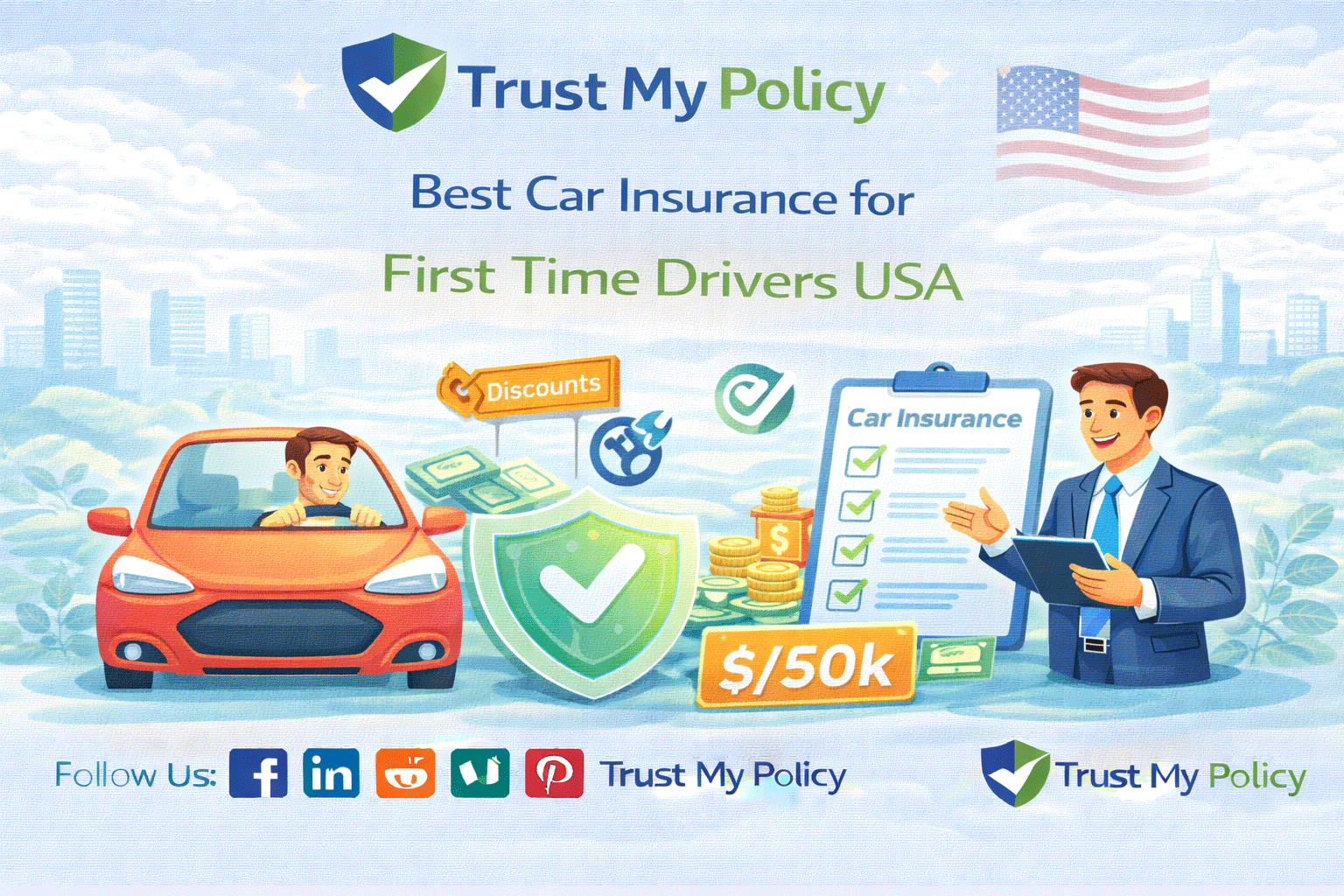
For first-time drivers in the USA, the cheapest car insurance is found by: staying on a parent’s or family plan (reduces rates by 41–68% vs a standalone policy), choosing GEICO or State Farm (lowest rates for young drivers nationally), and stacking discounts — good student, defensive driving, telematics/usage-based. The average 20-year-old pays $307/month on their own policy; on a family plan the effective cost drops to approximately $85–$125/month for most drivers.
Jordan, 19, got his license in January. His first instinct was to go straight to GEICO’s website and get a quote. The first number he saw: $341/month for full coverage as a standalone policy. He nearly gave up on having a car. His older sister suggested a different approach: stay on the family plan, take the defensive driving course discount, and use the good student discount his 3.4 GPA qualified for. Total effective cost on the family plan: $94/month for his share. He nearly overpaid by $247/month — every single month.
First-time drivers pay the highest car insurance rates of any group in the USA. A 20-year-old pays an average of $307/month for full coverage in 2026 — more than double what a 35-year-old pays for identical coverage on the same vehicle. But the gap between the cheapest and most expensive insurer for the same new driver exceeds $7,000 per year. The right company, the right plan structure, and the right discounts make an enormous financial difference.
This guide covers everything first-time drivers need to know in 2026: which companies offer the lowest rates, how to use your situation to qualify for every discount available, whether to stay on a family plan or get your own policy, and what coverage you actually need.
Car insurance rates are based on statistical risk. First-time drivers — regardless of age — have no driving record. Young first-time drivers face a double penalty: no record plus statistical risk. The CDC reports that motor vehicle crashes are the leading cause of death for Americans aged 15–29, and insurance companies price accordingly.
| Driver Profile | Average Monthly Premium (Full Coverage, 2026) | Notes |
| 20-year-old first-time driver (own policy) | $307/month | NerdWallet April 2026 analysis; national average |
| 20-year-old on family plan (effective share) | $85–$125/month | 41–68% cheaper than standalone — MoneyGeek 2026 |
| 17-year-old male (standalone policy) | $10,638/year ($886/month) | MoneyGeek analysis; most expensive new driver profile |
| 17-year-old female (standalone policy) | $7,800–$9,000/year | Women pay less at teen driver stage |
| 16-year-old on parent’s policy (effective share) | $3,403/year ($284/month) | 68% cheaper than standalone |
| 25-year-old first-time driver (own policy) | ~$200–$250/month | Rates improve significantly after 21 and again after 25 |
| 35-year-old (comparison — experienced driver) | $139/month | NerdWallet 2026; shows the experience premium for new drivers |
This is the most financially significant decision a first-time driver makes. The answer for most people living at home: stay on the family plan.
| Scenario | Annual Cost | Monthly Cost |
| 16-year-old — own standalone policy | $10,638/year | $886/month |
| 16-year-old — added to family plan (effective cost) | $3,403/year | $284/month |
| 18-year-old — own standalone policy | $7,200–$8,400/year | $600–$700/month |
| 18-year-old — added to family plan (effective cost) | $3,800–$4,800/year | $317–$400/month |
| Progressive: 16-yr standalone policy | $15,578/year | $1,298/month |
| Progressive: 16-yr added to family plan | $2,704 added to family premium (effective share) | $225/month |
| 💡 TIP: Stay on the family plan as long as you legally can
Most insurers allow you to stay on a parent’s or family policy as long as you live in the same household, regardless of age. Some allow it at college addresses if you’re a student. The first-time savings are enormous — a 16-year-old saves over $7,200/year by being on the family plan vs. a standalone policy. This is almost always the best financial decision for a new driver who still lives at home. |
| Company | Annual Rate (New Drivers 16–25) | Best For | State Farm Availability | Key Discount for New Drivers |
| National General | $4,028/year | Cheapest for new drivers overall nationally | Nationwide | Young driver programs |
| GEICO | $4,036/year | Near-cheapest, huge network, strong digital tools | All 50 states | Good student (up to 15%), defensive driving |
| State Farm | $141/month (under 25) | Cheapest for under-25 new drivers, LendingTree | All 50 states | Steer Clear program (up to 15%) |
| Erie Insurance | $4,568–$5,934/year for teens | Cheapest for teen drivers where available | 12 states + DC | Young driver rates, accident forgiveness |
| Travelers | Competitive for young adults 20+ | Good rates for 20–25 age group, broad network | All 50 states | Good student, IntelliDrive telematics |
| USAA | $5,472/year for male teens | Cheapest for military families | All 50 states | Military discounts, usage-based (SafePilot) |
| Auto-Owners | Below-average rates for new drivers | Available in 26 states; strong customer service | 26 states | Good student, teen monitoring telematics |
Note: National averages can be misleading for new drivers. State matters enormously. A new driver in Washington pays as little as $1,211/year while the same profile in Florida averages $5,339/year. Always compare quotes in your specific state — the cheapest national company may not be the cheapest in your zip code.
Most major insurers offer a good student discount for full-time students who maintain at least a 3.0 GPA (B average). GEICO, State Farm, Allstate, Travelers, and Progressive all offer this. Documentation required: a copy of your report card or transcript. Savings: 10–15% off your premium, applied to your portion of the family plan or your standalone policy.
Completing an approved defensive driving course earns a discount with most major insurers. Online courses are available for $25–$75 in most states. State Farm’s Steer Clear programme is specifically designed for drivers under 25, combining a course with a monitored driving period. After completion, participants earn up to 15% off. Savings persist for 3 years in most states and can compound with other discounts.
Telematics programmes monitor your driving via a smartphone app or in-car device and offer discounts for safe driving habits. For a first-time driver who drives carefully, this is one of the most powerful discount opportunities:
| Programme | Insurer | Max Discount | What It Monitors |
| Snapshot | Progressive | Up to 30% (but can increase rates if unsafe) | Speed, braking, phone use, time of day |
| DriveWise | Allstate | Up to 40% | Speed, braking, time of driving, hard turns |
| Steer Clear + telematics | State Farm | Up to 15% | Young driver safety monitoring |
| IntelliDrive | Travelers | Up to 30% | Speed, braking, phone use, mileage |
| SmartRide | Nationwide | Up to 40% | Braking, acceleration, idle time, night driving |
| SafePilot | USAA | Up to 20% | Mileage and safe driving behaviour |
| ⚠️ WARNING: Telematics can raise your rates
Some telematics programmes like Progressive Snapshot can increase your premium if the app detects unsafe driving — hard braking, late-night driving, high speeds. First-time drivers who are still building habits should ask their insurer whether the programme has a rate-increase provision, or look for programmes that only offer discounts (no penalties), like Nationwide SmartRide or USAA SafePilot. |
|||
If you’re a student going to college more than 100 miles from home without a car, many insurers dramatically reduce your rate. You’re on the policy but counted as an infrequent driver. State Farm, GEICO, and Allstate all offer this — document your college’s address and confirm the 100-mile threshold with your insurer.
If you’re on a family plan, the family’s home or renters insurance bundled with the auto policy often saves 10–25% on the overall premium. GEICO’s multi-policy discount reaches 25%. State Farm’s bundling saves 10–20%. This isn’t specifically a ‘new driver’ discount but contributes to the overall family plan premium reduction.
| Coverage Type | Required? | What It Pays | Should a New Driver Have It? |
| Liability (bodily injury + property damage) | Yes — all states except NH | Damages you cause to others in an at-fault accident | Yes — meet or exceed state minimums; lean toward higher limits |
| Collision | No | Your car damage in an accident, regardless of fault | Yes if car is worth >$4,000 or financed |
| Comprehensive | No | Your car damage from theft, weather, animals, fire | Yes — pairs with collision for ‘full coverage’ |
| Uninsured/underinsured motorist (UM/UIM) | Required in some states | Your costs if hit by an uninsured driver | Yes — very valuable; about 13% of US drivers are uninsured |
| Personal injury protection (PIP) | Required in no-fault states | Your medical costs regardless of fault | Check your state — required in FL, MI, NY, NJ, PA + others |
| Gap insurance | No — but important if car financed | Difference between car value and loan balance if totalled | Yes if you financed a car and owe more than it’s worth |
| Rideshare coverage | No | Covers you while driving for Uber/Lyft | Only if you drive for a rideshare company |
How much coverage should a first-time driver get? We recommend: liability at 100/300/100 ($100k bodily injury per person / $300k per accident / $100k property damage) rather than the bare state minimum — a single serious accident at minimum coverage can leave you personally liable for hundreds of thousands. Add collision and comprehensive if your car is worth more than $4,000 or if it’s financed. Full coverage (liability + collision + comprehensive) averages $307/month for a 20-year-old nationwide, but on a family plan the effective cost is $85–$125/month.
Situation: Jordan drives 8,000 miles/year, maintains a 3.4 GPA, and completed a defensive driving course online for $35.
Policy: Added to family State Farm policy. Full coverage on a 2020 Honda Civic. Good student discount (10%), Steer Clear programme (15%) applied.
Cost: Effective share on family plan: approximately $94/month. Standalone policy would have been $341/month. Annual saving: $2,964.
Verdict: Staying on the family plan is the single best financial decision Jordan made. The discount stacking (good student + Steer Clear programme) reduced his effective share by an additional 25%. He should remain on the family plan through college and build 2–3 years of clean driving history before getting his own policy.
Situation: Aaliyah never needed a car in New York City but has just moved to Texas and got her license at 24. She’s not on anyone’s family plan.
Reality: Adult first-time drivers are priced between teenagers and experienced adults — American Family offers the cheapest rates for older new drivers at approximately $85/month (LendingTree data). State Farm’s Steer Clear programme is open to first-time drivers under 25, which Aaliyah qualifies for, even though she’s not a teenager.
Cost: American Family: approximately $85/month for minimum liability. Full coverage on her 2019 Honda CR-V: approximately $165/month. She also qualifies for the Snapshot/telematics discount, which can reduce this further.
Verdict: Adult first-time drivers should look at American Family, State Farm, and GEICO for the best first-year rates. After 12–18 months of clean driving history, rates drop significantly. Use the IntelliDrive/telematics programme to earn the safe driver discount and build a clean record.
Situation: Kyle lives with his single mother in Miami. She cannot add him to her policy because she drives a rideshare. He needs his own standalone policy.
Reality: Florida’s high-risk insurance environment means Kyle pays among the highest teen driver rates nationally ($5,339 average for new drivers in Florida). GEICO and National General are the cheapest available in his state.
Practical steps: (1) Choose a cheap-to-insure car — a 2010 Honda Civic is among the cheapest to insure for teen drivers. (2) GEICO minimum liability at Kyle’s age runs approximately $220–$260/month in Florida. Full coverage would be $380+. (3) Consider usage-based insurance — driving to school and back only keeps mileage low. (4) Apply for every available discount.
Verdict: In high-cost states like Florida, teen drivers face brutal standalone premiums. Choosing a cheap car to insure (small sedan, older, no collision history on the model), keeping mileage low, and building a clean record for 1 year are the highest-leverage actions.
Situation: Sofia has a foreign (UK) driving license and is converting to a California license. She needs car insurance with no US driving history.
Best options: GEICO and Progressive are the most commonly cited by international drivers for accepting foreign driving history. Some insurers refuse to recognise foreign records entirely, putting new international drivers in the same pricing bucket as 16-year-olds. The solution: call GEICO and Progressive directly, request that your foreign license history be reviewed by an underwriter.
Cost: With foreign history acknowledged: approximately $140–$180/month. Without: up to $340+/month.
Verdict: International drivers should explicitly ask each insurer whether they accept foreign driving history before applying. GEICO and Progressive accept it more often than other major insurers. Building 6–12 months of US credit history also helps, as most states use credit scores in insurance pricing.
| Strategy | Pros | Cons |
| Family plan | 41–68% cheaper than standalone | Not available if you don’t live with family; family’s record can affect rates |
| GEICO standalone | Cheapest standalone option nationally; all 50 states | Customer service rated below average (7th nationally); fewer add-ons |
| State Farm + Steer Clear | Strong discount programme for under-25; great customer service (2nd J.D. Power) | Must use State Farm agents; can’t compare via independent brokers |
| Telematics discount programmes | Up to 30–40% off for safe driving; builds clean record | Can increase rates if driving habits are unsafe; data privacy concerns |
| Older/cheaper car | Lower collision/comprehensive premiums; liability only OK if low value | Car may be less safe or reliable |
| Good student discount | Easy 10–15% discount if you qualify | Requires ongoing GPA documentation; ends when you leave school |
Adding a first-time driver to an existing family policy saves 41–68% compared to a standalone policy. Always check this option first, even if you feel embarrassed asking your parents. The financial logic is overwhelming.
Minimum liability in most states is dangerously low — often $15,000/$30,000. A serious accident can produce medical bills of $200,000+. If you cause that accident, you’re personally liable for anything above your coverage limit. We recommend 100/300/100 liability as a minimum for any driver.
National averages are misleading. The cheapest company nationally (National General or GEICO) may not be the cheapest in your state. Always get quotes from at least 3–5 companies for your specific zip code. The difference between the cheapest and most expensive insurer for the same new driver can exceed $7,000/year.
Yes, telematics monitors your driving. But for a genuinely careful new driver, programmes like Nationwide SmartRide and USAA SafePilot can reduce your premium by 20–40% — potentially $600–$1,200/year. The data collected is generally not shared with third parties. The financial upside for safe drivers is significant.
The car you drive has a massive impact on your premium. A 2010 Honda Civic with full coverage costs significantly less to insure than a 2022 Ford Mustang with full coverage — for the exact same driver. If you’re a first-time driver choosing a first car, prioritise low-cost insurance categories: small sedans, older models, high safety ratings.
| Car | Why Cheap to Insure | Typical Insurance Group (Lower = Cheaper) |
| Honda Civic (2010–2015) | Low repair costs, common parts, high safety rating | Low group |
| Toyota Corolla | Extremely reliable, low theft rate, affordable parts | Low group |
| Ford Focus | Low-cost repairs, common parts | Low-moderate group |
| Subaru Impreza | High safety ratings, moderate repair costs | Moderate group |
| Mazda 3 | Strong safety ratings, moderate repair costs | Low-moderate group |
| AVOID: Sports cars, luxury vehicles, high-powered engines | Higher theft targets, expensive parts, higher horsepower = insurer assumes higher risk | High-premium groups |
A 20-year-old first-time driver pays an average of $307/month ($3,682/year) for full coverage as a standalone policy in 2026, according to NerdWallet’s April 2026 analysis. Rates vary enormously by state — from $1,211/year in Washington to $5,339/year in Florida. On a family plan, the effective share drops to approximately $85–$125/month, making this 41–68% cheaper than a standalone policy.
National General and GEICO are the cheapest nationally for new drivers (ages 16–25), both coming in at approximately $4,000–$4,036/year for standalone full coverage on average. State Farm is the cheapest for drivers under 25 according to LendingTree at $141/month. Erie is the cheapest for teen drivers in the 12 states where it operates. Always compare quotes in your specific state — the cheapest nationally isn’t always the cheapest locally.
Yes — all major US insurers offer coverage to 18-year-olds. You don’t need parental consent at 18. Your premium will be high as a first-time driver, but you can reduce it significantly by staying on a family plan if possible, qualifying for a good student discount, completing a defensive driving course, and enrolling in a telematics safe driving programme.
It depends on your car. If your car is financed (you have a loan), your lender will require full coverage (liability + collision + comprehensive). If your car is paid off and worth less than $4,000, you may be able to drop collision and comprehensive and carry liability only — but you’d receive nothing from insurance if your car is totalled. Full coverage averages $307/month for a 20-year-old nationally; if you’re on a family plan, this drops to approximately $85–$125/month for your share.
The most effective strategies: (1) Join a family plan — 41–68% cheaper than a standalone policy; (2) Good student discount — 10–15% off with a 3.0+ GPA; (3) Defensive driving course — 5–15% off with most major insurers; (4) Telematics/safe driving programme — up to 30–40% off for genuinely safe driving; (5) Choose a cheap car to insure — older small sedans have significantly lower premiums than sports cars; (6) Choose a higher deductible to reduce monthly premiums.
For drivers interested in reducing premiums based on low mileage, see our pay per mile car insurance companies USA guide. UK readers can find guidance in our cheapest car insurance with no deposit UK] article.
| 📋 Disclaimer
This article is for informational purposes only. Always check with your insurer and state/country regulator for the most current rates and requirements. TrustMyPolicy.com does not sell insurance products or represent any insurer. |

Jagadeesh Gutha is the founder of TrustMyPolicy.com, an independent insurance information platform covering life, health, car, home, and business insurance for US and UK readers. He researches insurance products, policy structures, and consumer rights to help everyday people make informed coverage decisions without the jargon. All content on TrustMyPolicy is independently researched, fact-checked, and written to educate — not to sell.

Insurance Guides for UK, USA & Worldwide We are not an insurer or broker.
Reader Comments (0)