
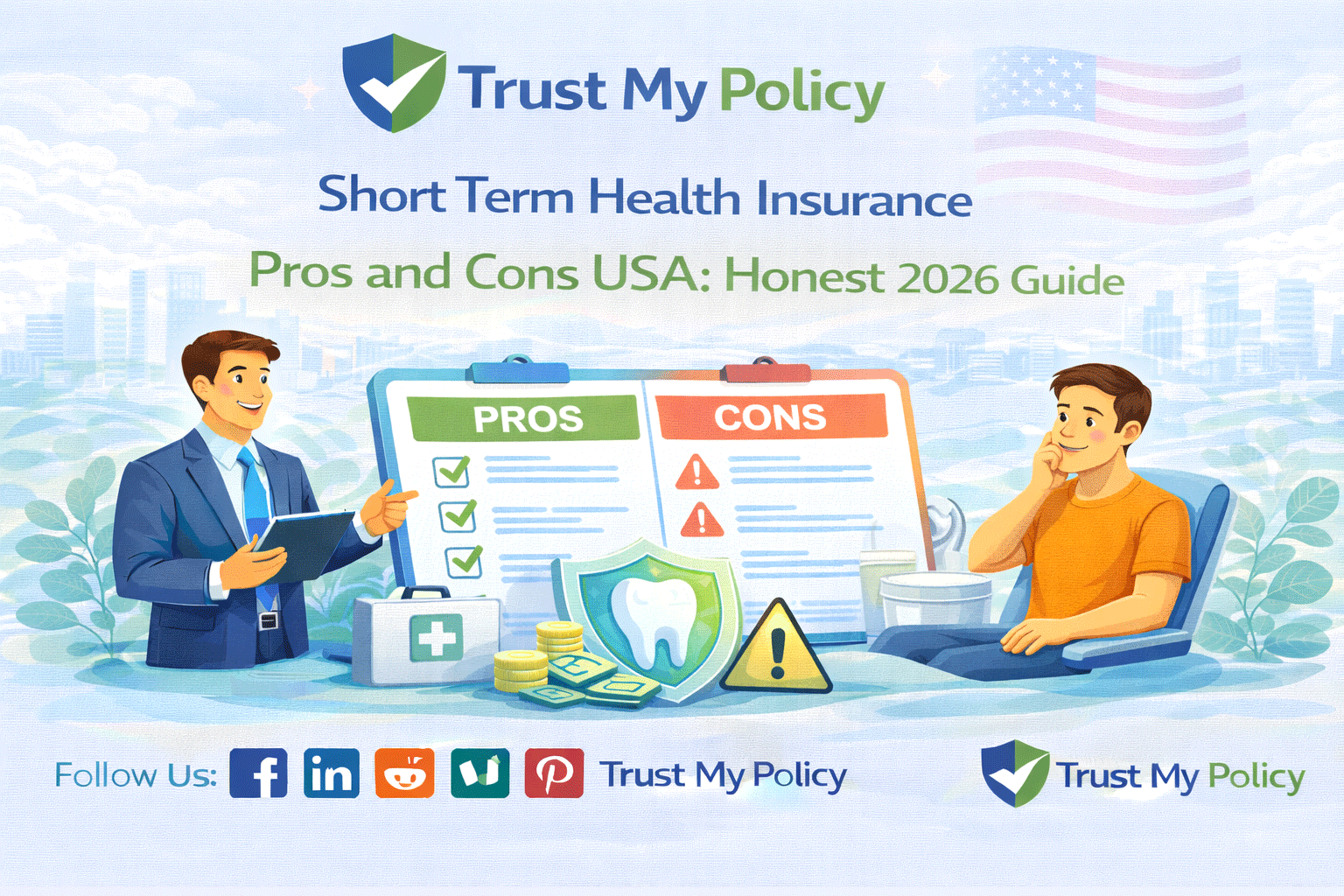
Short-term health insurance plans are temporary medical coverage policies designed to bridge gaps between comprehensive plans. They are not ACA-compliant — they can deny coverage for pre-existing conditions, exclude essential health benefits, and impose annual caps. As of September 1, 2024, federal rules limit them to 3 months initial term with one 1-month extension (4 months total). They cost significantly less than ACA plans but cover significantly less. They are available year-round without open enrollment, with coverage starting as soon as the next day.
Jake, 27, finished his job at a marketing agency in February. His employer coverage ended the same day. He had no income, missed ACA Open Enrollment, and faced a $748/month unsubsidised ACA Bronze plan. A short-term health plan cost him $89/month. He took it, assuming it worked like real insurance. Four months later, he was diagnosed with a condition that had caused him mild symptoms the previous year. His short-term insurer denied the entire claim — pre-existing condition. He owed $14,000.
Short term health insurance in the USA offers genuine value in very specific situations — and serious, sometimes catastrophic risk in others. Understanding the difference is not optional. It is the most important thing you can do before buying one.
This guide covers everything: what short-term health plans actually cover, what they don’t, the new 2024 federal rules that limit their duration, real costs, which states ban them, who they genuinely work for, and which providers are the most trustworthy in 2026.
| Feature | Details |
| Maximum federal duration | 3 months initial term + 1-month extension = 4 months total (post September 2024 rules) |
| ACA-compliant? | No — not required to cover 10 essential health benefits |
| Pre-existing conditions | Not covered — claims can be denied based on prior health history |
| Typical monthly premium | $50–$200/month for individuals (vs $400–$700+ for ACA Bronze unsubsidised) |
| Typical deductible | $1,000–$10,000; coinsurance typically 70–80% after deductible |
| Medical underwriting | Yes — can deny your application based on health history |
| Available year-round | Yes — no open enrollment window required |
| States where banned/unavailable | 15 states (including California, New York, New Jersey, DC, Massachusetts) |
| Regulated by | State insurance commissioners; NOT covered by ACA federal protections |
| Best use case | Bridge coverage for healthy people during genuine, short coverage gaps |
Short-term health insurance — also called temporary or limited-duration health insurance — is a category of private health coverage that sits entirely outside the Affordable Care Act framework. It was originally created to cover people during brief gaps: between jobs, waiting for employer coverage to start, or between graduation and employer eligibility.
Think of it like a waterproof jacket versus a full weatherproof suit. The jacket keeps you relatively dry in a light shower but leaves you exposed in a storm. Short-term health plans protect you against some medical costs — typically acute injuries and illnesses — but leave significant gaps that can result in enormous out-of-pocket bills if you face a serious or pre-existing condition.
Because short-term plans are not classified as individual market insurance under federal law, they are exempt from most ACA consumer protections. They can deny your application, exclude conditions, impose lifetime caps, and cancel non-renewal at the end of the term — all things ACA plans cannot do.
| ⚠️ CRITICAL 2024 RULE CHANGE
As of September 1, 2024, a Biden administration rule reduced the maximum duration of short-term health plans to 3 months initial term with one 1-month extension — 4 months total. The Trump administration has signalled it intends to roll back these restrictions through new rulemaking by end of 2026, which could restore longer-duration plans (up to 12 months with renewals to 36 months, as was the rule under 2018 Trump-era regulations). As of April 2026, the 4-month federal cap remains in effect — but check your state’s rules, which may be more or less restrictive. The regulatory situation is actively evolving. |
| Status | States |
| Banned or effectively unavailable | California, New York, New Jersey, Massachusetts, Washington DC, Connecticut, Hawaii, Maine, New Mexico, New Jersey, Rhode Island, Vermont, Washington State, Maryland, Minnesota |
| Significant state restrictions | Colorado, Illinois, and others — check your state Department of Insurance |
| Generally available (36 states) | Available subject to the federal 4-month cap and any state-specific rules |
| Feature | Short-Term Plan | ACA Marketplace Plan |
| Monthly premium (individual) | $50–$200 (no subsidies available) | $0–$700+ (after subsidies; 86%+ qualify) |
| Pre-existing conditions | Not covered | Must be covered — cannot be excluded |
| Essential health benefits | Not required — varies widely by plan | All 10 EHBs required as standard |
| Medical underwriting | Yes — can deny application | No — guaranteed issue |
| Annual/lifetime caps | Often imposed | Prohibited under ACA |
| Preventive care | Not required | 100% covered, no cost-sharing |
| Maternity coverage | Rarely included | Required as standard |
| Mental health coverage | Rarely included | Required as standard |
| Prescription drugs | Often excluded or capped | Required as standard |
| Available year-round | Yes | No — open enrollment required (or SEP) |
| Maximum duration | 4 months (federal 2024 rule) | 12 months renewable |
| Regulatory protection | State level only | Full ACA federal protections |
Situation: Left job in February. ACA plan costs $748/month unsubsidised. Short-term plan: $89/month. Took the short-term plan.
What happened: Diagnosed with a new condition. Insurer reviewed medical history and found a related symptom from 14 months prior in GP notes. Claim denied. Bill: $14,000.
Verdict: Jake qualified for a Special Enrollment Period (job loss is a qualifying event) and could have enrolled in an ACA plan. At his income, he likely qualified for subsidies. He should have gone to HealthCare.gov first, not straight to a short-term plan. Short-term plans should never be chosen without first checking ACA subsidy eligibility.
Situation: Graduated in May. New job starts July 1. Employer benefits begin August 1. She has a 45-day gap, is healthy, no chronic conditions, no recent medical history.
What she did: Purchased a 2-month short-term plan from UnitedHealthcare MotionSafe. Premium: $78/month. Had a minor ankle sprain during the gap — treated at urgent care, bill $620, plan covered $480 after deductible.
Verdict: This is the textbook use case for short-term health insurance. Rachel is young, healthy, had a genuine 45-day gap, used it for exactly the period needed, and it worked. The plan covered an acute injury, which is what short-term plans do best.
Situation: David lives in Wyoming. Earns $14,000/year — below 100% FPL. Wyoming hasn’t expanded Medicaid. He’s ineligible for Medicaid AND ineligible for ACA subsidies. Cheapest ACA plan in his county: $898/month.
Reality: David is in the coverage gap — one of the worst-designed outcomes of US healthcare policy. He cannot realistically afford either option. A short-term plan at $120/month is his only viable choice.
Verdict: This is the most legitimate case for a short-term plan — not by choice, but by policy failure. David understands the risks but has no other affordable option. He picks the plan with the lowest deductible he can find and hopes for the best. This situation affects hundreds of thousands of Americans in non-expansion states.
Situation: Sarah earns $55,000 in Texas. She qualifies for a $200/month ACA Silver plan after premium tax credit. She sees a short-term plan for $95/month and considers switching to ‘save’ $105/month.
What she should do: Stay on the ACA plan. The $105/month she ‘saves’ disappears entirely with one prescription drug claim, one mental health visit, or any condition that existed previously. Her ACA plan includes CSR-equivalent benefits and full pre-existing condition protection. The short-term plan is genuinely not worth the trade-off.
Verdict: For anyone who qualifies for ACA subsidies (the vast majority of individual market buyers), short-term plans are almost never a better financial choice. The subsidy narrows or eliminates the premium gap, while the coverage gap remains enormous.
| Profile | Short-Term Plan Cost | Comparable ACA Bronze (No Subsidy) | ACA After Subsidy (Est.) |
| 25-year-old, healthy, no conditions | $50–$80/month | $280–$350/month | $0–$80/month (if subsidy-eligible) |
| 35-year-old, healthy | $80–$130/month | $380–$480/month | $50–$200/month |
| 45-year-old, healthy | $130–$200/month | $530–$650/month | $100–$300/month |
| Family of 3 (35-yr parents + child) | $200–$350/month | $1,000–$1,400/month | $200–$600/month (if subsidy-eligible) |
| 55-year-old, smoker, some history | Likely denied — underwriting | $800–$1,100/month | $200–$500/month (if subsidy-eligible) |
| 💡 TIP: Check ACA Subsidies Before Buying Short-Term
Before purchasing any short-term plan, spend 10 minutes on HealthCare.gov or your state marketplace. Enter your income and family size. You may be shocked by how low your ACA premium is after subsidies. A person earning $35,000 individually often pays under $100/month for a Silver plan with much stronger coverage. Short-term plans only make sense if you’re ineligible for subsidies AND the ACA full-price premium is genuinely unaffordable. |
Why: MoneyGeek rates UnitedHealthcare as the top short-term provider for 2026, with the widest plan selection, lower deductibles, and lower out-of-pocket limits than most competitors. Their MotionSafe and SureBridge plans are available in most states. UHC has a well-established claims process and clear exclusion language.
Typical cost: $80–$150/month for a 35-year-old, $1,000–$5,000 deductible options.
Best for: Healthy individuals in states where UHC short-term plans are available who need a 30–90 day bridge with broad provider access.
Why: MoneyGeek’s second-ranked short-term provider. National General offers competitive pricing, clear benefit summaries, and reasonable out-of-pocket maximums relative to the market. Available in multiple states.
Best for: Budget-conscious applicants who need a basic coverage bridge and want clear documentation of what is and isn’t covered.
Why: Pivot Health is known for unusually clear policy language and consumer-friendly online tools that help you understand what is excluded before you buy. Given how frequently short-term plan claims are disputed, clarity at the point of purchase is a significant advantage.
Best for: First-time short-term insurance buyers who want to understand exactly what they’re buying before committing.
Most people who buy short-term plans qualify for ACA subsidies that make Marketplace plans significantly cheaper. Always check HealthCare.gov before buying a short-term plan.
Short-term plans do not cover pre-existing conditions, essential health benefits, or preventive care. They are catastrophic-style gap coverage, not comprehensive insurance. Treat them accordingly.
Job searches run longer than expected. Employer benefit start dates slip. If your short-term plan ends and you’ve developed any new condition, your next application may be denied or that condition excluded. Always have a plan for what happens if the gap extends.
A $50/month plan with a $10,000 deductible provides almost no real coverage for anything short of major hospitalisation. Calculate your total potential cost (premium × term + deductible) for each option.
If you have diabetes, heart disease, asthma, cancer history, or any ongoing condition, short-term plans will almost certainly deny relevant claims. The ACA Marketplace is the only option that guarantees coverage of pre-existing conditions.
| ⚠️ WARNING: Short-Term Plans Are Not Minimum Essential Coverage
Short-term plans are not classified as minimum essential coverage (MEC) under the ACA. While there is no federal individual mandate penalty since 2019, some states (California, Massachusetts, New Jersey, Rhode Island, Vermont, DC) have their own individual mandates with tax penalties. In these states, a short-term plan does not satisfy your insurance requirement. Check your state’s mandate rules before buying. |
| Your Situation | Our Recommendation |
| Between jobs, qualifying for ACA SEP, subsidy-eligible | Enrol in ACA plan via HealthCare.gov — do not use short-term |
| 45-day gap before employer benefits start, healthy, no conditions | Short-term plan is reasonable — genuine bridge for a defined, short period |
| Missed Open Enrollment, earn too much for subsidies, healthy | Short-term plan as interim — enrol in ACA at next Open Enrollment |
| Have any ongoing or recent health condition | Never use short-term — ACA Marketplace is the only option that covers you |
| Live in a non-expansion state, income below 100% FPL (coverage gap) | Short-term plan may be the only realistic option — proceed with eyes open |
| Considering short-term to save money vs. subsidised ACA plan | Stay on ACA — the subsidy likely makes it comparable in cost with far better cover |
| Need coverage during a waiting period for Medicare at 65 | ACA Marketplace plan — do not risk a gap in coverage at this life stage |
| Graduate, aged 26, just off parents’ plan, healthy | ACA Marketplace first (SEP triggered by losing coverage); short-term only if truly unaffordable |
Under federal rules that took effect September 1, 2024, short-term plans have a maximum duration of 3 months initial term with one 1-month extension — 4 months total. Some states impose stricter limits or ban short-term plans entirely. The Trump administration has signalled it may roll back the 2024 rules through new rulemaking in 2026, which could restore longer durations (up to 12 months with renewals), but as of April 2026 the 4-month federal cap remains in effect.
No — this is their most critical limitation. Short-term plans use medical underwriting to assess your health history at application, and they can deny your application or exclude conditions that existed before the policy started. The definition of ‘pre-existing’ is broad and is evaluated at claim time, not application time — meaning a claim can be denied even for conditions you weren’t aware of or considered resolved.
No. Short-term health plans are explicitly excluded from ACA classification as individual market insurance, which exempts them from ACA consumer protections. They cannot be sold on the ACA Marketplace and are not eligible for premium tax credits. They are not required to cover any of the 10 essential health benefits and can impose annual and lifetime caps that ACA plans are prohibited from using.
COBRA allows you to continue your former employer’s group health insurance after leaving a job, typically for up to 18 months. COBRA plans are ACA-compliant and maintain your existing coverage including pre-existing conditions — but they are expensive (you pay the full premium your employer previously covered, often $500–$700/month for an individual). Short-term plans are much cheaper but offer far weaker coverage. If you have any health conditions, COBRA is almost always safer than a short-term plan.
Yes. Unlike ACA Marketplace plans, which are guaranteed-issue (cannot deny your application), short-term plans use medical underwriting. You can be denied coverage based on your answers to health questions. Common denial triggers include recent diagnoses, ongoing medication use, cancer history, heart conditions, and many other medical events in the previous 2–5 years.
In very specific circumstances — yes. For a genuinely healthy person with no significant medical history, facing a true short gap (under 4 months) and who doesn’t qualify for ACA subsidies, a short-term plan provides meaningful protection against acute injury or illness at a lower cost. For anyone with health conditions, who qualifies for ACA subsidies, or who is planning a longer gap, short-term plans present serious financial risk and are not recommended.
For those who need comprehensive coverage rather than a bridge plan, our guide to health insurance for self-employed low income USA covers ACA Marketplace options in detail. For families considering their US coverage options, see our best health insurance for families of 4 USA guide.
| 📋 Disclaimer
This article is for informational purposes only. Always consult a licensed insurance professional before making coverage decisions. TrustMyPolicy.com does not sell insurance products or represent any insurer. |

Jagadeesh Gutha is the founder of TrustMyPolicy.com, an independent insurance information platform covering life, health, car, home, and business insurance for US and UK readers. He researches insurance products, policy structures, and consumer rights to help everyday people make informed coverage decisions without the jargon. All content on TrustMyPolicy is independently researched, fact-checked, and written to educate — not to sell.


Insurance Guides for UK, USA & Worldwide We are not an insurer or broker.
Reader Comments (0)