
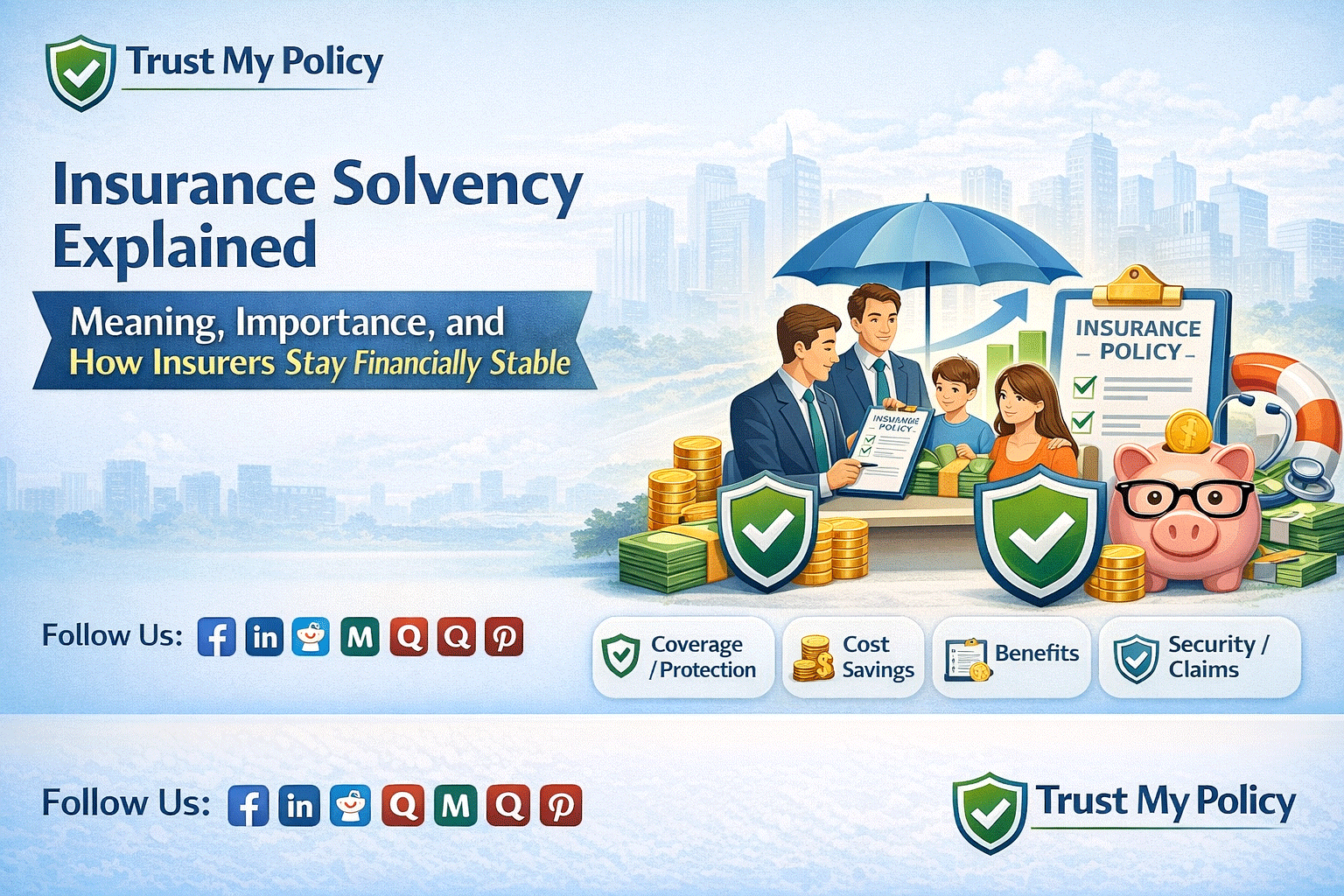
Insurance solvency refers to an insurer’s ability to meet its financial obligations, especially future claims, over time. Regulators require insurers to hold capital reserves above a calculated minimum, using frameworks like risk-based capital requirements in the US and the Solvency UK regime, the post-Brexit reform of Solvency II, in the UK. If an insurer becomes insolvent, US state guaranty associations and the UK’s Financial Services Compensation Scheme provide a safety net for policyholders.
Howard Lindqvist, 63, held a life insurance policy with a small regional insurer in Florida and grew anxious after reading about a different, unrelated insurer becoming insolvent elsewhere in the US. His broker explained that solvency regulation, and a specific state guaranty system, exists precisely to protect policyholders like him even in the rare event an insurer fails.
Insurance Solvency in 2026 refers to an insurer’s ability to meet its financial obligations, primarily future claims, over both the short and long term. Regulators require insurers to hold capital reserves well above their expected claims liabilities, using frameworks like risk-based capital requirements in the US and the Solvency UK regime in the UK. This guide breaks down exactly how solvency is measured, monitored, and what protections exist if an insurer ever fails.
This article covers how solvency requirements work, the specific frameworks used in each country, real scenarios showing the protections in action, and what you can check yourself before buying a policy. By the end, you’ll understand exactly what’s standing behind your insurer’s promise to pay.
| Feature | Details |
| What it is | An insurer’s measured ability to meet its financial obligations, especially future claims |
| Who it protects | Every policyholder relying on an insurer’s promise to pay future claims |
| US framework | Risk-based capital (RBC) requirements set by state regulators, coordinated via the NAIC |
| UK framework | Solvency UK, the post-Brexit reformed version of the EU’s Solvency II regime |
| Key benefit | Ensures insurers maintain sufficient reserves to pay claims even in adverse conditions |
| Key protection if an insurer fails | US state guaranty associations; UK Financial Services Compensation Scheme |
| Regulator | State insurance departments and NAIC (US); Prudential Regulation Authority (UK) |
Think of insurance solvency like a bank’s capital reserves — a bank doesn’t keep every depositor’s money sitting in a vault, but it must hold enough capital to cover withdrawals even during stressful conditions. Insurers work similarly: they invest premiums but must maintain enough capital to cover claims even in a bad year.
Insurance solvency is a measure of an insurer’s ability to meet its financial obligations, primarily future claims, both now and over the longer term. Regulators require insurers to calculate and maintain capital reserves above a specific minimum threshold, using formal frameworks designed to stress-test the insurer’s finances against adverse scenarios. Anyone holding a long-term policy, like life insurance or annuities, especially benefits from understanding solvency, since the insurer’s promise to pay may not be fulfilled for decades.
| Criteria | US Risk-Based Capital (RBC) | UK Solvency UK |
| Structure | State-based, coordinated through NAIC model formulas | Centralized, overseen by the Prudential Regulation Authority |
| Origin | Developed domestically by US regulators | Reformed version of the EU’s Solvency II regime, fully in force since December 31, 2024 |
| Key components | RBC ratio compared against regulatory action levels | Solvency Capital Requirement (SCR) and Minimum Capital Requirement (MCR) |
| Pros | Tailored to US state-based insurance markets | Provides a more internationally harmonized, risk-sensitive framework |
| Cons | Varies somewhat in application across different states | Significant compliance and reporting burden for insurers |
We recommend US readers check an insurer’s RBC ratio or independent rating, and UK readers confirm an insurer’s PRA authorization, since both reflect the underlying solvency framework relevant to their country.
Scenario 1: Howard, 63, life insurance policyholder in Florida. Howard’s broker explained that his insurer’s strong financial strength rating and the existence of his state’s guaranty association together provided real protection, even in a worst-case scenario. Verdict: solvency regulation and guaranty protections work together to protect long-term policyholders. Action: Howard checked his insurer’s AM Best rating directly and confirmed it remained strong.
Scenario 2: A UK pension and life insurer adjusting its capital strategy after the Solvency UK reforms took full effect. The insurer increased its allocation to long-term productive assets, made possible by the reformed framework’s adjusted capital treatment. Verdict: solvency framework reforms can directly influence how insurers manage their investment strategy. Action: the insurer’s actuarial team confirmed continued compliance with both the Solvency Capital Requirement and Minimum Capital Requirement.
Scenario 3: A regional US auto insurer facing declining capital reserves after a series of severe weather losses. State regulators placed the insurer under increased supervision before its RBC ratio fell to a critical level. Verdict: regulatory intervention often begins well before an insurer reaches actual insolvency. Action: the insurer raised additional capital and adjusted its regional underwriting guidelines to stabilize its position.
Scenario 4: A policyholder whose small UK insurer entered insolvency proceedings. The Financial Services Compensation Scheme stepped in to protect his claim up to the scheme’s specific coverage limits. Verdict: the UK’s compensation scheme provides real protection even when an insurer fails outright. Action: he filed his claim directly with the FSCS following the insurer’s formal failure.
| Pros | Cons |
| Capital requirements ensure insurers maintain reserves well above expected claims. | Compliance costs for insurers are significant and can affect pricing over time. |
| Guaranty associations and compensation schemes provide a real safety net if an insurer fails. | Protection limits under these schemes aren’t always unlimited or fully comprehensive. |
| Regulatory intervention often begins well before an insurer reaches actual insolvency. | Solvency frameworks can be complex and difficult for ordinary consumers to evaluate directly. |
| Independent financial strength ratings give consumers an accessible solvency proxy. | Insurer failures, while rare, can still cause real disruption and delay for policyholders. |
| International frameworks like Solvency UK aim for more risk-sensitive, harmonized standards. | Frequent regulatory reforms require insurers to continually adapt compliance processes. |
⚠️ WARNING: Never assume a low-cost insurer offering significantly cheaper premiums than competitors carries the same financial strength. Always check an independent rating before committing to a long-term policy, since unusually low pricing can sometimes reflect a weaker capital position.
| Your Situation | Our Recommendation |
| You’re buying a life insurance policy or annuity | Yes — check the insurer’s AM Best or equivalent financial strength rating |
| You’re in the UK considering a long-term insurer | Yes — confirm the insurer’s PRA authorization status |
| You’re worried about a specific insurer after hearing concerning news | Yes — check that specific insurer’s current rating rather than assuming the worst |
| You’re comparing two insurers with significantly different pricing | Yes — verify whether the cheaper insurer’s financial strength rating is comparable |
| You want to understand your protection if an insurer fails | Yes — check your state guaranty association limits (US) or FSCS limits (UK) |
| You’re a long-term policyholder who has never checked your insurer’s rating | Yes — check it now, even on an existing policy, for peace of mind |
| You assume solvency regulation guarantees zero risk whatsoever | No — understand the protections are substantial but not absolute |
💡 TIP: The single golden rule for solvency: before committing to any long-term policy, check the insurer’s independent financial strength rating, since this is the simplest, most accessible proxy for solvency available to ordinary consumers.
| Scenario | Protection Mechanism | Notes |
| US life insurer becomes insolvent | State guaranty association coverage | Coverage limits vary by state and policy type, often in the hundreds of thousands of dollars |
| UK life insurer becomes insolvent | Financial Services Compensation Scheme (FSCS) | Provides protection up to scheme-specific limits depending on policy type |
| Checking AM Best rating before buying a policy | Free | Publicly available rating reflecting insurer financial strength |
| Checking UK insurer’s PRA authorization | Free | Searchable on the Financial Conduct Authority’s Financial Services Register |
| Insurer under increased regulatory supervision | No direct cost to policyholder | Often resolved through capital raising or operational changes before failure |
| Insurer required capital under RBC (US) framework | Varies by insurer size and risk profile | Calculated using NAIC model formulas specific to each line of business |
| Insurer required capital under Solvency UK (SCR/MCR) | Varies by insurer size and risk profile | Reflects the post-Brexit reformed UK solvency framework, fully in force since December 31, 2024 |
AM Best (US and global) — The leading independent rating agency specifically focused on insurer financial strength. Cost range: free public ratings. Best for: checking any US or globally operating insurer’s solvency proxy. Rating: industry-standard financial strength rating agency.
Your state guaranty association (US) — Provides specific coverage limit information for policyholders if an insurer becomes insolvent in your state. Cost range: free to access information. Best for: US consumers wanting to understand their specific protection limits. Rating: state-mandated protection mechanism.
Financial Services Compensation Scheme (UK) — Provides policyholder protection information if a UK insurer becomes insolvent. Cost range: free to access information. Best for: UK consumers wanting to understand their specific protection limits. Rating: UK statutory compensation scheme.
Prudential Regulation Authority (UK) — Oversees UK insurer solvency under the Solvency UK framework and maintains the Financial Services Register. Cost range: free to consult. Best for: UK consumers verifying an insurer’s authorization and regulatory standing. Rating: government regulatory body.
NAIC (National Association of Insurance Commissioners) — Coordinates risk-based capital standards and provides consumer resources on US insurer solvency. Cost range: free public resource. Best for: US consumers researching solvency regulation. Rating: regulatory standards body.
We recommend AM Best as best overall starting point because it provides a single, free, independent financial strength rating that works as a practical solvency proxy for nearly any insurer you’re considering.
Insurance solvency refers to an insurer’s ability to meet its financial obligations, primarily future claims, both currently and over the long term, measured against regulatory capital requirements.
Regulators require insurers to calculate and maintain capital reserves above a specific minimum threshold, using frameworks like risk-based capital in the US or the Solvency UK regime in the UK.
In the US, state guaranty associations provide protection up to specific limits; in the UK, the Financial Services Compensation Scheme provides similar protection for policyholders.
Check an independent financial strength rating like AM Best, or in the UK, confirm the insurer’s authorization status on the Financial Conduct Authority’s Financial Services Register.
Risk-based capital (RBC) is a US regulatory framework requiring insurers to hold capital proportional to their specific risk profile, with regulatory intervention triggered if reserves fall below required thresholds.
Solvency UK is the UK’s reformed prudential regulatory framework for insurers, replacing the EU’s Solvency II regime following Brexit, with the new regime fully in force since December 31, 2024.
No. Both US state guaranty associations and the UK’s Financial Services Compensation Scheme provide protection up to specific limits, which vary by policy type and jurisdiction.
It’s worth checking, since long-term policies like life insurance and annuities rely on the insurer’s financial stability for decades. Checking an independent rating provides useful peace of mind.
Not necessarily, but unusually low pricing compared to competitors can sometimes reflect a weaker capital position, so it’s worth verifying the insurer’s financial strength rating regardless of price.
Yes. Regulators typically increase supervision and may require corrective action well before an insurer’s capital position deteriorates to the point of actual insolvency.
This article is for informational purposes only. Always consult a licensed insurance professional before making coverage decisions. Trust My Policy does not sell insurance products or represent any insurer.

Jagadeesh Gutha is the founder of TrustMyPolicy.com, an independent insurance information platform covering life, health, car, home, and business insurance for US and UK readers. He researches insurance products, policy structures, and consumer rights to help everyday people make informed coverage decisions without the jargon. All content on TrustMyPolicy is independently researched, fact-checked, and written to educate — not to sell.


Insurance Guides for UK, USA & Worldwide We are not an insurer or broker.
Reader Comments (1)
[…] oversight covering insurer licensing, rate approval, market conduct, consumer complaints, and financial solvency requirements. In the US, this is handled primarily at the state level, with each state insurance […]