
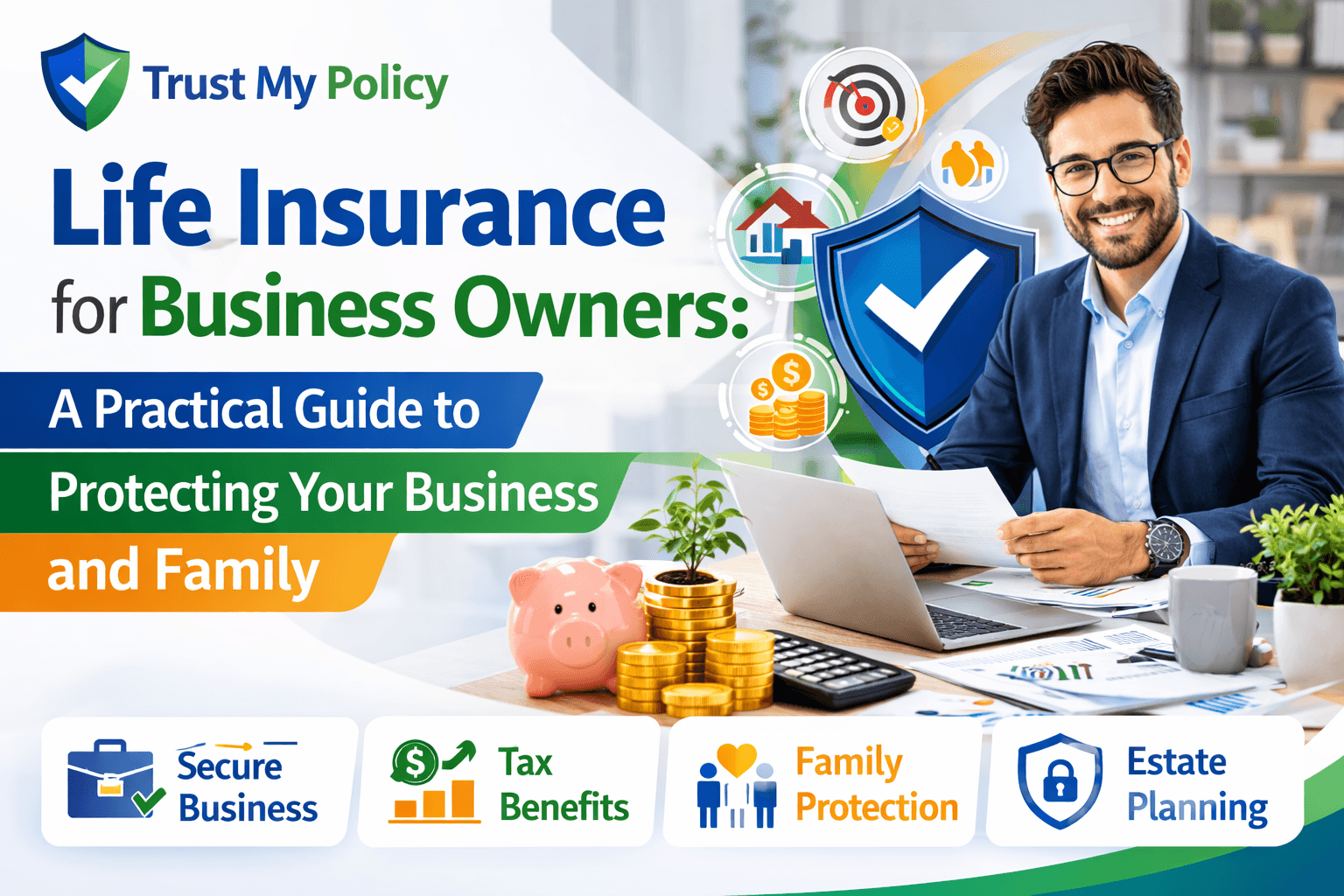
Business owners typically need life insurance for three distinct purposes: key person insurance to compensate the business for the financial impact of losing a critical owner or employee, buy-sell agreement funding to give surviving partners or co-owners the cash to purchase the deceased’s business interest, and SBA or lender-required collateral coverage for business loans. Each serves a different purpose and requires a separate or specifically structured policy.
Patrick Vega, 51, co-owned a $2.4 million plumbing company in Charlotte with his business partner of eighteen years. Neither had any life insurance in place between them. When his partner died unexpectedly, Patrick found himself legally obligated to pay his partner’s estate for the deceased partner’s share of the business — money he didn’t have on hand, nearly forcing a fire sale of the company.
Life Insurance for Business Owners in 2026 serves three distinct purposes that personal life insurance doesn’t address: key person coverage that compensates the business if an owner or critical employee dies, a buy-sell agreement-funding policy that gives surviving partners the cash to purchase the deceased partner’s share, and SBA loan collateral requirements that many lenders impose on business borrowers. This guide breaks down all three and explains exactly how Patrick could have avoided his crisis.
This article covers the three core uses of business life insurance, how each one is structured, real scenarios with specific dollar amounts, and which type applies to your specific situation. By the end, you’ll know exactly what coverage to put in place before you need it.
| Feature | Details |
| What it is | Business-purpose life insurance covering three distinct use cases beyond personal coverage |
| Who needs it | Business owners, co-owners in partnerships or LLCs, and business borrowers |
| Core uses | Key person coverage, buy-sell agreement funding, SBA/lender collateral |
| Typical policy type | Term life is most common; permanent life used for executive benefit and buy-sell strategies |
| Typical cost | $50–$500+/month depending on coverage amount, age, and health |
| Key benefit | Prevents Patrick’s scenario: a partner’s death creating a forced business sale |
| Regulator | State insurance departments (US); Financial Conduct Authority (UK) |
Most business owners think of life insurance as something for their family — coverage that replaces their income if they die. Business-purpose life insurance is different: it protects the business entity itself, its surviving owners, and often its lenders, from the financial disruption caused by the death of a critical person.
Life insurance for business owners addresses three distinct needs: key person insurance, which the business owns and which compensates it for the revenue disruption caused by losing an owner or critical employee; buy-sell agreement funding, which gives surviving partners the liquidity to purchase the deceased owner’s business interest rather than being forced to sell the company or bring in unwanted new partners; and SBA or lender-required collateral coverage, which many business lenders require as a condition of approving a significant business loan. Any business owner with a co-owner, a critical employee, or an outstanding business loan should evaluate all three.
| Criteria | Key Person Insurance | Buy-Sell Funding | Personal Life Insurance |
| Policy owner | The business | Each co-owner or the business | The individual |
| Beneficiary | The business | Surviving partners or the business | Family members |
| Purpose | Compensate the business for revenue impact | Fund the purchase of the deceased’s business interest | Replace personal income for dependents |
| Best for | Any business with an owner or employee whose death would significantly impact revenue | Any business with two or more co-owners | Any individual with personal dependents |
| Tax treatment | Death benefit generally income-tax-free; premiums typically not deductible | Varies by structure | Death benefit generally income-tax-free |
We recommend all three types for any business with co-owners and a business loan for most readers, since personal life insurance alone addresses none of the three business-specific scenarios.
Scenario 1: Patrick, 51, co-owner of a plumbing company in Charlotte. Patrick’s partner’s death created an obligation to buy out the estate with no funding mechanism in place, nearly forcing a company sale. Verdict: a buy-sell agreement funded by life insurance would have given Patrick the cash to purchase his partner’s share without crisis. Action: Patrick subsequently implemented both a buy-sell agreement and cross-purchase life insurance policies with a new business partner.
Scenario 2: A marketing agency in London whose revenue was 60% tied to one founding partner. After the partner died, the agency lost three major accounts within the first month. A £500,000 key person policy covered the revenue gap during an eight-month transition period. Verdict: key person insurance compensates a business for real, documented revenue impact. Action: the surviving partners used the payout to hire two senior replacements and retained most of the remaining client base.
Scenario 3: A restaurant owner in Dallas who was required to assign a life insurance policy as SBA loan collateral. Her lender required a $350,000 policy with the lender named as collateral assignee as a condition of the SBA loan. Verdict: SBA loan collateral requirements are a common, non-negotiable lender condition for many business borrowers. Action: she purchased a 10-year term policy specifically sized to the loan amount and confirmed the collateral assignment with the lender before closing.
Scenario 4: A two-owner LLC in Bristol using a cross-purchase buy-sell structure. Each owner held a policy on the other’s life. When one died, the surviving owner used the policy proceeds to purchase the deceased’s 50% stake from the estate, retaining full control without new partners or a forced sale. Verdict: the cross-purchase structure gave the survivor full control using insurance proceeds rather than personal funds. Action: the surviving owner engaged a solicitor to update the company structure documents after the purchase was complete.
| Pros | Cons |
| Buy-sell funding prevents a forced business sale after a co-owner’s death. | Premiums are an ongoing business cost that varies significantly by ownership structure. |
| Key person insurance provides real revenue protection during a transition period. | The policy amount requires a realistic, documented valuation of the business impact. |
| SBA collateral coverage satisfies a common, non-negotiable lender requirement. | Cross-purchase buy-sell structures become administratively complex with more than two owners. |
| Policies can be structured to support specific business succession planning goals. | Tax treatment varies by structure and requires confirmation from a business tax advisor. |
| Both term and permanent life can be used depending on the specific business purpose. | Regular business valuation updates are needed to ensure coverage amounts remain adequate. |
⚠️ WARNING: Never operate a multi-owner business without a fully funded buy-sell agreement. A co-owner’s death without this structure can force a business sale, introduce unwanted new partners (the deceased’s heirs), or create a legal dispute over the business’s value — any of which can destroy a business Patrick and his partner spent decades building.
| Your Situation | Our Recommendation |
| You own a business with a co-owner and no buy-sell agreement | Yes — implement both the legal agreement and life insurance funding immediately |
| You have an SBA or significant business loan | Yes — confirm the lender’s specific collateral assignment requirements |
| Your business has an employee or owner whose death would significantly impact revenue | Yes — key person insurance should be sized to a realistic revenue impact estimate |
| You have a funded buy-sell but haven’t updated the coverage in over 3 years | Yes — review whether the coverage amount still reflects the business’s current value |
| You only have personal life insurance with no business-specific coverage | Yes — personal life insurance addresses none of the three business-specific scenarios |
| You’re a sole trader with no partners and no significant business debt | No — business-specific life insurance may not be necessary in this scenario |
| You’re considering permanent vs. term for buy-sell funding | Yes — consult a fee-only financial advisor before choosing permanent life for this purpose |
💡 TIP: The single golden rule for business owner life insurance: implement a funded buy-sell agreement before anything else — it’s the single coverage type that most directly prevents a co-owner’s death from destroying the business itself.
| Scenario | Typical Annual Cost | Notes |
| Key person policy, healthy 45-year-old, $500,000 coverage | $600–$1,500/year | Term life most common for key person coverage |
| Buy-sell cross-purchase policy, two healthy 45-year-old co-owners | $1,200–$3,000/year combined | Each owner holds a policy on the other |
| SBA loan collateral policy, $350,000, 10-year term | $300–$800/year | Sized to the loan amount; may reduce as the loan is repaid |
| Entity purchase buy-sell, $2,000,000 business valuation | $2,000–$5,000+/year | Business owns policies on each co-owner |
| Key person policy, business-critical employee, $1,000,000 coverage | $1,000–$3,000/year | Reflects the documented revenue impact of losing that person |
| UK key person (keyman) insurance, £500,000 | £500–£2,000/year | Similar structure to US key person insurance |
| UK partnership protection (buy-sell equivalent) | £400–£1,500/year per partner | Standard UK product for partnership succession planning |
A business attorney or solicitor — Essential for drafting the buy-sell agreement itself, which is a separate legal document from the insurance policy. Cost range: varies, one-time legal fee. Best for: ensuring the legal agreement is correctly structured before the insurance is purchased.
A fee-only financial advisor or insurance broker specialising in business coverage — Can help structure the right combination of key person, buy-sell, and loan coverage for your specific business. Cost range: varies, often free through a broker. Best for: choosing the right policy structure and coverage amounts. Rating: varies by firm, check credentials.
Your SBA lender or business bank — The authoritative source for confirming your specific loan’s collateral assignment format and coverage requirements. Cost range: free to consult. Best for: US business owners with SBA or bank-required life insurance. Rating: not applicable, primary lender.
LIMRA business market research — Publishes data on business insurance coverage rates and gaps among US small and medium-sized businesses. Cost range: free public summaries. Best for: business owners wanting context on how common these coverage gaps are. Rating: industry research organisation.
Association of British Insurers (UK) — Provides guidance on business protection insurance, including keyman and partnership protection products available in the UK market. Cost range: free. Best for: UK business owners researching their options. Rating: industry trade association.
We recommend a combination of a business attorney and a specialist insurance broker as best overall, since the buy-sell agreement and its life insurance funding need to be implemented together to provide complete protection.
Key person insurance is a policy owned by the business on the life of an owner or critical employee, with the business named as beneficiary, to compensate for the revenue impact of that person’s death.
A buy-sell agreement is a legal contract between co-owners specifying how a deceased partner’s business interest will be purchased. Life insurance provides the cash to fund that purchase without requiring the survivor to use personal funds or sell the business.
Many SBA lenders require the business owner to purchase a life insurance policy and assign a portion of the death benefit to the lender as collateral for the business loan.
Term life is typically more cost-effective for buy-sell funding. Permanent life may be used in specific circumstances, such as when the buy-sell obligation extends beyond a typical term period.
In a cross-purchase structure, each co-owner holds a policy on the other’s life. The surviving owner uses the payout to purchase the deceased’s business interest from the estate.
In an entity purchase structure, the business holds policies on all co-owners. The business uses the payout to purchase the deceased’s interest, which is then redistributed among surviving owners.
A common starting point is a multiple of the key person’s annual contribution to the business — typically 5–10 times annual revenue impact, though a formal business valuation may be more accurate.
Usually less so for buy-sell purposes if you have no partners, though key person coverage may still be relevant if your business relies heavily on your own skills, and lender collateral requirements may still apply.
It depends on the specific structure. Business-owned life insurance premiums are typically not deductible in the US, though death benefits are generally income-tax-free. Consult a business tax advisor for your specific situation.
Every two to three years, and immediately after any significant change in business value, ownership structure, or outstanding loan amounts.
This article is for informational purposes only. Always consult a licensed insurance professional before making coverage decisions. Trust My Policy does not sell insurance products or represent any insurer.

Jagadeesh Gutha is the founder of TrustMyPolicy.com, an independent insurance information platform covering life, health, car, home, and business insurance for US and UK readers. He researches insurance products, policy structures, and consumer rights to help everyday people make informed coverage decisions without the jargon. All content on TrustMyPolicy is independently researched, fact-checked, and written to educate — not to sell.



Insurance Guides for UK, USA & Worldwide We are not an insurer or broker.

Reader Comments (0)