
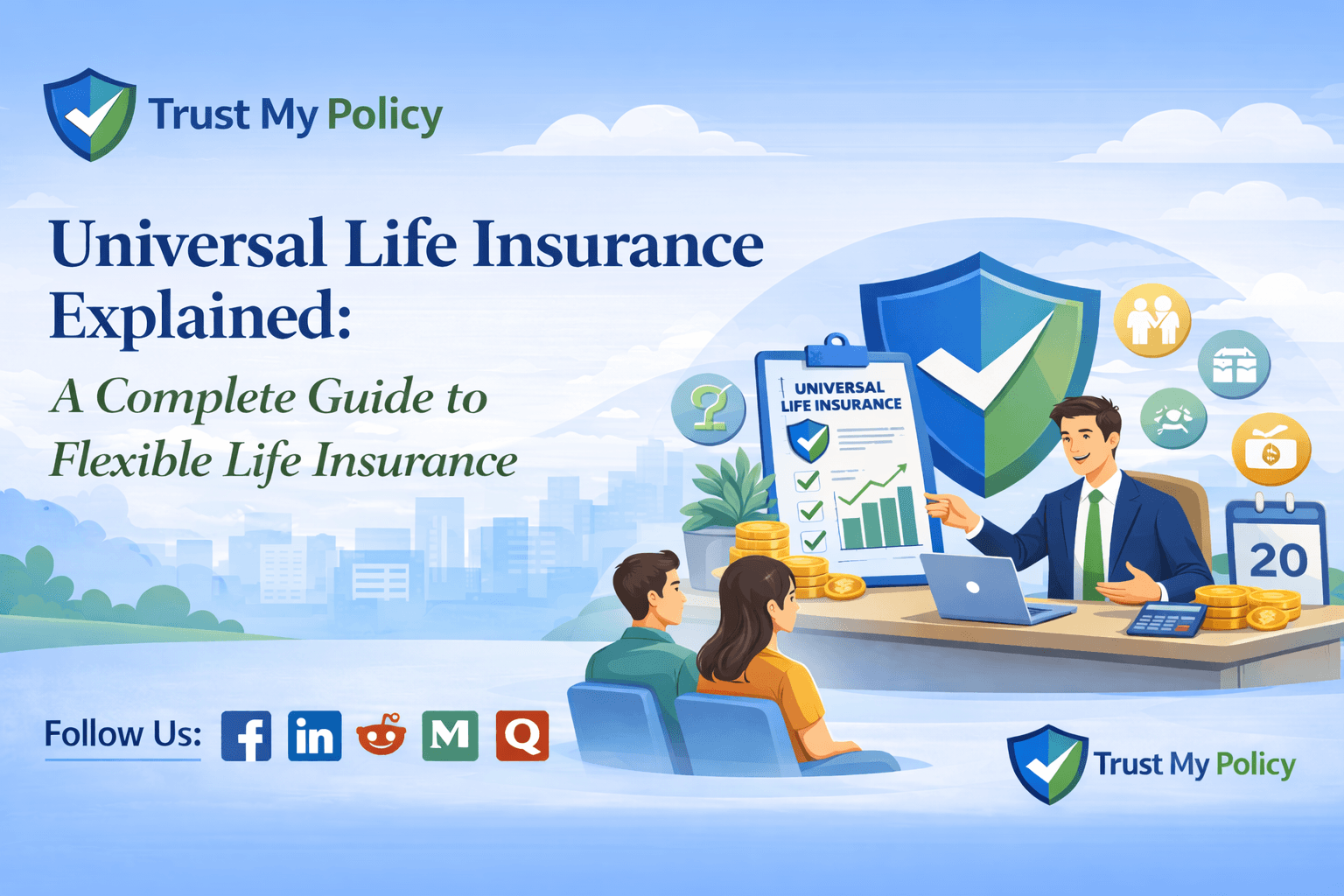
Universal life insurance is a permanent life insurance policy that combines lifelong death benefit coverage with a cash value component that earns interest, while offering flexible premium payments and death benefit amounts. Unlike whole life, the internal cost of insurance rises annually with age, and this rising cost is deducted from the cash value. According to LIMRA, universal life accounted for approximately 23% of all US individual life insurance in-force in 2024.
Karen Yoo, 48, had held a universal life insurance policy for twelve years and assumed it was performing well because the insurer had never contacted her with a problem. Then her annual policy review — the first she’d done in eight years — revealed her cash value had been gradually depleted by rising insurance costs and that, unless she increased her premium, her policy would lapse within six years.
Universal Life Insurance in 2026 is a flexible permanent life insurance product that combines a death benefit with a cash value component that earns interest, but unlike whole life insurance, its internal cost of insurance rises each year with the insured person’s age. That rising cost is deducted from the cash value, meaning a policy that looks healthy early on can quietly deteriorate if premiums don’t keep pace. This guide breaks down exactly how universal life works, why it requires active monitoring, and when it makes more sense than term or whole life.
This article covers the mechanics of universal life insurance, the main types (traditional, indexed, and variable), real scenarios showing how policies can underperform, and a clear framework for deciding whether it’s the right product for your situation. By the end, you’ll understand the flexibility universal life offers — and the vigilance it requires.
| Feature | Details |
| What it is | A flexible permanent life insurance policy with a death benefit and a cash value component |
| Main types | Traditional (fixed interest), indexed (tied to a market index), variable (invested in sub-accounts) |
| Flexibility | Adjustable premiums and death benefit amounts within policy limits |
| Key risk | Rising internal cost of insurance can deplete cash value if premiums don’t keep pace |
| Typical cost | Significantly higher than term life; varies widely by age, health, and coverage amount |
| Key benefit | Flexibility plus permanent coverage, unlike term life |
| Regulator | State insurance departments (US); Financial Conduct Authority (UK) |
Think of universal life insurance like a flexible mortgage with a built-in savings account. You can adjust your payments within certain limits, the savings account grows over time, but there’s a running monthly charge being deducted automatically — and if you underfund the account over years, the charges will eventually exceed what’s in it.
Universal life insurance is a permanent life insurance product designed to provide lifelong death benefit coverage alongside a cash value that grows at a declared or market-linked interest rate. Its defining feature is flexibility: unlike whole life insurance with its fixed premium, universal life allows you to adjust your premium payments (within limits) and sometimes your death benefit amount. In exchange for this flexibility, the policy’s internal cost of insurance rises annually with your age, and this cost is deducted monthly from your cash value rather than appearing as a separate bill — which is why policies like Karen’s can quietly underperform over time.
| Criteria | Universal Life | Whole Life | Term Life |
| Coverage duration | Permanent (if funded adequately) | Permanent (guaranteed) | Fixed term, e.g. 20 years |
| Premium flexibility | Yes — adjustable within limits | No — fixed premiums | No — fixed premiums |
| Cash value | Yes — variable, depends on funding | Yes — guaranteed growth | No |
| Death benefit flexibility | Sometimes adjustable | Fixed | Fixed |
| Risk of lapse from underfunding | Yes — a real risk | No — premiums are fixed | Only if premium not paid |
| Cost vs term | Much higher | Higher than UL typically | Lowest of all three |
| Best for | Those wanting flexibility with permanent coverage | Those wanting guaranteed permanent coverage | Those wanting maximum death benefit per premium dollar |
We recommend term life for most younger adults wanting pure death benefit protection, whole life for those specifically wanting guaranteed permanent coverage with no lapse risk, and universal life for those who genuinely need the premium flexibility that permanent coverage with adjustable payments provides.
Scenario 1: Karen, 48, universal life policyholder. Karen’s eight-year gap in policy reviews let rising insurance costs erode her cash value to the point where lapse risk had become real. Verdict: universal life requires annual review — not occasional review. Action: Karen increased her premium and set a calendar reminder for an annual policy review every year.
Scenario 2: A 55-year-old business owner who used an indexed universal life policy as a supplemental retirement savings vehicle. In years where the linked index performed well, his cash value accumulated significantly; in flat years, the floor guarantee prevented loss. Verdict: indexed UL can be a useful supplemental savings vehicle for the right profile, but the cap and floor mechanics limit both gains and losses. Action: he works with a financial advisor to review the index performance and internal costs annually.
Scenario 3: A 38-year-old who chose universal life for premium flexibility during variable-income years. In high-income years he paid maximum premiums; in lower-income years he paid minimum premiums. Verdict: premium flexibility is the core practical advantage of universal life for people with genuinely variable income. Action: he monitors his cash value level annually to ensure minimum premium payments during low-income years don’t cause long-term underfunding.
Scenario 4: A 62-year-old whose variable universal life policy suffered significant cash value losses after poor sub-account investment performance. The combination of market losses and rising insurance costs depleted his policy rapidly. Verdict: variable UL carries genuine investment risk that can compound the internal cost risk. Action: he worked with an advisor to shift his sub-account allocation to more conservative options to stabilise the remaining cash value.
| Pros | Cons |
| Flexible premium payments within policy limits accommodate variable incomes. | Rising internal cost of insurance can quietly deplete cash value over time. |
| Permanent lifetime coverage unlike term life. | Requires active annual monitoring to catch underfunding before it becomes a lapse risk. |
| Cash value can accumulate meaningfully with adequate funding and favourable conditions. | Significantly more complex than term or whole life insurance. |
| Indexed and variable types offer market-linked growth potential. | Variable UL adds genuine investment risk on top of the standard insurance cost risk. |
| Death benefit amounts can sometimes be adjusted without new underwriting. | Flexibility is also a risk — most lapse problems trace back to underpayment during the policy’s early years. |
⚠️ WARNING: Never go more than one year without reviewing your universal life insurance policy statement. Rising insurance costs deducted from the cash value can create a lapse risk that compounds silently over several years, and by the time it’s visible it may require a significant premium increase to correct.
| Your Situation | Our Recommendation |
| You need maximum death benefit per premium dollar | No — term life delivers this more cost-effectively |
| You want permanent coverage with guaranteed no lapse risk | No — whole life’s fixed premiums eliminate underfunding risk |
| You have genuinely variable income and need premium flexibility | Yes — universal life’s flexible premium structure addresses this need |
| You want permanent coverage with growth potential beyond guaranteed rates | Yes — indexed or variable UL may suit, with appropriate risk understanding |
| You’re willing to actively monitor your policy every year | Yes — this is the non-negotiable condition for universal life to work well |
| You’ve had a UL policy for years and never reviewed the annual statement | Yes — review it immediately and ask for a lapse projection |
| You’re considering variable UL but have no investment experience | No — work with a financial advisor first to understand the investment risk |
💡 TIP: The single golden rule for universal life insurance: ask your insurer every single year for a current lapse projection showing how long your policy will remain in force under your current premium payment pattern — this is the one number that tells you everything about your policy’s health.
| Scenario | Typical Cost | Notes |
| Universal life, healthy 35-year-old, $500,000 death benefit | $200–$500/month | Varies by type (traditional, indexed, variable) |
| Term life equivalent, healthy 35-year-old, $500,000, 20-year term | $25–$45/month | For comparison: universal life costs significantly more |
| Indexed UL annual return in a positive market year | Often 5%–9% credited (capped) | Cap limits upside; floor (often 0%) limits downside |
| Variable UL sub-account loss in a market downturn | Can be significant (no floor in most) | Adds genuine investment risk on top of insurance cost risk |
| Cost of insurance at age 35 vs age 60 (illustrative) | Roughly 4–8x higher at 60 | Demonstrates why cash value must grow to keep pace |
| Policy reinstatement after lapse (if eligible) | Full back premiums plus possible new underwriting | Much more expensive than maintaining continuous coverage |
| Annual policy review with an advisor | Varies ($0–$300+) | One of the highest-value annual financial reviews available |
Your insurer’s annual policy illustration — An updated projection showing your current cash value, projected future cash value, and estimated lapse date under your current premium. Cost range: free, request from your insurer. Best for: the single most important annual document for any UL policyholder. Rating: not applicable, primary policy document.
Independent fee-only financial advisors — Advisors with no commission incentive can objectively assess whether your UL policy is on track or whether a different approach makes more sense. Cost range: hourly or flat fee, varies. Best for: anyone wanting an independent assessment of their UL policy’s health. Rating: varies by firm, check credentials and licensing.
Your state insurance department (US) — Can explain your rights if you believe your UL policy was mis-sold or misrepresented. Cost range: free. Best for: US policyholders with concerns about their policy’s original sale. Rating: government regulatory body.
LIMRA research — Provides industry data on universal life performance, persistence rates, and market trends. Cost range: free public summaries. Best for: readers wanting industry context on UL product performance. Rating: industry research organisation.
Financial Conduct Authority (UK) — Sets standards for how UK insurers must manage and disclose permanent life insurance products. Cost range: free. Best for: UK policyholders with concerns about their whole or universal life policy. Rating: government regulatory body.
We recommend requesting an updated policy illustration from your insurer as best overall first step, since this single document shows your current policy trajectory and whether action is needed.
Universal life insurance is a flexible permanent life insurance policy combining a lifelong death benefit with a cash value component, with adjustable premiums and rising internal insurance costs that are deducted monthly from the cash value.
Whole life has fixed, guaranteed premiums and guaranteed cash value growth. Universal life has flexible premiums and a cash value that depends on actual credited interest and rising insurance costs, creating the risk of underfunding.
Indexed universal life (IUL) is a type of UL where the cash value earns interest linked to a market index’s performance, typically with a floor (often 0%) preventing losses and a cap limiting maximum gains.
Variable universal life (VUL) is a type of UL where the cash value is invested in sub-accounts, similar to mutual funds, meaning it has genuine investment risk and no guaranteed floor.
Most UL policy lapses trace back to consistent underpayment relative to rising insurance costs, often compounded by low credited interest rates, resulting in cash value depletion over time.
Every year, without exception, requesting an updated illustration showing your current cash value and estimated lapse date under your current premium payment pattern.
Often yes, though the amount required to restore the policy to a sustainable position depends on your age, current cash value, and the policy’s projected lapse date.
It can provide tax-advantaged cash value accumulation, but the internal cost of insurance creates a drag on returns that makes it generally less efficient than a term policy plus a separate investment account for most people.
The cost of insurance is the monthly charge deducted from your cash value to pay for the death benefit coverage, which increases each year as you age.
This depends on your specific policy’s health, your age, and your coverage needs. A fee-only financial advisor can help you assess whether replacement makes sense for your situation.
This article is for informational purposes only. Always consult a licensed insurance professional before making coverage decisions. Trust My Policy does not sell insurance products or represent any insurer.

Jagadeesh Gutha is the founder of TrustMyPolicy.com, an independent insurance information platform covering life, health, car, home, and business insurance for US and UK readers. He researches insurance products, policy structures, and consumer rights to help everyday people make informed coverage decisions without the jargon. All content on TrustMyPolicy is independently researched, fact-checked, and written to educate — not to sell.



Insurance Guides for UK, USA & Worldwide We are not an insurer or broker.
Reader Comments (0)