
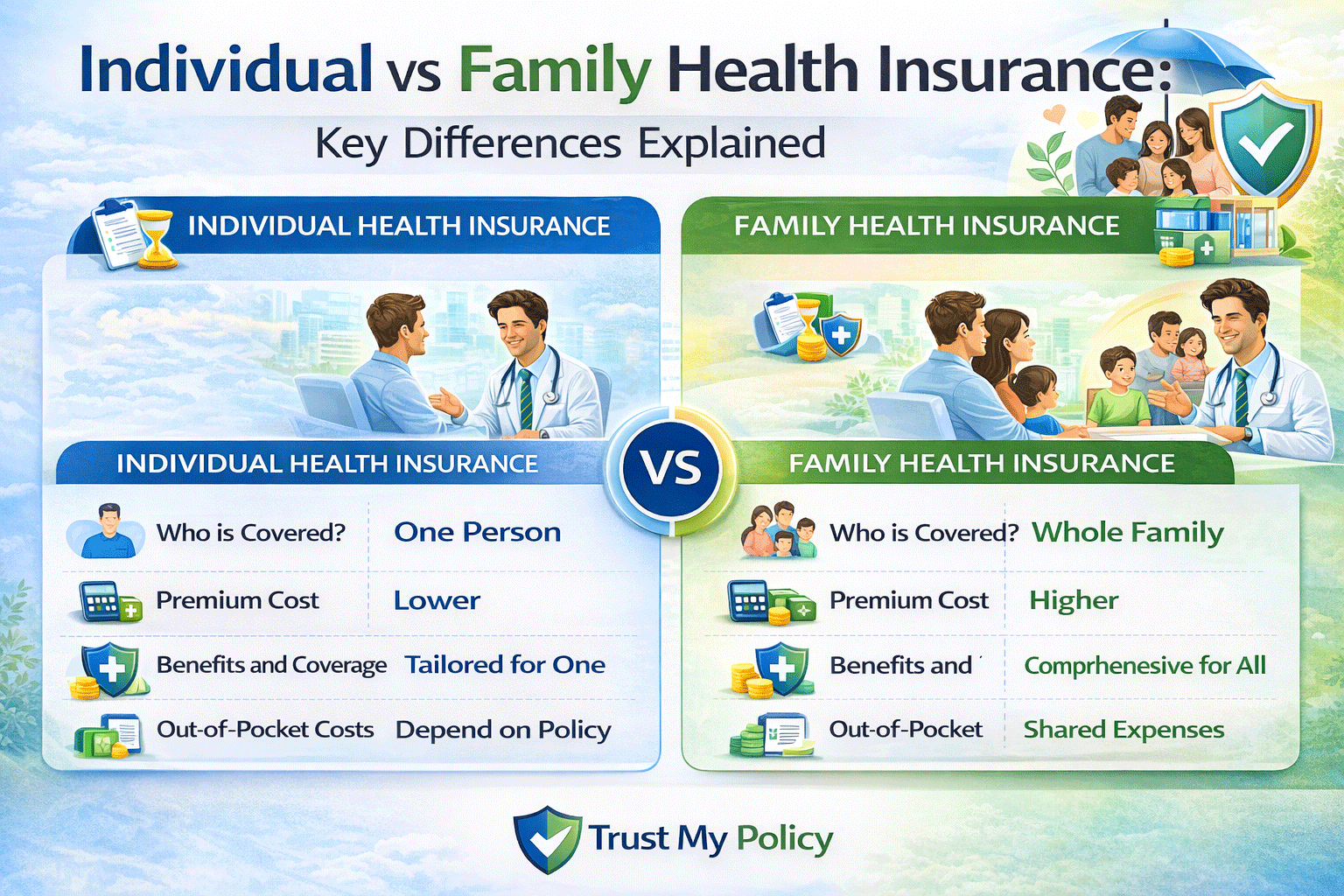
An individual health insurance plan covers one person. A family plan covers a policyholder and their dependents — spouse, children, or both — under one premium and one shared deductible. In 2026, individual Silver plan premiums average $220–$520/month before subsidies. A family of four on a Silver ACA plan pays $950–$1,800/month before subsidies (Keen Coverage 2026) — often cheaper than four separate individual plans. Family plans use embedded deductibles, meaning any family member starts benefiting from coverage once they individually hit their embedded limit.
When Daniel, a 36-year-old accountant from Ohio, got married and his wife became pregnant, he faced a question he had no idea how to answer: should he add his wife and baby to his existing individual plan, switch to a family plan, or keep two separate individual plans? His HR team quoted $340/month for his individual plan, $820/month to add his wife as a dependent, or $1,050/month for a full family plan. He could not tell which option was cheapest — or which would protect his family best when the baby arrived.
Individual vs family health insurance in 2026 is one of the most consequential plan decisions a household makes. According to Keen Coverage April 2026 analysis, a family of four on a Silver-tier ACA plan pays $950–$1,800/month before subsidies — often less than combining three or four separate individual plans for the same people. But that is not always true. For couples without children, two individual plans can sometimes cost less. Knowing exactly when each structure wins — based on family size, age gap between spouses, and subsidy eligibility — can save a family $3,000–$8,000 per year.
In this guide you will learn exactly how individual and family plans differ in structure and cost, how the embedded deductible system works on family plans, the 2026 ACA subsidy thresholds by household size, four named scenarios showing which plan wins for each family type, and the five most expensive mistakes families make when choosing coverage.
| Feature | Individual Plan | Family Plan |
| Who is covered | One person only | Policyholder + spouse and/or children |
| Average monthly cost 2026 | $220–$520 (Silver plan, before subsidy) | $950–$1,800 (family of four, Silver, before subsidy) |
| Deductible structure | Single annual deductible | Embedded individual + overall family deductible |
| Out-of-pocket maximum | $9,450 individual (CMS 2026) | $18,900 family (CMS 2026) |
| Subsidy eligibility | Based on individual income vs FPL | Based on household size and income vs FPL |
| Best for | Single adults, self-employed individuals | Couples with children, large families |
| Regulated by | CMS, state DOI (US); FCA (UK) | CMS, state DOI (US); FCA (UK) |
An individual health insurance plan covers exactly one person. The premium, deductible, copays, and out-of-pocket maximum all apply to that single policyholder. If you have a claim, only your own costs count toward your deductible and OOP maximum. If you need to cover a partner or child, you either add them as dependents (on the same policy) or they enrol in their own separate individual plan.
Individual plans are available through your employer (if offered), the ACA Marketplace (healthcare.gov), directly from an insurer, or through a broker. For 2026, a 40-year-old on a Silver individual ACA plan pays an average of $752/month before subsidies, per Venteur April 2026 analysis — though state averages range from $480 to $1,224.
Individual plans are ideal for: single adults with no dependants, self-employed people with no family to cover, employees whose employer covers only the individual — not dependants — at a reasonable cost, and adults whose children are covered under a spouse’s employer plan or under CHIP.
For full details on what each metal tier covers at what cost, see our guide on [INTERNAL LINK: ACA health insurance metal tiers — Bronze, Silver, Gold, and Platinum explained for 2026]
A family health insurance plan covers multiple people — typically a policyholder plus their spouse and dependent children — under one policy with one combined premium. All covered members share the family deductible and family out-of-pocket maximum, but each member also has their own individual embedded deductible.
The embedded deductible system is the critical mechanism most people do not understand. Under an embedded structure (required for ACA plans), each family member has their own individual deductible limit within the family plan. Once any single member hits their individual embedded deductible, cost-sharing begins for that person — they do not have to wait for the entire family to collectively meet the full family deductible. The family deductible cap prevents total family spending from exceeding the overall limit.
Family plans are available through employer group plans (where employers typically cover 70–80% of the premium), the ACA Marketplace, or directly from insurers. According to NewHealthInsurance 2026, employer plan family premiums average $650/month in employee contributions — the employer covers the remaining $1,200–$1,800/month.
If you are self-employed and need family coverage, see our guide on [INTERNAL LINK: self-employed health insurance 2026 — best options for freelancers and business owners]
| Criteria | Individual Plan | Family Plan |
| 2026 average premium (Silver, ACA) | $220–$520/month per person | $950–$1,800/month for family of four (Keen Coverage 2026) |
| Employer plan average contribution | $210/month employee share (NewHealthInsurance 2026) | $650/month employee share (NewHealthInsurance 2026) |
| Deductible type | Single person deductible | Embedded individual + family aggregate deductible |
| OOP maximum 2026 (CMS) | $9,450 per individual | $18,900 per family; $9,450 per individual embedded |
| Subsidy calculation | Individual income vs Federal Poverty Level | Household size + combined income vs FPL |
| CHIP eligibility for children | N/A | Children in families earning too much for Medicaid but too little for private plans qualify for free/low-cost CHIP |
| Large age gap between spouses | N/A — each priced individually | Family premium reflects oldest member — may be higher than two individual plans |
| Best for | Single adults, self-employed, one-person households | Couples with children; large families; employer-subsidised family plans |
We recommend a family plan for most couples with one or more children because the per-person cost is almost always lower than stacking individual plans. Couples with no children and a large age gap between spouses should do the individual-vs-family maths before assuming a family plan is cheaper.
Most comparison articles skip the actual calculation. Here is when individual plans win:
Scenario: Couple, ages 34 and 52, no children. A family Silver plan premiums based on the oldest member (52) costs $1,400/month. Two individual Silver plans — one for a 34-year-old ($320/month) + one for a 52-year-old ($680/month) = $1,000/month combined. Individual plans save $400/month = $4,800/year.
Scenario: Couple, both aged 35, two children. Family Silver plan: $1,100/month. Four individual plans: 35+35+child+child = $520+$520+$180+$180 = $1,400/month combined. Family plan saves $300/month = $3,600/year.
Rule: The larger the age gap between spouses, the more likely two individual plans beat a family plan on cost. The more children you have, the more a family plan wins. Always run the exact premium comparison for your household before enrolling.
Scenario 1: Daniel, 36, Accountant — New Family, Ohio
Daniel (36), wife (34), baby due in 3 months. His employer offers: individual plan $340/month (Daniel only), add spouse $820/month total, family plan $1,050/month. Marketplace family Silver: $1,180/month before subsidies. His household income qualifies for an $800/month ACA subsidy. Net family plan: $380/month. This beats both employer options. Verdict: Check ACA subsidies before defaulting to your employer plan when adding dependants. Daniel saved $440/month by using the ACA Marketplace.
Scenario 2: Priya, 41, Nurse — Large Family, Texas
Priya (41), husband (43), three children ages 4, 7, 12. Family Silver plan: $1,650/month before subsidies. Five individual plans: $580+$620+$180+$180+$180 = $1,740/month. Family plan wins by $90/month = $1,080/year. Embedded deductible: each child has their own $1,500 individual embedded deductible — meaning if the 12-year-old breaks an arm ($4,000 bill), that child starts benefiting from cost-sharing after $1,500 regardless of total family deductible status. Verdict: Family plan is cheaper and the embedded deductible protects each child individually.
Scenario 3: Sophie and Marcus — Large Age Gap, No Children, California
Sophie (28), Marcus (56). Family Silver ACA plan priced at older member (56): $1,320/month. Individual plans: Sophie ($240/month) + Marcus ($940/month) = $1,180/month. Individual plans save $140/month = $1,680/year. They also have different health needs — Sophie rarely sees a doctor; Marcus manages hypertension and prefers a specific specialist who is in-network on his individual plan but out-of-network on the family plan. Verdict: Two individual plans are cheaper AND give each person the right network for their needs.
Scenario 4: The Khan Family — Children on CHIP, Parents on ACA
Ahmed (38), wife (36), two children ages 6 and 9. Family income: $72,000. The children qualify for CHIP in their state (free). ACA Marketplace Silver plan for Ahmed and wife only: $720/month before subsidies. With ACA subsidies at their income level: $380/month net. Individual plans for two adults: $460+$440 = $900/month. Family plan (ACA, adults only): $380/month. CHIP handles the children at zero cost. Verdict: Split strategy — CHIP for children, ACA marketplace plan for parents — saved the Khan family $520/month vs a full family plan.
| Pros of Individual Plans | Cons of Individual Plans | Pros of Family Plans | Cons of Family Plans |
| Each person can choose the plan and network that fits their exact needs | Multiple premiums, deductibles, and OOP maximums to track | One premium, one plan, one deductible structure to manage | Family premium reflects oldest member — age gap inflates cost |
| Large age gap couples can save $1,000–$5,000/year vs a family plan | No shared deductible — each person must meet their own deductible separately | Embedded deductibles protect each family member individually from the start | Family OOP max is higher — $18,900 vs $9,450 individual (CMS 2026) |
| Subsidy calculated individually — may qualify for more if incomes differ | More paperwork at enrollment — multiple plan forms and ID cards | Employer family subsidies often reduce total premium significantly | Provider network applies to all members — one person may lose preferred doctor |
| Easier to change plans at renewal without affecting others | Children on separate plans cannot benefit from family deductible pooling | Children may qualify for CHIP separately — eliminating child premium entirely | CHIP eligibility disappears when income rises — cliff effect on family budget |
| Self-employed individuals can deduct 100% of individual premiums | May miss out on employer family plan subsidies if splitting plans | ACA family subsidies based on household size — often larger for bigger families | Large families may face $18,900 OOP max in a high-claim year |
Mistake 1: Automatically Choosing the Employer Family Plan Without Comparing
Why it happens: Employer plans feel like the default. What to do instead: Compare your employer family premium against ACA Marketplace options with subsidies. Daniel saved $440/month because his ACA subsidy made the marketplace cheaper than his employer family plan.
Mistake 2: Not Checking CHIP Eligibility for Children
Why it happens: Parents assume all children need to be on their plan. What to do instead: Check CHIP eligibility at your state’s Medicaid office or healthcare.gov before enrolling children. CHIP covers children at zero or very low cost for families earning up to 200–300% of the Federal Poverty Level, depending on state.
Mistake 3: Ignoring the Embedded Deductible When Comparing Plans
Why it happens: People see one deductible number on the family plan and assume everyone must collectively hit it before anyone benefits. What to do instead: Ask your insurer specifically: “Is this an embedded or aggregate deductible?” ACA plans must use embedded deductibles — each family member has their own limit within the family plan.
Mistake 4: Not Accounting for Age Gap Between Spouses
Why it happens: Couples assume a family plan is always cheaper. What to do instead: If spouses are more than 10 years apart in age, run the cost comparison both ways. The older spouse’s age inflates the entire family premium. Two individual plans may be significantly cheaper.
Mistake 5: Missing the ACA Subsidy Cliff at 400% FPL
Why it happens: Families earn just above 400% FPL and receive no subsidies at all in 2026 — the cliff returned after 2025 enhanced subsidies expired. What to do instead: Calculate your household income as a percentage of the 2026 FPL. At 400% FPL: $62,600 single, $84,600 couple, $106,600 family of three, $128,600 family of four (Venteur March 2026). If you are just above the cliff, consider retirement contributions to reduce MAGI below the threshold.
⚠️ WARNING: Adding a High-Cost Spouse to an Individual Plan Without Comparing
What happens: You add your spouse to your employer plan without comparing costs. Many employers charge 2–3x the individual premium to add a spouse. Adding a spouse at $480/month extra may be more expensive than your spouse getting their own ACA Marketplace plan at $320/month with a subsidy. What to do instead: Before open enrollment, get quotes for (a) employer family plan, (b) your employer individual + spouse ACA marketplace, (c) ACA family plan. The cheapest option saves $2,000–$6,000/year and most families never compare all three.
| Your Situation | Our Recommendation |
| Single adult with no dependants | ✅ Individual plan — family plan is not applicable or cost-effective |
| Married couple, no children, age gap under 5 years | ✅ Family plan — usually cheaper; compare to confirm |
| Married couple, no children, age gap over 10 years | ✅ Compare both — individual plans often save $1,000–$5,000/year for large age gaps |
| Couple with one or more children | ✅ Family plan — per-person cost beats stacking individual plans in most cases |
| Children qualify for CHIP (household income under 200–300% FPL) | ✅ Put children on CHIP (free/low-cost) + parents on ACA plan — split strategy wins |
| Self-employed, one person only | ✅ Individual ACA Marketplace plan — 100% premium deductible as a business expense |
| Employer subsidises family plan significantly (over 60%) | ✅ Employer family plan — employer subsidy makes this the cheapest option |
| Household income just above 400% FPL (subsidy cliff) | ✅ Maximise retirement contributions to bring MAGI below threshold before enrolling |
💡 Tip: Always compare three options side by side — employer family plan, employer individual + marketplace spouse, and full ACA marketplace family plan. The cheapest answer is rarely obvious without running all three numbers. Use healthcare.gov’s plan comparison tool before every open enrollment.
| Household | Individual Plans Total | Family Plan Total | Best Option & Saving |
| Single adult, age 30 | $280/month | N/A | Individual — only option |
| Single adult, age 50 | $680/month | N/A | Individual — only option |
| Couple, both age 35 | $640/month combined | $720/month | Individual saves $80/month ($960/yr) |
| Couple, ages 30 and 55 | $340+$940 = $1,280/month | $1,350+/month (based on age 55) | Individual saves $70+/month |
| Couple + 1 child | $640+$180 = $820/month | $950–$1,100/month | Individual saves $130–$280/month |
| Couple + 2 children | $640+$360 = $1,000/month | $1,050–$1,200/month | Compare — close call |
| Family of 4 (couple + 2 kids) | $640+$360 = $1,000+/month | $950–$1,800/month (Keen Coverage 2026) | Family usually wins with 4+ members |
| Family of 4 + CHIP for children | $640/month (adults only on ACA) | $950–$1,800/month (full family) | CHIP split strategy — adults on ACA, kids on CHIP |
Blue Cross Blue Shield (US) — Best Network for Family Plans
Why recommended: Largest US network — covers 96% of US hospitals and physicians; available in all 50 states; strong family plan options at Silver and Gold tiers. Average family Silver premium: $1,050–$1,400/month. Best for: Families who need broad network access and multiple specialists. Rating: A+ AM Best; 3.9/5 JD Power 2025.
Kaiser Permanente (US) — Best Value Family Plan
Why recommended: Lowest out-of-pocket costs in JD Power 2025 Commercial Health Study; integrated care model reduces unnecessary referrals; strong preventive care for children. Average family Silver: $950–$1,200/month. Best for: Families in CA, CO, GA, HI, MD, OR, VA, WA. Rating: A AM Best; 4.2/5 JD Power 2025.
Oscar Health (US) — Best Individual Plan for Young Adults
Why recommended: Low-premium individual plans with strong telehealth and app-based care; free primary care visits. Average individual Silver: $220–$320/month. Best for: Healthy single adults under 35 wanting low cost individual coverage. Rating: B++ AM Best; 3.7/5 JD Power.
Bupa (UK) — Best Family Private Health Plan
Why recommended: Comprehensive family plans from £85–£250/month; fast specialist access; dental and optical add-ons available. Best for: UK families wanting private coverage alongside NHS. Rating: Defaqto 5 stars; 4.0/5 Trustpilot.
We recommend Blue Cross Blue Shield (US) for families needing broad network access and Kaiser Permanente (US) for families in eligible states seeking best-value coverage. UK families should consider Bupa for private family plan options.
It depends on your family composition and age profile. A family of four with children almost always saves money on a family plan vs four individual plans. Couples with a large age gap (over 10 years) often save money on two individual plans because the family premium is priced at the older partner’s age. Always compare both options using healthcare.gov or a licensed broker before enrolling.
An embedded deductible means each family member has their own individual deductible limit within the family plan. Once any individual hits their embedded limit (for example $1,500), cost-sharing begins for that person even if the rest of the family has not yet hit the overall family deductible. ACA-compliant plans are required to use embedded deductibles. This protects individual family members from being denied cost-sharing while waiting for the collective family deductible to be met.
Yes. Children can be on a separate individual plan, a family plan with one or both parents, or enrolled in CHIP if they qualify. A common cost-saving strategy is enrolling children in CHIP (free or low-cost for eligible families) while parents enrol in an individual or couples ACA plan. This split strategy often saves $300–$700/month compared to a full family plan.
Outside of open enrollment, you can add a family member only after a qualifying life event — marriage (within 60 days), birth or adoption (within 60 days), loss of other coverage (within 60 days), or moving to a new state. Employer plans follow the same qualifying life event rules. Miss the 60-day window and you must wait until the next open enrollment period (November–January for ACA plans).
Not necessarily. Self-employed individuals can buy individual plans on the ACA Marketplace (100% premium tax-deductible as a business expense). If you have a spouse and children, you can add them to your marketplace plan as a family. The self-employed health insurance deduction applies to all enrolled family members on the same policy. Compare ACA marketplace family premiums with your net-of-deduction cost before assuming employer-style group coverage is needed.
In 2026, the ACA out-of-pocket maximum is $18,900 for a family and $9,450 per individual (CMS 2026). The individual embedded OOP cap means no single family member can be required to pay more than $9,450 in a plan year, even if the family total has not reached $18,900. Once any individual hits $9,450 or the family total hits $18,900, all remaining covered services are free for that person or all family members respectively.
The ACA subsidy cliff returned in 2026 after the enhanced subsidy extensions from 2021–2025 expired. Families earning above 400% of the Federal Poverty Level receive zero premium tax credits. For 2026, the 400% FPL cliff is $62,600 for a single individual, $84,600 for a couple, $106,600 for a family of three, and $128,600 for a family of four (Venteur March 2026). Families just above these thresholds may benefit from maximising pre-tax retirement contributions (401k, IRA) to reduce their Modified Adjusted Gross Income below the cliff.
It depends on your state and insurer. ACA Marketplace plans must cover legal spouses and dependent children. Domestic partner coverage is not federally mandated — it is offered at the insurer’s discretion and varies by state. California, New York, and several other states require domestic partner coverage. If you are in a state without this requirement, check your specific plan documents or call your insurer before assuming a domestic partner is covered.
Only following a qualifying life event — divorce, legal separation, or a dependent losing eligibility. You cannot voluntarily drop a family plan mid-year without a qualifying event. At the annual open enrollment period, you can freely switch from a family plan to individual plans or vice versa. If your family structure changes significantly (divorce, children ageing off at 26), set a calendar reminder to review coverage at the next open enrollment.
CHIP (Children’s Health Insurance Program) provides free or low-cost health coverage to children in families who earn too much to qualify for Medicaid but cannot afford private insurance. Income thresholds vary by state but generally range from 200–300% of the Federal Poverty Level. Children enrolled in CHIP do not need to be on a parent’s family health plan. A parent can hold an individual or couples ACA plan while their children receive CHIP coverage — a split strategy that often saves $300–$600/month on total family premiums.
This guide reflects the latest 2026 health insurance data and ACA regulations.
This article is for informational purposes only. Always consult a licensed insurance professional before making coverage decisions. Trust My Policy does not sell insurance products or represent any insurer.

Jagadeesh Gutha is the founder of TrustMyPolicy.com, an independent insurance information platform covering life, health, car, home, and business insurance for US and UK readers. He researches insurance products, policy structures, and consumer rights to help everyday people make informed coverage decisions without the jargon. All content on TrustMyPolicy is independently researched, fact-checked, and written to educate — not to sell.




Insurance Guides for UK, USA & Worldwide We are not an insurer or broker.


Reader Comments (0)