
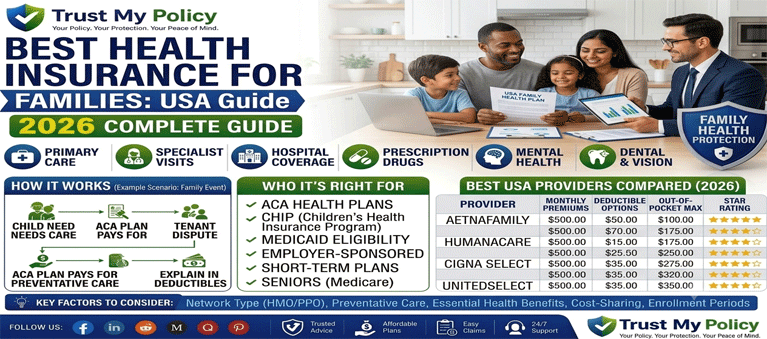
Best health insurance for families in 2026 depends on income, health usage, and whether employer coverage is available. For employer plans, the average family pays $6,575/year in premiums (KFF 2024). On the ACA marketplace, a family of four earning $90,000/year qualifies for subsidies that reduce a Silver plan to approximately $600-$900/month. Blue Cross Blue Shield, UnitedHealthcare, Kaiser Permanente, Aetna, and Cigna are the top five US family health insurers. All ACA plans cover ten Essential Health Benefits including paediatric care, maternity, mental health, and prescription drugs.
When the Torres family — Carlos, 41, Elena, 39, and their three children aged 5, 9, and 13 — lost their employer health plan after Carlos was laid off in February 2024, they had 60 days to find a replacement before their COBRA option became unaffordable at $2,140 per month. They had no idea which plan type to choose or whether they qualified for any help with the cost.
Best health insurance for families in 2026 means finding the plan that balances premium, deductible, and out-of-pocket maximum against what your family actually uses — not just the lowest monthly price. According to the Kaiser Family Foundation (KFF) 2024, the average employer-sponsored family health plan costs $23,968 per year in total premium, of which employees pay $6,575 per year. Families who buy independently on the ACA marketplace pay more upfront but can qualify for substantial subsidies depending on household income. If you are still weighing up whether a family plan or separate individual policies would work out cheaper for your household, that comparison is worth running before you commit to either option.
This guide covers every plan type available to US families in 2026 — ACA marketplace plans, employer-sponsored coverage, Medicaid, CHIP, and HDHP options — with specific premium figures, a direct comparison of the top five providers, four family scenarios with real dollar figures, the most expensive buying mistakes, a decision guide, and ten FAQs.
| Feature | Details |
| What It Is | A health insurance policy covering all eligible family members under one plan |
| Who Needs It | Any US family without adequate employer coverage or public programme eligibility |
| Average Employer Family Premium (Employee Share) | $6,575/year ($548/month) — KFF 2024 |
| Average ACA Marketplace Family Premium (Unsubsidised) | $1,200-$1,800/month for a family of four |
| ACA Subsidy Eligibility (2026) | 100%-400% FPL; enhanced subsidies extend to 600% FPL under the Inflation Reduction Act 2022 |
| Family Out-of-Pocket Maximum (ACA, 2026) | $18,900 per year (HHS 2026) |
| Essential Health Benefits (All ACA Plans) | 10 mandatory benefits: maternity, paediatric dental/vision, mental health, prescriptions, and more |
| Open Enrollment Period | November 1 – January 15 (most states) |
| Children’s Free Coverage | CHIP covers children up to 200%-300% FPL depending on state — free in most states |
| Regulator | HHS / CMS for ACA plans; state insurance commissioners for all plans |
Family health insurance is a single policy covering two or more family members — a policyholder plus a spouse or domestic partner, plus dependent children up to age 26 under ACA rules. Unlike individual plans, family plans apply a shared family deductible and a shared family out-of-pocket maximum: all family members’ medical spending counts toward one combined limit. Once that limit is reached, the insurer pays 100% of all covered in-network costs for the rest of the policy year. For a breakdown of how these cost-sharing structures work across individual vs family health insurance plans specifically, the numbers often surprise families who have only ever held single-person cover.
US family health insurance comes from four main sources: employer-sponsored plans (covering 155 million Americans, KFF 2024), ACA marketplace plans (covering 21.4 million people as of 2024), Medicaid and CHIP (covering 93 million low-income individuals and children), and individual private plans purchased directly from insurers. Families may combine sources — for example, one parent on an employer plan and children enrolled separately in CHIP — if that combination reduces total annual cost.
The right source depends on your household income, your employer’s contribution, and how frequently your family uses healthcare. If keeping the monthly premium as low as possible is the priority, our guide to cheap health insurance for families walks through every subsidy, programme, and plan-design strategy available to US families in 2026.
An HMO requires your family to choose a Primary Care Physician who coordinates all care and provides referrals to in-network specialists. Out-of-network care is not covered except in emergencies. HMOs have the lowest premiums and most predictable costs, making them a strong option for healthy families with straightforward medical needs. For a direct side-by-side of what separates an HMO from a PPO on cost and flexibility, our HMO vs PPO health insurance comparison covers both plan types with worked premium examples and a decision guide. Average family HMO premium on the ACA marketplace: $900-$1,300/month (KFF 2024).
A PPO lets your family see any doctor — in-network or out-of-network — without a referral. In-network care costs less; out-of-network is covered but at a higher cost share. PPOs suit families with children seeing multiple specialists, families living across state lines, or parents who want direct specialist access. Average family PPO premium: $1,200-$1,800/month unsubsidised (KFF 2024).
An EPO combines HMO cost efficiency with PPO freedom: no referrals required, but all care must stay in-network except emergencies. EPOs suit families comfortable within a defined network who still want to self-refer to specialists without needing a GP gatekeeper. Average family EPO premium: $1,000-$1,400/month (KFF 2024).
An HDHP carries a higher family deductible (minimum $3,200 in 2026 under IRS rules) but lower monthly premiums, paired with a Health Savings Account allowing tax-free contributions up to $8,300 per year for families in 2026. HSA balances roll over annually and can be invested — making HDHPs a strong long-term strategy for healthy families. Self-employed families above the ACA subsidy threshold will find this combination particularly effective; our guide on the best health insurance options for self-employed people models the HDHP plus HSA strategy at several income levels with specific tax-saving figures. Average family HDHP premium: $750-$1,100/month (KFF 2024).
| Metal Tier | Insurer Pays | Best For |
| Bronze | 60% of covered costs | Very healthy families who rarely need care; lowest premium but highest deductible ($7,000-$10,000 family) |
| Silver | 70% of covered costs | Most families — the only tier eligible for Cost Sharing Reductions (CSRs) if income is under 250% FPL |
| Gold | 80% of covered costs | Families with regular medical needs, chronic conditions, or a planned procedure in the year |
| Platinum | 90% of covered costs | Highest-usage families; premium is highest but out-of-pocket maximum is the lowest available |
| Catastrophic | 60% after very high deductible | Under-30s or hardship exemptions only; not eligible for premium tax credits |
We recommend Silver tier for most ACA marketplace families because it is the only metal tier eligible for Cost Sharing Reductions. For families earning under 250% of the Federal Poverty Level, CSRs reduce deductibles, copays, and out-of-pocket maximums significantly — a Silver plan with CSRs can deliver better total value than a Gold plan at a lower net premium. For Gold vs Silver modelling at your specific income level, the health insurance cost estimator on TrustMyPolicy gives a side-by-side figure.
| Provider | Best For | Avg. Family Premium/Month | AM Best |
| Blue Cross Blue Shield | Widest national network; all 50 states | $950-$1,500/month | A to A+ |
| UnitedHealthcare | Largest insurer; broadest plan selection | $980-$1,600/month | A |
| Kaiser Permanente | Integrated care; lowest total out-of-pocket | $850-$1,250/month | A |
| Aetna (CVS Health) | MinuteClinic access; strong pharmacy benefits | $900-$1,400/month | A |
| Cigna | Self-employed families; international cover option | $920-$1,450/month | A |
Blue Cross Blue Shield (BCBS) operates in all 50 states through 33 independent companies and covers over 107 million Americans — the broadest network of any US health insurer. For families who move between states, have children at out-of-state universities, or live in rural areas, the BlueCard programme provides in-network access at over 1.7 million providers nationwide. BCBS offers HMO, PPO, EPO, and HDHP plan types across all four ACA metal tiers. J.D. Power 2024 ranked BCBS plans above average in 21 of 22 regions studied. Average family premium: $950-$1,500/month unsubsidised. AM Best: A to A+.
Best for: families in rural or multi-state situations, families with children at out-of-state colleges, and families who need the widest possible specialist network.
UnitedHealthcare is the largest single US health insurer by revenue, covering 49 million members in 2024. It offers HMO, PPO, EPO, HDHP, and short-term plans in more states than any competitor. Its Rally Health digital wellness platform and 24/7 virtual care service are strong practical benefits for families with young children who need off-hours GP access. Paediatric dental and vision are available as add-ons in most states. Average family premium: $980-$1,600/month unsubsidised. AM Best: A.
Best for: self-employed families comparing multiple plan designs, and households needing reliable telehealth access for children or family members in different locations.
Kaiser Permanente operates an integrated care model — it owns the hospitals, employs the physicians, and manages the insurance plan as one organisation. This eliminates friction between insurer and provider, producing the lowest administrative cost structure in the market and the most coordinated care experience. According to the National Committee for Quality Assurance (NCQA) 2024, Kaiser plans ranked first or second in clinical quality in 6 of the 8 states where it operates. Average family premium: $850-$1,250/month — consistently the lowest of the five providers reviewed. Available in California, Colorado, Georgia, Hawaii, Maryland, Oregon, Virginia, Washington, and Washington DC. AM Best: A.
Best for: families in Kaiser’s service areas who want the lowest combined annual premium and out-of-pocket cost and are comfortable staying within the Kaiser network exclusively.
Aetna’s merger with CVS Health in 2018 gives members walk-in MinuteClinic access at over 1,000 CVS locations nationwide, with most visits covered at a lower copay than a standard GP appointment — a genuine practical benefit for families with young children who need frequent sick visits. Aetna’s CVS Caremark pharmacy benefit manager negotiates some of the lowest drug prices in the market, which matters significantly for families managing any ongoing prescriptions. Average family premium: $900-$1,400/month unsubsidised. AM Best: A.
Best for: families with school-age children who need frequent sick visits, and households with members managing chronic conditions requiring regular prescription refills.
Cigna serves 190 million customers across 30+ countries and is the only major US family insurer offering a genuine global health coverage option — making it the clear choice for families with international travel, expat assignments, or self-employed parents with overseas clients. Its US marketplace plans include strong behavioural health benefits and one of the most comprehensive maternity programmes available. For self-employed families navigating the marketplace without employer support, our full breakdown of health insurance options for self-employed individuals covers how Cigna compares against the other major carriers on both cost and benefit breadth. Average family premium: $920-$1,450/month unsubsidised. AM Best: A.
Best for: self-employed families buying on the ACA marketplace, and families with international travel or work requirements throughout the year.
We recommend Blue Cross Blue Shield as the best overall for most US families because of its unmatched national reach across all 50 states, consistently strong J.D. Power quality ratings, and the widest plan type selection. For families within Kaiser’s 9-state service area, Kaiser delivers the lowest total annual cost. For self-employed families purchasing on the marketplace, Cigna provides the most complete benefits package.
Carlos (41), Elena (39), three children. Annual income after job loss: $82,000. They enrolled in a BCBS Silver plan with premium tax credits of $640/month, paying $780/month net ($9,360/year). Their child needed an appendectomy billed at $28,000. After meeting the $4,500 family deductible and reaching the $9,200 out-of-pocket maximum, total family spending for the entire year including premiums came to $18,560. Without insurance, the surgery alone would have exceeded $28,000. Verdict: The subsidised Silver plan capped total family exposure at $18,560 for a full year of coverage including a major surgical event. Action: Always check your after-subsidy premium before assuming a marketplace plan is unaffordable — the gap between list price and real cost is often several hundred dollars per month.
Minh (44), Thu (42), two children. Minh’s employer offered a family PPO at $520/month employee share ($6,240/year). The family also qualified for a subsidised Gold ACA plan at $610/month ($7,320/year). The employer PPO had a $3,000 family deductible and a $12,000 out-of-pocket maximum. The Gold ACA plan had a $1,500 family deductible and a $7,500 OOP max. Despite the Gold plan’s lower deductible, the employer’s contribution made the employer PPO $4,200/year cheaper when accounting for the full cost including what the employer pays. This decision depends heavily on how much the employer contributes — a question covered in detail in our individual vs family health insurance cost comparison. Verdict: The employer’s contribution was the deciding factor. Action: Always factor in the employer share of the premium — not just your payroll deduction — when comparing an employer plan to the ACA marketplace.
Marcus (38), Keisha (36), two children aged 4 and 7. Family income: $55,000. Both children qualified for free CHIP in their state (income under 200% FPL). Marcus and Keisha enrolled in a Silver ACA plan for two adults at $295/month after subsidies. Total monthly family health insurance cost: $295 — compared to $680/month for a full family Silver plan. The split strategy saved the Jacksons $4,620 per year without any reduction in coverage quality for either the parents or the children. Verdict: Enrolling children in CHIP and parents in a two-adult ACA plan saved $4,620/year. Action: Check CHIP eligibility for your children separately before buying a full family plan — the income thresholds are much higher than most parents expect.
Arjun (46), Priya (44), one child aged 16. Self-employed combined income: $145,000 — above the ACA subsidy threshold. They chose a Cigna HDHP family plan at $890/month ($10,680/year) with a $4,500 family deductible. Contributing the maximum $8,300 to their family HSA in 2026 saved $2,988 in federal income tax at their 36% marginal rate, reducing their effective annual health insurance cost to $7,692. For self-employed families at this income level trying to decide between a standard plan and an HDHP, the best health insurance for self-employed individuals guide models the HDHP tax saving against standard plan costs at several income brackets. Verdict: The HSA tax saving reduced the Patels’ effective health insurance cost by 28%. Action: Self-employed families above the subsidy threshold should always calculate the HDHP plus maximum HSA strategy before defaulting to a standard PPO.
| Plan Source | Pros | Cons |
| Employer-Sponsored | Employer pays average 73% of family premium (KFF 2024); premiums come out pre-tax, reducing taxable income | No choice of plan design; coverage ends immediately on job loss with no transition period |
| ACA Marketplace | Subsidies available up to 600% FPL; guaranteed issue — no pre-existing condition exclusions | Unsubsidised premiums are very high; open enrollment window restricts when you can purchase |
| Medicaid | Free or near-free for eligible families; covers all ten Essential Health Benefits | Income-based eligibility only; provider networks can be limited in some states |
| CHIP | Free or very low cost for children up to 200%-300% FPL; paediatric dental and vision included as standard | Children only — parents must enrol separately in an ACA or employer plan |
| HDHP + HSA | Lowest monthly premium; HSA saves tax at your marginal rate; unspent funds roll over indefinitely | High deductible creates real financial risk for families with frequent or unpredictable medical needs |
Mistake 1: Choosing a plan based on the monthly premium alone. A Bronze plan at $480/month with a $9,000 family deductible costs your family $14,760 before insurance pays anything meaningful on a year with significant medical needs. A Gold plan at $1,100/month with a $2,000 family deductible costs $15,200 total — nearly identical, but with far stronger mid-year protection. Before locking in any tier, it is worth using the health insurance cost estimator on TrustMyPolicy to model total annual cost at your expected usage level across two or three plan options side by side.
Mistake 2: Not checking whether your family’s doctors are in-network before enrolling. Switching to a plan where your child’s paediatrician or your spouse’s specialist is out-of-network can add thousands of dollars in unexpected costs annually. According to the American Academy of Paediatrics (AAP) 2024, families who do not verify in-network status before enrolment pay an average of $1,800 more per year in surprise out-of-network charges. Always use the insurer’s own provider search tool — not the doctor’s office — to verify status, because directories are updated more frequently.
Mistake 3: Missing the ACA open enrollment window. Open enrollment in most states runs from November 1 to January 15. Missing this window means you cannot buy a marketplace plan until the following year unless a qualifying life event — job loss, marriage, birth, or a move — triggers a Special Enrollment Period. Families without a fallback frequently end up on short-term health plans that exclude pre-existing conditions and maternity care entirely.
Mistake 4: Not reporting income changes to the ACA marketplace during the year. Your premium tax credit is based on your estimated annual income. If income rises significantly — a new job, freelance work, a partner returning to work — and you do not report it, the IRS recovers the excess subsidy at tax filing. The IRS 2024 reports families who missed this step owed an average of $1,340 in repayment. Update your income estimate through your state marketplace or Healthcare.gov within 30 days of any material change.
| ⚠️ WARNING: Unreported Income Increases Trigger IRS Clawback
If your family income rises significantly and you do not report the change to your state marketplace within 30 days, the IRS will claw back the overpaid premium tax credit at year-end tax filing — dollar for dollar, with no cap for families above 400% FPL. Families have received tax bills of $1,000-$4,000 from this single oversight. Log in to your marketplace account, update your annual income estimate, and confirm the revised premium before your next billing cycle. |
Mistake 5: Assuming children cannot qualify for CHIP because household income seems too high. CHIP covers children in families earning up to 200%-300% of the Federal Poverty Level in most states — well above what many families consider a low-income threshold. A family of four earning $65,000/year often qualifies their children for free CHIP while the parents buy a subsidised two-adult ACA plan at a significantly lower premium than a full family plan. If you have not already verified whether this applies to your household, the health insurance guides for families on TrustMyPolicy include state-specific coverage breakdowns that make the eligibility check straightforward.
| Your Situation | Our Recommendation |
| Employer offers family coverage and pays 50%+ of the premium | Yes — take the employer plan; the employer subsidy almost always beats the marketplace net cost |
| Employer coverage costs more than 9.83% of your household income | Yes — check the ACA marketplace; the 2023 family glitch fix may make your family subsidy-eligible |
| Family income under 138% FPL ($42,745 for a family of four in 2026) | Yes — apply for Medicaid; children almost certainly qualify for CHIP regardless |
| Family income 138%-250% FPL | Yes — ACA Silver with CSRs; the deductible reduction under Cost Sharing Reductions is substantial |
| Family income 250%-400% FPL | Yes — ACA Silver or Gold; compare total annual cost at your expected usage level |
| Family income above 400% FPL; family is generally healthy | Yes — HDHP plus maximum HSA contribution; models out to the lowest effective annual cost for most healthy high-income families |
| Child with a chronic condition requiring regular specialist care | Yes — Gold or Platinum tier; the lower deductible and OOP max protect against predictably high costs |
| Self-employed with variable income | Yes — ACA marketplace with income estimated conservatively; report any increase within 30 days to avoid IRS clawback |
| 💡 TIP: The Golden Rule for Family Health Insurance
Calculate total annual cost — not just the monthly premium. Add: (12 x monthly premium) + your expected deductible spending + your expected copays and coinsurance. Run this for two or three plans. The plan with the lowest total for your family’s actual medical usage is always the right choice — not the plan with the lowest headline premium. The health insurance cost estimator at TrustMyPolicy.com/health-insurance-calculator runs this comparison in under five minutes using your specific family size and usage level. |
| Scenario | Monthly Premium | Key Cost Details |
| Employer PPO, family of 4 (employee share only) | $548/month avg (KFF 2024) | Employer pays avg. additional $1,447/month; family deductible $2,000-$5,000 |
| ACA Silver, family of 4, income $70,000 (subsidised) | $620-$820/month after credit | CSR eligible; family deductible reduced to $1,500-$3,500 |
| ACA Silver, family of 4, income $120,000 (subsidised) | $980-$1,200/month after credit | Enhanced IRA subsidies still apply; no CSR eligibility above 250% FPL |
| ACA Gold, family of 4, income $90,000 (subsidised) | $1,050-$1,300/month after credit | Family deductible $1,000-$2,000; better for families with regular planned care |
| ACA Bronze, family of 4, income $80,000 (subsidised) | $480-$680/month after credit | Family deductible $7,000-$10,000; suited only to very healthy families |
| HDHP + HSA, family of 4, no subsidy (self-employed, $140,000) | $850-$1,050/month | HSA max $8,300/year tax-free; effective cost after tax saving: $700-$870/month |
| CHIP (children only, income under 200% FPL) | $0/month for children | Parents buy 2-adult ACA plan separately; saves $200-$500/month vs full family plan |
| Medicaid (income under 138% FPL in expansion states) | $0-$20/month | Full Essential Health Benefits; provider network breadth varies by state |
The best plan depends on income and medical usage. If your employer offers family coverage with a significant contribution, that is almost always the best value — the average employer pays $17,393/year toward family coverage (KFF 2024). On the ACA marketplace, Blue Cross Blue Shield has the widest national network and Kaiser Permanente delivers the lowest total cost in its service areas. For self-employed families above the subsidy threshold, an HDHP with maximum HSA contributions is the most tax-efficient option. Our dedicated guide on the best health insurance for a family of four breaks down each scenario by income band with specific plan recommendations.
The average employer-sponsored family plan costs $23,968/year in total premium, with employees paying $6,575/year ($548/month) — KFF 2024. On the ACA marketplace without subsidies, a family of four pays $1,200-$1,800/month depending on tier and state. With premium tax credits, this drops to $480-$1,300/month depending on income. Families qualifying for Medicaid pay $0-$20/month. The real after-subsidy cost for your specific household depends on your state, your income, and the plan tier you choose.
Silver tier is the right starting point for most ACA marketplace families because it is the only tier eligible for Cost Sharing Reductions. For families earning under 250% of the Federal Poverty Level, CSRs reduce deductibles, copays, and out-of-pocket maximums substantially — a Silver plan with CSRs often provides better value than a Gold plan at a lower net premium. For families with high predictable medical costs, Gold tier is worth the higher premium because the lower deductible and OOP max reduce total annual spending.
Yes — and for many families this is the more cost-effective approach. CHIP covers children in families earning up to 200%-300% of the Federal Poverty Level in most states, regardless of adult eligibility. Parents enrol in their own two-adult ACA plan at a lower premium than a full family plan, while the children receive free or near-free CHIP coverage. A family of four earning $60,000/year often saves $200-$500/month this way compared to enrolling everyone in a single family ACA plan.
All ACA-compliant plans must cover the ten Essential Health Benefits, so common exclusions are: services deemed not medically necessary, out-of-network providers on HMO and EPO plans, cosmetic procedures, most fertility treatments, experimental therapies, non-formulary prescription drugs, adult dental care, and adult vision care. Long-term care is also excluded from standard health plans and requires a separate policy.
Under ACA rules, the 2026 family out-of-pocket maximum is $18,900. No individual family member’s covered costs count toward more than the individual OOP max ($9,450 in 2026) of the family total. Once the family OOP max is reached, the insurer pays 100% of all covered in-network services for every family member for the rest of the policy year — regardless of how much additional care is needed.
You have three options: COBRA continuation (keeping your current plan for up to 36 months but paying the full premium — average $2,140/month for a family, KFF 2024), enrolling in a subsidised ACA marketplace plan through the Special Enrollment Period triggered by job loss, or applying for Medicaid if income drops below 138% FPL. You have 60 days from losing coverage to enrol in a new marketplace plan. For most families, the subsidised marketplace plan is significantly cheaper than COBRA within weeks of income changing.
For most families, a single family plan is more cost-effective because the shared family deductible and out-of-pocket maximum are lower in aggregate than the combined individual limits — the family reaches 100% coverage faster. The main exception is when children qualify for free CHIP and the parents can obtain a heavily subsidised two-adult marketplace plan. That split strategy often beats a full family plan by $200-$500/month. The full comparison between these two approaches is covered in our individual vs family health insurance guide with specific cost examples.
Before 2023, the ‘family glitch’ meant that if an employer’s self-only coverage was considered affordable, the whole family was ineligible for marketplace subsidies even if the family premium was not affordable. The Biden Administration fixed this in 2023: if the employee’s family premium share exceeds 9.83% of household income in 2026, family members may now qualify for marketplace subsidies even when employer coverage exists. This change affects an estimated 5 million family members who were previously locked out of ACA subsidies.
Yes — maternity and newborn care is one of the ten Essential Health Benefits mandated on all ACA-compliant plans, including marketplace plans, employer plans, and Medicaid. Short-term health plans are not ACA-compliant and frequently exclude maternity coverage entirely. If you are planning a pregnancy, confirm your plan is fully ACA-compliant and check that your preferred hospital and obstetrician are in-network — out-of-network delivery costs can run $15,000-$30,000 even with insurance in place.
ℹ️ Disclaimer
This article is for informational purposes only. Always consult a licensed insurance professional or a certified ACA navigator before making health insurance decisions. Trust My Policy does not sell insurance products or represent any insurer.

Jagadeesh Gutha is the founder of TrustMyPolicy.com, an independent insurance information platform covering life, health, car, home, and business insurance for US and UK readers. He researches insurance products, policy structures, and consumer rights to help everyday people make informed coverage decisions without the jargon. All content on TrustMyPolicy is independently researched, fact-checked, and written to educate — not to sell.

Insurance Guides for UK, USA & Worldwide We are not an insurer or broker.
Reader Comments (0)