
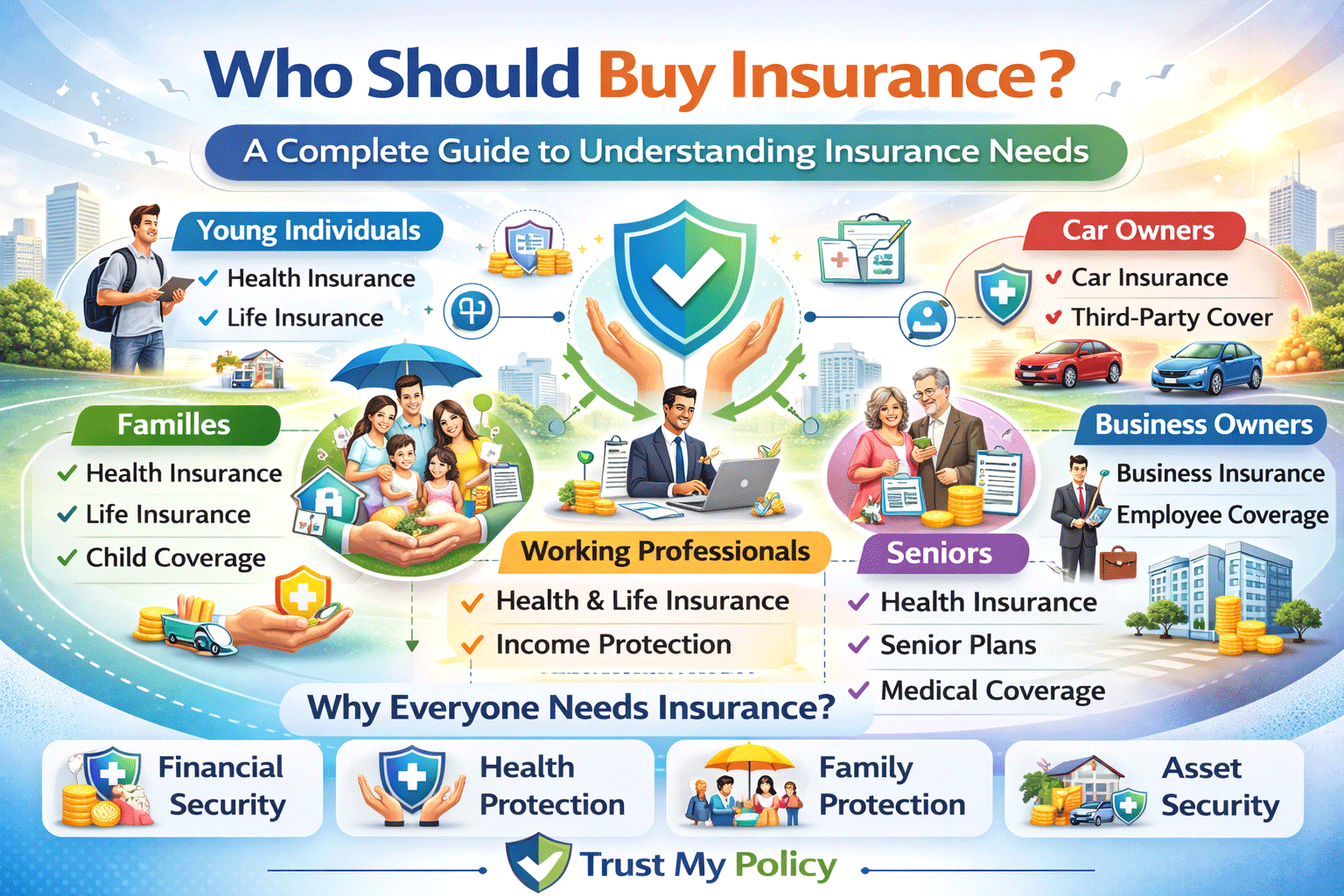
Nearly everyone should buy at least some core insurance: drivers need auto liability coverage, renters and homeowners need property coverage, anyone with a dependent or debt needs life insurance, and anyone without employer-provided coverage needs individual health insurance. The common thread isn’t age or wealth — it’s whether a single loss could create a financial gap you can’t absorb.
Ben Castillo, 22, figured insurance was for “people with families and mortgages,” not a single guy renting a small flat in Manchester with no car. Then a kitchen fire two doors down spread smoke and water damage into his flat, destroying $4,300 worth of electronics and furniture he had no way to replace out of pocket.
Who Should Buy Insurance in 2026 is a much longer list than most people assume — it includes renters with no assets to their name, young single drivers, freelancers without an employer plan, and anyone whose absence would create a financial gap for someone else. This guide breaks down exactly which insurance types apply to which life situations, so you stop assuming coverage is only for people further along in life than you.
This article covers who needs each core insurance type, the specific situations that make coverage essential, real scenarios with dollar amounts, and a clear checklist by life stage. By the end, you’ll know exactly where you fit.
| Feature | Details |
| What it is | Coverage matched to specific life situations rather than age or income alone |
| Who it applies to | Renters, drivers, parents, freelancers, homeowners, and dependents of any income earner |
| Typical starting cost | $15–$30/month for renters insurance; $25–$50/month for term life at younger ages |
| Coverage available | Property, liability, health, and income/life protection |
| Key benefit | Matches the cost of premiums to the real size of the risk being protected |
| Key limitation | People without obvious assets often wrongly assume they don’t need coverage |
| Regulator | State insurance departments (US); Financial Conduct Authority (UK) |
Most people picture insurance as something for homeowners with mortgages and parents with mouths to feed. That picture leaves out a huge number of people who are just as financially exposed — a renter with no savings, a single driver, a freelancer between contracts.
The real test for who should buy insurance isn’t age, marital status, or visible wealth. It’s whether a single event — a car accident, an apartment fire, a lawsuit, an illness, or your own death — would create a financial loss you or someone who depends on you couldn’t absorb. If the answer is yes, that’s your signal to buy.
| Criteria | Likely Needs Core Coverage | May Be Able to Skip (Case by Case) |
| Renters/homeowners insurance | Anyone renting or owning property with belongings to protect | Rare — even minimal belongings usually exceed the annual premium cost |
| Auto liability insurance | Anyone who drives, owns, or finances a vehicle | Legally required almost everywhere; skipping isn’t really an option |
| Life insurance | Anyone with a dependent, a partner, or significant debt | Single people with no dependents and no debt may have lower urgency |
| Health insurance | Anyone without employer or government-provided coverage | Those fully covered by an employer or public system like the NHS |
| Disability/income protection | Anyone relying on their own income to cover essential expenses | Those with substantial guaranteed income or savings cushion |
We recommend core coverage for most readers because the financial exposure in each category above is usually far larger than the premium required to protect against it.
Scenario 1: Ben, 22, renter in Manchester with no car or dependents. Ben assumed insurance wasn’t for him until a neighbor’s fire caused $4,300 in damage to his belongings. Verdict: even young, single renters carry real financial exposure. Action: Ben bought a renters policy for £9 a month within a week of the incident.
Scenario 2: Priya, 29, freelance designer in Austin with no employer health plan. Priya went two years without health coverage, assuming she was healthy enough to skip it, until a $7,800 emergency appendectomy bill arrived. Verdict: lacking employer coverage is itself a clear signal to buy individual coverage. Action: Priya now budgets for a marketplace health plan as a fixed monthly cost.
Scenario 3: Marcus, 34, father of two in Dallas with a $310,000 mortgage. Marcus assumed life insurance was something to “get around to” until a colleague his age died unexpectedly, leaving a family with no coverage. Verdict: anyone with dependents and debt has an urgent, not optional, need for life insurance. Action: Marcus applied for a $750,000 term policy within a month.
Scenario 4: A retired couple in Florida living on a fixed income with no dependents. They questioned whether they still needed life insurance once their mortgage was paid off and their children were financially independent. Verdict: their need for life insurance had genuinely decreased, while their need for health and long-term care coverage had increased. Action: they let their term life policy lapse and redirected the premium toward long-term care coverage.
| Pros | Cons |
| Matches your coverage to your actual financial exposure, not assumptions about age. | Requires an honest self-assessment that some people avoid doing. |
| Catches renters, freelancers, and single people who often wrongly skip coverage. | Coverage needs change over time, requiring periodic reassessment. |
| Helps prioritize spending on the highest-exposure risks first. | Some core coverage, like auto liability, is mandatory regardless of personal preference. |
| Encourages dropping coverage that’s genuinely no longer needed, like retirees’ term life. | Determining “enough” coverage takes more thought than buying a flat amount. |
| Reduces the chance of being financially blindsided by an uninsured loss. | Initial setup across multiple policy types can feel like a lot to organize at once. |
⚠️ WARNING: Never assume you’re too young, too single, or too asset-light to need insurance. Renters and single drivers without dependents still carry real, immediate financial exposure that a single event can turn into a serious loss.
| Your Situation | Our Recommendation |
| You rent and have never bought renters insurance | Yes — buy it now, premiums are low relative to your real exposure |
| You drive a car, financed or owned | Yes — auto liability coverage is mandatory almost everywhere |
| Someone depends on your income (partner, child, parent) | Yes — get life insurance now, ideally term life |
| You’re a freelancer or contractor without employer health coverage | Yes — budget for individual health insurance as a fixed cost |
| You’re single, debt-free, and no one depends on your income | No — life insurance is lower priority, though health and renters coverage usually still apply |
| You’re retired with no dependents and a paid-off mortgage | No — reassess whether life insurance is still needed; consider long-term care coverage instead |
| You own a small business with any customer-facing risk | Yes — liability insurance is essential, not optional |
💡 TIP: The single golden rule for deciding who should buy insurance: if a single bad event would create a financial hole you or your dependents couldn’t climb out of, you need coverage for it.
| Scenario | Typical Cost | Notes |
| Young renter, no dependents, renters insurance | $12–$20/month | Among the cheapest core policies available |
| Single driver, state-minimum auto liability | $40–$90/month | Varies significantly by state and driving record |
| Freelancer, individual health insurance | $150–$450/month | Varies by income, subsidy eligibility, and age |
| Parent of two, $500,000 term life policy | $25–$50/month | Lower cost while young and healthy |
| Homeowner, standard property insurance | $100–$180/month | Varies by home value and location risk |
| Small business owner, general liability insurance | $40–$120/month | Often the highest-value policy relative to lawsuit risk |
| Retiree, long-term care insurance | $150–$400/month | Often replaces the need for life insurance at this life stage |
Independent insurance brokers — Brokers can review your specific life situation and recommend coverage types you may not have considered. Cost range: typically free for the consumer. Best for: anyone unsure which policies actually apply to them. Rating: varies by broker, check state or FCA licensing.
Policygenius (US) — A comparison platform with calculators for life insurance needs based on income, debt, and dependents. Cost range: free to use. Best for: US shoppers wanting a quick needs estimate. Rating: independent comparison service.
Compare the Market (UK) — A UK comparison site covering renters, home, auto, and life insurance across multiple providers. Cost range: free to compare. Best for: UK shoppers assessing multiple coverage types at once. Rating: FCA-regulated comparison service.
NAIC consumer resources (US) — Publishes plain-language guidance on which insurance types apply to different life situations. Cost range: free public resource. Best for: US consumers wanting unbiased educational material. Rating: regulatory standards body.
Citizens Advice (UK) — Offers free, independent guidance on insurance needs across renting, driving, and family situations. Cost range: free. Best for: UK consumers wanting plain-language guidance. Rating: independent charity.
We recommend starting with an independent broker as best overall because a short conversation about your specific life situation is the fastest way to identify real gaps in your coverage.
Nearly everyone should carry some core coverage: drivers need auto liability insurance, renters and homeowners need property coverage, and anyone with dependents or debt needs life insurance.
Not urgently in most cases, though it can still make sense if you have debt that would burden a co-signer or family member, or if you want to lock in a low rate while young.
Yes. Most renters underestimate the total replacement value of their belongings, and renters insurance is typically inexpensive relative to that exposure.
List your specific exposures — dependents, debt, property, driving, and income — and match each one to the insurance type designed to cover that exact risk.
Yes, especially health insurance, since freelancers don’t have an employer plan and face the same medical cost exposure as anyone else.
Often less so. Many retirees with no dependents reduce or drop life insurance and redirect that budget toward health or long-term care coverage instead.
No. Most US states and the UK require minimum liability coverage for any vehicle that’s owned, financed, or driven, regardless of how often you use it.
Yes, particularly if they expect to take on dependents or debt later, since locking in a policy while young and healthy secures a lower long-term rate.
Yes, in most cases, since even a small business can face a lawsuit that exceeds years of premium costs many times over.
Reassess after every major life change — a new job, relationship, child, home, or retirement — since each shifts who depends on you and what you need protected.
This guide reflects the latest 2026 insurance data.
This article is for informational purposes only. Always consult a licensed insurance professional before making coverage decisions. Trust My Policy does not sell insurance products or represent any insurer.

Jagadeesh Gutha is the founder of TrustMyPolicy.com, an independent insurance information platform covering life, health, car, home, and business insurance for US and UK readers. He researches insurance products, policy structures, and consumer rights to help everyday people make informed coverage decisions without the jargon. All content on TrustMyPolicy is independently researched, fact-checked, and written to educate — not to sell.



Insurance Guides for UK, USA & Worldwide We are not an insurer or broker.

Reader Comments (0)