
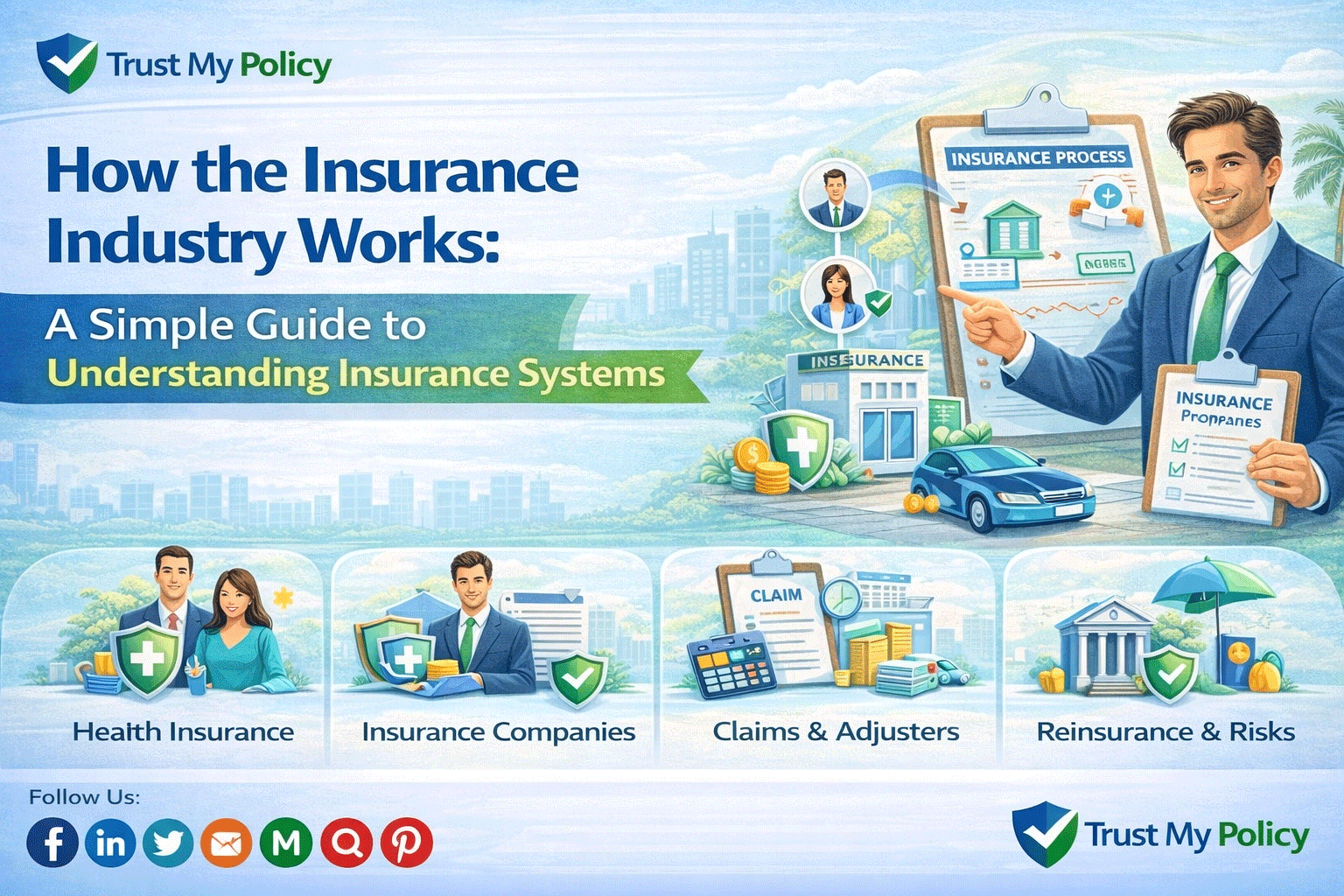
The insurance industry works through a chain of connected players: brokers and agents who help consumers buy policies, insurers who collect premiums and pay claims, reinsurers who insure the insurers against catastrophic losses, and regulators who oversee the system’s stability. According to AM Best, US property and casualty insurers reported $89 billion in investment profit in 2024, much of it supported by this layered structure.
Lauren Ashby, 35, runs a small marketing agency in London and was confused when her broker mentioned “reinsurance” after a particularly high quote for her business policy. She’d never heard of an insurer buying insurance for itself, and assumed her premium only ever flowed in one direction — straight to her insurance company.
How the Insurance Industry Works in 2026 involves far more players than just you and your insurer. Behind every policy sits a chain that includes brokers and agents who help you buy coverage, insurers who underwrite and pay claims, reinsurers who insure the insurers against catastrophic losses, and regulators who oversee the entire system. This guide breaks down exactly how each part of that chain functions and how they connect.
This article covers the full structure of the insurance industry, how each player fits together, real scenarios showing the chain in action, and what this means for you as a policyholder. By the end, you’ll understand the system behind every policy you hold.
| Feature | Details |
| What it is | A layered system of brokers, insurers, reinsurers, and regulators working together |
| Who’s involved | Brokers/agents, insurers, reinsurers, regulators, and policyholders |
| Typical industry scale | US insurers held nearly $9 trillion in invested assets as of 2024, per the NAIC |
| Key benefit | Spreads catastrophic risk across multiple layers so no single failure collapses the system |
| Key limitation | Multiple layers can make pricing and claims processes feel opaque to consumers |
| Regulator | State insurance departments (US); Financial Conduct Authority and PRA (UK) |
Most people picture the insurance industry as a single company taking their premium and occasionally paying a claim. The real structure looks more like a relay race, where your premium passes through several specialized runners — each with a distinct job — before the system as a whole is able to absorb a major loss.
The insurance industry is a layered system involving brokers and agents who help consumers and businesses choose policies, insurers who underwrite risk and pay claims, reinsurers who provide insurance to the insurers themselves for catastrophic losses, and regulators who oversee solvency and fair practices across the whole chain. Anyone buying insurance, working in the industry, or simply trying to understand a confusing premium increase benefits from seeing this full structure.
| Criteria | Primary Insurers | Reinsurers |
| Who they insure | Individual policyholders and businesses | Other insurance companies |
| Customer-facing | Yes, directly sells policies to consumers | No, operates behind the scenes |
| Role in a major disaster | Pays claims directly to policyholders | Reimburses the primary insurer for catastrophic losses |
| Pros | Familiar, accessible point of contact for consumers | Allows primary insurers to take on larger risks safely |
| Cons | Limited capacity to absorb truly catastrophic losses alone | Adds a layer of cost passed through to consumer premiums |
We recommend most readers understand both layers exist, since reinsurance is a major reason your insurer can promise to pay a six- or seven-figure claim without risking its own solvency.
Scenario 1: Lauren, 35, marketing agency owner in London. Lauren learned her business insurer purchased reinsurance specifically to protect against the kind of catastrophic claim her own policy could theoretically trigger. Verdict: reinsurance exists precisely to make her own coverage more reliable, not less. Action: Lauren now sees her premium as partly funding this broader, more resilient system.
Scenario 2: A homeowner in Florida after a major hurricane caused billions in regional damage. Her insurer was able to pay her full claim despite the scale of regional losses because it had purchased substantial reinsurance coverage in advance. Verdict: reinsurance is what allows individual insurers to survive disasters that would otherwise overwhelm them. Action: she asked her insurer directly about its reinsurance and capital strength before renewing.
Scenario 3: A small business owner in Texas who used an independent broker instead of buying directly from one insurer. The broker compared quotes across five different insurers and found coverage 18% cheaper than the business owner’s previous direct-purchase renewal. Verdict: brokers can access options a single insurer’s direct sales team won’t offer. Action: the business owner now uses the broker for every renewal rather than going direct.
Scenario 4: A consumer in the UK confused about why the Financial Conduct Authority doesn’t directly handle individual claims. They learned the FCA regulates industry practices and insurer conduct, while the Financial Ombudsman Service handles individual consumer disputes. Verdict: regulators and dispute-resolution bodies serve different functions within the industry. Action: the consumer escalated their specific claim dispute to the Ombudsman after their insurer’s internal appeal was denied.
| Pros | Cons |
| Reinsurance allows individual insurers to safely take on catastrophic risks. | The layered structure can make pricing and claims feel opaque to consumers. |
| Brokers can compare multiple insurers to find better coverage or pricing. | Using an agent tied to one insurer limits your comparison options. |
| Regulators provide oversight that protects policyholders’ ability to be paid. | Regulatory complaint processes can take time to resolve a dispute. |
| The system as a whole is more resilient to large-scale disasters than any single insurer alone. | Reinsurance costs are ultimately passed through to consumer premiums to some degree. |
| Multiple layers of capital reserves protect against insurer insolvency. | Understanding the full chain takes more effort than simply trusting a single company. |
⚠️ WARNING: Never assume any licensed insurer is automatically financially capable of paying a major claim. Check independent financial strength ratings, since reinsurance backing and capital reserves vary meaningfully between companies.
| Your Situation | Our Recommendation |
| You’re buying a policy for the first time | Yes — consider using an independent broker to compare multiple insurers |
| You’re unsure if your insurer has strong reinsurance backing | Yes — check its AM Best or Defaqto financial strength rating before committing |
| Your claim was denied and you’ve exhausted your insurer’s internal appeal | Yes — escalate to the relevant ombudsman or state regulator complaint process |
| You’re choosing between a direct insurer and a broker-sourced quote | Yes — compare both, since pricing can differ meaningfully |
| You assume regulators will resolve your specific claim dispute | No — use the dedicated consumer dispute body for case-specific issues instead |
| You’re a business owner with complex or large-scale risk | Yes — ask your broker specifically about the insurer’s reinsurance capacity |
| You’re satisfied with your current insurer’s claims history | No further action needed — continued monitoring of financial ratings is still wise |
💡 TIP: The single golden rule for understanding the industry: your premium supports a much larger chain than just one company, so checking an insurer’s financial strength rating tells you more about its real ability to pay than its size or advertising alone.
| Scenario | Cost Impact | Notes |
| Insurer with strong reinsurance backing in a catastrophe-prone region | Often a modest premium increase | Reflects the cost of reinsurance passed through to policyholders |
| Insurer with weak reinsurance backing in the same region | Risk of insolvency after a major event | Lower upfront premium can carry higher long-term risk |
| Broker-sourced auto insurance quote | Often comparable or lower than direct-to-consumer pricing | Brokers can access multiple insurers’ rates |
| Direct-to-consumer digital insurer | Sometimes lower overhead costs reflected in pricing | Limited to that single company’s products only |
| US state guaranty fund assessment (industry-wide) | Indirect cost spread across all policyholders | Funds protection if an individual insurer becomes insolvent |
| UK Financial Services Compensation Scheme coverage | Indirect cost built into industry-wide pricing | Protects policyholders if a UK insurer fails |
| Global reinsurance capacity shifts after major disasters | Can raise primary insurance premiums industry-wide | Reflects rising reinsurance costs passed down the chain |
Munich Re — One of the world’s largest reinsurers, providing capacity that allows primary insurers to absorb catastrophic losses. Cost range: not retail-facing. Best for: understanding how large-scale risk gets distributed globally. Rating: AM Best A+.
Swiss Re — Another major global reinsurer working behind the scenes with primary insurers across multiple countries. Cost range: not retail-facing. Best for: understanding the global reinsurance market’s scale. Rating: AM Best A+.
Independent insurance brokers — Compare multiple insurers on your behalf, often accessing better rates than direct purchase. Cost range: typically free for the consumer. Best for: anyone wanting to compare coverage and pricing across several insurers. Rating: varies by broker, check state or FCA licensing.
State insurance departments (US) — Regulate insurer solvency and consumer protections at the state level. Cost range: free to contact. Best for: US consumers with regulatory or compliance questions. Rating: government regulatory body.
Financial Conduct Authority and Financial Ombudsman Service (UK) — Regulate UK insurer conduct and resolve individual consumer disputes, respectively. Cost range: free for consumers. Best for: UK consumers navigating regulatory or dispute issues. Rating: government regulatory body and independent ombudsman.
We recommend working with an independent broker as best overall starting point because they sit closest to the consumer-facing side of this entire chain and can translate the industry’s structure into a practical recommendation for your specific situation.
The insurance industry works through a chain of brokers and agents who help consumers buy coverage, insurers who underwrite risk and pay claims, reinsurers who insure the insurers against catastrophic losses, and regulators who oversee the system’s stability.
Reinsurance is insurance purchased by insurance companies themselves, allowing them to safely take on large or catastrophic risks without risking their own solvency.
A broker typically represents multiple insurers and compares options on your behalf, while an agent usually represents one specific insurance company directly.
In the US, state insurance departments regulate insurers; in the UK, the Financial Conduct Authority and Prudential Regulation Authority oversee insurer conduct and solvency.
Many countries have a backstop system, like US state guaranty funds or the UK’s Financial Services Compensation Scheme, designed to protect policyholders if an insurer fails.
It depends. Brokers can often access multiple insurers and competitive rates, while direct-to-consumer insurers sometimes offer lower overhead-driven pricing, so comparing both is worthwhile.
Large disasters can raise global reinsurance costs, which primary insurers then pass through to policyholders as higher premiums across the wider market.
Check independent financial strength ratings like AM Best in the US or Defaqto in the UK, which assess an insurer’s capital reserves and reinsurance backing.
Not usually directly. Most countries have a separate consumer dispute body, like the Financial Ombudsman Service in the UK, specifically for individual claim disputes.
Your premium supports the broader risk pool, the insurer’s reinsurance purchases, and the regulatory system that keeps the entire industry solvent and accountable.
This guide reflects the latest 2026 insurance data.
This article is for informational purposes only. Always consult a licensed insurance professional before making coverage decisions. Trust My Policy does not sell insurance products or represent any insurer.

Jagadeesh Gutha is the founder of TrustMyPolicy.com, an independent insurance information platform covering life, health, car, home, and business insurance for US and UK readers. He researches insurance products, policy structures, and consumer rights to help everyday people make informed coverage decisions without the jargon. All content on TrustMyPolicy is independently researched, fact-checked, and written to educate — not to sell.




Insurance Guides for UK, USA & Worldwide We are not an insurer or broker.
Reader Comments (1)
[…] solvency refers to an insurer’s ability to meet its financial obligations, especially future claims, over time. Regulators […]