
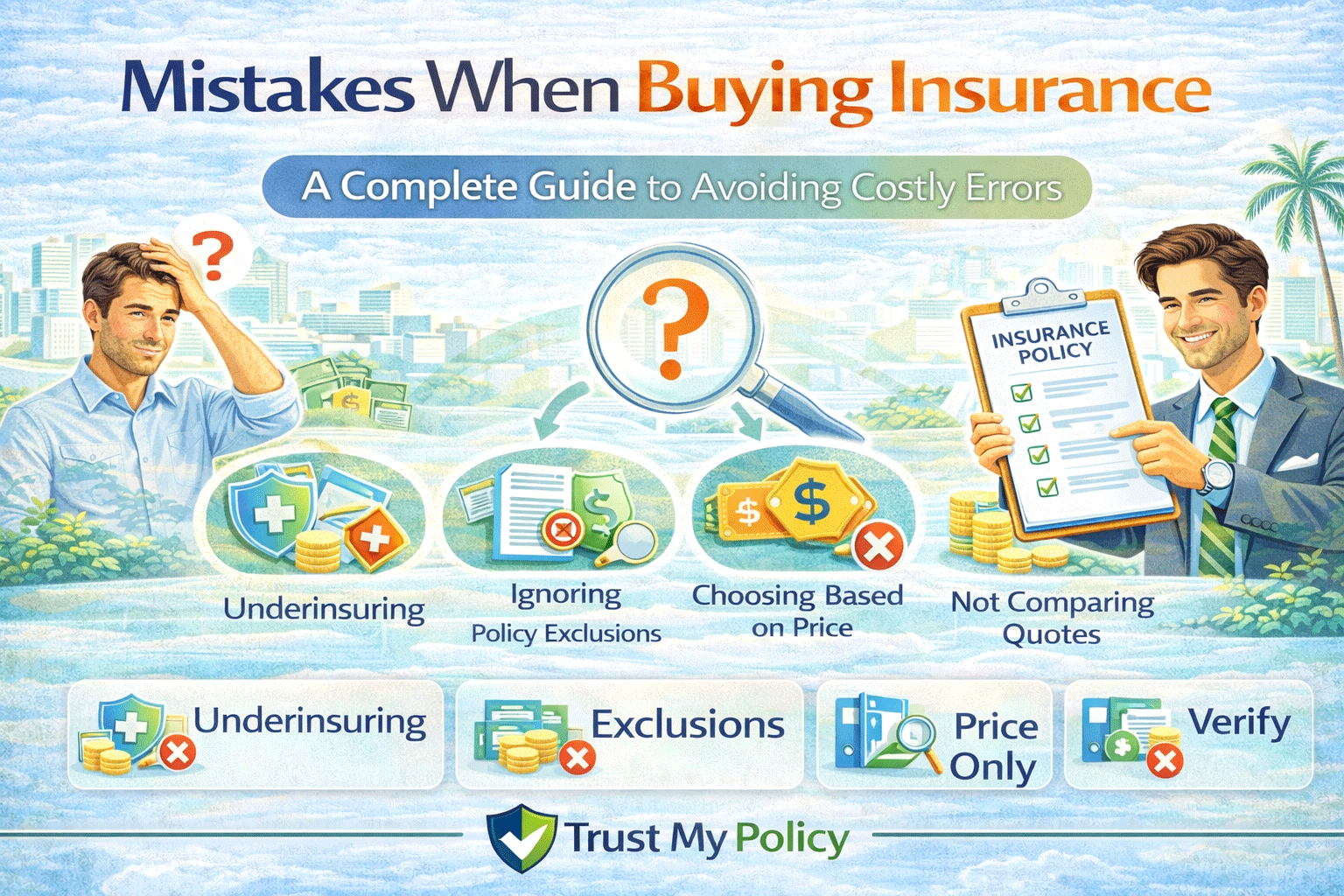
The most common mistakes when buying insurance are focusing only on premium price, underinsuring to save money, skipping the exclusions section, choosing a deductible you can’t afford, and not comparing multiple insurers. Any one of these can cost thousands of dollars more than the premium savings during an actual claim.
Greg Lawson, 47, switched his home insurer in Atlanta to save $300 a year, only to discover after a storm claim that his new policy had a $5,000 wind and hail deductible instead of his old flat $1,000 deductible. The “savings” cost him $4,000 extra out of pocket on his very first claim.
Mistakes When Buying Insurance in 2026 usually happen at the comparison stage, not the claims stage — people focus on premium price while missing deductibles, coverage limits, and exclusions that matter far more during an actual loss. This guide walks through the 10 most common, most expensive mistakes buyers make and exactly how to avoid each one.
This article covers the costliest buying mistakes, why each one happens, real scenarios showing the financial impact, and a clear checklist to use before your next purchase or renewal. By the end, you’ll know exactly what to double-check before you buy.
| Feature | Details |
| What it is | The recurring errors buyers make when purchasing or renewing insurance |
| Who it affects | Anyone buying health, auto, home, or life insurance |
| Typical cost of a mistake | $1,000–$50,000+ in unexpected out-of-pocket exposure |
| Most common mistake | Comparing premium price without matching coverage limits |
| Key benefit (of avoiding mistakes) | Full, reliable coverage when an actual loss happens |
| Key limitation | Many mistakes aren’t discovered until claim time, when it’s too late to fix |
| Regulator | State insurance departments (US); Financial Conduct Authority (UK) |
Most insurance mistakes happen the same way diet mistakes happen — not from a single bad decision, but from defaulting to the easiest option under time pressure. Buying insurance often gets squeezed into a few rushed minutes during a move, a new car purchase, or an auto-renewal email, which is exactly when the costliest shortcuts get taken.
These mistakes are recurring errors in how people compare, select, and maintain insurance policies, usually driven by prioritizing speed and price over coverage accuracy. Anyone buying a new policy, switching insurers, or auto-renewing an existing one needs to understand these patterns, since most of them are easy to avoid once you know to look for them.
| Criteria | Rushed Buying | Careful Buying |
| Typical time spent | Minutes | 30–60 minutes across multiple quotes |
| Comparison basis | Premium price alone | Price, deductible, limits, and exclusions together |
| Risk of underinsurance | High | Low |
| Pros | Fast | Avoids expensive coverage gaps |
| Cons | Frequently misses critical coverage gaps | Takes more upfront time and effort |
We recommend careful buying for most readers because the time invested upfront is consistently smaller than the financial cost of a coverage gap discovered during a real claim.
Scenario 1: Greg, 47, homeowner in Atlanta. Greg switched insurers to save $300 a year and ended up with a $5,000 wind and hail deductible instead of his previous $1,000 flat deductible. Verdict: his “savings” cost him $4,000 extra on his first storm claim. Action: Greg switched back to a flat-deductible policy at renewal despite the higher premium.
Scenario 2: Nina, 33, who let her life insurance lapse over a missed payment notice. Nina missed a renewal email and her 15-year-old policy lapsed without her noticing for two months. Verdict: reapplying at her current age and health meant a meaningfully higher premium than her lapsed policy. Action: Nina now uses autopay and a calendar reminder to prevent any future lapse.
Scenario 3: A small business owner in Texas who under-declared annual revenue to lower a liability premium. A claim review revealed the discrepancy, and the insurer reduced the payout proportionally. Verdict: misrepresenting risk factors to save on premium backfired significantly at claim time. Action: the owner now reports accurate revenue figures every renewal, even though it raised the premium.
Scenario 4: A UK driver who didn’t declare a modified exhaust on their car insurance. After an accident, the insurer voided the claim for non-disclosure of a relevant vehicle modification. Verdict: omitting a known detail to keep the premium low cost the driver the entire payout. Action: the driver now discloses every modification upfront, even minor ones, on every renewal.
| Pros | Cons |
| Full, reliable coverage when you actually need to file a claim. | Requires more time and effort during the buying process. |
| Avoids expensive surprises like unexpected deductibles or sub-limits. | Sometimes results in a higher premium than the cheapest available quote. |
| Protects against voided claims from misrepresentation or non-disclosure. | Requires gathering accurate information, like income or vehicle modifications. |
| Builds a habit of re-shopping coverage, often finding genuine savings elsewhere. | Comparing exclusions and limits across insurers takes deliberate effort. |
| Reduces the risk of a lapsed policy at the worst possible moment. | Setting up autopay and reminders requires a small amount of upfront setup. |
⚠️ WARNING: Never omit or misrepresent a known risk factor — undisclosed modifications, inaccurate income, or pre-existing conditions — to lower your premium. Insurers can void your entire claim, not just reduce it, once non-disclosure is discovered.
| Your Situation | Our Recommendation |
| You’re about to choose the cheapest quote without checking coverage | No — match coverage limits first, then compare price |
| You’re unsure if you could pay your chosen deductible in cash | No — lower the deductible even if it raises your premium |
| You haven’t disclosed a known risk factor to lower your premium | No — disclose accurately, even if it costs more |
| You missed a renewal payment notice recently | Yes — set up autopay and a calendar reminder immediately |
| You’ve had a major life change since your last review | Yes — re-shop and reassess your coverage now |
| You’re considering an add-on offered at checkout | No — check its real payout likelihood before buying |
| You’ve only gotten one quote so far | Yes — get at least two more before deciding |
💡 TIP: The single golden rule for avoiding buying mistakes: compare coverage limits and deductibles before price, since the cheapest quote is often cheap because it covers less.
| Scenario | Mistake | Real-World Cost Impact |
| Switching home insurers for a $300 savings | Hidden higher peril deductible | $4,000+ extra out of pocket on a single claim |
| Choosing liability-only auto coverage | Misunderstanding what’s covered | Full repair or replacement cost of your own vehicle |
| Letting a life insurance policy lapse | Missed payment notice | Reapplying at an older age can raise premiums 20%–50%+ |
| Under-declaring business revenue for lower premium | Misrepresentation | Proportionally reduced claim payout when discovered |
| Not disclosing a vehicle modification | Non-disclosure | Entire claim voided after an accident |
| Buying an extended warranty on a low-failure-rate item | Low-value add-on | $200–$300 spent with a low chance of any payout |
| Underinsuring a home’s dwelling coverage | Wrong rebuild cost estimate | $20,000–$60,000+ rebuild gap after a total loss |
NerdWallet — A free US comparison platform that flags common coverage gaps alongside price comparisons. Cost range: free to use. Best for: US buyers wanting a side-by-side coverage and price check. Rating: independent comparison service.
Compare the Market (UK) — A leading UK comparison platform showing policy features and exclusions alongside price. Cost range: free to use. Best for: UK buyers wanting feature-level comparisons before purchasing. Rating: FCA-regulated comparison service.
Your state insurance department (US) — Most US states publish free consumer guides and insurer complaint ratios to check before buying. Cost range: free. Best for: verifying an insurer’s claims-handling reputation. Rating: government regulatory resource.
An independent insurance broker — A licensed broker can review your specific exposure and flag gaps a direct-to-consumer quote might miss. Cost range: usually free for the consumer, paid by insurer commission. Best for: complex situations like business or high-value home coverage. Rating: varies by broker, check state or FCA licensing.
AM Best / Defaqto — Independent rating agencies confirming an insurer’s financial strength and product quality before you commit. Cost range: free to check ratings. Best for: anyone buying a long-term policy like life insurance. Rating: independent rating agencies.
We recommend speaking with an independent broker as best overall for any high-stakes purchase like home or business insurance, because a second set of eyes catches gaps that direct-to-consumer comparison tools sometimes miss.
The most common mistakes are comparing premium price without matching coverage, choosing an unaffordable deductible, skipping exclusions, misrepresenting risk factors, and not comparing multiple insurers.
Costs vary widely, but underinsurance or a voided claim from non-disclosure can cost anywhere from a few thousand dollars to tens of thousands more than any premium savings.
Price is the easiest figure to compare quickly, while coverage limits and exclusions require more time and effort to evaluate properly.
Not always, but only if you’ve first confirmed the cheaper quote has matching coverage limits, deductibles, and exclusions compared to other options.
Yes. Insurers can void a claim entirely, not just reduce it, once they discover a material misrepresentation like undisclosed modifications or inaccurate income.
Set up autopay for every policy and add a separate calendar reminder a few days before each renewal date as a backup check.
Yes. Moving, marriage, having a child, or a significant income change are all common triggers for needing different coverage limits or policy types.
For complex situations like business insurance or high-value homes, yes, since a broker can flag coverage gaps a direct comparison tool might miss.
Many products have low failure rates within the warranty period, meaning the premium paid often exceeds the realistic expected payout.
Re-check every renewal at minimum, and immediately after any major life or financial change.
This guide reflects the latest 2026 insurance data.
This article is for informational purposes only. Always consult a licensed insurance professional before making coverage decisions. Trust My Policy does not sell insurance products or represent any insurer.

Jagadeesh Gutha is the founder of TrustMyPolicy.com, an independent insurance information platform covering life, health, car, home, and business insurance for US and UK readers. He researches insurance products, policy structures, and consumer rights to help everyday people make informed coverage decisions without the jargon. All content on TrustMyPolicy is independently researched, fact-checked, and written to educate — not to sell.



Insurance Guides for UK, USA & Worldwide We are not an insurer or broker.

Reader Comments (0)