
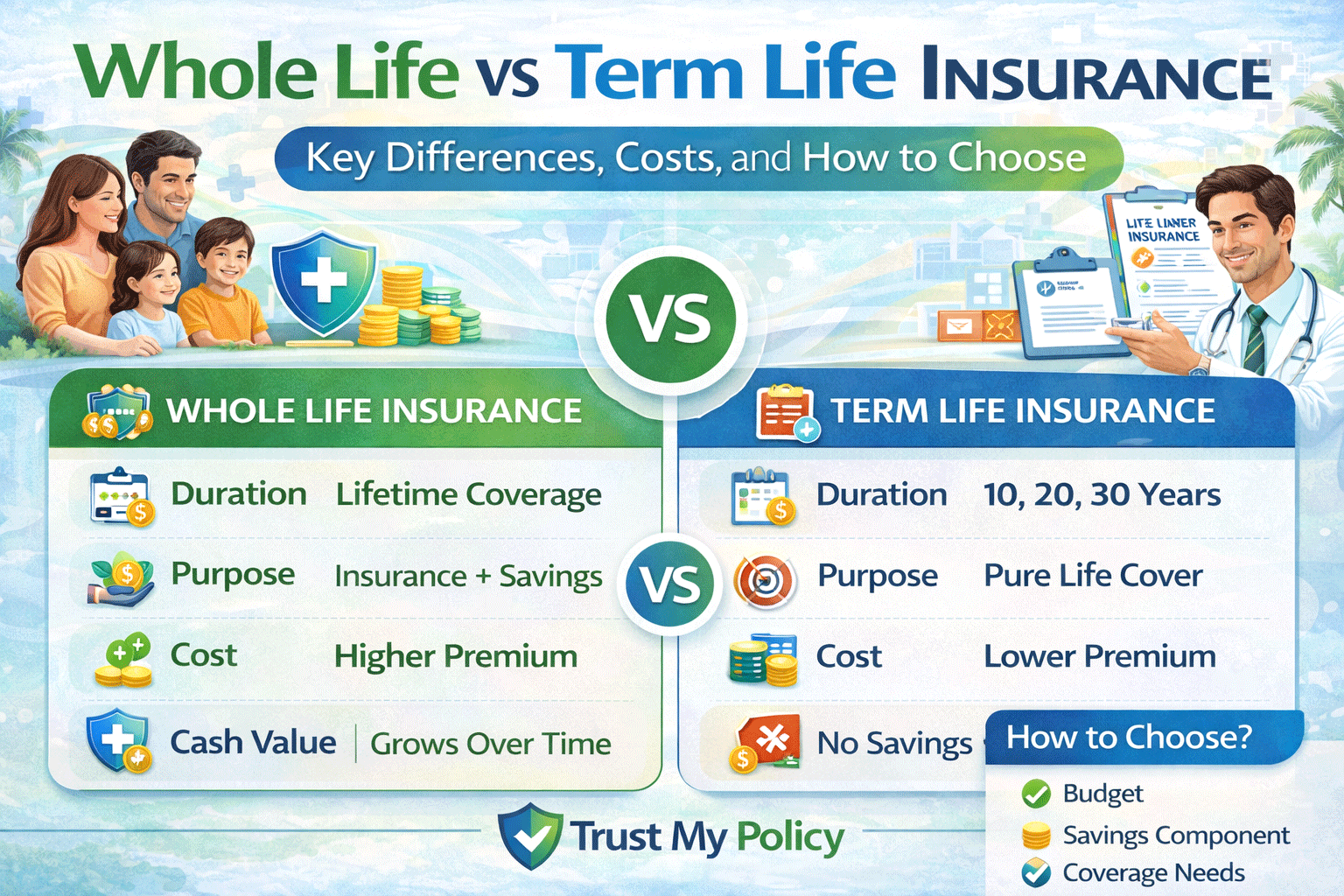
Term life insurance covers you for a fixed period — 10, 20, or 30 years — and pays the death benefit only if you die within that term. A healthy 40-year-old pays an average of $53/month for $500,000 over 20 years (MoneyGeek 2026). Whole life insurance covers you for your entire lifetime, builds guaranteed cash value, and pays a death benefit whenever you die. It costs 10-15 times more than term. For most families with a mortgage and dependants, term life is the right first choice. Whole life makes financial sense only in specific estate planning, business protection, and permanent coverage scenarios.
Daniel, a 34-year-old accountant from Manchester, sat with a life insurance broker in early 2026 and expected a quick decision. The broker showed him two options: a 25-year term policy at £28/month for £500,000 cover, or a whole of life policy at £320/month for the identical sum assured. Daniel asked the obvious question — why would he pay 11 times more? The broker talked about cash value and lifetime protection. Daniel left confused and bought nothing. Three months later, his wife was pregnant, their mortgage stood at £380,000, and he still had zero life insurance.
Whole life vs term life insurance in 2026 is one of the most important financial decisions any family makes — and one of the most confusing, because both products carry the same name yet solve entirely different problems. According to MoneyGeek 2026, a 40-year-old non-smoker pays an average of $53/month for $500,000 of 20-year term life insurance versus $557/month for the same $500,000 of whole life — a 951% price difference. That gap is not just markup: whole life builds guaranteed cash value and covers you for life. But for most working families with a mortgage and young children, term life delivers 10 times more protection per dollar during the years that matter most.
In this guide you will learn exactly what each policy covers and excludes, a full 2026 cost comparison by age from MoneyGeek and InsuranceGeek data, when whole life genuinely makes financial sense, the buy-term-and-invest-the-difference calculation with real numbers, four real-life scenarios showing which product wins for each household type, and the five most expensive mistakes people make when choosing between them.
| Feature | Term Life Insurance | Whole Life Insurance |
| Coverage period | Fixed term — 10, 15, 20, or 30 years | Permanent — covers you for your entire lifetime |
| Death benefit paid | Only if you die within the policy term | Guaranteed — paid whenever you die, no time limit |
| Cash value component | None | Yes — grows at guaranteed rate; accessible via loans |
| Average monthly cost — age 40, $500k (MoneyGeek 2026) | $53/month (term, 20-year) | $557/month (whole life) |
| Cost multiplier | Baseline | 10.5 times more expensive than term |
| Premiums change over time | Fixed for the full term length chosen | Fixed for life — locked at the age you buy |
| Expiry risk | Yes — coverage ends if you outlive the term | No — guaranteed coverage for life |
| Cash value access | None | Policy loans, withdrawals, or full surrender |
| Best for | Families, mortgages, income replacement during working years | Estate planning, business buy-sell, permanent needs |
| Regulated by | State DOI (US); FCA / PRA (UK); IRDAI (India) | State DOI (US); FCA / PRA (UK); IRDAI (India) |
Term life insurance is the simplest, most affordable form of life cover. You choose a coverage amount — for example $500,000 or £500,000 — and a policy term: 10, 20, or 30 years. If you die within that term, your beneficiaries receive the full death benefit tax-free. If you outlive the term, the policy expires with no payout and no cash value returned. Coverage simply ends.
Think of term life like motor insurance. You pay every year to protect against a risk. If no claim occurs, you receive no refund at renewal — and most people do not consider their motor insurance a waste because they did not crash. The same logic applies to term life: the premium buys protection for the period you need it most.
Term life is designed to cover you during the years when others most depend on your income — while your children are young, while your mortgage is outstanding, while your business partners rely on your contribution. According to Insurance By Heroes 2026, only 1-2% of term life policies ever result in a death claim, which is precisely why term premiums are so low. The insurer prices the statistical probability of payout over the term, and for most healthy applicants that probability is low.
For guidance on how much term life cover you need for your mortgage and family situation life insurance vs health insurance — what you need and when in 2026
Whole life insurance is a permanent policy covering you for your entire lifetime. It has two components working simultaneously: the death benefit — paid to your beneficiaries whenever you die, guaranteed, with no time limit — and the cash value — a savings element that grows inside the policy at a guaranteed minimum rate, typically 2-4% per year, plus potential dividend payments from participating mutual insurers.
Every whole life premium payment is split between the cost of insurance and the cash value account. Over 20-30 years the cash value can grow into a significant sum. You can borrow against it through a policy loan without a credit check or tax consequences. You can withdraw from it. If you choose to surrender the policy entirely, you receive the accumulated cash value minus any outstanding loans and surrender charges.
The critical trade-off is cost. According to InsuranceGeek’s 2026 MassMutual data, a 40-year-old male pays $386.50/month for $250,000 of whole life coverage versus just $17.17/month for a comparable 20-year term policy — a 22.5 times difference for the identical death benefit amount. That premium gap funds two things: the permanent coverage guarantee and the cash value accumulation. Whether that gap is worth paying depends entirely on why you need life insurance.
For a complete comparison of whole life, universal life, and variable life insurance types types of permanent life insurance explained — whole life, universal life, and variable life in 2026
| Criteria | Term Life | Whole Life |
| Monthly premium — age 30, $500k (NerdWallet 2026) | $18-$22/month | $400-$570/month |
| Monthly premium — age 40, $500k (MoneyGeek 2026) | $53/month (female $47) | $557/month (female approx $500) |
| Monthly premium — age 50, $500k (estimated) | $130-$160/month | $800-$1,100/month |
| MassMutual data — age 40 male, $250k (InsuranceGeek 2026) | $17.17/month (term) | $386.50/month (whole life) — 22.5x more |
| UK — age 34, £500k, 25-year term | £28/month (estimated) | £280-£350/month (estimated) |
| Coverage duration | 10-30 year fixed term | Lifetime — no expiry |
| Cash value | None | Grows at 2-4% guaranteed + potential dividends |
| Death benefit guarantee | Only within the term | Guaranteed at any age |
| Tax treatment (US) | Death benefit tax-free to beneficiaries | Death benefit tax-free; cash value loans tax-free; gains on surrender may be taxable |
| Tax treatment (UK) | Death benefit paid free of income tax; may form part of estate for IHT | Same — place in trust to remove from estate for IHT purposes |
| Employer-sponsored option | Common — group term life at 1-4x salary, often free | Rarely employer-sponsored |
| Convertibility | Most term policies include a conversion option to permanent coverage without new medical exam | Already permanent — no conversion needed |
We recommend term life for the vast majority of readers. The cost difference is so substantial that term life plus disciplined investing of the premium difference outperforms whole life financially in most scenarios. Whole life is appropriate in the specific circumstances set out in the decision table and scenarios below.
This is the analysis most whole life articles skip entirely. It shows whether whole life’s cash value accumulation justifies the premium gap versus simply buying cheaper term life and investing what you save.
Example — 40-year-old male, $500,000 coverage, 20-year horizon:
Option A — Whole Life: $557/month premium. Cash value grows at approximately 3-4% guaranteed plus dividends from a participating mutual insurer.
Option B — Term + Invest: $53/month term premium. Remaining $504/month invested in a low-cost S&P 500 index fund at the historical 7% average annual return.
After 20 years — Option A whole life cash value: approximately $140,000-$180,000. Option B investment portfolio at 7% on $504/month over 20 years: approximately $265,000-$275,000.
Result: buying term and investing the difference generates roughly $90,000-$130,000 more than whole life cash value over 20 years — assuming the 7% historical index return holds.
Where whole life wins the calculation: if the policyholder dies in year 2, both term and whole life pay $500,000 as the death benefit. The investment portfolio at that point is only $12,000-$15,000. The cash value argument only outperforms the term-plus-invest strategy if (a) the policyholder lives long enough for cash value to accumulate significantly AND (b) investment returns fall below 4% annually. For most disciplined investors in diversified index funds, neither condition holds.
The case for whole life is not investment returns — it is permanence, guaranteed insurability, and specific estate or business needs that term cannot structurally solve. Those cases are real. They are simply not the majority of life insurance buyers.
Scenario 1: Daniel, 34, Accountant — Young Family, Large Mortgage (UK)
Daniel has a £380,000 mortgage, a pregnant wife, and a £65,000 salary his family depends on entirely. He needs income replacement and mortgage protection for the next 25 years. Term option: £28/month for £500,000 over 25 years. Whole life option: £320/month for £500,000 permanent. Annual premium difference: £3,504. If Daniel invests £3,504 per year for 25 years at 6% return, he accumulates approximately £196,000. The whole life policy’s cash value after 25 years: approximately £85,000-£110,000. Term plus invest outperforms whole life by £86,000-£111,000. Verdict: Term life is the clear winner. Daniel should buy the 25-year term today — his family’s mortgage and income protection are the immediate priority. Whole life is a conversation for when the mortgage is smaller and cash flow is stronger.
Scenario 2: The Krishnamurthy Family — High Net Worth Estate Planning (US)
The Krishnamurthys have a net estate of $7.8 million. Under current federal estate tax law, anything above the $13.61 million exemption (2024 — check current IRS thresholds as these change) is taxed at 40%. Their attorney has identified a $2.2 million potential estate tax liability when both spouses die. They purchase a $2.5 million joint-life second-to-die whole life policy at $3,200/month. The death benefit funds the estate tax without forcing the children to liquidate assets. Term life cannot solve this — the estate tax liability is permanent, not time-limited. Verdict: Whole life is the structurally correct product for permanent, large-scale estate tax planning. Term creates a gap risk that is unacceptable in this context.
Scenario 3: Marcus, 55, Business Owner — Buy-Sell Agreement (US)
Marcus co-owns a manufacturing business valued at $3 million with one partner. Their buy-sell agreement obligates the surviving partner to purchase the deceased partner’s share. Each partner needs $1.5 million in coverage. At 55, a 20-year term policy costs $380/month — but the buy-sell obligation does not expire in 20 years. If Marcus lives past 75, the term policy lapses and his estate has no funded mechanism to transfer his business interest. A whole life policy at $2,100/month provides permanent coverage matching the permanent obligation. Verdict: Whole life is the right product for permanent business obligations. Term creates a coverage expiry risk precisely when it is most likely to be needed.
Scenario 4: Priya, 27, IT Professional — Healthy, Long Horizon (India/US)
Priya is 27, healthy, single, and considering whole life now to lock in her young healthy rates before her health potentially changes. A $500,000 whole life policy at 27 costs approximately $260/month — significantly cheaper than the same policy at 37 ($390/month). The 10-year premium saving over 30 years: $47,000. However, the same $500,000 term policy at 27 costs $18/month. The $242/month difference invested at 7% for 30 years accumulates to approximately $290,000 — versus approximately $170,000-$200,000 whole life cash value over the same period. Verdict: Even buying at 27 to lock in healthy rates, term plus investing the difference outperforms whole life by approximately $90,000-$120,000 over 30 years. Priya should buy a 30-year term when she has dependants and invest the difference.
| Pros of Term Life | Cons of Term Life | Pros of Whole Life | Cons of Whole Life |
| Dramatically lower cost — 10-15x cheaper than whole life for identical coverage amount | Coverage expires at term end — if you outlive it, no payout and no cash value returned | Guaranteed death benefit regardless of when you die — no expiry risk at any age | Costs 10-15x more than term for identical death benefit — most of the extra premium goes to insurer costs and cash value in early years |
| Maximum protection per premium dollar — $500k for $53/month at age 40 (MoneyGeek 2026) | Health deterioration before term ends may make new coverage unaffordable or unavailable | Cash value grows tax-deferred and can be borrowed against without credit checks or tax liability on loan amount | Cash value in years 1-10 is typically low — most early premium covers insurer acquisition costs and commission |
| Simple and transparent product — pure death benefit with no investment complexity or moving parts | Does not accumulate any savings or wealth component — premium dollars purchase protection only | Premiums locked forever at purchase age — buying at 30 locks in the healthiest-life rate for life | Surrender charges in early years — withdrawing cash value in years 1-10 often incurs significant penalties reducing actual return |
| Convertible — most UK and US term policies include an option to convert to permanent coverage without new medical underwriting | Group term from employers typically ends at retirement or job change — personal term needed for ongoing protection | Useful for permanent estate planning — death benefit funds estate tax obligations or irrevocable trust without market timing risk | Complexity — dividend participation, paid-up additions, and policy loan mechanics require specialist advice to structure correctly |
| Covers the years that matter most — young family, active mortgage, peak earning decade — at the lowest possible premium | Return of Premium term costs 2-3x more than standard term and rarely outperforms term plus invest on a net return basis | From mutual insurers (Northwestern Mutual, MassMutual, Guardian) whole life earns dividends — historically boosting cash value above the guaranteed floor | Heavy sales commission — agents earn $1,000-$3,000+ selling a whole life policy versus $100-$200 for term — creates a structural conflict of interest in advice |
Mistake 1: Buying Whole Life When Term Covers Your Actual Need
Why it happens: Whole life is presented first and most prominently because commission rates are 5-15 times higher than on term policies. The agent’s financial incentive is not aligned with your need. What to do instead: Identify your specific need before meeting any broker. If it is income replacement and mortgage protection for 20-25 years, that is a term life need. Buying whole life for a term-life problem costs an extra $500/month — $120,000 over 20 years — for features you do not need.
Mistake 2: Walking Away With No Insurance Because Whole Life Seems Too Expensive
Why it happens: The broker presents whole life at $557/month; the buyer cannot afford it; the buyer assumes all life insurance costs that much and buys nothing. What to do instead: Always ask specifically for term-only quotes. A $500,000 20-year term policy costs $53/month for a 40-year-old (MoneyGeek 2026) — less than most broadband contracts. Some coverage at the right price is infinitely better than perfect coverage at an unaffordable price.
Mistake 3: Delaying Term Life Purchase Because You Plan to Buy Whole Life Later
Why it happens: People assume they will buy whole life when their income is higher. Meanwhile they carry no coverage and their family is exposed. What to do instead: Buy term life the moment you have dependants or a mortgage. Every year of delay increases term premiums by 5-8% (Insurance By Heroes 2026 estimate). A 30-year-old pays $22/month for $500,000 term; a 40-year-old pays $53/month for the identical policy. Waiting 10 years costs an extra $31/month — $7,440 more over a 20-year term.
Mistake 4: Not Using the Term Conversion Option When Your Health Deteriorates
Why it happens: Policyholders do not know their term policy includes a conversion right. What to do instead: If you are diagnosed with a significant health condition while holding a term policy, check your conversion option immediately. Most UK and US term policies allow you to convert to a whole life or universal life policy at any time during the term without new medical underwriting — regardless of your current health status. This preserves insurability at your original health classification even if you would now be declined or rated significantly higher for new coverage.
Mistake 5: Treating Whole Life Cash Value as a High-Yield Savings Account
Why it happens: Agents describe cash value as an asset you can access. They rarely emphasise that cash value in years 1-5 is often minimal or zero — most of the early premium covers insurer acquisition costs and agent commission. What to do instead: Before buying any whole life policy, request the full policy illustration showing guaranteed and non-guaranteed cash value at years 1, 5, 10, 20, and projected to age 85. A well-designed participating whole life policy from a mutual insurer shows meaningful cash value after year 10-12. A poorly designed one shows negligible cash value even at year 20. Compare illustrations from at least three A-rated mutual insurers before committing.
⚠️ WARNING: Buying Whole Life Instead of Term When You Have a Mortgage and Young Children
What happens: You buy a £320/month whole life policy instead of a £28/month term policy because the broker emphasises the cash value and lifelong protection. Financial pressure builds. You miss two premium payments during a difficult month. The whole life policy lapses in year 3 with minimal cash value returned — surrender charges in early years can reduce or eliminate your returned premium. Your family has no life insurance. What to do instead: Match the product to the need. A £380,000 mortgage and two children under 5 need maximum death benefit at minimum affordable premium — that is term life without question. Buy £500,000 of 25-year term at £28/month today. Review whether whole life serves an additional purpose in 15 years when your mortgage is substantially smaller and your disposable income is meaningfully higher.
| Your Situation | Our Recommendation |
| You have a mortgage and children under 18 | ✅ Term life — 20-25 year term matching mortgage duration; maximum death benefit at minimum affordable premium |
| You need cover for a specific time period — mortgage term, until children finish education | ✅ Term life — match the term to the liability period; paying for permanent cover for a temporary need wastes thousands per year |
| You have an estate worth over $1m / £1m with inheritance or estate tax implications | ✅ Whole life — permanent coverage funds estate tax obligations that a term expiry cannot solve |
| You are a business owner with a buy-sell agreement or key person obligation | ✅ Whole life — buy-sell obligations are permanent; a term expiry at the wrong moment leaves partners with no funded mechanism |
| You cannot sustain whole life premiums reliably every month | ✅ Term life — a lapsed whole life policy in the first 10 years is a significant financial loss; affordable consistent coverage always beats expensive lapsed coverage |
| You want life insurance as a forced savings vehicle and cannot invest independently | ✅ Whole life may suit — cash value is guaranteed to grow; better than no savings at all. But compare with a term policy plus a managed ISA (UK) or 401k/IRA (US) |
| You are over 60 with no mortgage and no financial dependants | ❌ Review with a fee-only financial adviser before purchasing any new policy — coverage may no longer be necessary |
| You want to lock in low rates while young and healthy | ✅ Buy a 30-year term now — the premium saving vs whole life is far more valuable over 30 years than the cash value difference for most buyers |
💡 Tip: The single most important rule — buy the life insurance you can afford to maintain without interruption. A £28/month term policy held for 25 years protects your family far more effectively than a £320/month whole life policy cancelled after 3 years because it became unaffordable. Consistent affordable coverage beats perfect coverage that lapses.
| Age / Coverage / Profile | Term Life Monthly | Whole Life Monthly | Annual Saving (Term) | 20-Year Invest Saving @ 7% |
| Age 30, $500k, 20yr, female (NerdWallet 2026) | $18/month | $400-$500/month | $4,584-$5,784/year | $239,000-$302,000 accumulated |
| Age 30, $500k, 20yr, male (NerdWallet 2026) | $22/month | $450-$570/month | $5,136-$6,576/year | $268,000-$343,000 accumulated |
| Age 40, $500k, 20yr, female (MoneyGeek 2026) | $47/month | Approx $500/month | $5,436/year | $284,000 accumulated |
| Age 40, $500k, 20yr, male (MoneyGeek 2026) | $53/month | $557/month | $6,048/year | $316,000 accumulated |
| Age 40, $250k, 20yr, male — MassMutual (InsuranceGeek 2026) | $17.17/month | $386.50/month | $4,480/year | $234,000 accumulated |
| Age 50, $500k, 20yr, male (estimated) | $160/month | $900-$1,100/month | $8,880-$11,280/year | $463,000-$589,000 accumulated |
| UK — age 34, £500k, 25yr (estimated) | £28/month | £280-£350/month | £3,024-£3,864/year | £173,000-£221,000 accumulated |
| Age 40, $500k, whole life — smoker (estimated) | N/A | $1,100-$1,400/month | Term at $194: saves $10,872-$14,472/year | Smoker term + invest still outperforms whole life |
Haven Life (US) — Best Term Life Online
Why recommended: Fully digital application process; competitive term rates; backed by MassMutual (A++ AM Best). A 40-year-old non-smoker pays $53-$62/month for $500,000 of 20-year term. Coverage decisions issued within minutes for most applicants. Best for: Healthy adults under 60 wanting fast, competitively priced term life. Rating: A++ AM Best (MassMutual backing); 4.4/5 NerdWallet 2026.
Banner Life by Legal & General (US) — Best Term for Longer Terms and Older Buyers
Why recommended: One of the few US insurers offering 35-year term policies; competitive rates for applicants aged 50-70; strong underwriting flexibility for well-controlled common health conditions such as hypertension and type 2 diabetes. Best for: Adults over 50 needing extended term coverage or buyers with managed health conditions. Rating: A+ AM Best.
Northwestern Mutual (US) — Best Whole Life
Why recommended: Highest dividend-paying whole life policies in the US insurance market; strong long-run cash value growth from participating policy structure; 166-year track record of continuous dividend payments. Best for: High-income individuals needing permanent coverage with strong cash value accumulation for estate planning. Rating: Aaa Moody’s; A++ AM Best.
MassMutual (US) — Best Whole Life for Mid-Market Buyers
Why recommended: Competitive whole life premiums relative to Northwestern Mutual; strong dividend history; wide range of paid-up additions riders to accelerate cash value growth. InsuranceGeek 2026 sample data: $386.50/month for $250,000 coverage for a 40-year-old male. Best for: Adults who want whole life benefits at a lower entry premium than Northwestern Mutual. Rating: A++ AM Best.
Legal & General (UK) — Best UK Term Life
Why recommended: The UK’s largest term life insurer by market share; competitive rates from approximately £14/month for £250,000 coverage for a 30-year-old non-smoker on a 25-year term; straightforward online application. Best for: UK adults with mortgages needing pure term protection at a competitive price. Rating: AA- Standard and Poor’s; 4.2/5 Trustpilot.
Vitality Life (UK) — Best UK Whole of Life
Why recommended: Whole of life policies with premium discounts linked to healthy living milestones — discounts of 10-40% available for maintaining healthy behaviours; strong cash value products. Best for: UK adults under 50 who want permanent coverage with built-in wellness incentives reducing the premium cost over time. Rating: A+ AM Best; Defaqto 5 stars.
We recommend Haven Life (US) and Legal & General (UK) as the best starting points for term life — both deliver the lowest rates with strong financial backing. Northwestern Mutual (US) is the top recommendation for whole life when permanent coverage and strong cash value accumulation are genuinely required.
Yes — in specific circumstances. Whole life is worth the premium for people who have a permanent, lifelong coverage need that term cannot structurally solve: estate tax funding for high net worth estates, buy-sell agreement coverage for business partners where the obligation has no expiry date, guaranteed insurability for individuals who develop health conditions that would make new coverage impossible to obtain, or as a forced long-term savings vehicle for those unable to maintain investment discipline independently. For the majority of working families with mortgages and children, term life delivers far more protection per pound or dollar and is the financially superior choice.
When your term life policy expires, coverage ends. You receive no payout and no cash value — the premium has purchased pure protection for the term, which is now complete. If you still need life insurance at term end, you have three options: convert your existing term policy to a permanent policy using the conversion option (no new medical exam required — available on most UK and US term policies), purchase a new term or permanent policy at your current age and health (subject to new underwriting at older rates), or confirm that your dependants are now financially independent and your mortgage is paid off, meaning no further coverage is needed. Planning your conversion decision well before expiry gives you the most options.
Yes — and this is a legitimate financial planning strategy sometimes called policy laddering. A common structure is a large term policy for maximum income replacement during peak earning and mortgage years (for example $750,000 for 25 years at $70/month), combined with a smaller whole life policy for permanent estate planning needs (for example $250,000 permanent coverage at $300/month). This gives maximum total coverage while young at a combined premium significantly lower than $1,000,000 of whole life, while maintaining permanent coverage for estate planning after the term expires.
Cash value is the savings component built into every whole life policy. It grows at a guaranteed minimum rate — typically 2-4% annually — plus potential dividends from participating mutual insurers. You can access cash value through a policy loan (tax-free, no credit check, at low interest rates), a partial withdrawal (potentially taxable on gains above premiums paid), or full policy surrender (you receive cash value minus outstanding loans and any surrender charges). Cash value in the first 5-10 years is typically low because most early premiums cover insurer acquisition costs and sales commissions. Request the full policy illustration before purchasing to see the projected cash value at year 5, 10, 20, and beyond.
No. Standard term life insurance has zero cash value. Your premium purchases pure death benefit protection for the stated term period. If you outlive the policy, nothing is returned. The only exception is Return of Premium term life, which refunds premiums if you outlive the term but typically costs 2-3 times more than standard term. Most financial advisers recommend standard term life over Return of Premium term because the extra premium paid for the refund, invested in a low-cost index fund over the same period, nearly always generates more than the returned premium amount.
Whole life has fixed premiums, a guaranteed death benefit, and a guaranteed minimum cash value growth rate — everything is locked and predictable from day one. Universal life is more flexible: you can adjust premium payments up or down within limits, modify the death benefit, and cash value growth is linked to current interest rates (or stock market performance in variable universal life). Universal life costs less than whole life but carries more risk — if interest rates fall or insufficient premiums are paid, the policy can lapse unexpectedly. According to MoneyGeek 2026, a 40-year-old pays approximately $336/month for universal life versus $557/month for whole life for equivalent $500,000 coverage.
The standard financial planning guideline is 10-12 times your annual gross income. A person earning $80,000/year should carry $800,000-$960,000 in coverage. More precisely: calculate your outstanding mortgage balance, plus all other outstanding debts, plus projected education costs for your children, plus 5-10 years of your family’s annual living expenses. That total represents your minimum coverage requirement. Review this calculation every 3-5 years and after any major life event — marriage, divorce, birth, home purchase — as both your income and obligations change.
Many whole life policies include an accelerated death benefit (ADB) rider that allows you to access a portion of the death benefit early if you are diagnosed with a terminal illness — typically defined as a life expectancy of 12-24 months. The early payout is usually 50-90% of the death benefit and can be used for medical costs, care fees, or living expenses. The remaining death benefit is paid to beneficiaries at death. Check your specific policy document for ADB terms — some insurers include this rider at no additional cost; others charge a small premium addition. UK whole of life policies may include a terminal illness benefit as standard or via an optional rider.
In the US, life insurance death benefits are paid income tax-free to beneficiaries under federal law. Cash value growth inside the policy is also tax-deferred. In the UK, the death benefit is not subject to income tax or capital gains tax. However, it may be subject to inheritance tax (IHT) if it forms part of your estate — currently taxed at 40% above the £325,000 nil-rate band. UK policyholders should place their life insurance policy in trust (a free legal step arranged by most UK life insurers at point of sale) to keep the payout outside their estate for IHT purposes. In trust, the death benefit passes directly to beneficiaries without probate delay and without IHT liability.
Yes — you can surrender a whole life policy and receive the accumulated cash value minus outstanding policy loans and any applicable surrender charges. In the first 5-10 years, surrender charges significantly reduce the cash value you actually receive — you could surrender a policy with $60,000 in accumulated cash and receive only $35,000 after charges. Before surrendering, consider three alternatives that preserve some value: take a policy loan against the cash value instead of surrendering (keeps coverage active); elect reduced paid-up status (stop paying premiums; maintain a smaller death benefit using the existing cash value); or explore a life settlement — selling the policy to a third-party investor for more than the surrender value if the policy face value exceeds $100,000.
This guide reflects the latest 2026 life insurance cost data from MoneyGeek, InsuranceGeek, NerdWallet, Insurance By Heroes, and Legal & General.
This article is for informational purposes only. Always consult a licensed insurance professional before making coverage decisions. Trust My Policy does not sell insurance products or represent any insurer.

Jagadeesh Gutha is the founder of TrustMyPolicy.com, an independent insurance information platform covering life, health, car, home, and business insurance for US and UK readers. He researches insurance products, policy structures, and consumer rights to help everyday people make informed coverage decisions without the jargon. All content on TrustMyPolicy is independently researched, fact-checked, and written to educate — not to sell.




Insurance Guides for UK, USA & Worldwide We are not an insurer or broker.

Reader Comments (0)