
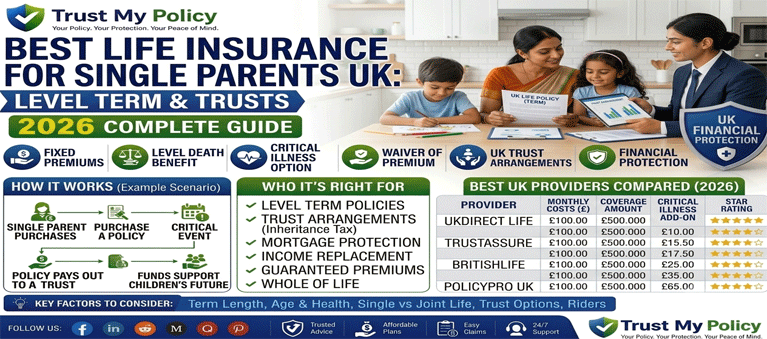
Best life insurance for single parents in the UK in 2026 is level term life insurance, written in trust, with a cover amount of GBP 200,000-GBP 500,000 depending on mortgage, income, and number of children. Legal & General, Aviva, and Royal London are the top three providers by claims-paid rate and premium competitiveness. A healthy, non-smoking single parent aged 32 pays approximately GBP 12-GBP 20/month for GBP 250,000 of 20-year level term cover. Critical illness cover is strongly recommended as an add-on — there is no partner income to fall back on during a serious illness. Write every policy in trust on the day documents arrive: it is free and prevents both probate delays and inheritance tax exposure.
When Nadia Rahman, 34, a nurse and sole carer for her two children aged 4 and 7, was asked by her mortgage adviser whether she had life insurance, she realised she had nothing in place. No employer death-in-service benefit on her part-time NHS contract, no savings that would last more than four months, and no family nearby who could support the children long-term. She had been putting the decision off for two years, assuming it would be expensive and complicated. Her actual premium, arranged the following week: GBP 17.40 per month for GBP 300,000 of level term cover over 22 years.
Best life insurance for single parents in the UK in 2026 is not simply about finding the lowest monthly premium — it is about choosing the right policy type, the right cover amount, the right term length, and ensuring the payout reaches your children quickly and tax-free through a trust. Single parents face a specific combination of risks that couples do not: no second income, no partner to manage childcare if you become seriously ill, and no automatic financial backstop if you die. According to the Association of British Insurers (ABI) 2024, the average UK life insurance claim pays just GBP 18,700 — a sum that would cover less than four months of household costs for a single parent with two children. If you are unsure what figure your own family would actually need, our step-by-step cover calculation guide using the DIME method produces an accurate, personalised figure in under ten minutes.
This guide covers which policy type single parents need, how much cover to take, which providers offer the best value and claims record in 2026, how to write the policy in trust so your children receive money without probate delays, four real-life scenarios with specific figures, the five most expensive mistakes, a decision guide, a cost table, and ten FAQs.
| Feature | Details |
| Best Policy Type | Level term life insurance — fixed payout, fixed premium, chosen term length |
| Recommended Cover Amount | GBP 200,000-GBP 500,000 depending on mortgage, income, and number of children |
| Recommended Term Length | Until youngest child reaches age 21-25; typically 18-25 years from today |
| Average Monthly Cost (Female, 32, non-smoker) | GBP 12-GBP 17/month for GBP 250,000 over 22 years |
| Average Monthly Cost (Female, 40, non-smoker) | GBP 20-GBP 28/month for GBP 250,000 over 18 years |
| Top Providers (UK 2026) | Legal & General, Aviva, Royal London, Zurich, LV= |
| Critical Step After Purchase | Write in trust immediately — free, prevents probate delay, removes inheritance tax risk |
| Key State Benefit | Guardian’s Allowance: GBP 21.75/week per child for carers raising a child whose parent has died (2026) |
| Regulator | Financial Conduct Authority (FCA) |
| Industry Claims Paid Rate | 98%+ for term life policies (ABI 2024) |
For a couple, life insurance protects against losing one income while the other parent continues earning and parenting. For a single parent, the policy does something more fundamental: it provides everything simultaneously — income replacement, childcare funding, mortgage clearance, and the financial foundation for whoever steps in to raise your children. There is no layer beneath this one. If you want to understand exactly how a UK life insurance policy works before you compare options — how premiums are set, what the payout triggers, and how beneficiaries receive the money — that foundational knowledge is worth covering first.
According to the Office for National Statistics (ONS) 2024, there are 1.8 million single-parent families in the UK, representing 15% of all families. The median gross weekly income for a single-parent household is GBP 453 (ONS 2024) — approximately GBP 23,556 per year before tax. Against an average UK outstanding mortgage of GBP 134,000 and childcare costs of GBP 7,000-GBP 14,000 per year per child under five (Coram Family and Childcare 2024), the financial exposure of dying uninsured as a single parent is immediate, severe, and entirely preventable at a cost of GBP 12-GBP 20 per month for most parents under 40.
Single parents need more cover than coupled households for four specific reasons: no second income means the full income replacement must come from the policy; children cannot legally receive large sums directly until age 18, making the trust arrangement essential rather than optional; the term must run to the youngest child’s financial independence rather than the mortgage end date; and critical illness cover matters more because a serious diagnosis leaves a single parent unable to work without any household income covering costs in the interim.
Level term life insurance pays a fixed lump sum if you die at any point during the agreed policy term. The payout stays identical from year one to the final year — GBP 300,000 in year 1 is still GBP 300,000 in year 20. This predictability is precisely what single parents need, because children’s financial requirements do not fall over time the way a mortgage balance does. Education costs, childcare fees, and living costs often peak in the later years of the policy. For a full breakdown of how the top UK providers compare on premium, claims rate, and additional features for this policy type, our 2026 guide to the best term life insurance in the UK covers every major insurer with current pricing data.
Decreasing term insurance reduces the payout over time, roughly tracking the declining balance of a repayment mortgage. It costs 20%-30% less than level term for the same initial sum insured. For single parents, we recommend it only as a supplement to level term — to cover the mortgage specifically — rather than as a standalone policy, because the declining payout in later years may be insufficient to cover childcare, education, and income replacement costs alongside whatever mortgage balance remains.
Critical illness cover pays a tax-free lump sum on diagnosis of a specified serious illness — typically covering cancer, heart attack, stroke, multiple sclerosis, and 40-80 additional conditions depending on the provider. For single parents, this cover is arguably more pressing than life insurance in practical terms: you are far more likely to be diagnosed with a serious illness during the policy term than to die. According to Cancer Research UK 2024, one in two people born after 1960 will develop cancer at some point in their lifetime. Our guide to term life insurance for parents with young children explains why the combination of life plus critical illness cover provides the most complete financial protection for single-income households, with specific examples of how the two claims scenarios compare in practice.
Whole of life insurance guarantees a payout whenever you die, with no fixed end date. It costs 4-8x more per month than level term for the same cover amount. For most single parents, this additional cost is not justified. The two exceptions are: a child with a lifelong disability who will always be financially dependent on you, or inheritance tax planning as part of a larger estate strategy. Outside these two situations, level term provides far more protection per pound of premium for the vast majority of single parents.
The standard 10x salary rule used as a starting figure for two-parent households significantly underestimates the cover a single parent requires. The DIME method — Debt, Income replacement, Mortgage, Education — gives a more accurate picture. Our detailed DIME calculation guide for UK families walks through every component with worked examples, but here is how the four elements apply specifically to a single-parent household.
After totalling these four figures, deduct: any employer death-in-service benefit, existing life insurance policies, liquid savings, and state benefits including Guardian’s Allowance (GBP 21.75/week per child in 2026). The result is your net cover gap. For most UK single parents, this produces a total requirement of GBP 300,000-GBP 600,000. If the premium for the full calculated amount is unaffordable, prioritise the mortgage plus ten years of income replacement as a minimum — and use the free life insurance calculator on TrustMyPolicy to find the premium at different cover levels before committing.
| Provider | Best For | Monthly Cost (GBP250k, 20yr, F35, Non-Smoker) | Claims Paid (2023) |
| Legal & General | Lowest premiums; widest online availability | GBP 14-GBP 17/month | 98% (ABI 2024) |
| Aviva | Strongest financial strength; free Digicare+ health service | GBP 15-GBP 19/month | 99.5% (Aviva 2024) |
| Royal London | Mutual insurer; widest critical illness cover; 100% claims paid | GBP 16-GBP 21/month | 100% (Royal London 2024) |
| Zurich | Best children’s CIC cover (41 conditions at no extra cost) | GBP 17-GBP 22/month | 98% (ABI 2024) |
| LV= (Liverpool Victoria) | Mutual; flexible trust payout age; premium waiver on job loss | GBP 15-GBP 20/month | 99% (LV= 2024) |
Legal & General is consistently the most price-competitive term life insurer for healthy non-smokers under 45 in the UK. It paid GBP 1.3 billion in life insurance claims in 2023 with a 98% claims-paid rate. Its online application takes under 15 minutes for most standard health profiles with same-day decisions. Policies can be written in trust using Legal & General’s free standard trust form at no additional charge. For parents who want to keep their monthly premium as low as possible while maintaining reliable cover, Legal & General is the most frequently recommended provider on UK comparison sites and rarely beaten on price for women aged 28-42. Defaqto: 5 Stars. Monthly cost: GBP 14-GBP 17/month for GBP 250,000 over 20 years, female, age 35, non-smoker.
Best for: single parents in good health aged 25-45 who want the lowest premium from a financially secure, FCA-regulated insurer with a strong claims-paid record.
Aviva is the UK’s largest insurer by gross written premium and holds an AA- financial strength rating from Standard and Poor’s. Its life insurance division paid 99.5% of claims in 2023. Aviva’s Digicare+ service is included free with all life policies and provides single parents with virtual GP access, a second medical opinion service, mental health support, and a bereavement support programme for named children — a genuinely useful ongoing benefit at no additional cost. Critical illness cover can be added from GBP 5-GBP 15/month depending on the sum insured. Defaqto: 5 Stars. Monthly cost: GBP 15-GBP 19/month for GBP 250,000 over 20 years, female, age 35, non-smoker.
Best for: single parents who want the strongest financial backing behind their policy and benefit from the Digicare+ virtual GP access — particularly useful for parents managing their children’s healthcare appointments around a working schedule.
Royal London is a mutual insurer owned by its members rather than external shareholders, meaning profits are reinvested rather than paid as dividends. It paid 100% of life insurance claims in 2023 — the strongest record of any provider reviewed here. Its critical illness policy covers over 60 conditions, the broadest range in the mainstream UK market, including children’s critical illness cover paying GBP 25,000 if a child named on the policy is diagnosed with a specified condition. For single parents whose primary concern is the scenario where they are too ill to work rather than the scenario where they die, the combination of term life plus Royal London’s critical illness cover is the most complete protection package available. Defaqto: 5 Stars. Monthly cost: GBP 16-GBP 21/month for GBP 250,000 over 20 years, female, age 35, non-smoker.
Best for: single parents who prioritise critical illness cover breadth alongside life insurance, particularly those with a personal or family history of cancer, heart disease, or stroke.
Zurich offers the most generous children’s critical illness benefit of any mainstream UK life insurer — covering 41 conditions per child as standard on its combined life and CIC policies at no additional cost. Covered conditions include childhood cancers, meningitis, cerebral palsy, Type 1 diabetes, and cystic fibrosis. The payout per child is 50% of the insured sum up to GBP 25,000 — providing meaningful financial support during a period when the parent may need to reduce their working hours to care for a seriously ill child. Defaqto: 5 Stars. Monthly cost: GBP 17-GBP 22/month for GBP 250,000 over 20 years, female, age 35, non-smoker.
Best for: single parents whose children have existing health conditions or a family history of serious childhood illness, and who want financial protection for the scenario where a child’s diagnosis forces a reduction in working hours.
LV= is a mutual insurer with consistently high customer satisfaction scores and one of the most flexible trust arrangements available — allowing single parents to specify the exact age at which each child should receive their share of the payout, rather than defaulting to age 18. Many single parents prefer age 21 or 25 to avoid a lump sum being received at 18 before the child has the financial maturity to manage it. LV= also offers a premium waiver option that keeps the policy active if the policyholder loses their job — particularly valuable for single parents on contract or variable income. Defaqto: 5 Stars. Monthly cost: GBP 15-GBP 20/month for GBP 250,000 over 20 years, female, age 35, non-smoker.
Best for: single parents who want control over when their children receive the payout and whose income is variable or contract-based, making the premium waiver on job loss a meaningful protection.
We recommend Legal & General as the best overall for most single parents in the UK because it combines the most competitive premiums in the market with a 98% claims-paid rate and a straightforward free trust service. For single parents who want the broadest critical illness cover alongside life insurance, Royal London’s 100% 2023 claims-paid rate and 60+ condition CIC policy make it the stronger complete protection package.
Nadia had no employer death-in-service on her part-time contract. Her mortgage balance was GBP 187,000. Using the DIME method, her gross cover need was approximately GBP 570,000: GBP 187,000 mortgage + GBP 28,000 x 17 years income replacement + GBP 35,000 childcare for the 4-year-old + GBP 60,000 university for two children. After deducting GBP 18,000 in savings, the net gap was GBP 552,000. She could afford GBP 17.40/month, which funded GBP 300,000 of level term cover over 22 years with Legal & General. She wrote it in trust naming her sister as trustee. To work out the minimum viable cover for your own household, the free life insurance calculator on TrustMyPolicy shows what different cover amounts cost at your specific age and health profile. Verdict: Partial cover at GBP 300,000 was meaningfully better than no cover — protecting the mortgage and providing 4 years of income replacement. Action: If the full calculated amount is unaffordable, start with what you can fund and build up with a second policy when income allows.
Marcus had no employer cover at all. He took GBP 350,000 of level term over 16 years from Aviva at GBP 31/month, and added GBP 150,000 of critical illness cover for GBP 18/month — total GBP 49/month. Eight months after the policy started, he was diagnosed with bowel cancer. His critical illness policy paid GBP 150,000, allowing him to stop work for six months during treatment without losing his home or falling into debt. The life insurance remained active throughout his recovery. This is precisely the scenario our guide for parents with young children explains — the illness claim is statistically more likely than the death claim for most parents under 50. Verdict: GBP 18/month in critical illness cover delivered a GBP 150,000 payout on a diagnosis that would otherwise have meant losing his home. Action: Self-employed single parents with no sick pay must treat critical illness cover as essential alongside life insurance.
Priya purchased GBP 400,000 of level term cover over 23 years from Legal & General at GBP 16.80/month — but did not write the policy in trust at purchase. Three years later she died in a road accident. The GBP 400,000 payout was frozen inside her estate during probate for nine months, during which her sister — who had taken in the child — had no access to any of the funds. When the estate was eventually distributed, Priya’s total assets including the payout exceeded the GBP 325,000 nil-rate band. Her family paid GBP 30,000 in inheritance tax that would have been entirely avoided had the policy been written in trust on day one. Verdict: Not writing in trust cost Priya’s family GBP 30,000 and a nine-month wait for funds needed immediately. Action: Write your policy in trust the same day your documents arrive — it is free, takes under 10 minutes, and prevents both the probate delay and the inheritance tax exposure.
Sarah’s employer provided a 4x salary death-in-service benefit of GBP 112,000. She initially assumed this was adequate cover. Her DIME calculation produced a gross need of approximately GBP 490,000. After deducting the GBP 112,000 employer benefit and GBP 22,000 in savings, her net gap was GBP 356,000. She took a GBP 350,000 level term policy from Royal London with critical illness cover added for GBP 37/month total, written in trust naming her mother as trustee with a payout age of 21 for each child. Verdict: Employer death-in-service covered 23% of her actual requirement. Action: Treat employer death-in-service as a contribution to cover, not a replacement for it — and remember it disappears entirely the moment you change jobs.
| Factor | Pros | Cons |
| Financial Protection | Provides children with the funds to maintain their home, education, and living standard without relying on relatives | Monthly premium is a fixed cost on an already stretched single-parent income |
| Peace of Mind | Removes the single largest financial risk facing a single-parent household at a cost of GBP 12-GBP 20/month for most under-40s | Requires active management: trust setup, annual review, and a will with guardian nomination |
| Critical Illness Add-on | Pays out on diagnosis — protecting income during treatment before you die | Adds GBP 10-GBP 25/month depending on cover amount and age |
| Trust Arrangement | Payout reaches children immediately, inheritance-tax-free, without 6-12 months of probate delay | Requires nominating a trustee you trust implicitly to manage significant funds responsibly |
| Premium Stability | Fixed monthly cost for the entire term — never increases regardless of age or health changes during the policy | No refund if you outlive the term — premiums paid are not returned on expiry |
Mistake 1: Not buying any cover at all. The most common reason single parents give for not having life insurance is that they assume it will be expensive or complicated. A healthy non-smoking parent under 40 typically pays GBP 12-GBP 20/month for GBP 250,000 of cover — less than most people’s monthly streaming subscriptions. The real cost of not having it is the entire financial security of the children left behind.
Mistake 2: Relying entirely on employer death-in-service. Employer group life cover pays 2-4x annual salary. For a single parent earning GBP 30,000, that produces GBP 60,000-GBP 120,000 — against a GBP 134,000 average mortgage and years of income replacement needed. It also disappears the moment you change employer, are made redundant, or take a career break. It should supplement personal cover, never replace it.
Mistake 3: Choosing too short a term. Your policy must run until your youngest child is financially independent — age 21-25. A single parent whose youngest child is 3 needs at least a 20-year policy, ideally 22. Matching the term to the mortgage end date leaves a coverage gap during precisely the years when education costs and teenage living costs are highest.
Mistake 4: Under-insuring because the correct amount seems unaffordable. Many single parents take GBP 100,000-GBP 150,000 when their actual need is GBP 400,000+. A practical solution: take two smaller policies from different insurers rather than one large one — it is often cheaper and spreads insurer risk. Use the DIME method calculator to find your accurate minimum figure before deciding how much to take.
| ⚠️ WARNING: Never Skip Writing Your Policy in Trust
Not writing your life insurance policy in trust is the most financially damaging single mistake a single parent can make after purchasing cover. Without a trust, the payout is frozen inside your estate during probate — an average of 6-12 months in the UK — during which your children’s guardian has no access to the funds regardless of how urgent the need is. If your estate including the payout exceeds GBP 325,000, the excess is subject to 40% inheritance tax. Both outcomes are entirely preventable at no cost. Your insurer’s trust form is free, takes under 10 minutes, and must be completed the same day your policy documents arrive. |
Mistake 5: Failing to review cover after a major life change. A pay rise, a new or larger mortgage, an additional child, or a change from employed to self-employed all alter your cover requirement. The GBP 200,000 policy bought at age 28 on a GBP 22,000 salary may leave a GBP 200,000+ gap for a parent now earning GBP 35,000 with a larger mortgage. Review your cover every three years and after any significant financial or family change.
| Your Situation | Our Recommendation |
| I am a single parent with a mortgage and young children | Yes — level term for the length of your mortgage or until youngest child is 21-25, whichever is longer |
| I rent and have no mortgage | Yes — level term is still essential; replace the mortgage component with 3-5 years of rent in your cover calculation |
| I am self-employed with no employer death-in-service | Yes — life insurance plus critical illness cover; no safety net exists below your own income |
| My employer provides 4x salary death-in-service | Yes — still buy personal cover for the gap; the employer benefit disappears the moment you change jobs |
| I can only afford GBP 15-GBP 20/month | Yes — buy the most cover that premium will fund from Legal & General; GBP 200,000 is vastly better than nothing |
| I have a child with a lifelong disability who will always be dependent | Yes — consider whole of life insurance alongside term cover to guarantee a permanent payout regardless of when you die |
| I am over 50 with older children approaching adulthood | Yes — a 10-15 year policy still provides meaningful cover until your youngest is fully financially independent |
| I have not written my existing policy in trust yet | Yes — contact your insurer today, request the trust form, and complete it before your next premium payment |
| 💡 TIP: The Golden Rule for Single Parent Life Insurance
Write your policy in trust on the same day you buy it — not next week. Set the term to run until your youngest child reaches age 21-25, not just until your mortgage ends. And treat critical illness cover as essential alongside life insurance — you are far more likely to need the living payout from a serious diagnosis than the death payout during your working years. Every year you delay buying cover costs you more in premiums and leaves your children unprotected in the interim. |
| Profile | Monthly Cost (Level Term) | Notes |
| Female, 28, non-smoker, GBP 200,000, 22 years | GBP 9-GBP 12/month | Lowest premium bracket; buy as early as possible for maximum value |
| Female, 32, non-smoker, GBP 250,000, 22 years | GBP 12-GBP 17/month | Standard profile; Legal & General most competitive at this age |
| Female, 35, non-smoker, GBP 300,000, 20 years | GBP 14-GBP 20/month | Covers typical mortgage plus 10 years income for 2 children |
| Female, 40, non-smoker, GBP 300,000, 18 years | GBP 20-GBP 28/month | Premium rises with age; still affordable; buy as early as income allows |
| Male, 35, non-smoker, GBP 300,000, 20 years | GBP 17-GBP 25/month | Men pay more than women for identical cover at the same age |
| Female, 35, smoker, GBP 250,000, 20 years | GBP 28-GBP 42/month | Smoking doubles or triples premium; stopping for 12 months reduces the loading significantly |
| Female, 32, non-smoker, GBP 250,000 life + GBP 100,000 CIC, 22 years | GBP 28-GBP 38/month | Critical illness adds approximately GBP 15-GBP 20/month to the life premium |
| Female, 38, managed asthma, GBP 250,000, 18 years | GBP 20-GBP 35/month | Mild pre-existing conditions typically result in standard or nominal loading; always use a broker |
Level term life insurance, written in trust, is the best choice for the vast majority of UK single parents. It provides a fixed, tax-free payout for the entire policy term at a fixed monthly premium — predictable, affordable, and directly matched to the years your children depend on your income. Legal & General offers the most competitive premiums for most healthy non-smokers, while Royal London provides the strongest critical illness cover breadth and a 100% 2023 claims-paid rate. The full 2026 comparison of UK term life providers covers current premium data and claims-paid rates for all major insurers.
Most single parents in the UK need GBP 300,000-GBP 600,000 of life insurance, depending on mortgage balance, net income, number of children, and the age of the youngest child. The DIME method (Debt + Income replacement + Mortgage + Education) gives the most accurate figure. After calculating the gross need, deduct employer death-in-service, savings, and state benefits including Guardian’s Allowance of GBP 21.75/week per child (2026). Our DIME method cover calculation guide for UK families walks through the full calculation with worked examples specifically for single-parent households.
Yes — for single parents this is essential, not optional. Without a trust, the payout passes through your estate and is frozen during probate for an average of 6-12 months. Your children’s guardian has no access to those funds during this period regardless of immediate financial need. If your total estate including the payout exceeds GBP 325,000, a 40% inheritance tax charge applies to the excess. Writing in trust costs nothing, takes under 10 minutes, and eliminates both risks entirely. Every UK life insurer provides a free standard trust form — request it the same day your policy documents arrive.
Yes — most pre-existing conditions result in a standard or slightly loaded premium rather than an outright decline. Managed conditions such as controlled asthma, treated depression, or cancer in remission for five or more years are accepted by most mainstream UK insurers. More complex conditions may require specialist underwriting through a broker. Always disclose your full medical history honestly — non-disclosure is the most common reason UK life insurance claims are contested or denied, and the consequences for your children could be catastrophic.
Guardian’s Allowance is a UK state benefit paid to anyone raising a child whose parents have both died. In 2026 it pays GBP 21.75 per week per child. It is paid in addition to Child Benefit and does not depend on the carer’s income. To qualify, at least one parent must have died and the surviving child must be under 16 (or under 20 in approved education or training). At GBP 1,131 per year per child, it covers a fraction of actual childcare and living costs — use it as a deduction in your DIME cover calculation, but do not rely on it as a substitute for adequate life insurance.
Yes — strongly. You are statistically far more likely to be diagnosed with a serious illness during your working years than to die. According to Cancer Research UK 2024, one in two people born after 1960 will develop cancer at some point. A diagnosis that prevents you working leaves a single parent with no income and no partner to cover household costs. Critical illness cover pays a tax-free lump sum on diagnosis — before you die — allowing you to manage mortgage payments, childcare, and treatment costs without losing your home. For single parents, this is not an optional extra; it is the most likely scenario in which a payout will be needed.
Your term must run until your youngest child is financially independent — typically age 21-25. If your youngest child is 4 today, you need at least a 20-year term, ideally 22. Many single parents match the term to their mortgage end date rather than their children’s dependency period, which creates a coverage gap exactly when children are approaching university age and costs are highest. Always set the term to whichever is longer: mortgage end date or youngest child reaching age 21.
If your premiums are not paid, most insurers allow a short grace period — typically 30 days — before cancelling the policy. After that, the cover lapses and you lose all protection without any refund of premiums paid. LV= offers a premium waiver add-on that keeps the policy active if you lose your job — useful protection for single parents on variable or contract income. If you are struggling to pay premiums, contact your insurer before missing a payment — some providers will allow a payment holiday or premium reduction rather than cancelling the policy.
Children under 18 cannot legally receive large sums of money directly in the UK. If your children are named as beneficiaries without a trust in place and they are under 18 when you die, the money will be held by the court until they reach 18 — during which time no one has practical access to the funds for childcare, housing, or living costs. A trust resolves this by appointing an adult trustee to manage the payout on the children’s behalf immediately. Always use a trust if your children are minors.
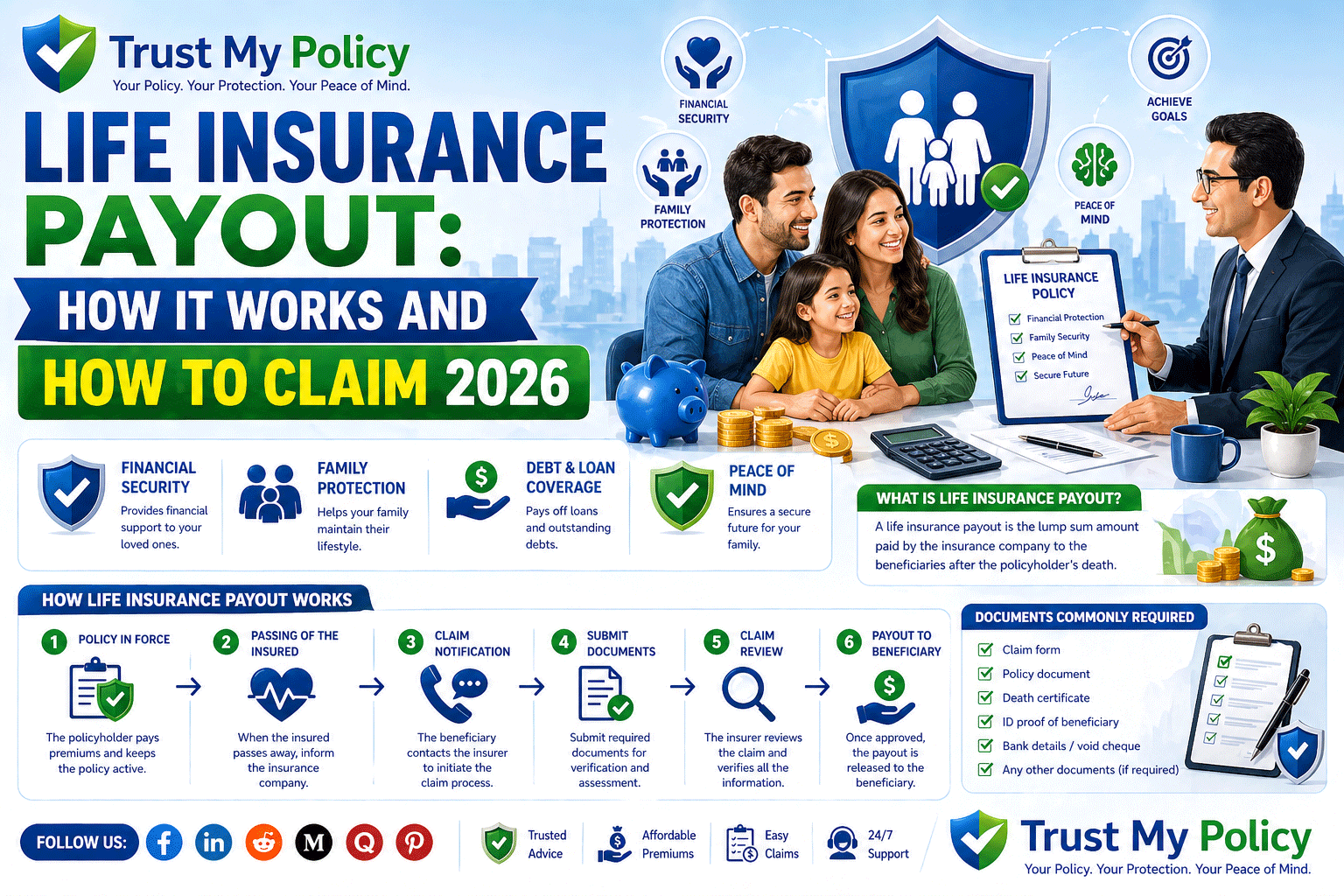
Your trustees will need: a certified copy of the death certificate, the original policy document or policy number, a completed claim form from the insurer, and documentation of the trust arrangement. Most UK insurers settle undisputed term life claims within 5-30 working days of receiving complete paperwork. The step-by-step guide to how UK life insurance payouts work explains the full claim process, which documents each major insurer requires, and realistic settlement timelines for different claim types.
This guide reflects the latest 2026 insurance data.
| ℹ️ Disclaimer
This article is for informational purposes only. Always consult a licensed insurance professional or FCA-regulated financial adviser before making life insurance decisions. Trust My Policy does not sell insurance products or represent any insurer. |

Jagadeesh Gutha is the founder of TrustMyPolicy.com, an independent insurance information platform covering life, health, car, home, and business insurance for US and UK readers. He researches insurance products, policy structures, and consumer rights to help everyday people make informed coverage decisions without the jargon. All content on TrustMyPolicy is independently researched, fact-checked, and written to educate — not to sell.


Insurance Guides for UK, USA & Worldwide We are not an insurer or broker.
Reader Comments (0)