
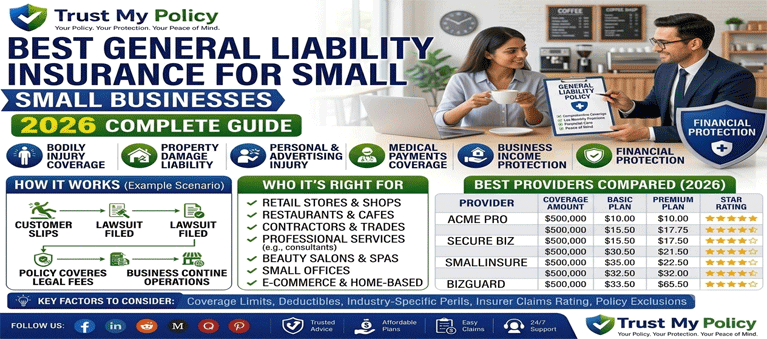
General liability insurance for small businesses covers third-party bodily injury, third-party property damage, and advertising injury claims made against your business. In the US, a standard $1 million per-occurrence / $2 million aggregate policy costs $400-$1,500/year for most small businesses, according to the NAIC 2024. In the UK, public liability insurance (the equivalent) costs GBP 100-GBP 600/year for most SMEs. The best overall US provider for small businesses in 2026 is Next Insurance for speed and digital access; the best for comprehensive cover and agent support is The Hartford. The best UK provider is Simply Business for online comparison and Hiscox for specialist trades.
Maria Santos, 34, opened a dog-grooming salon in Austin, Texas in January 2024. Six weeks later, a client’s Labrador knocked over a display stand and a customer fractured her wrist in the fall. The medical bill came to $11,400. Maria’s general liability policy — $47/month from Next Insurance — covered the full claim with a $500 deductible. Without it, she would have faced the bill personally before her business had even turned a profit.
Best general liability insurance for small businesses in 2026 means finding the right combination of coverage limit, price, speed of purchase, and claims service for your specific trade — because a $300/year policy that covers a freelance graphic designer is completely different from a $1,800/year policy required by a building contractor working on commercial sites. According to the National Association of Insurance Commissioners (NAIC) 2024, general liability insurance is the most commonly held business insurance policy in the US, with over 44 million small business policies in force.
This article covers what general liability insurance is, what it covers and excludes, how it works step by step, a direct comparison of the top five US providers and top four UK providers, real costs with specific figures, four real-life scenarios, a pros and cons table, the five most common buying mistakes, a decision guide, and ten FAQs. By the end, you will know exactly which provider and policy best fits your business.
| Feature | Details |
| What It Is | Insurance covering third-party bodily injury, property damage, and advertising injury claims against your business |
| Who Needs It | Every small business with customers, clients, or the public visiting premises or receiving services |
| US Average Cost | $500-$1,500/year for a $1M/$2M policy; sole traders from $400/year (NAIC 2024) |
| UK Average Cost | GBP 100-GBP 600/year for GBP 1M-GBP 5M public liability (ABI 2024) |
| Standard Coverage Limit (US) | $1 million per occurrence / $2 million aggregate |
| Standard Coverage Limit (UK) | GBP 1 million to GBP 5 million (GBP 5M+ required for most public sector contracts) |
| Key Benefit | Covers legal defence costs and damages without the business owner paying out of pocket |
| Key Exclusion | Professional errors (covered by Professional Indemnity / E&O); employee injury (covered by Workers’ Comp / Employers’ Liability) |
| US Regulator | State insurance commissioners; coordinated by NAIC |
| UK Regulator | Financial Conduct Authority (FCA) |
Running a small business without general liability insurance is like driving without a seatbelt: most journeys end fine, but when they do not, the consequences are catastrophic. General liability insurance — called public liability insurance in the UK — is the policy that pays when a third party (a customer, visitor, or member of the public) suffers a bodily injury or property damage that your business is legally responsible for.
In the US, the standard general liability policy covers three categories: bodily injury and property damage liability (if a customer slips on your premises or you damage a client’s property during service delivery), personal and advertising injury (if your marketing inadvertently infringes a competitor’s copyright or makes a defamatory statement), and medical payments (paying a third party’s immediate medical costs, typically up to $5,000-$10,000, without admitting liability). The policy pays your legal defence costs, court-awarded damages, and settlements — up to your policy limit.
In the UK, public liability insurance covers the same core risks: third-party bodily injury and property damage caused by your business activities. Unlike the US, where personal and advertising injury is typically bundled in, UK businesses must add this separately if needed. UK public liability does not cover employees — that is covered by employers’ liability insurance, which is legally mandatory for any UK business with at least one employee under the Employers’ Liability (Compulsory Insurance) Act 1969.
General liability suits every small business that: serves customers at a premises, provides services at clients’ locations, produces or sells physical products, or carries out manual work (cleaning, building, catering, landscaping, personal training). Businesses that operate entirely online with no physical client contact have a lower but non-zero liability exposure — advertising injury claims can arise from digital marketing content alone.
| Provider | Best For | Cost Range (Annual) | AM Best Rating |
| Next Insurance | Sole traders; fast digital purchase | $400-$1,200/year | A- |
| The Hartford | Established SMBs; broad coverage | $800-$2,500/year | A+ |
| Hiscox US | Professionals; creative businesses | $500-$1,800/year | A |
| Chubb | High-value or high-risk businesses | $1,200-$5,000/year | A++ |
| Thimble | Gig workers; hourly/project policies | $200-$900/year | A- |
| Provider | Best For | Cost Range (Annual) | Defaqto |
| Simply Business | Online comparison; all trade types | GBP 100-GBP 500/year | 4 Star |
| Hiscox UK | Professional and creative trades | GBP 120-GBP 600/year | 5 Star |
| AXA Business | Retail, hospitality, contractors | GBP 150-GBP 700/year | 5 Star |
| Zurich UK | Larger SMEs; complex risk profiles | GBP 300-GBP 1,500/year | 5 Star |
We recommend Next Insurance as the best overall for US sole traders and micro-businesses because policies can be purchased and certificated in under 10 minutes, monthly billing is available from $33/month, and certificate of insurance (COI) downloads are instant — essential when a client requires proof of insurance before a job starts. For established small businesses with employees, The Hartford delivers the strongest combination of coverage breadth, claims service, and financial strength at A+ from AM Best.
A customer fractured her wrist when Maria’s display stand fell. The medical claim totalled $11,400. Maria’s Next Insurance policy ($47/month; $1M per occurrence) covered the full amount after her $500 deductible. Her total out-of-pocket: $500. Without insurance, Maria would have faced the full $11,400 from a business generating $3,200/month revenue. Verdict: General liability was essential for Maria from day one. Action: Any business where members of the public visit your premises must have general liability in force before opening day — not the week after.
Callum photographed a corporate event and accidentally knocked over GBP 2,800 of hired AV equipment. His Hiscox UK public liability policy (GBP 1M limit; GBP 140/year) covered the full repair bill after a GBP 100 excess. Callum paid GBP 100 total. Without cover, GBP 2,800 represented nearly half a month’s gross income. Verdict: Even low-risk freelancers face significant third-party property damage exposure. Action: Any self-employed person handling client equipment or working on client premises needs public liability insurance regardless of how ‘safe’ their work appears.
A competitor alleged that Raj’s website contained a tagline that infringed their trademarked phrase, filing a $35,000 advertising injury claim. Raj’s Hiscox US general liability policy covered advertising injury. The insurer’s legal team negotiated the dispute down to a $12,000 settlement and paid legal fees of $8,400. Total insured payout: $20,400. Raj paid his $1,000 deductible. Without cover, the combined legal fees and settlement would have exceeded his annual profit. Verdict: Advertising injury is a real, commonly overlooked risk for any business with an online presence. Action: Confirm your general liability policy explicitly includes personal and advertising injury — not all budget policies include this.
Sandra won a local authority catering contract requiring GBP 5 million in public liability cover. Her existing GBP 1 million policy did not qualify. Her Simply Business broker arranged a GBP 5 million policy for GBP 340/year — GBP 190 more than her current premium. The contract was worth GBP 28,000 annually. Verdict: The right liability limit unlocked GBP 28,000 in new revenue for GBP 190 in extra premium. Action: Always check the liability limit required by contracts before renewing or purchasing — defaulting to the cheapest minimum limit can disqualify you from your most valuable clients.
| Factor | Pros | Cons |
| Financial Protection | Covers legal defence costs and damages that could otherwise bankrupt a small business | Annual premium is an ongoing cost even if no claim is ever made |
| Legal Defence | Insurer appoints and pays for your solicitor or attorney — even for unfounded claims | Deductible / excess is still payable by the business on each claim |
| Client and Contract Access | Most commercial clients and public sector contracts require proof of cover before engagement | Policy limits required by large clients (GBP 5M+) can cost significantly more than basic cover |
| Peace of Mind | Business owner can focus on operations without fear of a single incident causing closure | Policy does not cover professional errors — a separate PI / E&O policy is always needed |
| Coverage Breadth | Covers bodily injury, property damage, and advertising injury in a single policy | Employee injury is excluded — workers’ compensation (US) or employers’ liability (UK) is separate |
Mistake 1: Choosing the lowest-cost policy without checking what it excludes. Budget general liability policies sometimes omit personal and advertising injury coverage or cap medical payments at $1,000 rather than the standard $5,000-$10,000. A $200/year policy that excludes advertising injury is inadequate for any business with a website, social media, or printed marketing materials.
Mistake 2: Buying the wrong limit for your contracts. The most common liability limits for small businesses are $1M per occurrence / $2M aggregate in the US and GBP 1M or GBP 2M in the UK. However, local authorities, NHS trusts, corporate clients, and construction contractors typically require GBP 5M or $5M minimum. Always read every client contract’s insurance requirements before purchasing or renewing.
Mistake 3: Assuming general liability covers employee injury. General liability covers third parties — customers and members of the public — not your own employees. Employee injury at work requires a separate workers’ compensation policy in the US (legally required in most states) and employers’ liability insurance in the UK (legally required for any business with at least one employee). Conflating the two can leave you criminally liable for an uninsured employee claim.
Mistake 4: Not notifying the insurer of a potential claim immediately. Most general liability policies are occurrence-based (US) or contain a clause requiring prompt notification (UK). Failing to notify your insurer of a potential claim within the specified window — often 24-72 hours of becoming aware — can give the insurer grounds to deny your claim on procedural grounds, regardless of the underlying validity.
| ⚠️ WARNING: Claims-Made vs Occurrence Policies
US general liability policies come in two forms: occurrence-based and claims-made. An occurrence policy covers any incident that happens during the policy period, even if the claim is filed years later. A claims-made policy covers only claims filed while the policy is active. If you cancel a claims-made policy without purchasing tail cover (an extended reporting period endorsement), you lose protection for incidents that occurred during the policy period but are claimed after cancellation. Always confirm which type you are buying and whether tail cover is needed before switching insurers or closing your business. |
Mistake 5: Not reviewing coverage as the business grows. A sole trader policy purchased for a one-person operation is typically not adequate once the business has employees, new premises, or operates in higher-risk activities. Insurers set premiums based on declared revenue, headcount, and activity — understating any of these at renewal invalidates your coverage for claims arising from the undisclosed activities.
| Your Situation | Our Recommendation |
| I am a sole trader / freelancer in the US needing cover quickly | Yes — Next Insurance or Thimble; policies start from $33/month with instant COI |
| I run a shop or premises-based business with daily public footfall | Yes — The Hartford or Hiscox US ($1M/$2M minimum); premises liability is your highest risk |
| I need a GBP 5 million limit for a public sector contract in the UK | Yes — AXA Business or Zurich UK; confirm the limit before quoting |
| I am a UK self-employed tradesperson (electrician, plumber, decorator) | Yes — Simply Business or Hiscox UK; trades policies from GBP 100/year |
| I only need cover for a single event or short-term project | Yes — Thimble (US) or Markel (UK) offer event and short-term project policies |
| My business sells physical products to the public | Yes — ensure your policy includes product liability; not all basic GL policies include this |
| I already have Professional Indemnity — do I still need GL? | Yes — PI covers your professional errors; GL covers physical injury and property damage. Both are needed |
| My client contract requires additional insured status | Yes — most providers offer additional insured endorsements; confirm before purchase |
| 💡 TIP: The Golden Rule for Small Business Liability Insurance
Buy your general liability policy before you take on your first client, customer, or member of the public — not after. The most expensive claim is always the one that happens before you are covered. An incident on day one of trading is just as legally valid as one on day 1,000. If you cannot yet afford a comprehensive policy, start with a basic $1M / GBP 1M occurrence policy and increase the limit as your revenue grows. |
| Business Type / Scenario | Annual Cost | Notes |
| US: Freelance designer, sole trader, $500k limit | $400/year | Minimum adequate cover; advertising injury included |
| US: Coffee shop, 3 employees, $1M/$2M | $900/year | Standard premises liability rate; slip-and-fall exposure priced in |
| US: General contractor, $1M/$2M + tools | $1,800/year | Higher risk; consider umbrella policy for contracts over $500k |
| US: IT consultant, $1M/$2M | $520/year | Low physical risk; advertising injury and PI sold together by Hiscox |
| US: Event catering, 8 employees, $2M/$4M | $2,200/year | Food service multiplier applies; product liability included |
| UK: Freelance photographer, GBP 1M | GBP 110/year | Low-risk sole trader rate; equipment cover sold separately |
| UK: Hair salon, 4 staff, GBP 2M | GBP 280/year | Includes treatment liability; employers’ liability sold separately |
| UK: Building contractor, GBP 5M | GBP 850/year | High-risk trade rate; tools and plant cover add GBP 200-GBP 400 |
| UK: Restaurant, 12 staff, GBP 5M | GBP 620/year | Food hygiene rating affects premium; employers’ liability extra |
| US: Technology startup, $2M/$4M (claims-made) | $1,400/year | Claims-made basis; tail cover needed if policy cancelled |
Next Insurance is a digital-first insurer offering general liability, professional liability, and commercial auto in one platform. Policies are issued instantly — no phone calls or broker meetings required. A certificate of insurance (COI) can be shared digitally with a client within 60 seconds of purchase. Cost: $400-$1,200/year. Coverage: $1M per occurrence / $2M aggregate standard. Best for: sole traders, freelancers, and micro-businesses that need proof of coverage to start a job immediately. AM Best Rating: A-. Monthly billing available from $33/month.
The Hartford has over 200 years of commercial insurance history and holds an A+ AM Best rating, making it one of the most financially secure options for small business owners. Its Business Owner’s Policy (BOP) bundles general liability, commercial property, and business interruption for $800-$2,500/year — often cheaper than buying each separately. Claims are handled by dedicated small business claims teams with average settlement within 30 days. Best for: established SMBs with 2-20 employees and physical premises. AM Best Rating: A+.
Hiscox operates in both the US and UK, making it the only provider on this list that offers consistent coverage on both sides of the Atlantic for businesses operating internationally. Its policies are designed for professional and creative trades — consultants, designers, photographers, marketing agencies, and tech businesses. UK Defaqto rating: 5 Stars. US AM Best rating: A. Cost: $500-$1,800/year (US); GBP 120-GBP 600/year (UK). Best for: UK and US professionals needing general liability and professional indemnity in a single policy package.
Thimble pioneered short-term general liability insurance in the US — policies can be purchased by the hour, day, week, or month. A single-day event policy starts at $5. Annual policies start at $200/year for very low-risk trades. Thimble is ideal for gig economy workers, freelancers, and seasonal businesses that do not need year-round cover or want to match insurance spend to revenue. AM Best Rating: A-. Not suitable as the primary policy for businesses with permanent premises or employees.
Simply Business is a UK insurance broker — not a direct insurer — that compares public liability policies from over 30 FCA-authorised insurers in one quote. This makes it the most efficient starting point for any UK small business that is unsure which insurer to use. Policies start from GBP 55/year for very low-risk sole traders. GBP 1M to GBP 10M limit options available. FCA-authorised broker. Best for: UK sole traders and small businesses wanting to compare the market in one place before committing to a policy.
We recommend The Hartford as the best overall US provider for small businesses with employees because of its A+ financial strength, BOP bundle value, and dedicated small business claims teams. For sole traders and micro-businesses needing cover immediately, Next Insurance is the most practical choice. In the UK, we recommend Hiscox for professionals and AXA Business for trade and hospitality businesses.
General liability insurance covers three main categories: bodily injury and property damage liability (a customer is injured at your premises or you damage a client’s property), personal and advertising injury (claims of defamation, copyright infringement, or invasion of privacy arising from your marketing), and medical payments to third parties (immediate medical costs up to $5,000-$10,000 without admission of liability). It does not cover your own employees, your professional errors, or your own business property.
According to the NAIC 2024, the average US small business pays $500-$1,500/year for a standard $1 million per occurrence / $2 million aggregate general liability policy. Sole traders in low-risk sectors (consulting, design, photography) typically pay $400-$600/year. Higher-risk trades (construction, food service, childcare) pay $1,500-$3,000/year. In the UK, public liability insurance averages GBP 100-GBP 600/year for sole traders and GBP 200-GBP 1,500/year for businesses with employees.
General liability insurance is not federally mandated in the US, but it is frequently required by: state licensing boards (contractors, electricians, plumbers in most states), commercial lease agreements (landlords typically require $1M-$2M minimum as a tenancy condition), and client contracts (corporate and government clients routinely require proof of coverage before engagement). Some states also require it for specific licensed trades. Not having it is legally permissible in most sectors but financially reckless.
Public liability insurance is not legally required for most UK businesses — but employers’ liability insurance is legally mandatory for any business with at least one employee, under the Employers’ Liability (Compulsory Insurance) Act 1969. Public liability is, however, a contractual requirement for most commercial leases, local authority licenses (market traders, food vendors, event organisers), and public sector contracts — effectively making it essential for any client-facing business.
General liability covers physical incidents: a customer slipping, a client’s property being damaged during service delivery, or an advertising injury claim. Professional liability (called professional indemnity or PI in the UK, and errors and omissions or E&O in the US) covers financial losses caused by a professional error, omission, or failure to deliver the agreed service. A consultant who gives wrong advice causing a client a $50,000 loss needs PI — general liability does not cover this. Most professional businesses need both policies.
An additional insured endorsement extends your general liability coverage to include another party — typically a client, landlord, or general contractor — on your policy. This means if they are sued as a result of your work, your policy defends them too. Most commercial contracts require you to add the client as an additional insured before work begins. All five US providers reviewed in this article offer additional insured endorsements, typically at no additional cost or for $25-$50 per endorsement.
A certificate of insurance (COI) — called a certificate of liability insurance in the US — is a one-page document issued by your insurer summarising your coverage: policy type, limits, effective dates, and insurer details. Clients request COIs to verify your coverage before awarding a contract or allowing you on site. Next Insurance and Thimble both allow instant COI download and digital sharing. The Hartford and Hiscox generate COIs within 24 hours of purchase.
For most small businesses, a $1 million per occurrence / $2 million aggregate policy (US) or a GBP 2 million policy (UK) provides adequate protection. Increase to $2M/$4M (US) or GBP 5M (UK) if you: work on government or local authority contracts, work in construction or high-risk trades, have high daily public footfall, or your client contracts specify higher minimums. According to the Insurance Information Institute (III) 2024, the average general liability claim against a small business is $75,000 — well within a standard $1M limit.
Yes, but a claims history will increase your premium. Most insurers accept businesses with one or two previous claims, particularly if they were resolved without litigation. Frequent claims (three or more in five years) may restrict your options to specialist insurers or surplus lines markets in the US, or Lloyd’s syndicates in the UK. Always disclose all previous claims honestly — non-disclosure is grounds to void your policy under the Consumer Insurance Act 2012 (UK) and state insurance codes (US).
An occurrence policy covers any incident that happens during the policy period, regardless of when the claim is filed — even years later. A claims-made policy covers only claims filed while the policy is still active. Most small business general liability policies in the US are occurrence-based, providing the stronger protection. Claims-made policies are more common for professional liability. If you hold or are considering a claims-made policy, always purchase tail cover (an extended reporting period endorsement) before cancelling, to protect against claims filed after the policy ends.
This guide reflects the latest 2026 insurance data.
| ℹ️ Disclaimer
This article is for informational purposes only. Always consult a licensed insurance professional before making coverage decisions. Trust My Policy does not sell insurance products or represent any insurer. |

Jagadeesh Gutha is the founder of TrustMyPolicy.com, an independent insurance information platform covering life, health, car, home, and business insurance for US and UK readers. He researches insurance products, policy structures, and consumer rights to help everyday people make informed coverage decisions without the jargon. All content on TrustMyPolicy is independently researched, fact-checked, and written to educate — not to sell.
Insurance Guides for UK, USA & Worldwide We are not an insurer or broker.
Reader Comments (1)
[…] best insurance for small business owners typically starts with general liability insurance, which covers third-party injury or property damage claims, and property insurance, which covers […]