
Level term life insurance pays a fixed amount to your beneficiaries if you die within a set period — usually somewhere between 10 and 30 years — and both that payout and your premium stay exactly the same for the whole term. Nothing creeps up, nothing shrinks. If you’re still alive when the term ends, the coverage generally stops unless you renew or convert it, and renewing later almost always costs more because it’s priced off your age at that point, not your age when you first bought it.
It’s the plainest, and usually the cheapest, way to put a real financial safety net under your family for a specific stretch of life — paying off a mortgage, raising kids, or covering the years until retirement.
“Level” is doing all the work in that name. It just means two numbers don’t move for the life of the policy: the death benefit (what your beneficiaries get) and the premium (what you pay). Compare that to a decreasing term policy, where the payout shrinks every year, or a permanent policy, where premiums can be flexible and there’s a savings component layered in.
A level term policy has none of that complexity. You pick an amount, you pick a term, the insurer prices it, and that price is locked for as long as the term runs.
What makes it level term, specifically:
- Fixed death benefit for the entire term
- Fixed premium for the entire term
- A defined end date — commonly 10, 15, 20, 25, or 30 years
- No cash value, no investment component
- Coverage generally ends at the term’s expiry unless you renew or convert
How It Actually Works
- You pick a coverage amount — say $500,000 or £250,000.
- You pick a term — 20 years is a common middle-ground choice.
- The insurer underwrites you. This usually means a health questionnaire, sometimes a medical exam, and a look at your age, lifestyle, and occasionally your job or hobbies.
- You get a rate, calculated to stay flat for the whole term.
- You pay premiums — monthly, quarterly, or annually, your choice.
- If you die during the term, your beneficiaries file a claim and receive the death benefit, generally free of income tax in most jurisdictions (though how it’s treated inside your broader estate can differ by country — more on that below).
- If you outlive the term, the policy typically ends. Depending on the insurer, you may be able to renew (usually at a much higher rate reflecting your current age) or convert to a permanent policy without new medical underwriting, if you do it within the window your policy allows.
Level Term vs. Other Types of Life Insurance
| Feature |
Level Term |
Decreasing Term |
Whole Life |
Universal Life |
| Death benefit |
Fixed |
Declines over time |
Fixed |
Flexible |
| Premium |
Fixed |
Fixed, often lower |
Fixed |
Flexible |
| Duration |
Set term |
Set term |
Lifetime |
Lifetime |
| Cash value |
None |
None |
Yes |
Yes |
| Typical use |
Income replacement, family protection |
Paying off a repayment mortgage |
Lifelong coverage plus savings |
Lifelong coverage, flexible premiums |
| Relative cost |
Lowest |
Lower still |
Significantly higher |
Higher, variable |
If you just need protection for a defined stretch of your life, level term almost always wins on cost. If you’re after something that never expires and builds value alongside it, that’s a different conversation — one worth having with a licensed advisor rather than deciding from a comparison table alone.
What Drives the Cost
There’s no single number that applies to level term life insurance as a category — pricing is individual, and depends on things like:
- Age at application — the single biggest lever; rates climb steadily with age
- Health — medical history, current conditions, and results from any required exam
- Tobacco or nicotine use — smokers routinely pay several times what non-smokers pay
- Coverage amount — a $1 million policy costs more than a $250,000 one, obviously, but not linearly
- Term length — a 30-year term costs more per year than a 10-year term, since the insurer is locking in a rate over a longer horizon
- Gender — factored into pricing in many markets due to differing mortality statistics
- Occupation and hobbies — high-risk work or activities (private aviation, certain hazardous trades) can push rates up
- Family medical history
- The individual insurer’s underwriting appetite — this is why quotes vary meaningfully between companies for the same person
Because of how many variables are in play, the only way to get a real number is to get quotes. Anyone telling you “term life costs $X a month” without knowing your age and health is guessing.
Who It’s Best For
Level term tends to make the most sense for people who:
- Have dependents relying on their income
- Are carrying a mortgage or other long-term debt they’d want covered if they died unexpectedly
- Want the largest death benefit for the lowest premium
- Have a clearly bounded need — until the kids are grown, until the mortgage is paid off, until retirement
- Aren’t looking for a savings or investment feature bundled into their life insurance
It’s a weaker fit if you specifically want coverage that never expires regardless of age, or a policy built around cash value accumulation for estate planning — that’s the territory of permanent life insurance instead.
Pros and Cons
Pros
- Premiums are predictable and easy to budget for
- Generally the cheapest way to get a meaningful death benefit
- Simple to understand — no moving parts, no investment sub-accounts
- Many policies allow conversion to permanent coverage without new medical underwriting
- Term lengths flexible enough to match specific life stages or debts
Cons
- Coverage ends at the term’s expiry unless you actively renew or convert
- Renewing without new underwriting is usually priced off your then-current age, and it shows in the premium
- No cash value — nothing comes back if you outlive the term, unless you specifically bought a return-of-premium variant, which costs meaningfully more
- If your health has declined by the time the term ends, buying a fresh policy at standard rates may not be an option
Choosing Your Term Length and Coverage Amount
Term length: A practical approach is matching the term to your longest financial obligation — the years left on your mortgage, or the years until your youngest child is likely to be financially independent.
Coverage amount: There’s no universal formula, but people commonly weigh:
- Years of income they want replaced
- Outstanding debts (mortgage, loans)
- Future costs (education, childcare)
- Existing savings and assets that would already cover some of the gap
Turning those considerations into a specific number is exactly what a financial advisor is for — this guide will get you informed for that conversation, not replace it.
What Happens When You Need to File a Claim
This is the part most articles skip, and it’s the part that actually matters to your family.
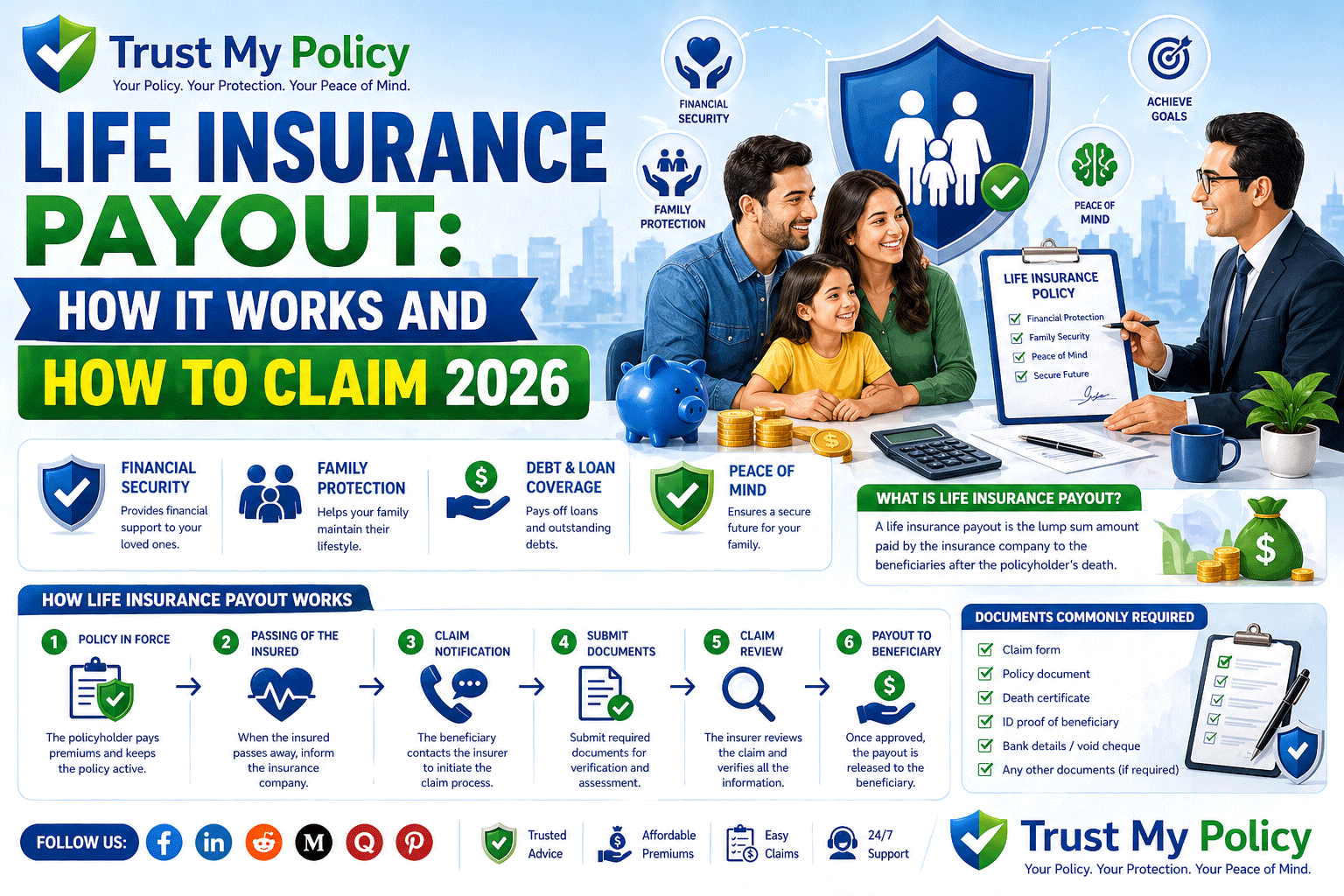
The general process:
- The beneficiary contacts the insurer and requests claim forms (most insurers now offer this online).
- The insurer typically asks for a certified death certificate, the policy number, and a completed claim form.
- The insurer reviews the claim — this is faster for straightforward cases and can take longer if the death occurred within the policy’s early “contestability period” (commonly the first two years), during which insurers can investigate for misrepresentation on the original application.
- If approved, the payout is issued, often within weeks for clean claims — though timelines vary by insurer and jurisdiction. In India, for example, insurers are required to settle claims within 30 days of receiving all required documentation, or up to 90 days if further investigation is needed, under IRDAI’s claim settlement rules.
Common reasons a claim can be delayed or denied:
- Inaccurate or incomplete information on the original application (misrepresentation)
- Death occurring within the contestability period alongside a disputed cause
- Death caused by an excluded event specifically named in the policy (exclusions vary by insurer)
- Missed premium payments causing the policy to have already lapsed
The practical takeaway: answer application questions completely and honestly, and make sure whoever you’d want to file a claim actually knows the policy exists and where to find it.
Cancelling or Changing Your Mind (Free-Look Periods)
Almost every level term policy comes with a free-look period — a window after you receive the policy during which you can cancel for a full refund, no questions asked. How long that window is depends on where you live:
- United States: Most states set a minimum free-look period of around 10 days, though several states require longer — commonly up to 30 days, particularly for older buyers. The exact figure is set at the state level and printed in your policy documents.
- United Kingdom: The FCA requires a cooling-off period of 30 days for pure protection and life insurance policies (14 days for most general insurance), starting from whichever is later — the policy start date or the date you receive your documents.
- India: IRDAI sets a minimum free-look period of 15 days for policies bought in person, and 30 days for policies bought electronically or through distance-selling channels.
If you cancel within the free-look window, you generally get every premium you paid back in full. Miss the window, and you can still cancel a term policy any time simply by stopping premium payments — but you won’t get a refund, and coverage lapses.
If Something Goes Wrong: Complaints and Regulators
If a claim is denied, or you feel a policy was mis-sold, you’re not without options. The right first step is always a formal complaint directly to the insurer — but if that doesn’t resolve things:
- United States: Each state has its own insurance department (regulated individually rather than nationally); a good starting point is your state’s Department of Insurance, which handles consumer complaints against insurers licensed in that state.
- United Kingdom: Insurers regulated by the FCA must acknowledge complaints and issue a final response within 8 weeks. If you’re unhappy with that response, or don’t get one in time, you can escalate — free of charge — to the Financial Ombudsman Service, generally within 6 months of the insurer’s final response.
- India: IRDAI oversees insurer conduct, and unresolved complaints can be escalated to the Insurance Ombudsman, a free, independent dispute resolution channel for policyholders.
Keep every document — the original policy, correspondence, and anything related to the disputed claim. It’s the single most useful thing you can do if a dispute ever needs to be escalated.
Common Mistakes
- Waiting too long to apply. Premiums rise with age, and a health change can affect both eligibility and price.
- Choosing too short a term. Needing coverage again after a term expires almost always means paying a lot more, later in life.
- Underinsuring based on what feels affordable today, rather than what dependents would actually need.
- Being imprecise on the application. Misrepresenting health history can lead to a denied claim later, even years down the line.
- Forgetting about the conversion window. If your policy has one, it may only be available for part of the term — not the whole thing.
- Assuming one quote reflects the market. Underwriting standards differ meaningfully between insurers, so it’s worth comparing more than one.
What Happens When the Term Ends
One of a few things happens, depending on your specific policy:
- Coverage simply ends. No more premiums, no more payout eligibility.
- Automatic renewal, if your policy includes it — usually year-to-year, at a substantially higher premium reflecting your current age.
- Conversion to permanent coverage, if your policy allows it and you exercise that option in time — often without new medical underwriting.
These provisions differ by insurer and by country, so it’s worth actually reading (or asking about) what your specific policy does at term’s end, well before you get there.
Real-World Examples
A 35-year-old with two young kids and a 25-year mortgage might take out a 25-year level term policy sized to cover the remaining mortgage balance plus several years of income replacement — so a sudden loss doesn’t also mean losing the house.
A 50-year-old with grown children and a nearly paid-off mortgage might choose a shorter 10-year term instead, mainly to cover remaining debts and bridge the years until retirement savings become fully accessible.
A self-employed 40-year-old with no employer-provided coverage might take a 20-year term sized to replace their income until a planned retirement age, giving their family a cushion during the working years when the household depends most heavily on that income.
(These are illustrative scenarios, not personalized recommendations.)
FAQ Section
Is level term life insurance the same thing as term life insurance? Not quite — level term is a specific type of term life insurance where the premium and death benefit stay fixed for the whole term. “Term life insurance” is the broader category, which also includes decreasing term and other variations.
Can I renew level term life insurance after the term ends? Often, yes, but the renewal rate is typically based on your age at renewal, not your original age — so it’s usually a lot more expensive than your original premium.
Does level term life insurance build cash value? No. That’s a feature of permanent policies like whole life or universal life, not standard term policies.
What happens if I stop paying premiums? The policy generally lapses and coverage ends, subject to whatever grace period your specific policy allows.
Can I convert level term life insurance to a permanent policy? Many, though not all, policies include a conversion option that lets you switch to permanent coverage without new medical underwriting, usually within a defined window during the term. Check your policy for the specific deadline.
How much level term life insurance do I actually need? It depends on your income, debts, dependents, and existing savings. A licensed financial advisor or insurance professional can help translate your specific situation into a number.
Is level term life insurance cheaper than whole life insurance? Generally, yes — term only covers a fixed period and skips the savings/investment component that makes permanent policies both lifelong and more expensive.
What’s the difference between the free-look period and the contestability period? They’re often confused but they’re opposites. The free-look period is your right, early on, to cancel the policy and get a full refund. The contestability period (commonly the first two years) is the window during which the insurer can investigate and potentially contest a claim if there was a misrepresentation on the original application.
6. Suggested Internal Links
- “Term Life Insurance vs. Whole Life Insurance: Which Is Right for You?”
- “How Much Life Insurance Do You Actually Need?”
- “How Does Life Insurance Underwriting Work?”
- “Decreasing Term Life Insurance Explained”
- “Life Insurance Conversion Options: What to Know Before Your Term Ends”
- “How to File a Life Insurance Claim: A Step-by-Step Guide”
- “What Is the Contestability Period in Life Insurance?”
Key Takeaways
- Level term life insurance locks in a fixed death benefit and fixed premium for a set number of years.
- It’s generally the most affordable way to secure a meaningful amount of coverage.
- Coverage ends at the term’s expiry unless you renew (usually at a higher cost) or convert to permanent coverage.
- Free-look periods let you cancel for a full refund early on — the window is typically 10–30 days in the US, 30 days in the UK, and 15–30 days in India, depending on how the policy was purchased.
- If a claim is disputed, formal complaints channels exist in every major market — state insurance departments in the US, the Financial Ombudsman Service in the UK, and the Insurance Ombudsman in India.
- This guide is educational and doesn’t replace personalized financial or legal advice.
Content Refresh Notes
- Free-look period figures for the US, UK, and India were verified via multiple sources as of July 2026; state-level US minimums and India’s IRDAI rules are both subject to periodic regulatory change and should be re-checked at each refresh.
- India: note ongoing government discussion (reported early 2026) about extending the free-look period further; not yet confirmed as enacted policy — re-verify before citing as current rule.
- India: recent GST exemption on individual life insurance premiums is a relevant, dateable regulatory change worth expanding on in a dedicated pricing-focused article, with the effective date confirmed against IRDAI/government sources at time of writing.
- Re-verify claim settlement timelines (India’s 30/90-day rule, UK’s 8-week complaint response window) annually, as regulatory timelines are periodically revised.
- Consider a follow-up cluster article specifically on the contestability period, since it’s a high-confusion, high-search topic distinct from the free-look period.
Mandatory Legal Disclaimer: This article is for informational and educational purposes only. Always consult a licensed insurance broker or qualified financial advisor before purchasing coverage. Trust My Policy does not sell insurance products or represent any insurer.
Jagadeesh Gutha
AUTHOR
Jagadeesh Gutha is the founder of TrustMyPolicy.com, an independent insurance information platform covering life, health, car, home, and business insurance for US and UK readers. He researches insurance products, policy structures, and consumer rights to help everyday people make informed coverage decisions without the jargon. All content on TrustMyPolicy is independently researched, fact-checked, and written to educate — not to sell.
Continue Reading





Reader Comments (0)