
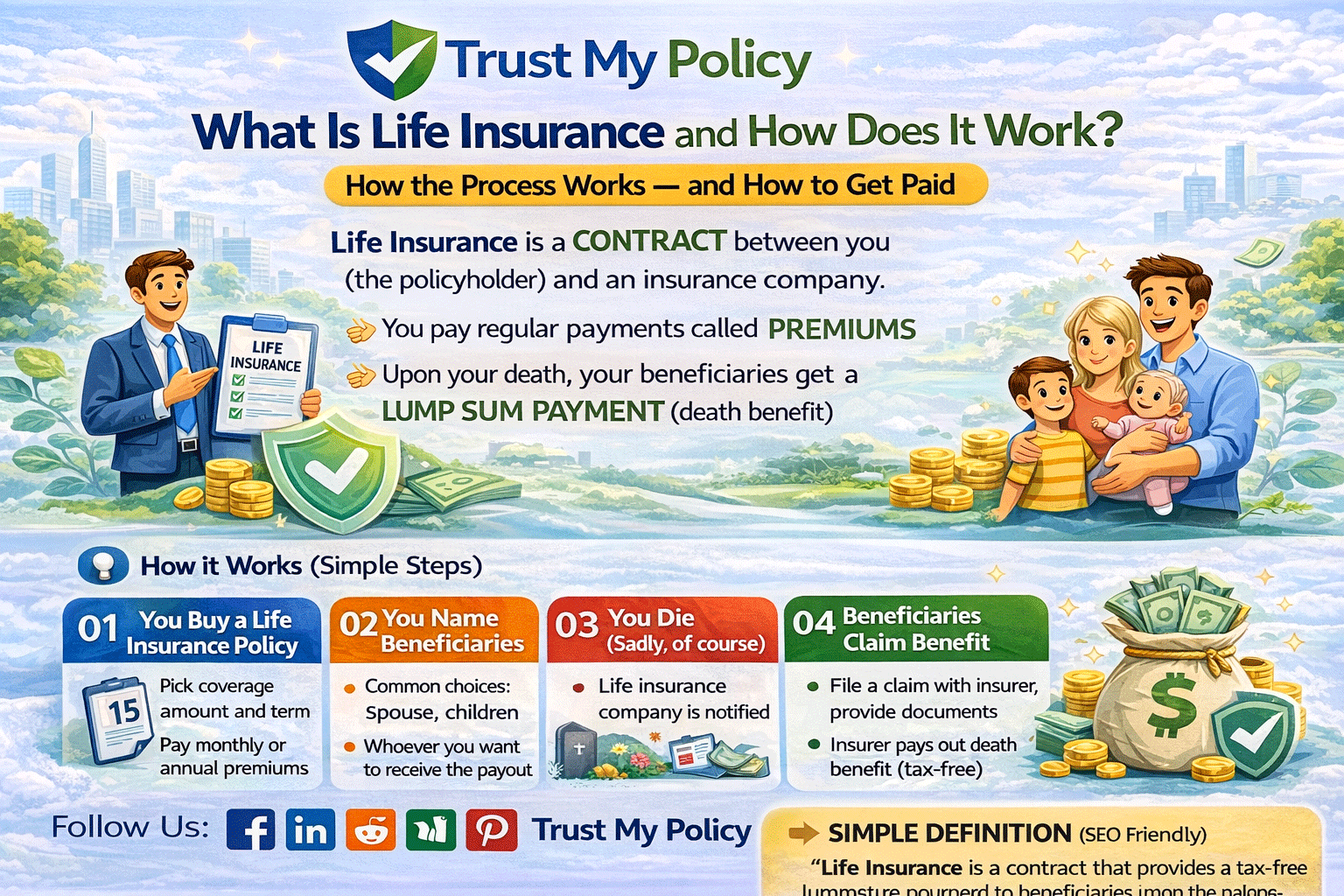
Life insurance is a contract between you and an insurance company. You pay regular premiums. In return, the insurer promises to pay a specified sum of money — called the death benefit or sum assured — to your nominated beneficiaries when you die. The payout is typically tax-free and can be used by your family for any purpose.
That’s the entire concept. The mechanics are simple:
When Tom’s father died unexpectedly at 54, the family discovered he had no life insurance. The mortgage had 12 years remaining. His wife worked part-time. The children were 15 and 18. Within a year, the family home was sold. Tom has had his own life insurance policy in place since the day he turned 27. ‘It took me about 20 minutes and cost me £14 a month,’ he says. ‘The hardest part was accepting that it was necessary.’
Life insurance is one of the simplest and most important financial products you can buy. It pays a sum of money to the people you choose when you die. That money can clear a mortgage, replace your income, fund your children’s education, or simply ensure your family doesn’t face financial devastation on top of grief.
This guide explains exactly what life insurance is, how it works, the different types available, what affects your premium, who genuinely needs it, and how to buy the right policy in the UK or USA in 2026.
Term life insurance covers you for a fixed period — the ‘term’. If you die during the term, the benefit is paid. If you outlive the term, the policy expires and nothing is paid out.
| Feature | Details |
| How long it lasts | 10, 15, 20, 25, or 30 years — you choose at the start |
| Premium | Fixed for the entire term — never increases |
| Cash value | None — pure insurance, no savings component |
| Payout | Only if you die within the term |
| Best for | Covering a mortgage, replacing income during working years, protecting dependants while they’re young |
| Cost (UK, non-smoker, 35, £250,000, 20 years) | Approximately £11–£16/month |
| Cost (USA, non-smoker, 35, $500,000, 20 years) | Approximately $25–$35/month |
| Types | Level term (fixed payout), decreasing term (reduces with mortgage balance), family income benefit (monthly payments rather than lump sum) |
Term life insurance is the most popular type for working-age people with dependants and a mortgage. It provides the maximum coverage for the minimum cost during the years your family needs protection most.
Whole life insurance covers you for your entire life, not just a fixed term. As long as you keep paying premiums, the policy remains in force and pays the death benefit whenever you die.
| Feature | Details |
| How long it lasts | Your entire life — no expiry date |
| Premium | Fixed (standard whole life) or reviewable (can change at intervals) |
| Cash value | Yes — a portion of your premium builds a cash value you can later borrow against or withdraw from |
| Payout | Guaranteed — whenever you die, as long as premiums are paid |
| Best for | Estate planning, leaving a guaranteed legacy, permanent protection for lifelong dependants, funeral cost cover |
| Cost (UK, non-smoker, 40, £100,000 whole life) | Approximately £150–£300/month |
| Cost (USA, non-smoker, 40, $100,000 whole life) | Approximately $100–$200/month |
| Policy Type | What It Is | Best For |
| Over 50s / Guaranteed issue | Whole life policy with guaranteed acceptance, no medical exam, coverage usually up to £20,000–$25,000; 2-year graded death benefit | Seniors who want funeral cost cover; those who cannot qualify for standard underwriting |
| Simplified issue | No medical exam; short health questionnaire; coverage up to £40,000–$50,000 | People with moderate health conditions who want faster approval than fully underwritten policies |
| Joint life insurance | Covers two people under one policy; pays out on the first death; policy then ends | Couples who want cheaper combined cover — but note: two single policies provide two payouts and better protection |
| Family income benefit | Instead of a lump sum, pays a monthly income to your family for the remainder of the policy term | Parents who want to replace a monthly salary; simpler for families to manage than a large lump sum |
| Relevant life insurance (UK) | Policy held by a limited company; provides life cover to a director; premiums are corporation tax deductible | UK limited company directors — most tax-efficient life cover structure |
| Universal life (USA) | Permanent coverage with flexible premiums and adjustable death benefit; cash value linked to interest rates | Those who want permanent cover with premium flexibility |
Your premium — what you pay each month or year — is calculated based on your statistical risk of dying during the policy term. The higher the risk, the higher the premium. Insurers assess:
| Factor | Effect on Premium | Notes |
| Age | Higher with age — every year you wait to apply costs more | A 30-year-old locks in a premium that is typically 30–50% cheaper than the same policy at 40 |
| Health history | Pre-existing conditions can load premiums or result in exclusions | Diabetes, heart disease, cancer history all affect rates; degree of control matters |
| Smoker status | 50–100% higher than non-smoker rates | Smokers include those who have smoked in the last 12 months; vaping is treated as smoking by most UK insurers |
| Amount of cover (sum assured) | Directly proportional — more cover = higher premium | Balance between what you need and what you can afford |
| Policy term | Longer term = higher total premium but same monthly cost for same level of cover | 20-year term typically cheaper per month than 25-year for same age and amount |
| Gender | Men pay slightly more than women (UK) as men statistically die younger | USA: gender pricing allowed in most states; some states prohibited |
| Occupation and lifestyle | High-risk occupations (construction, mining) and hobbies (skydiving, motorsport) can increase premiums | Declare honestly — non-disclosure voids claims |
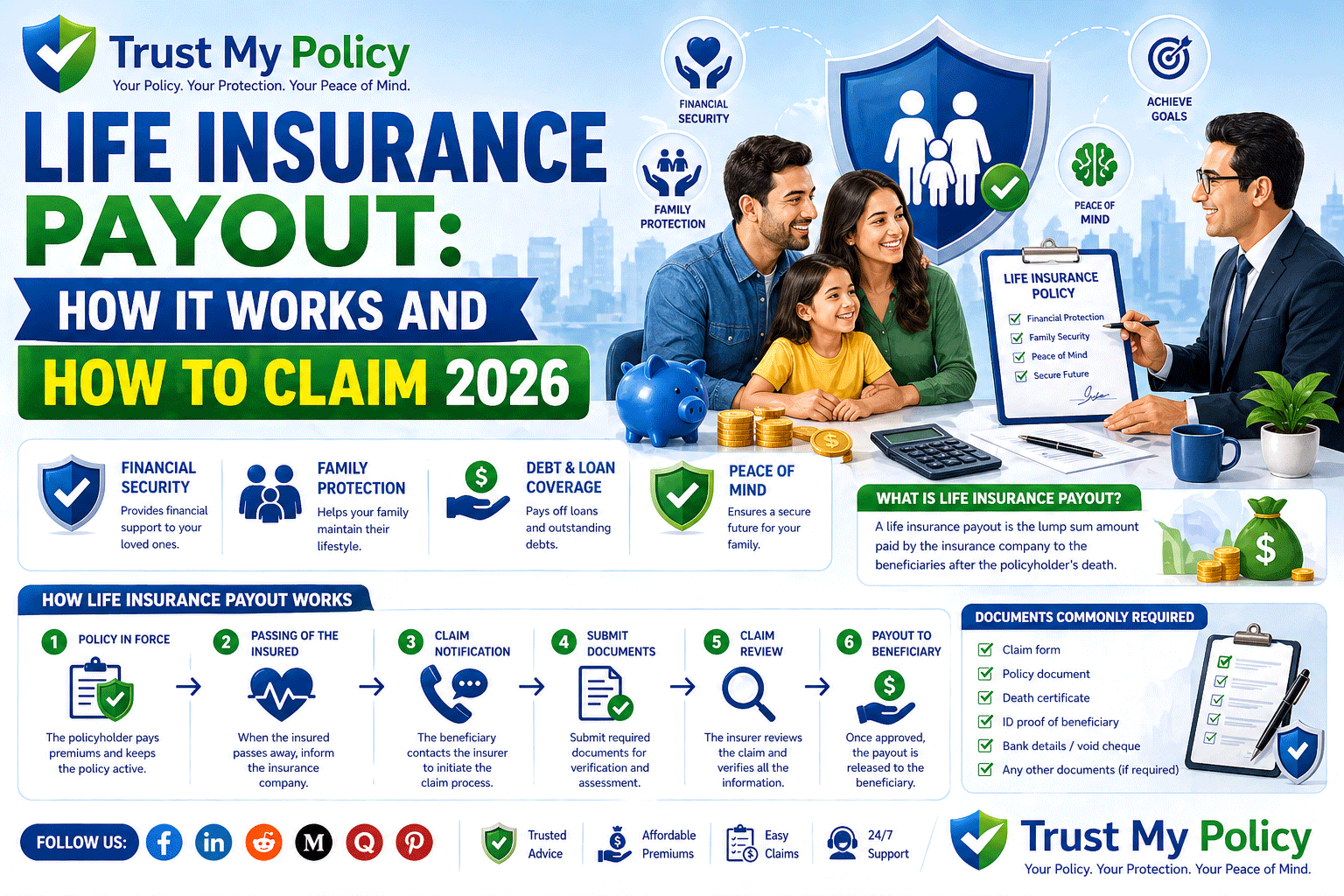
When the insured person dies, the beneficiaries (nominated in the policy) make a claim:
UK specific — write in trust: If your UK life insurance policy is written in trust, the payout goes directly to your nominated beneficiaries without passing through your estate — avoiding probate delays (which can take 6–12 months) and potential inheritance tax. Writing in trust is free and takes minutes. Do it at the time of application.
| Claim Scenario | Typical Outcome | Notes |
| Death from illness or accident — policy was active, premiums paid | Claim paid — full death benefit to beneficiaries | Standard outcome; majority of claims are paid this way |
| Death from suicide — within 12–24 months of policy start | Claim may be declined or reduced depending on policy terms | Standard exclusion; always read the suicide clause |
| Policyholder lied about health on application — discovered at claim | Claim denied; policy voided | Non-disclosure is the most common reason for claim denial |
| Policy lapsed due to missed premium — then policyholder died | Claim denied — no active policy | Keep premiums on direct debit; contact insurer immediately if you miss a payment |
| Death occurs after term ended — term life policy | No payout — policy expired | This is expected; term life is not meant to be permanent cover |
| Your Situation | Recommendation |
| You have a partner or children who depend on your income | Yes — essential. Your death would leave them financially vulnerable. |
| You have a mortgage | Yes — at minimum, enough to cover the outstanding mortgage balance. |
| You’re single with no dependants and no mortgage | Probably not essential right now. Consider if your situation changes. |
| You’re self-employed with no employer death-in-service benefit | Yes — you have no employer safety net. Term life is particularly important. |
| You have significant savings and your family would be financially secure | May not be necessary if your estate fully covers your family’s needs. |
| You want to leave a guaranteed legacy or cover funeral costs | Yes — whole life or final expense policy for a guaranteed payout whenever you die. |
| Your children are now financially independent and mortgage is paid | Review your cover — you may need less than before, but income replacement for a surviving spouse may still be relevant. |
| 💡 How Much Life Insurance Do You Need?
A starting point: your outstanding mortgage balance + 5–10 times your annual income. For a more accurate figure, use the DIME method: Debt + Income (years of replacement needed × annual income) + Mortgage + Education/dependant costs. Subtract any existing death-in-service benefit, savings, and other cover. The result is the net gap to insure. |
Tom has a £180,000 mortgage, a partner, and is planning children. He takes out a £300,000 level term policy over 25 years at £14/month with Legal & General. If he dies in the next 25 years, his partner receives £300,000 tax-free — enough to clear the mortgage and provide an income buffer. If he lives to 52, the policy expires and he’s paid £4,200 in total — the cost of 25 years of family financial protection.
Sarah is a director of her own IT consultancy. She needs £500,000 of life cover. A personal term life policy would cost her £45/month from post-tax income — but her accountant recommends Relevant Life Insurance instead. Her company pays the £45/month premium as a corporation tax-deductible business expense. The effective cost to Sarah: approximately £36/month after tax relief. The policy is held in trust, so the payout is inheritance tax-free to her family. Same cover, significantly lower effective cost.
Patricia wants to make sure her daughter doesn’t bear the cost of her funeral (approximately £4,000–£9,000 in the UK). She takes out a £10,000 guaranteed issue Over 50s plan at £28/month. No medical exam, no health questions. The 2-year graded benefit applies — if she dies in year one, only premiums are returned. But after 2 years, her daughter receives £10,000 guaranteed whenever Patricia dies. Total cost after 5 years of paying: £1,680 for a guaranteed £10,000 payout.
Carlos earns $75,000/year, has a $240,000 mortgage, and two young children. He takes out a $500,000 20-year term life policy through Banner Life at $29/month as a non-smoker in good health. His wife is the beneficiary. If Carlos dies in the next 20 years, she receives $500,000 tax-free — enough to clear the mortgage and replace 3.5 years of his income. Total 20-year cost: $6,960.
Term life insurance covers you for a fixed period (e.g. 20 years) and pays out only if you die during that term. If you outlive the term, the policy expires with no payout. Whole life insurance covers you permanently — for your entire life — and guarantees a payout whenever you die. Term life is significantly cheaper but temporary. Whole life is permanent but costs 5–10 times more per dollar/pound of coverage.
In the UK: yes, the life insurance death benefit is generally paid free of income tax and capital gains tax. However, if the policy forms part of your estate, it could be subject to 40% inheritance tax if your estate exceeds the £325,000 threshold. Writing your policy in trust removes it from your estate entirely, making the payout fully tax-free in most cases. In the USA: death benefits from life insurance are generally income tax-free to beneficiaries under IRC Section 101(a).
Yes — you can hold multiple life insurance policies with different providers simultaneously. This is legal and sometimes advisable. For example, a 20-year mortgage protection policy plus a whole life final expense policy, or a large term policy plus a critical illness policy. There is no legal limit to how many policies you can hold, though each insurer will consider your total insured amount relative to your income and assets.
Standard life insurance covers death from any cause — illness, accident, natural causes — as long as the policy is in force and the death is not excluded (e.g. suicide in the first 12–24 months, or death resulting from a declared excluded activity). Accidental death and dismemberment (AD&D) insurance is a separate, much narrower product that only covers accidental death and specific injuries.
For a healthy non-smoker in their 30s: term life insurance starts from approximately £10–£15/month (UK) or $20–$30/month (USA) for $250,000–$500,000 of cover over 20 years. Premiums rise with age, health conditions, and smoking status. A 45-year-old pays approximately 2–3 times more than a 30-year-old for identical coverage. A smoker pays 50–100% more than a non-smoker.
For specific guidance on term life, see our term life insurance for parents with young children guide. To understand how much cover you need, use our how much life insurance do I need calculator guide.
| 📋 Disclaimer
This article is for informational purposes only and does not constitute financial or insurance advice. Always consult a licensed insurance professional for guidance specific to your situation. TrustMyPolicy.com does not sell insurance products or represent any insurer. |

Jagadeesh Gutha is the founder of TrustMyPolicy.com, an independent insurance information platform covering life, health, car, home, and business insurance for US and UK readers. He researches insurance products, policy structures, and consumer rights to help everyday people make informed coverage decisions without the jargon. All content on TrustMyPolicy is independently researched, fact-checked, and written to educate — not to sell.



Insurance Guides for UK, USA & Worldwide We are not an insurer or broker.
Reader Comments (0)