
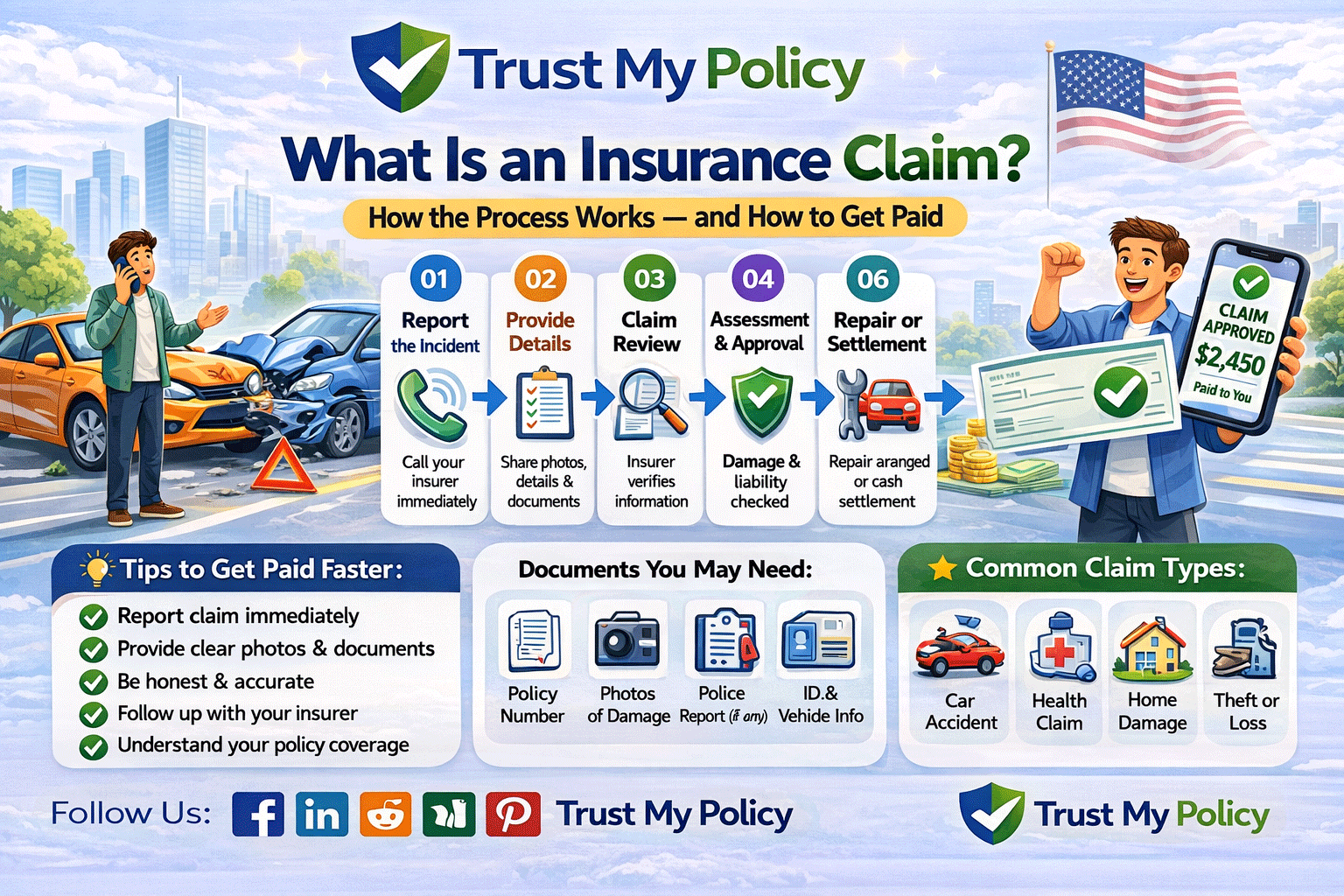
An insurance claim is a formal request made by a policyholder to their insurance company asking for payment or coverage for a loss or event that is covered under the terms of their policy. When you file a claim, you are asking the insurer to fulfil the promise it made in exchange for your premiums. The insurer will then investigate the claim, determine whether it falls within the policy’s coverage, and — if approved — make a payment or arrange repair/replacement.
In simple terms: something bad happened, you’re covered for it, and you’re asking your insurer to pay. The claim is the formal process that makes that happen.
Claims are the entire point of having insurance. Everything else — the premiums, the policy documents, the underwriting process — exists to make this moment possible. When a claim is paid fairly and promptly, the insurance system works as intended. When it’s denied or delayed unfairly, that’s when disputes arise.
After the flood, Maria had water to her knees in her ground-floor flat. Her home insurance policy had buildings and contents cover. She called her insurer the same evening and was told an assessor would visit within 72 hours. Within two weeks, she had a cheque for £14,800 covering replacement of the flooring, skirting boards, kitchen units, and contents. The process was stressful — but it worked because she’d documented everything, called immediately, and hadn’t thrown anything away before the assessor visited.
An insurance claim is how you turn your insurance policy into money. You’ve been paying premiums for months or years. When the event your policy covers actually happens, the claim is the mechanism for converting that policy into the financial help it promised.
This guide explains exactly what an insurance claim is, how the claims process works step by step across different types of insurance, why claims are sometimes denied, and what you can do to give your claim the best possible chance of being paid.
The first step in any claim is notifying your insurer as soon as the covered event occurs — or as soon as you discover it. Most policies have a notification requirement in the conditions section: ‘notify us as soon as reasonably possible’ or within a specific timeframe (e.g. 24 hours for a car accident).
Delaying notification can give the insurer grounds to reduce or deny your claim, particularly if the delay resulted in additional damage that could have been prevented (failure to mitigate). Contact your insurer’s claims line — available 24/7 for most major UK and US insurers — even if you’re not yet sure whether you’ll proceed with a formal claim.
Before any repair, cleanup, or disposal — document everything:
| 💡 TIP: Document Before You Act
The most common mistake claimants make is cleaning up or disposing of damaged property before documenting it or before the assessor visits. A claims assessor who cannot see the original damage has only your word and photos to go on — and photos from multiple angles are invaluable. Spend 15 minutes documenting before you do anything else. |
Most insurers require you to complete a formal claim form — either online, by phone, or on paper. The form asks for: your policy number; the date, time, and nature of the incident; a description of the loss or damage; a list of items claimed for; any supporting documentation (receipts, valuations, photos, police reports, death certificate for life claims).
Be accurate and complete. Exaggerating a claim — adding items you didn’t lose, inflating values — is insurance fraud. UK law and US state insurance laws both treat fraudulent claims as criminal offences. It also gives the insurer grounds to void your entire policy, not just deny the specific claim.
Once your claim is submitted, the insurer begins their investigation. Depending on the claim type and size, this involves:
| Claim Type | Investigation Process | Typical Timeframe |
| Small home / contents claim (under £5,000 / $5,000) | Desk review of documentation and photos; may call you for clarification | 1–2 weeks |
| Larger home claim / flood damage | Physical assessor visits the property; estimates are obtained from approved contractors | 2–4 weeks |
| Car accident claim | Insurer reviews police report, photos, independent witness statements; may instruct an approved repairer | 1–3 weeks for straightforward claims |
| Health insurance claim (UK PMI) | Review of medical records to determine if condition is covered under underwriting terms; GP notes obtained | 1–4 weeks depending on complexity |
| Life insurance death claim | Death certificate required; policy verified as in force; for large claims, medical records reviewed | UK: 5–30 working days; USA: 30–60 days typically |
| Disability / income protection claim | Medical evidence from GP and consultant; functional assessment may be required | 4–8 weeks; ongoing reviews throughout claim period |
After investigation, the insurer issues a decision:
If approved: The insurer pays the claim — either as a cash payment to you, directly to a repair company or hospital, or (in the case of life insurance) to your beneficiaries. In the UK, most large insurers aim to pay straightforward claims within 5–30 working days. In the USA, most states require insurers to acknowledge claims within 10–15 days and pay promptly once approved.
If denied: The insurer issues a written decline letter explaining the reason. Common reasons for denial include: the loss falls under an exclusion; the cause of damage is not covered; the notification was too late; the claim involves non-disclosure or misrepresentation; or the loss occurred outside the policy period.
| Insurance Type | What a Claim Involves | Payout Method |
| Car insurance (at-fault accident) | Report accident, photos of damage, third party details, police reference if applicable | Repair cost paid to approved garage; or cash settlement to you |
| Car insurance (theft) | Police report, crime reference number, proof of ownership | Cash payment based on market value of vehicle at time of theft |
| Home buildings insurance | Damage documentation, assessor visit for larger claims, contractor estimates | Repair costs paid directly or to contractor; cash settlement for total loss |
| Home contents insurance | List of stolen/damaged items with receipts or valuations | Cash payment; some policies offer replacement with new equivalent items |
| Health / medical insurance (UK PMI) | GP referral, pre-authorisation from insurer, then treatment | Directly to private hospital/consultant; or reimbursement to you |
| Life insurance | Death certificate, policy document, beneficiary ID | Lump sum payment to beneficiaries (tax-free in UK and USA) |
| Income protection / disability | Medical evidence of inability to work; ongoing review | Monthly income to policyholder; paid to you directly |
| Travel insurance | Documentation of cancellation, medical emergency, or lost baggage | Cash reimbursement or direct payment to medical provider abroad |
| Reason for Denial | What It Means | How to Avoid It |
| Exclusion applies | The specific event or cause is in the policy’s exclusions list | Read exclusions before you buy; ask your broker about specific scenarios |
| Non-disclosure / misrepresentation | You didn’t tell the insurer about a material fact on the application | Always disclose fully on application; update the insurer if circumstances change |
| Late notification | You reported the claim too late under the policy conditions | Notify as soon as the event occurs — even before you decide whether to proceed |
| Failure to mitigate | You didn’t take reasonable steps to prevent further damage | Make emergency repairs immediately; document everything before and after |
| Excess/deductible exceeds loss | Your excess is higher than the total claim amount | Only claim when loss genuinely exceeds your excess |
| Pre-existing condition (health) | The condition was present before the policy or within the moratorium period | Understand your underwriting terms; choose FMU if you want written clarity upfront |
| Policy lapsed | Premiums weren’t paid — no active policy at the time of loss | Set premiums on direct debit; contact insurer immediately if you miss a payment |
| Fraud suspicion | Claim appears inflated, staged, or inconsistent with evidence | Be accurate; never exaggerate; cooperate fully with the investigation |
UK — Financial Ombudsman Service (FOS): Free, independent service for consumer insurance disputes. You can complain to the FOS if your insurer has not resolved your complaint within 8 weeks, or if you’re unhappy with their final response. The FOS decision is binding on the insurer but not on you — you can still pursue legal action if you disagree with the FOS outcome.
Maria notified insurer same evening; photographed all damage before cleanup; cooperated fully with assessor; kept all damaged items until inspection. Claim: £14,800. Outcome: paid in full within 14 days. Lesson: document immediately, notify promptly, cooperate fully.
David discovered water damage under his kitchen floor after several months. His insurer found evidence of a slow, gradual leak (staining patterns consistent with weeks of leakage). His policy covered sudden and accidental water damage but excluded gradual damage. Claim denied. Lesson: understand the difference between ‘sudden’ and ‘gradual’ damage before signing. Read the definitions and exclusions sections.
Raj made a PMI claim for knee surgery. The insurer obtained his GP records and found a consultation about knee pain 14 months before his policy started — within the 5-year look-back window. His moratorium excluded this condition for 2 years from policy start. The claim occurred 8 months into his policy — inside the exclusion window. Claim denied. Lesson: consider full medical underwriting if you have any recent health history — you get written exclusions upfront rather than surprises at claim time.
Carlos was involved in an at-fault accident in Texas. He called his insurer from the scene, photographed the damage, exchanged details with the other driver, and filed a police report. His insurer assigned an approved repairer. His car was repaired within 9 days. He paid his $500 deductible; the insurer paid $6,200 for the full repair. His premium increased 28% at renewal, but he protected his driving record by not claiming for a minor prior incident. Lesson: use insurance for genuine losses; minor claims that barely exceed the deductible can cost more in future premiums than the claim was worth.
Not always. For small losses that only slightly exceed your excess/deductible, making a claim can cost more in future premium increases than the claim payout delivers.
| Claim Amount | Your Excess | Net Payout | Future Premium Increase (estimate, 3 years) | Net Financial Outcome |
| £800 damage | £250 excess | £550 paid | £150/year × 3 = £450 increase | Net benefit: £100 — borderline; worth it if damage is real need |
| £250 damage | £250 excess | £0 paid | £100/year × 3 = £300 increase | Net loss: £300 — don’t claim; pay out of pocket |
| £5,000 damage | £250 excess | £4,750 paid | £200/year × 3 = £600 increase | Net benefit: £4,150 — definitely claim |
| £400 contents theft | £200 excess | £200 paid | £120/year × 3 = £360 increase | Net loss: £160 — pay out of pocket |
| 💡 The Claim Decision Framework
Before filing a claim, calculate: (1) Net payout = claim amount – excess. (2) Estimated premium increase × number of years it will affect your renewal (typically 3–5 years). If net payout > estimated total premium increase, claim. If not, consider paying out of pocket and protecting your no-claims bonus. |
An insurance claim is a formal request made to your insurance company asking for payment or coverage after a covered event occurs. When you file a claim, you’re asking the insurer to fulfil its contractual promise to cover the loss described in your policy. The insurer investigates the claim, verifies it falls within coverage terms, and if approved, makes a payment to you, your beneficiaries, or directly to service providers (hospitals, garages, repair contractors).
Claim timelines vary by type and insurer: Car insurance straightforward claims: 1–3 weeks. Home insurance (small claims): 1–2 weeks; larger claims with assessor visits: 2–6 weeks. UK life insurance claims: 5–30 working days (UK’s largest insurers). USA life insurance: 30–60 days typically. Health insurance (UK PMI): 1–4 weeks for authorisation; medical records take time. Income protection: 4–8 weeks; ongoing monthly once approved.
Yes — making a claim typically increases your premium at renewal, particularly for car and home insurance. The size of the increase depends on the insurer, the nature of the claim, and your claims history. A single at-fault car accident can raise premiums 20–40% for 3–5 years. A home claim may increase premiums 10–25% for 2–3 years. For small losses only slightly above your excess, consider whether the net payout after premium increases is actually positive before filing.
If your claim is denied, you have several options: (1) Review the denial letter to understand the specific reason; (2) Gather additional evidence to challenge the reason; (3) Submit a formal written complaint to the insurer; (4) In the UK, escalate to the Financial Ombudsman Service (FOS) — free and independent; (5) In the USA, contact your state’s Department of Insurance consumer division; (6) Consult a public adjuster or insurance lawyer for complex or high-value disputes.
For theft and vandalism claims, most UK and US insurers require a crime reference number from the police as a condition of the claim. For accidental damage claims (burst pipes, accidental breakage), a police report is generally not required. For car accident claims, a police report is strongly advisable even when not strictly required — it provides independent documentation of the incident. Always check your policy’s specific requirements, particularly for the notification of incidents.
To understand what your policy covers before you need to claim, see our insurance policy definition guide. For an explanation of how premiums change after a claim, see our premium definition insurance article.
| 📋 Disclaimer
This article is for informational purposes only and does not constitute financial or insurance advice. Always consult a licensed insurance professional for guidance specific to your situation. TrustMyPolicy.com does not sell insurance products or represent any insurer. |

Jagadeesh Gutha is the founder of TrustMyPolicy.com, an independent insurance information platform covering life, health, car, home, and business insurance for US and UK readers. He researches insurance products, policy structures, and consumer rights to help everyday people make informed coverage decisions without the jargon. All content on TrustMyPolicy is independently researched, fact-checked, and written to educate — not to sell.



Insurance Guides for UK, USA & Worldwide We are not an insurer or broker.


Reader Comments (0)