
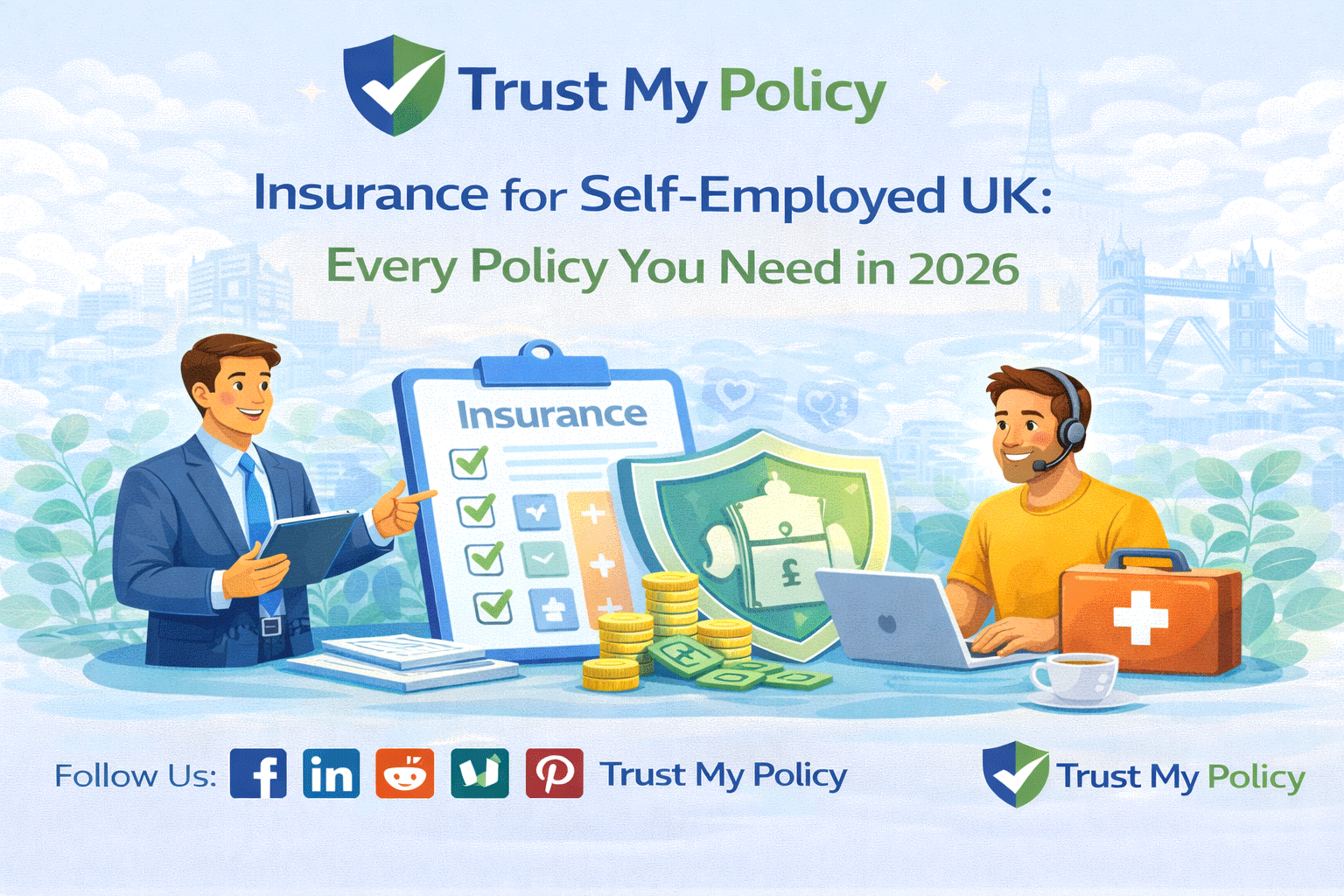
The most important insurances for self employed people in the UK are: public liability insurance (required by many clients and contracts), professional indemnity insurance (essential for advisers, consultants, designers), income protection insurance (replaces your income if you’re too ill to work), and private health insurance (bypasses NHS waiting lists). Public liability starts from around £5.64/month. None of these are legally mandatory for sole traders — but each protects against a different existential risk.
When James, a freelance electrician from Bristol, accidentally damaged a client’s kitchen ceiling during a rewire, the repair bill came to £4,300. He didn’t have public liability insurance. He paid out of his own pocket. It wiped out two months of profit. Six weeks later, he was covered — for £6.40/month.
Insurance for self employed workers in the UK is not a one-size-fits-all purchase. You need different types of cover depending on whether you’re a tradesperson, consultant, creative freelancer, or limited company director. Some of it is legally required. Most of it isn’t — but without it, a single claim or illness could end your business.
This guide covers every type of insurance relevant to the self employed in the UK in 2026: what each one does, what it costs, who needs it, and which providers offer the best value. The 4.33 million self employed people in the UK have no employer to fall back on. Your insurance is your safety net.
| Policy Type | What It Covers | Legally Required? | Typical Monthly Cost |
| Public Liability | Injury to a third party or damage to their property caused by your work | No (but often required by clients) | From £5.64/month |
| Professional Indemnity | Claims from clients for advice/errors that cost them money | No (but required by many professions) | From £10–£30/month |
| Employers’ Liability | Injury/illness claims from any staff or subcontractors you hire | Yes, if you employ anyone | From £60–£120/month |
| Income Protection | Replaces 50–70% of your income if you cannot work due to illness/injury | No | From £15–£40/month |
| Private Health Insurance | Fast-tracks treatment, bypasses NHS waiting lists | No | From £35–£80/month |
| Life Insurance | Lump sum payout to dependants if you die | No | From £10–£30/month |
| Business Equipment/Tools | Repair or replacement of tools, laptops, specialist kit | No | From £5–£20/month |
| Cyber Insurance | Data breach liability and recovery costs | No (recommended for data handlers) | From £10–£25/month |
Self-employed insurance is not a single product — it’s a collection of policies that together protect you, your business, your clients, and your income from the specific risks you face working for yourself. Unlike employed workers who benefit from employers’ liability cover, workplace health schemes, and statutory sick pay, you are entirely responsible for your own protection.
Think of it like a toolbox. Each type of insurance is a different tool — you don’t always need every tool in the box, but the ones you do need, you really need. A consultant who gives bad advice can face a professional indemnity claim worth tens of thousands. A builder without public liability insurance can be personally liable for injuries on a client’s property.
In the UK, the FCA regulates insurance products and the Health and Safety Executive (HSE) mandates employers’ liability for businesses with staff. Most other types of self employed insurance are voluntary — but skipping them carries serious financial risk.
Public liability (PL) covers you if your business activity injures a third party or damages their property. If a client trips over your cable and breaks their wrist, or you spill a drink on their laptop, PL pays the legal and compensation costs.
Who needs it: Any sole trader or freelancer who works at client premises, has clients visit their workspace, or works in public spaces. Tradespeople, consultants, photographers, personal trainers, therapists, market traders — almost everyone.
Cost: From £5.64/month for up to £2 million cover (Simply Business, 2026 pricing). Cover typically ranges from £1 million to £10 million.
Best providers: Simply Business, Hiscox, AXA. Simply Business compares quotes across multiple insurers for trades and freelancers.
Professional indemnity (PI) protects you against claims that your professional advice, design, or service caused a client financial loss. Even if the claim is baseless, legal defence costs alone can reach £50,000+.
Who needs it: Consultants, accountants, architects, IT professionals, marketers, designers, solicitors, financial advisers, and anyone who provides advice or a professional service. Many professional bodies require PI as a condition of membership.
Cost: From £10–£30/month for lower cover amounts. Higher-risk professions (legal, financial, medical) pay more.
Best providers: Hiscox, Simply Business, AXA. Hiscox is particularly strong for tech and creative freelancers.
Employers’ liability (EL) is legally mandatory under the Employers’ Liability (Compulsory Insurance) Act 1969 if you employ anyone — including part-time staff, temporary workers, and in some cases subcontractors. You must hold at least £5 million of cover. The fine for non-compliance is up to £2,500/day.
Who needs it: Any self employed person who hires staff, uses regular subcontractors, or has apprentices. If you work entirely alone, you don’t need it.
Cost: From £60–£120/month depending on the number of employees and the nature of the work.
Income protection is the most underused and most important insurance for self employed people. If you cannot work due to illness or injury, this policy pays you a monthly income — typically 50–70% of your pre-illness earnings — until you recover, retire, or the policy term ends.
Why it matters: As a sole trader or freelancer, you have no statutory sick pay (SSP). If you’re off for 6 months with a serious illness, your income drops to zero. Income protection bridges that gap.
Who needs it: Every self employed person with financial commitments — mortgage, rent, dependants, business overheads.
Cost: From £15–£40/month depending on your age, income level, occupation, and chosen deferral period (how long before payments begin — typically 4, 8, 13, or 26 weeks).
Best providers: Royal London, Aviva, Legal & General, The Exeter. The Exeter specialises in policies for the self employed with flexible self employed income definitions.
| ⚠️ WARNING: The Self Employed’s Biggest Protection Gap
Research from Opinium found that 13% of self-employed people have no life insurance, PMI, critical illness cover, or income protection at all. The HMRC does not provide meaningful sick pay for self-employed workers — Employment and Support Allowance (ESA) pays just £84.80/week (2026), which is not enough to cover most household expenses, let alone business costs. Income protection is not optional for the self employed. It is essential. |
Private medical insurance (PMI) gives you access to private healthcare — faster diagnosis, specialist appointments, and treatment — bypassing NHS waiting lists that can run 6–18 months for non-emergency procedures. For the self employed, time off sick is lost income.
Who needs it: Any self employed person who cannot afford to be off work for months waiting for NHS treatment. Particularly important for those with no sick pay, no partner’s income, and tight business margins.
Cost: AXA Health quotes from £50.02/month for a 35-year-old in Guildford with standard cover (moratorium underwriting, October 2025). Aviva reports 25% of customers aged 35–50 paid under £46.53/month in Q3 2025.
Best providers: Bupa (Bupa By You Comprehensive), Aviva (Healthier Solutions), AXA Health (Personal Health), Vitality (Personal Healthcare), The Exeter (Health+). All five are Defaqto 5-star rated.
Tax note: As a sole trader, PMI premiums are typically a personal expense (not tax-deductible). If you operate as a limited company, your company can pay for PMI as a business expense — but this becomes a taxable benefit-in-kind for you personally. Consult your accountant.
Life insurance pays a lump sum to your dependants if you die. As a self-employed person with no employer death-in-service benefit, you need to arrange this yourself if you have a partner, children, or a mortgage.
Cost: From £10–£20/month for a healthy non-smoker in their 30s with £200,000 of term cover over 20 years. Premiums are fixed for the term.
Best providers: Legal & General, Aviva, Royal London. For self-employed with variable income, Royal London’s Reviewable term policies are worth considering.
If your tools, laptop, cameras, or specialist equipment are damaged, stolen, or lost, this policy pays for repair or replacement. Standard home contents insurance rarely covers business equipment.
Who needs it: Tradespeople, photographers, musicians, IT contractors — anyone whose business depends on physical equipment.
Cost: From £5–£20/month depending on the value and nature of equipment.
If you handle client data and suffer a data breach, cyber liability insurance covers regulatory fines, legal costs, and client notification expenses. Since GDPR came into force, the Information Commissioner’s Office (ICO) can fine businesses up to £17.5 million or 4% of global turnover for data breaches.
Who needs it: Freelancers handling sensitive client data, IT contractors, marketing consultants, accountants, and anyone who stores personal data.
Cost: From £10–£25/month for basic cyber cover.
| Policy | Covers | Does NOT Cover | Best Provider (UK) |
| Public Liability | Third-party injury/property damage | Your own injury or equipment | Simply Business, Hiscox |
| Professional Indemnity | Client claims for advice errors or negligence | Deliberate wrongdoing | Hiscox, AXA |
| Employers’ Liability (legal req.) | Employee/subcontractor injury claims | Your own personal injury | AXA, Aviva |
| Income Protection | Monthly income if too ill/injured to work | Unemployment (redundancy) | The Exeter, Royal London |
| Private Health Insurance | Fast private treatment for acute conditions | Pre-existing conditions (initially), chronic conditions | Bupa, Aviva, AXA Health |
| Life Insurance | Lump sum for dependants on your death | Illness or disability | Legal & General, Aviva |
| Business Equipment | Repair/replacement of tools and kit | Vehicle accidents (need separate cover) | Simply Business, Hiscox |
| Cyber Insurance | Data breach costs and ICO regulatory exposure | Physical damage to IT systems | Hiscox, AXA |
Risks: Tom gives clients code and design advice. If something goes wrong with a website — say, a security flaw loses a client’s customer data — Tom could face a claim of £30,000+. He also has a mortgage and no sick pay.
What he needs: Professional indemnity (£1 million cover, £12/month with Hiscox), income protection (4-week deferral, £22/month with Aviva), and a small public liability policy (£6/month). Total: ~£40/month.
Verdict: PI is non-negotiable for any freelancer providing professional services. Income protection is equally essential — Tom cannot survive 3 months off work without income.
Risks: Sandra works at client premises daily. She has one employed apprentice and uses specialist tools worth £8,000. An accidental flood at a client’s property could cost £20,000.
What she needs: Public liability (£2 million, £8/month), employers’ liability (legally required, £75/month), tools insurance (£12/month), income protection (£30/month). Total: ~£125/month.
Verdict: Employers’ liability is not optional once Sandra hired her apprentice. Without it, she risks £2,500/day fines from the HSE. Tools insurance is cheap protection for her most valuable business assets.
Risks: Priya advises FMCG brands on digital campaigns. A campaign she recommended underperformed badly — the client claimed Priya’s advice caused £45,000 in wasted spend. Priya also has two young children and a mortgage.
What she needs: Professional indemnity (£1 million, £18/month with AXA), life insurance (£250,000 level term, £13/month with Legal & General), income protection (£25/month), and private health insurance (£52/month with Bupa). Total: ~£108/month.
Verdict: Priya’s key risk is a PI claim. But given her family situation, income protection and life insurance are equally critical — if she’s ill for 6 months, her family’s mortgage is at risk. PMI ensures she gets treated and back to work quickly, rather than waiting months for NHS referrals.
Risks: Derek handles client tax returns. A filing error that resulted in a £20,000 HMRC penalty for a client led to a professional negligence claim. Derek is also a sole earner with a health condition that means he monitors his health closely.
What he needs: Professional indemnity (£500k, £22/month — often required by ICAEW/AAT membership), private health insurance (£65/month with Vitality — good for monitoring chronic conditions), income protection (£35/month with The Exeter — excellent for over-50s self-employed). Total: ~£122/month.
Verdict: Accountants are in a high-risk category for PI claims. The Exeter’s income protection is particularly well-suited to self-employed people over 50, using a more favourable definition of self-employed income for claims assessment.
| Pros | Cons |
| Protects against existential financial risks — one PL claim can wipe out years of savings | Not all policies are tax-deductible for sole traders — consult an accountant |
| Income protection fills the SSP gap that employed workers have by default | Premiums add up — a full suite of cover can cost £80–£150/month |
| PI insurance is often a prerequisite to winning contracts with larger clients | Pre-existing health conditions can affect income protection and PMI pricing |
| Private health insurance keeps you working — delays in treatment mean lost income | Some policies have complex exclusions that only become clear at claim time |
| Bundling policies with one provider (e.g. Simply Business, Hiscox) can reduce admin | Over-insuring is possible — assess your actual risk exposure before buying |
| FCA regulation means all policies must meet minimum standards of fairness | Employers’ liability premiums rise significantly with headcount and risk level |
Most home insurance policies explicitly exclude business equipment or limit cover to £1,000–£2,000. If your laptop, camera, or tools are used for business, check your home policy — and get separate business equipment cover if they’re not fully covered.
| ⚠️ WARNING
Working without public liability insurance when a client or contract requires it can immediately void that contract. Many local authority and commercial contracts, as well as platforms like TaskRabbit and Bark.com, require proof of PL cover before work begins. Always check your contracts. |
The most common reason to claim income protection is not a dramatic accident — it’s back problems, mental health conditions, and cancer. These are statistical realities. A healthy 38-year-old has a 1-in-3 chance of suffering a long-term illness before retirement age. Income protection is cheap insurance against the most common risk, not an edge case.
PL and PI cover different risks. PL covers accidental physical damage. PI covers financial loss from your advice or work quality. A consultant or designer needs PI far more than PL — but many skip it because they don’t work in physical environments.
If you work from home and haven’t told your home insurer you also run a business from that address, your claim for a business-related incident could be declined. Always declare your self-employed status and any business visitors to your home insurer.
Many sole traders assume EL only applies to full-time employees. But under the Employers’ Liability (Compulsory Insurance) Act 1969, the requirement can extend to labour-only subcontractors and some casual workers. If in doubt, check with an FCA-regulated insurance broker.
| Policy | Minimum Cost | Mid-Range Cost | Notes |
| Public Liability (£2m) | £5.64/month | £10–£20/month | Higher-risk trades cost more |
| Professional Indemnity (£250k) | £10/month | £18–£35/month | Higher cover or higher-risk profession increases cost |
| Employers’ Liability | £60/month | £80–£150/month | Legal minimum; cost rises with employee count |
| Income Protection (50% income) | £15/month | £25–£50/month | Age, health, occupation, and deferral period affect price |
| Private Health Insurance (basic) | £35/month | £50–£90/month | Age and location are key cost drivers |
| Life Insurance (£200k term) | £10/month | £15–£30/month | Non-smokers in good health pay least |
| Business Equipment (£5k cover) | £5/month | £10–£20/month | Value and type of equipment determine premium |
| Full Suite (PL+PI+IP+PMI) | ~£75/month | £110–£180/month | Bundling with one provider may offer discounts |
Why: Trusted by over 594,000 SMEs. Compares PL, PI, tools, and business equipment quotes from multiple insurers in under 7 minutes. Feefo-rated 9/10. Operates as a broker for a wide range of UK insurers including AXA, Churchill, and Hiscox.
Best for: Tradespeople, freelancers, and sole traders who want to bundle business insurance policies at competitive rates.
Why: Hiscox is the UK’s most recognised specialist PI insurer. Particularly strong for IT professionals, consultants, media and creative freelancers. Flexible policy limits and good online quote process. FCA-regulated.
Best for: Consultants, designers, developers, and advisers who need professional indemnity as their primary cover.
Why: The Exeter uses a self-employed-friendly definition of ‘unable to work’ that accounts for variable income — fairer than many competitors who base payouts on employed-person income definitions. Their Health+ PMI policy is Defaqto 5-star rated. Trustpilot 4.5/5.
Best for: Self-employed people who need income protection tailored to the reality of irregular earnings.
Why: Bupa is the UK’s most trusted private health brand. Their ‘Bupa By You Comprehensive’ policy covers hospital treatment, mental health, cancer, and offers 24/7 virtual GP. Self-employed individuals apply as personal cover (not group/employer scheme). FCA-authorised.
Best for: Self-employed professionals who want a well-known brand with broad hospital access and strong mental health cover.
Why: Aviva offers life insurance, income protection, and private health insurance as a combined package, with multi-product discounts. Their Healthier Solutions PMI is Defaqto 5-star rated. Over 1.2 million people have health insurance with Aviva (2025). 98.2% life insurance claim acceptance rate.
Best for: Self-employed people who want to consolidate multiple types of cover — life, health, income protection — with one provider and benefit from loyalty pricing.
The only type of insurance legally required for sole traders and self-employed businesses is employers’ liability insurance — and only if you employ any staff, including part-time workers, temps, or labour-only subcontractors. Public liability, professional indemnity, income protection, and all other types are legally voluntary. However, many clients and contracts specifically require PL or PI as a condition of working.
For limited company directors, business insurance premiums (PL, PI, EL, business equipment) can generally be claimed as a business expense, reducing your corporation tax bill. However, private medical insurance paid by a limited company becomes a taxable benefit-in-kind for the director. For sole traders, most insurance premiums are classed as personal expenses rather than allowable business costs — consult your accountant before claiming.
Public liability covers accidental physical damage to third parties or their property caused by your business activity — for example, damaging a client’s carpet. Professional indemnity covers financial losses claimed by a client due to your advice, design, or service going wrong — for example, a consultant’s strategy that cost a client money. Many self-employed people need both, but the emphasis depends on your trade.
We recommend it strongly. Self-employed workers are not entitled to Statutory Sick Pay. If you’re too ill to work, Employment and Support Allowance (ESA) pays approximately £84.80/week (2026 rate) — not enough to cover most households. Income protection replaces 50–70% of your earnings from a set deferral period (typically 4–26 weeks after you stop working) until you recover or retire.
For the self-employed, time is money — and NHS waiting times for non-urgent treatment can run 6–18 months. Private health insurance gets you seen faster, back to work faster, and avoids the lost income of a prolonged illness. At £35–£70/month for a healthy person in their 30s, it is affordable relative to the risk. The NHS still covers accidents, emergencies, and most of your GP and prescriptions.
Working from home changes your insurance requirements in several ways. Your standard home contents insurance likely excludes business equipment and business visitor liability. You should notify your home insurer you work from home. If clients visit your home for business purposes, public liability insurance is essential. Business equipment insurance covers your work tools and tech even if used at home.
Yes — comparing quotes via a broker like Simply Business or Hiscox often produces better rates than buying policies individually from each insurer. Aviva also offers multi-product discounts when you hold life insurance, income protection, and PMI together. Always compare before renewing — self employed insurance is a competitive market and premiums vary significantly between providers.
Moratorium underwriting is faster — you don’t need to disclose your medical history upfront, but conditions you’ve had in the last 5 years are automatically excluded for 2 years. Full medical underwriting (FMU) requires a detailed health questionnaire, but gives you a clear written list of what is and isn’t covered from day one. If you’re in good health with no recent conditions, moratorium is simpler. If you have a complex health history and want certainty, choose FMU.
At an absolute minimum: public liability insurance (if you interact with the public or work on client premises) and income protection insurance (to replace your earnings if you cannot work). If you give professional advice, add professional indemnity. If you employ anyone, employers’ liability is legally mandatory. These three or four policies together can cost as little as £50–£80/month and protect you from the most serious risks.
Possibly. Under the Employers’ Liability (Compulsory Insurance) Act 1969, the requirement extends to ‘labour-only’ subcontractors in some cases — particularly if you control how and when they work. If you use genuine independent subcontractors (who supply their own tools, set their own hours, and take financial risk), EL is usually not required. If you’re unsure, get advice from an FCA-regulated broker or the HSE website.
To understand your private health insurance options in detail, see our guide to cheap private health insurance UK no waiting period. For income replacement in depth, read our income protection insurance for self employed UK guide.
| 📋 Disclaimer
This article is for informational purposes only. Always consult a licensed insurance professional before making coverage decisions. TrustMyPolicy.com does not sell insurance products or represent any insurer. |

Jagadeesh Gutha is the founder of TrustMyPolicy.com, an independent insurance information platform covering life, health, car, home, and business insurance for US and UK readers. He researches insurance products, policy structures, and consumer rights to help everyday people make informed coverage decisions without the jargon. All content on TrustMyPolicy is independently researched, fact-checked, and written to educate — not to sell.


Insurance Guides for UK, USA & Worldwide We are not an insurer or broker.
Reader Comments (0)