
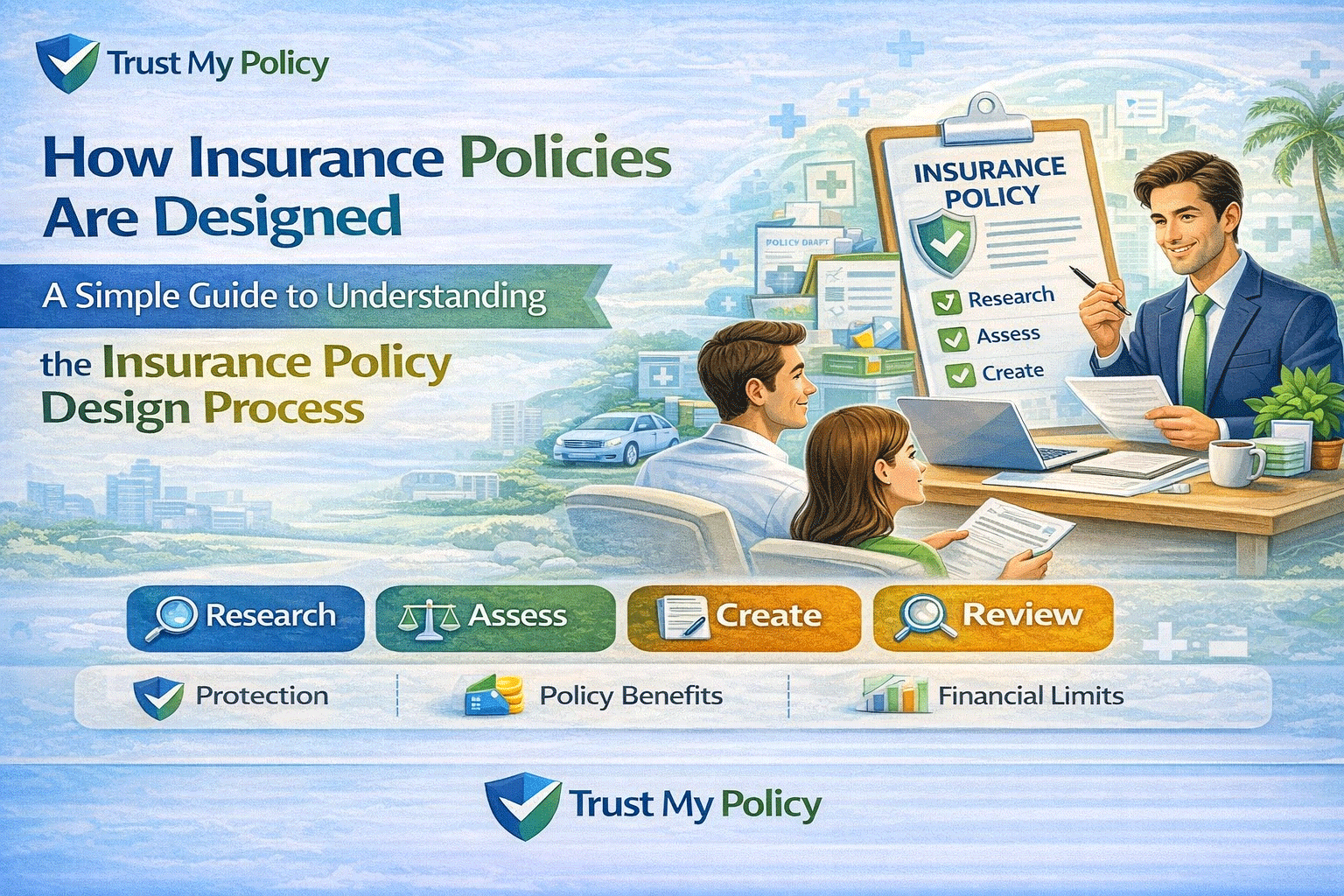
Insurance policies are designed using a consistent structure: a declarations page summarizing your specific coverage and limits, an insuring agreement defining what’s covered, exclusions listing what isn’t covered, conditions outlining your obligations, and a definitions section clarifying key terms. This structure is standard across most US and UK insurers, even though specific coverage details vary widely.
Vincent Cho, 44, read through his new homeowners policy in Seattle and was struck by how it was structured almost like a legal contract with numbered sections: declarations, coverage grants, exclusions, conditions, and definitions. He’d never realized every insurance policy, regardless of insurer, follows roughly the same architectural blueprint.
How Insurance Policies Are Designed in 2026 follows a consistent structure across nearly every insurer: a declarations page summarizing your specific coverage, an insuring agreement defining what’s covered, exclusions listing what isn’t, conditions outlining your obligations, and definitions clarifying key terms. This guide breaks down exactly how these building blocks fit together, so any policy you read makes immediate sense.
This article covers the core structural components every policy shares, how insurers decide what to include or exclude, real scenarios showing the structure in practice, and what this means for reading your own policy. By the end, you’ll be able to navigate any insurance document with confidence.
| Feature | Details |
| What it is | The consistent structural blueprint used to build nearly every insurance policy |
| Who needs to understand this | Anyone trying to actually read and understand their own policy document |
| Core sections | Declarations, insuring agreement, exclusions, conditions, definitions |
| Key benefit | Once you know the structure, any policy becomes far easier to navigate |
| Key limitation | Specific coverage details still vary significantly between insurers |
| Regulator | State insurance departments (US); Financial Conduct Authority (UK) |
Think of an insurance policy like a building’s architectural blueprint. Every building has a foundation, structural framework, walls, and a roof, even though the specific design varies from house to house. Insurance policies share the same kind of underlying blueprint, even though the exact coverage details differ between insurers and products.
Insurance policies are designed using a small number of consistent structural components: a declarations page, an insuring agreement, exclusions, conditions, and definitions. Insurers build the specific content within each section based on actuarial pricing, legal requirements, and competitive positioning, but the overall architecture stays remarkably consistent. Anyone trying to actually read their own policy, rather than just trusting a summary, needs to understand this structure.
| Criteria | Standardized Policy Forms | Customized Policy Wording |
| Used by | Many insurers for common lines like auto and home insurance | Specialty insurers, commercial lines, or unique risks |
| Consistency | Highly consistent structure and language across insurers | Can vary significantly even within the same general structure |
| Pros | Easier for consumers to compare across insurers | Can be tailored precisely to unusual or specific risks |
| Cons | Less flexibility for unusual or specialized risks | Harder for consumers to compare across different insurers |
We recommend most individual consumers expect standardized policy forms for common coverage types, while business owners with unusual risks should expect more customized wording requiring closer review.
Scenario 1: Vincent, 44, homeowner in Seattle. Vincent read through his policy’s declarations, insuring agreement, exclusions, and conditions sections and found the structure made even unfamiliar insurance language much easier to navigate. Verdict: understanding the standard structure demystifies even a lengthy, unfamiliar policy document. Action: Vincent now reviews the declarations page first at every renewal to confirm his limits and deductibles are still accurate.
Scenario 2: A small business owner in Manchester reviewing a customized commercial policy. The exclusions section was significantly longer and more specific than a standard personal policy, reflecting the insurer’s careful tailoring to the business’s unique risks. Verdict: commercial and specialty policies often require closer review of customized wording. Action: the owner had a broker review the exclusions section specifically before finalizing the policy.
Scenario 3: A driver in Texas confused by the term “named insured” in his auto policy. Checking the definitions section clarified that this term specifically determined who was covered to drive the vehicle under the policy. Verdict: the definitions section often resolves confusion about exactly who or what a policy covers. Action: the driver added his adult child as a named insured after confirming the term’s exact meaning.
Scenario 4: A family in the UK reviewing their travel insurance policy’s conditions section. They discovered a condition requiring them to report a stolen item to local police within 24 hours to remain eligible for a claim. Verdict: conditions sections often contain specific, actionable obligations that affect future claims eligibility. Action: they noted this requirement clearly before their next trip.
| Pros | Cons |
| The consistent structure makes policies easier to navigate once understood. | The legal language used within each section can still be difficult to parse. |
| Declarations pages provide a quick-reference summary of key details. | Many policyholders never read past the declarations page. |
| Exclusions sections clearly define the boundaries of coverage. | Exclusions are often the most overlooked, yet most important, section. |
| Definitions sections resolve ambiguity around key policy terms. | Specific definitions can vary meaningfully between insurers. |
| Conditions sections clarify your specific obligations as a policyholder. | Failing to meet a condition can jeopardize an otherwise valid claim. |
⚠️ WARNING: Never assume your policy’s exclusions section doesn’t apply to your situation without reading it directly. Exclusions are often where the real boundaries of your coverage are defined, and assuming they don’t apply to you can lead to a serious and costly surprise at claim time.
| Your Situation | Our Recommendation |
| You’ve never read past your policy’s declarations page | Yes — review the insuring agreement and exclusions sections as well |
| You’re confused by a specific term used in your policy | Yes — check the definitions section for the precise legal meaning |
| You’re a business owner with a customized commercial policy | Yes — have a broker review the exclusions and conditions closely |
| You’re comparing two insurers’ policies for the same coverage type | Yes — compare specific section wording, not just the overall structure |
| You’re about to file a claim for the first time | Yes — review the conditions section to confirm you’ve met all requirements |
| You assume all standard policies for a coverage type are identical | No — review the specific wording, since meaningful differences can exist |
| You’re renewing a policy you haven’t reviewed in several years | Yes — re-read the declarations and exclusions sections for any changes |
💡 TIP: The single golden rule for understanding policy design: read the exclusions section as carefully as the coverage description, since what’s left out defines your real protection just as much as what’s included.
| Scenario | Design Element | Financial Impact |
| Standard homeowners policy with a flood exclusion | Exclusion not reviewed before a flood claim | Full claim denial, potentially tens of thousands of dollars |
| Auto policy with an unclear “named insured” definition | Definition not checked before letting a family member drive | Potential claim denial if the driver isn’t a named insured |
| Commercial policy with a customized exclusion for a specific industry risk | Exclusion not reviewed by a broker before purchase | Significant uncovered liability exposure if that risk materializes |
| Travel insurance with a 24-hour police reporting condition | Condition not met after a theft | Claim denial despite an otherwise valid loss |
| Policy with clearly understood declarations, limits, and exclusions | Full understanding before a claim | Smoother, faster, and more predictable claims process |
| Two insurers’ “standard” policies with different exclusion wording | Wording difference not compared at purchase | Coverage gap discovered only after a loss occurs |
| Policy renewed without re-reading updated terms | Updated exclusion not noticed at renewal | Potential coverage gap introduced without the policyholder’s awareness |
Your insurer’s full policy document — The definitive source for the exact wording of your declarations, insuring agreement, exclusions, conditions, and definitions. Cost range: free to review. Best for: anyone wanting to understand their actual coverage in full. Rating: not applicable, primary source document.
Independent insurance brokers — Brokers can walk through your specific policy’s structure and flag any unusual or important exclusions. Cost range: typically free for the consumer. Best for: anyone wanting a plain-language walkthrough of a complex policy. Rating: varies by broker, check state or FCA licensing.
NAIC consumer resources (US) — Publishes plain-language guides explaining standard policy structure and terminology. Cost range: free public resource. Best for: US consumers wanting to better understand policy documents. Rating: regulatory standards body.
Financial Conduct Authority (UK) — Sets standards for how UK insurers must clearly present policy terms and conditions to consumers. Cost range: free to consult guidance. Best for: UK consumers wanting to understand disclosure requirements. Rating: government regulatory body.
Citizens Advice (UK) — Offers free, independent guidance on understanding UK insurance policy documents. Cost range: free. Best for: UK consumers wanting plain-language explanations. Rating: independent charity.
We recommend reading your own full policy document as best overall starting point, since no third-party resource can substitute for understanding your own specific declarations, exclusions, and conditions.
Insurance policies are designed using a consistent structure: a declarations page, an insuring agreement, exclusions, conditions, and definitions, even though specific coverage details vary by insurer and product.
A declarations page is a summary section at the front of your policy listing key details like your name, policy period, coverage types, limits, and deductibles.
Exclusions define exactly what isn’t covered under your policy, and they’re often the most important section for understanding the real boundaries of your protection.
The definitions section clarifies the precise legal meaning of key terms used throughout the policy, such as “named insured” or “occurrence,” which can directly affect your coverage.
Conditions outline your specific obligations as a policyholder, such as reporting a claim promptly, and failing to meet them can jeopardize an otherwise valid claim.
Most follow the same general structure, though specific wording within each section can vary meaningfully between insurers, especially for customized commercial or specialty policies.
You should review the full policy, especially the exclusions and conditions sections, since the summary or declarations page alone doesn’t capture the full scope of your coverage.
Standardized forms use consistent language across many insurers for common coverage types, while customized wording is tailored to unusual or specific risks, often for commercial or specialty insurance.
Yes, most insurers and brokers can walk through specific sections of your policy and explain unfamiliar terms or unusual exclusions in plain language.
Review your policy at every renewal, especially the declarations and exclusions sections, since insurers can update specific wording even within an otherwise familiar policy structure.
This article is for informational purposes only. Always consult a licensed insurance professional before making coverage decisions. Trust My Policy does not sell insurance products or represent any insurer.

Jagadeesh Gutha is the founder of TrustMyPolicy.com, an independent insurance information platform covering life, health, car, home, and business insurance for US and UK readers. He researches insurance products, policy structures, and consumer rights to help everyday people make informed coverage decisions without the jargon. All content on TrustMyPolicy is independently researched, fact-checked, and written to educate — not to sell.

Insurance Guides for UK, USA & Worldwide We are not an insurer or broker.
Reader Comments (0)