
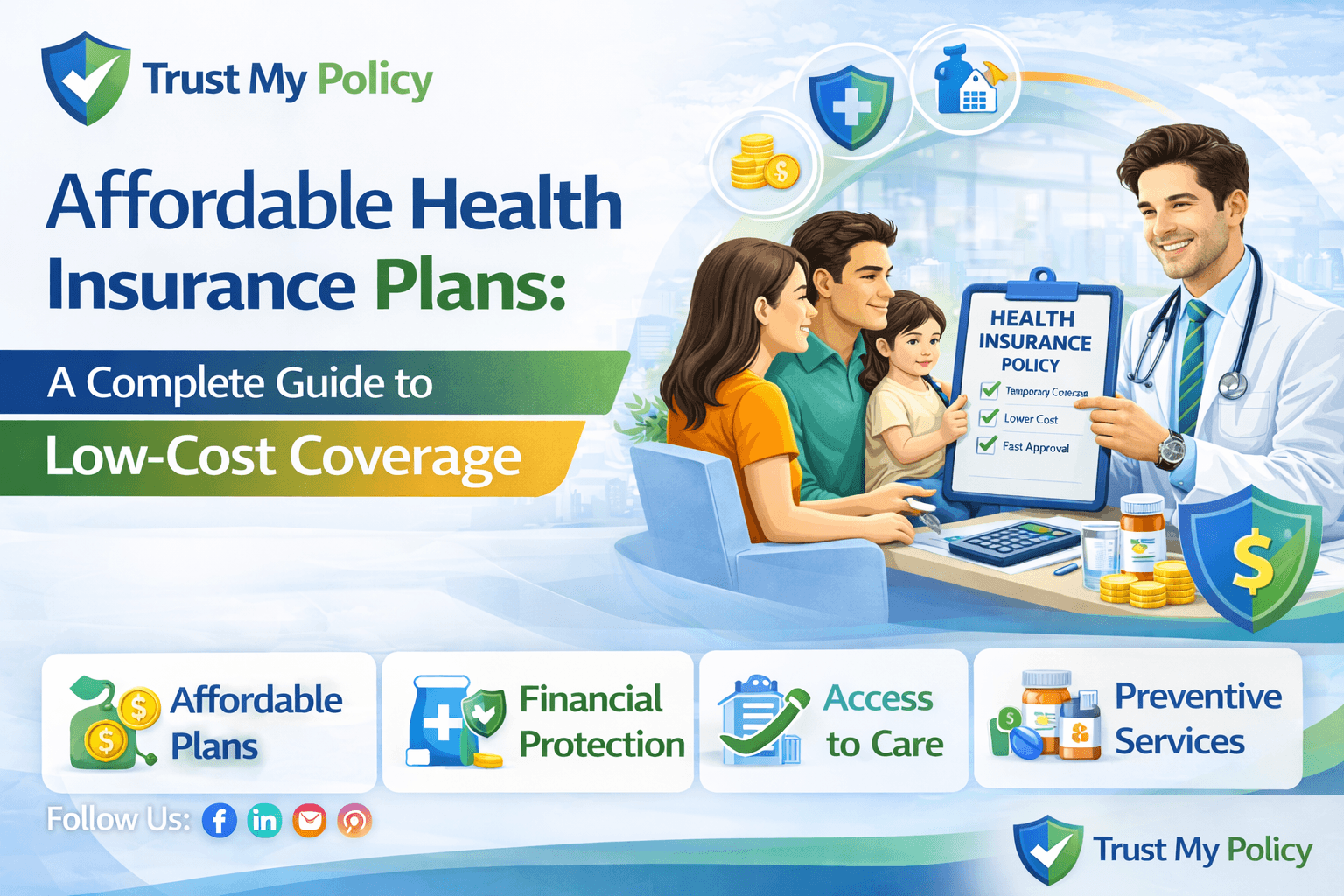
The most affordable health insurance options in 2026 are: Medicaid for those who qualify by income (free or near-free in expansion states), fully subsidised marketplace plans for lower-income households (potentially $0/month), catastrophic plans for those under 30 or with a hardship exemption (typically $150–$220/month), and Bronze marketplace plans for others (typically $250–$400/month). In the UK, NHS care is free and private supplements start from around £20–£30 a month.
Casey Morgan, 26, told herself she couldn’t afford health insurance on her $31,000 annual income as a part-time receptionist in Orlando. A colleague helped her apply on HealthCare.gov and Casey found a Silver plan for $0 a month after her premium tax credit — coverage she’d been going without for two years because she assumed it wasn’t an option.
Affordable Health Insurance Plans in 2026 exist across a wider range of price points than most people realise: fully subsidised marketplace plans are available to many lower-income households, Medicaid covers a significant portion of the lowest-income population, catastrophic plans offer a lower-cost option for eligible individuals under 30, and short-term plans provide a budget bridge between coverage gaps. In the UK, the NHS provides free baseline coverage regardless of income, with affordable private supplements available from under £30 a month. This guide maps the most affordable genuine options at every income level.
This article covers every genuinely affordable coverage pathway in order of cost, what each one actually covers, real scenarios with specific monthly figures, and how to identify which option applies to your income. By the end, you’ll know exactly which affordable pathway is available to you.
| Feature | Details |
| What it is | The most affordable genuine health coverage options available at each income level |
| Who qualifies | Varies by income, age, and state; Medicaid, marketplace subsidies, and catastrophic plans each have specific eligibility rules |
| Cheapest option | Medicaid: free or near-free in expansion states |
| Second cheapest | Subsidised marketplace Silver or Bronze: potentially $0/month at lower incomes |
| Cheapest private option (under 30) | Catastrophic plan: $150–$220/month |
| UK equivalent | NHS free access; private supplements from ~£20–£30/month |
| Regulator | State insurance departments and CMS (US); Financial Conduct Authority (UK) |
Think of affordable health insurance like affordable transport — genuinely affordable means reliably getting you where you need to go, not just the cheapest option that leaves you stranded in an emergency. A catastrophic plan that costs $180 a month but leaves you with a $9,000 deductible you can’t pay isn’t affordable in any meaningful sense if it’s your only healthcare budget.
Genuinely affordable health insurance is coverage with a monthly premium and out-of-pocket structure that matches your real financial situation, including your ability to pay a deductible or copay when care is actually needed. At the lowest income levels, Medicaid is the clearest genuinely affordable option in expansion states. For slightly higher incomes, subsidised marketplace plans can bring monthly costs to $0 or very low amounts. For healthy individuals under 30, catastrophic plans offer a genuine lower-cost option. Choosing the cheapest plan regardless of its actual coverage structure is a different thing entirely from finding genuinely affordable healthcare.
| Option | Eligibility | Typical Monthly Cost | Real Coverage Level |
| Medicaid | Income up to ~138% FPL in expansion states | $0 or near-$0 | Comprehensive, including primary care, hospital, and prescriptions |
| Subsidised Silver (with CSR) | Income 138%–250% FPL | $0–$100/month | Near-Gold coverage level due to reduced deductibles |
| Subsidised Bronze | Income up to ~400% FPL | $0–$200/month | Basic coverage with high deductible |
| Catastrophic plan | Under 30 or hardship exemption | $150–$220/month | Emergency coverage; high deductible (~$9,450 in 2026) |
| Unsubsidised Bronze | Above subsidy threshold | $250–$400/month | Basic coverage with high deductible |
| UK NHS access | All UK residents | £0 | Full baseline coverage |
| UK private medical supplement | All UK residents | £20–£100/month | Faster specialist access on top of NHS |
We recommend subsidised Silver with CSRs for most lower-income US readers because it provides near-Gold coverage at potentially $0 premium — a significantly better value than a low-premium Bronze plan with a crushing deductible.
Scenario 1: Casey, 26, receptionist in Orlando earning $31,000. Casey’s premium tax credit brought her Silver plan to $0 a month, with a subsidised deductible of approximately $1,400. Verdict: many people in Casey’s income bracket qualify for heavily or fully subsidised coverage without realising it. Action: Casey now updates her income estimate whenever her hours change to keep the subsidy accurate.
Scenario 2: A 24-year-old delivery driver in Texas earning $18,000. Texas has not expanded Medicaid, placing him in the coverage gap — too high for Texas Medicaid but qualifying for a marketplace subsidy. Verdict: the absence of Medicaid expansion in some states creates a real coverage gap at very low incomes. Action: he enrolled in a Silver plan for $0/month after his full subsidy applied, since his income was just above the marketplace eligibility floor.
Scenario 3: A healthy 28-year-old in Colorado earning $48,000. She qualified for a small premium tax credit and chose a catastrophic plan at $175/month, keeping a $4,000 savings buffer specifically for the high deductible. Verdict: catastrophic plans are a legitimate affordable option for healthy under-30 individuals with savings. Action: she plans to switch to a Bronze or Silver plan once she turns 30 and loses catastrophic eligibility.
Scenario 4: A UK part-time worker earning £18,000. She had full NHS coverage at £0 cost and added a private medical supplement for £22/month specifically to reduce waiting times for non-emergency physiotherapy she needed regularly. Verdict: UK affordable coverage starts at £0 (NHS) with a meaningful supplement available for the cost of a streaming subscription. Action: she confirmed the supplement specifically covered physiotherapy before committing.
| Pros | Cons |
| Medicaid provides comprehensive free coverage at the lowest income levels. | Medicaid expansion varies by state, creating coverage gaps in non-expansion states. |
| Premium tax credits can bring marketplace plans to $0 at lower incomes. | Many people don’t know these subsidies exist until they actually apply. |
| Catastrophic plans offer a genuinely low-premium option for eligible individuals. | Catastrophic plans’ very high deductibles can be financially devastating if care is needed. |
| UK NHS provides truly free comprehensive baseline coverage for all residents. | UK private supplements don’t reduce emergency wait times — only non-urgent specialist access. |
| The range of affordable options is significantly broader than most uninsured people realise. | Choosing the cheapest plan without considering deductible can create unaffordable out-of-pocket costs. |
⚠️ WARNING: Never choose a plan based solely on the monthly premium. A catastrophic plan or bare Bronze plan with a $9,000 deductible is not genuinely affordable if you don’t have $9,000 in savings available — the plan’s affordability depends on whether you can actually pay the out-of-pocket costs if care is needed.
| Your Situation | Our Recommendation |
| Your income is below ~138% of the federal poverty level (in an expansion state) | Yes — check Medicaid eligibility first; this is almost certainly your most affordable option |
| Your income is 138%–250% of the federal poverty level | Yes — enrol in a Silver plan on HealthCare.gov; CSRs make this significantly better value than Bronze |
| You’re under 30 with very low expected medical use and solid savings | Yes — compare catastrophic and Bronze plans specifically |
| You live in a non-expansion state with income below the marketplace floor | Yes — research your state’s specific Medicaid rules; some have alternative programmes |
| You’re a UK resident with no health coverage | No — you already have NHS coverage free; consider whether a private supplement adds value |
| You haven’t checked your specific subsidy on HealthCare.gov yet | Yes — do this before choosing any plan tier |
| You’re comparing a $0 premium plan against a higher-premium plan | Yes — compare total cost including deductible and expected out-of-pocket, not premium alone |
💡 TIP: The single golden rule for affordable health insurance: a $0 premium plan with a $9,000 deductible isn’t affordable health insurance if you don’t have $9,000 — choose based on total cost including deductible, not premium alone.
| Scenario | Monthly Premium | Deductible | Real Affordability |
| Medicaid, expansion state | $0 | Often $0–minimal | Genuinely affordable at the lowest incomes |
| Subsidised Silver with CSR, income ~$25,000 | $0–$50/month | ~$800–$1,400 | Strong coverage at very low total cost |
| Subsidised Silver with CSR, income ~$35,000 | $50–$120/month | ~$1,400–$2,500 | Very competitive total cost |
| Catastrophic plan, age 25 | $150–$220/month | ~$9,450 (2026 IRS limit) | Affordable only with savings to cover the deductible |
| Bronze plan, subsidised, income ~$45,000 | $120–$200/month | ~$7,000–$9,000 | Low premium but risky without substantial savings |
| UK NHS access | £0 | Not applicable | Genuinely free comprehensive baseline |
| UK private medical supplement | £20–£30/month | Per-claim excess (~£100–£200) | Very affordable complement to NHS access |
HealthCare.gov (US) — The federal marketplace where you check subsidy eligibility, compare plans, and enrol. Cost range: free. Best for: US individuals without employer coverage wanting to find their most affordable option. Rating: federal government marketplace.
Medicaid.gov (US) — The federal resource for checking Medicaid eligibility by state. Cost range: free. Best for: US individuals at lower incomes checking whether Medicaid applies before marketplace shopping. Rating: federal government resource.
Navigators (US) — Free, trained enrollment assistants available through community organisations who can help you understand your options at no cost. Cost range: free. Best for: US individuals wanting guided help with the enrollment process. Rating: federally funded consumer assistance programme.
NHS.uk (UK) — Confirms your right to NHS care and explains what it covers. Cost range: free. Best for: UK residents confirming their baseline coverage. Rating: national public health service.
Compare the Market (UK) — A UK comparison platform for private medical insurance supplements. Cost range: free to compare. Best for: UK residents wanting to add a private supplement at the lowest available price. Rating: FCA-regulated comparison service.
We recommend HealthCare.gov for US readers and NHS.uk for UK readers as best overall starting points, since confirming your free or subsidised coverage entitlement first is the foundation of any genuinely affordable health plan strategy.
Medicaid is the most affordable option for those who qualify in expansion states, followed by subsidised Silver plans with cost-sharing reductions, which can be available for $0/month at lower incomes.
Yes, in several scenarios: Medicaid is free in expansion states for qualifying incomes, and fully subsidised marketplace plans are available at $0/month for households whose income falls within specific ranges.
A catastrophic plan has the lowest marketplace premium but a very high deductible (approximately $9,450 in 2026), available only to individuals under 30 or those with an approved hardship exemption.
If you qualify for cost-sharing reductions, Silver is almost always the better total-cost choice. Above the CSR threshold, compare total annual cost rather than premium alone.
Check Medicaid eligibility first; if you’re in a non-expansion state and fall into the coverage gap, some states have alternative programmes, and navigators can help identify any available options.
Not necessarily. The most affordable premium plans often carry the highest deductibles. True affordability considers both the premium and your ability to pay the deductible when care is needed.
Yes, NHS care is free at the point of use for all UK residents regardless of income or employment status, funded through general taxation.
A cost-sharing reduction is an additional subsidy available on Silver marketplace plans for lower-income households, reducing deductibles and copays beyond what the standard Silver tier provides.
Yes. Losing a job is a qualifying life event for special enrollment in the US, and NHS access in the UK is unaffected by employment status.
Visit localhelp.healthcare.gov to find free navigator assistance in your area.
This article is for informational purposes only. Always consult a licensed insurance professional before making coverage decisions. Trust My Policy does not sell insurance products or represent any insurer.

Jagadeesh Gutha is the founder of TrustMyPolicy.com, an independent insurance information platform covering life, health, car, home, and business insurance for US and UK readers. He researches insurance products, policy structures, and consumer rights to help everyday people make informed coverage decisions without the jargon. All content on TrustMyPolicy is independently researched, fact-checked, and written to educate — not to sell.


Insurance Guides for UK, USA & Worldwide We are not an insurer or broker.
Reader Comments (0)