
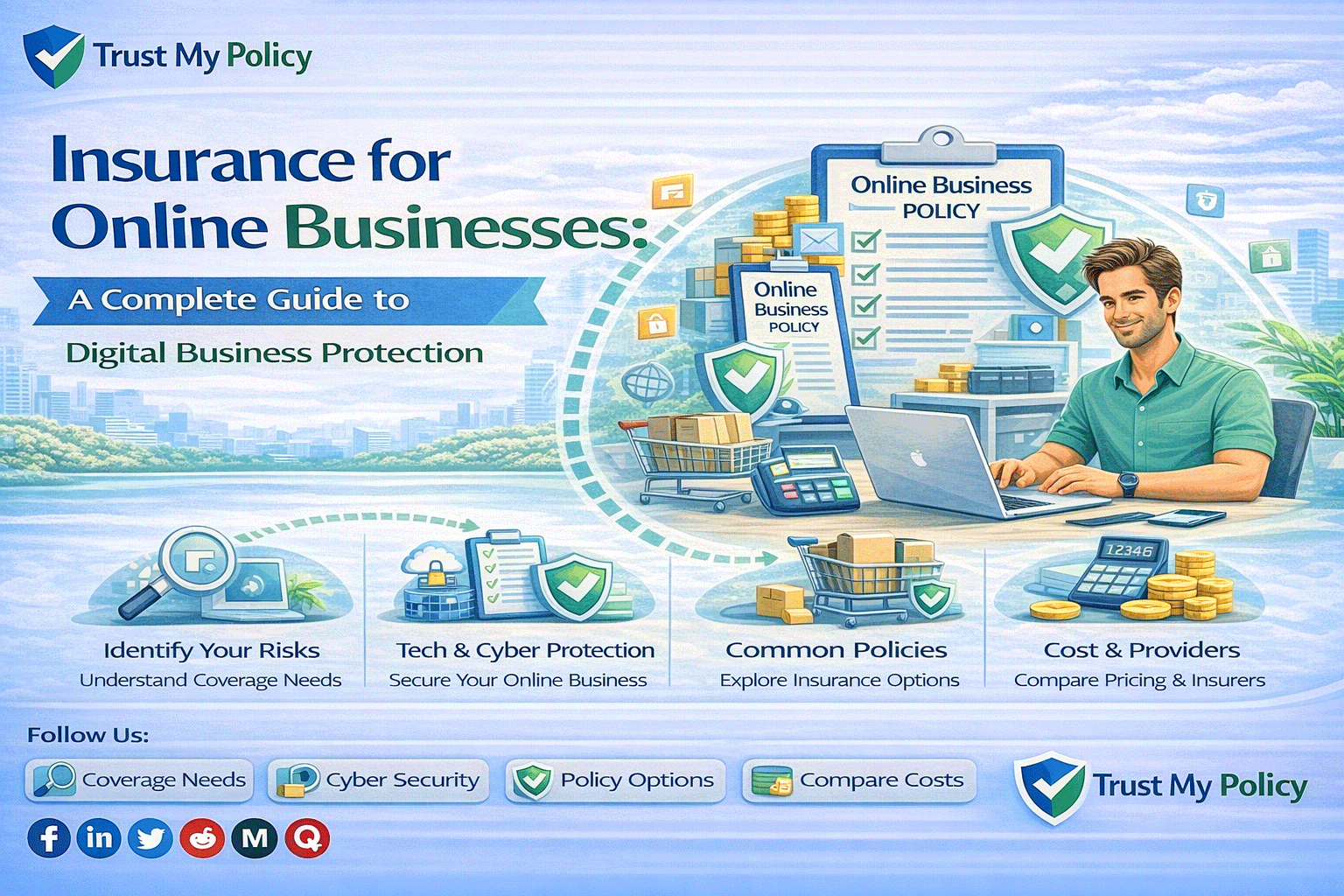
Online businesses need product liability insurance for anything they sell or ship, cyber liability insurance for payment and customer data, and shipping or cargo coverage for goods in transit, in addition to standard general liability. Product liability is especially critical for any business selling physical goods, since standard service-based liability policies often exclude it entirely.
Caroline Beck, 36, ran a small e-commerce skincare shop from her home in Phoenix and assumed a general liability policy designed for a physical retail store would cover her completely. When a customer alleged an allergic reaction to one of her products, she discovered her policy excluded product liability claims entirely, a gap that’s far more common among online sellers than they realize.
Insurance for Online Businesses in 2026 needs to address risks a brick-and-mortar policy often misses: product liability for anything you sell or ship, cyber liability for payment and customer data, and shipping or cargo coverage for goods in transit. This guide breaks down exactly which coverage online sellers need, by business model, and what most generic small business policies leave out.
This article covers the specific coverage types online businesses need, how they differ by business model, real scenarios with dollar figures, and a clear framework for closing the most common gaps. By the end, you’ll know exactly what Caroline’s policy was missing.
| Feature | Details |
| What it is | Coverage tailored to the specific risks of selling or operating a business online |
| Who needs it | E-commerce sellers, dropshippers, digital product creators, and online service providers |
| Core coverage types | Product liability, cyber liability, shipping/cargo insurance, general liability |
| Typical combined cost | $50–$200/month depending on product type and sales volume |
| Key benefit | Closes gaps that generic small business or service-based policies often leave open |
| Key limitation | Many sellers don’t realize product liability is excluded from a standard liability policy until a claim arises |
| Regulator | State insurance departments (US); Financial Conduct Authority (UK) |
Think of an online business’s risk profile like a relay race with three distinct legs: the product itself, the data involved in the transaction, and the physical journey of getting the product to the customer. A standard liability policy built for an office or storefront often only covers one leg of that race, leaving the other two completely exposed.
Insurance for online businesses generally needs to cover three specific areas beyond standard liability: product liability, which covers claims related to harm or damage caused by a physical product you sell; cyber liability, which covers breaches or losses involving customer payment and personal data; and shipping or cargo insurance, which covers goods lost or damaged in transit to customers. Which combination matters most depends heavily on whether you sell physical products, digital products, or services online.
| Criteria | Physical Product Sellers (E-commerce, Dropshipping) | Digital Product/Service Sellers (Software, Courses, Content) |
| Primary coverage need | Product liability plus cyber liability | Professional liability plus cyber liability |
| Shipping/cargo relevance | Highly relevant for goods in transit | Not applicable, since no physical shipping occurs |
| Common overlooked gap | Assuming general liability covers product-related claims | Assuming general liability covers software or service errors |
| Pros | Clear, well-defined coverage path once product type is known | Lower overall risk profile given no physical product exposure |
| Cons | Requires layering multiple specific policy types | Cyber liability exposure can still be significant despite no physical goods |
We recommend physical product sellers prioritize product liability insurance immediately for most readers, since this is the single most commonly excluded coverage from standard liability policies that online sellers assume they have.
Scenario 1: Caroline, 36, e-commerce skincare seller in Phoenix. Caroline’s general liability policy excluded the customer’s allergic reaction claim entirely, since it didn’t include product liability coverage. Verdict: standard liability policies frequently exclude product-related claims for businesses selling physical goods. Action: Caroline added a dedicated product liability policy and now reviews ingredient-related risk disclosures more carefully.
Scenario 2: A dropshipping business in Leeds selling electronics sourced from overseas suppliers. A defective product caused a customer’s minor injury, with liability ultimately resolved through the dropshipper’s product liability coverage rather than the manufacturer’s, due to jurisdictional complications. Verdict: dropshippers carry real product liability exposure even when they don’t manufacture the product themselves. Action: the business added product liability coverage specifically accounting for its dropshipping model.
Scenario 3: An online course creator in Austin selling digital education content. A customer data breach affecting payment information triggered significant notification costs, fully covered under the creator’s cyber liability policy. Verdict: digital-only businesses still carry significant cyber liability exposure tied to payment processing. Action: the creator increased her cyber liability limits after her customer base grew substantially.
Scenario 4: A small online furniture retailer in Manchester shipping large items nationwide. A shipment damaged in transit resulted in a costly replacement, covered under a dedicated cargo insurance policy rather than the retailer’s standard property insurance. Verdict: standard property insurance typically doesn’t extend to goods once they leave your premises in transit. Action: the retailer added cargo insurance specifically for its highest-value shipped items.
| Pros | Cons |
| Product liability insurance closes a commonly excluded gap for physical goods sellers. | Many sellers don’t realize this gap exists until a claim arises. |
| Cyber liability coverage addresses a genuinely significant risk for nearly any online business. | Comparing cyber liability policies requires understanding your specific data exposure. |
| Shipping/cargo insurance covers a transit risk that standard property insurance typically excludes. | Adding multiple specific policy types takes more research than a single generic quote. |
| Coverage can be tailored specifically to your business model (physical, digital, or service-based). | Dropshippers and marketplace sellers face added complexity in determining their exact liability exposure. |
| Relatively affordable given the scale of risk closed for most online business sizes. | Premiums scale with sales volume, requiring periodic reassessment as the business grows. |
⚠️ WARNING: Never assume a generic small business liability policy covers product-related claims if you sell any physical good online. This is one of the most commonly misunderstood gaps among online sellers, and it often isn’t discovered until a customer files a claim.
| Your Situation | Our Recommendation |
| You sell or manufacture any physical product online | Yes — get product liability insurance specifically |
| You run a dropshipping business | Yes — get product liability coverage, even though you don’t manufacture the product |
| You process any customer payment or personal data | Yes — get cyber liability insurance, regardless of business model |
| You regularly ship physical goods to customers | Yes — add shipping or cargo insurance for goods in transit |
| You sell only digital products or services | Yes — prioritize cyber liability and professional liability instead of product liability |
| You assumed your general liability policy already covers product claims | No — confirm this directly, since it’s a commonly excluded gap |
| Your sales volume has grown significantly since you last reviewed coverage | Yes — reassess your coverage limits to match your current scale |
💡 TIP: The single golden rule for online business insurance: if you sell or ship any physical product, confirm product liability coverage is explicitly included, since this is the single most commonly assumed-but-missing protection for online sellers.
| Scenario | Cost | Notes |
| Product liability insurance, small e-commerce skincare/cosmetics seller | $50–$150/month | Reflects elevated risk for ingestible or skin-contact products |
| Product liability insurance, general merchandise seller | $30–$80/month | Lower risk profile than ingestible or cosmetic products |
| Cyber liability insurance, small online business | $50–$150/month | Varies by transaction volume and data sensitivity |
| Shipping/cargo insurance, moderate shipping volume | $20–$60/month | Varies by average shipment value and frequency |
| Combined product, cyber, and general liability bundle | $100–$250/month | Common combination for established e-commerce sellers |
| Digital-only business (courses, software), cyber and professional liability | $60–$150/month | No product liability needed given no physical goods |
| UK product liability insurance, small online retailer | £150–£500/year | UK equivalent coverage for physical goods sellers |
Next Insurance (US) — Offers fast, online policies specifically tailored to e-commerce sellers, including product liability options. Cost range: competitive small business pricing. Best for: US online sellers wanting a quick, tailored quote. Rating: backed by AM Best-rated carrier partners.
Hiscox (US and UK) — Provides product liability and cyber liability coverage suited to a range of online business models. Cost range: competitive small business pricing. Best for: online sellers in either the US or UK needing flexible, combined coverage. Rating: AM Best A.
Coalition (US) — Specializes in cyber liability insurance with strong digital risk assessment tools well suited to online businesses. Cost range: competitive cyber-specific pricing. Best for: online businesses prioritizing cyber liability coverage. Rating: backed by AM Best-rated carrier partners.
Simply Business (UK) — A UK comparison platform specializing in product liability and e-commerce business insurance. Cost range: free to compare. Best for: UK online sellers comparing coverage options. Rating: FCA-regulated comparison service.
Independent insurance brokers — Brokers can help determine the exact combination of product, cyber, and shipping coverage your specific online business model requires. Cost range: typically free for the consumer. Best for: any online seller unsure which policies apply to their specific products. Rating: varies by broker, check state or FCA licensing.
We recommend Next Insurance for US sellers and Hiscox for UK sellers as best overall because both offer tailored, combined coverage specifically built around online and e-commerce business models.
Online businesses generally need product liability insurance for physical goods, cyber liability insurance for payment and customer data, and shipping or cargo insurance for goods in transit, in addition to standard general liability.
Often not. Standard general liability policies frequently exclude product-related claims, requiring a separate product liability policy for businesses selling physical goods.
Yes, in most cases, since dropshippers are typically considered the seller of record and can be held liable for product issues even though they don’t manufacture the product themselves.
Yes, almost always, since payment processing and customer data exposure exist for nearly any online transaction, regardless of whether physical products are involved.
Usually not. Standard property insurance typically only covers goods while on your premises, requiring a separate shipping or cargo policy for goods in transit.
Costs typically range from $30 to $150 a month depending on your specific product type, with higher-risk categories like cosmetics or ingestible products costing more.
Yes, in most cases, since product liability, cyber liability, and shipping coverage each address a genuinely distinct risk that the others don’t cover.
Yes, generally, since even small businesses processing customer payments face real data breach risk, and remediation costs can be significant without coverage.
At least annually, and especially after any significant growth in sales volume, product range, or customer data handling practices.
Yes, several insurers now offer policies specifically designed for e-commerce and online business models, often combining product, cyber, and general liability in one application.
This article is for informational purposes only. Always consult a licensed insurance professional before making coverage decisions. Trust My Policy does not sell insurance products or represent any insurer.

Jagadeesh Gutha is the founder of TrustMyPolicy.com, an independent insurance information platform covering life, health, car, home, and business insurance for US and UK readers. He researches insurance products, policy structures, and consumer rights to help everyday people make informed coverage decisions without the jargon. All content on TrustMyPolicy is independently researched, fact-checked, and written to educate — not to sell.



Insurance Guides for UK, USA & Worldwide We are not an insurer or broker.

Reader Comments (0)