
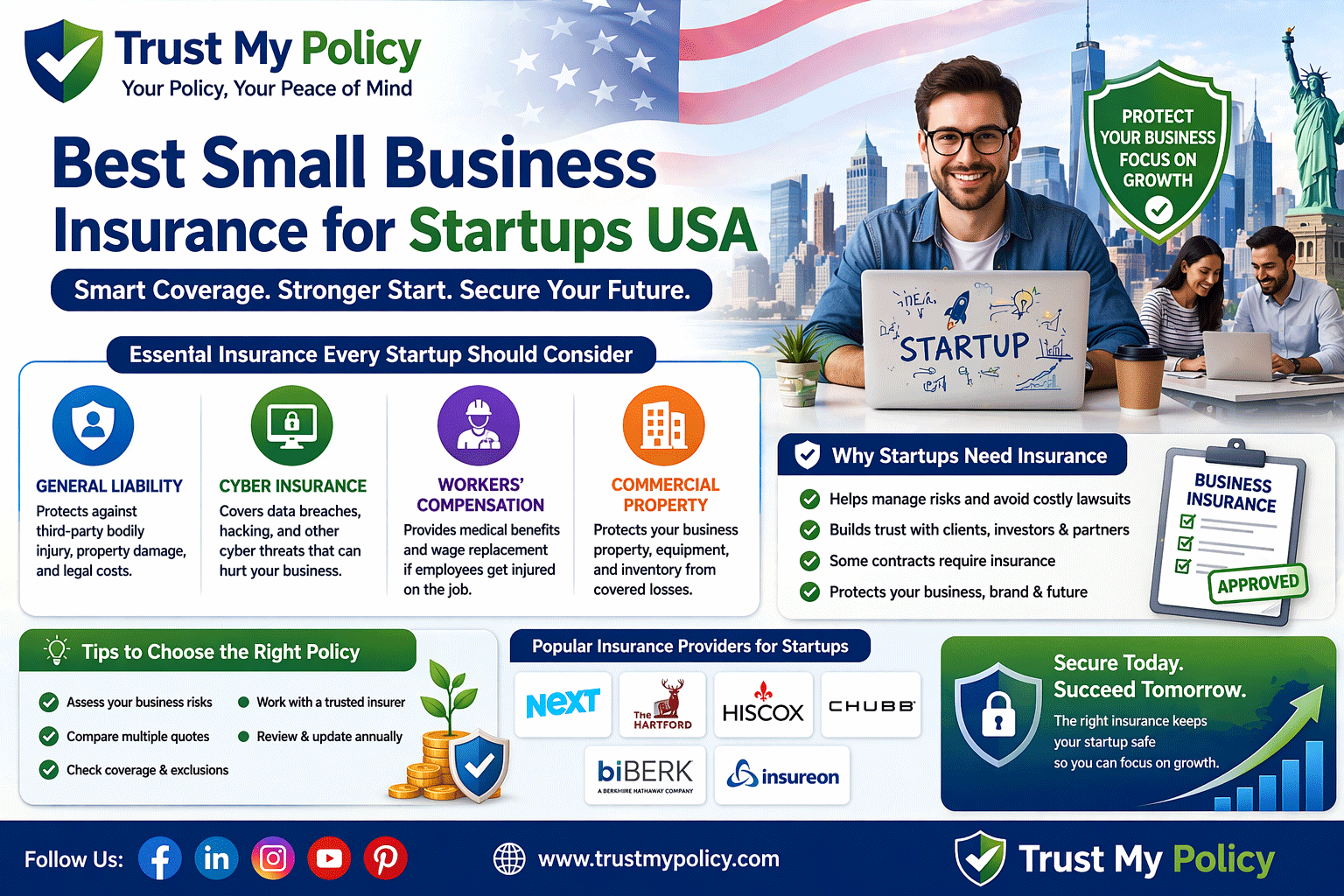
Best small business insurance for startups USA combines three core policies: general liability ($14–$20/month with ERGO NEXT or Simply Business), a Business Owner’s Policy or BOP ($21–$33/month bundling liability and property), and professional liability/E&O ($64–$80/month with The Hartford or Hiscox). Most startups need all three. Total cost for a tech startup with 2 employees: approximately $100–$180/month.
When Kezia launched her SaaS startup in Austin in 2024, she landed her first enterprise client within three months. On day one of the contract, the client’s legal team sent over a vendor requirements document. It listed three mandatory insurance types — general liability, professional liability (E&O), and cyber insurance — each with specific minimum limits. Kezia had none of them. She nearly lost the deal. She spent two frantic days getting covered. The whole package cost her $142/month. She almost lost a $60,000 contract over $142.
The best small business insurance for startups USA in 2026 is not one policy — it is a layered stack of coverages matched to the specific risks your startup faces. The right stack protects you from client lawsuits, data breaches, employee injuries, and the vendor requirements that close or kill deals.
This guide covers every coverage type a US startup needs, what each one costs, which providers offer the best value for early-stage companies, and the exact order to buy them in — so you’re protected from day one without overspending on coverage you don’t yet need.
| Feature | Details |
| What it is | A bundle of commercial insurance policies protecting your startup from lawsuits, property loss, data breaches, and employee claims |
| Who needs it | All US startups — especially those with clients, employees, contracts, physical inventory, or digital data |
| Typical cost (early-stage, 2 employees) | $100–$200/month for a full coverage stack; general liability alone from $14/month |
| Core coverages | General liability, professional liability (E&O), BOP, cyber liability, workers’ comp (legally required once you hire) |
| Amazon/Walmart threshold | Both require $1M per occurrence general liability when sales exceed $10,000 over 3 consecutive months |
| Key benefit | Protects from business-ending lawsuits and unlocks enterprise contracts that require proof of insurance |
| Key limitation | Startup policies have revenue and employee count limits — re-underwrite annually as you grow |
| Regulated by | State insurance commissioners; NAIC sets model standards across all 50 states |
Think of startup insurance like a seatbelt system — you don’t buy one seatbelt, you buy a full set for every seat. General liability is your primary belt. Professional liability is your side airbag. Cyber coverage is the crumple zone you hope you never need.
Startup business insurance is a collection of commercial insurance policies that protect your company’s finances, assets, and reputation when something goes wrong. A single lawsuit from a client or employee can cost six figures in legal fees alone — even if you win. The right insurance stack absorbs that cost so your startup survives it.
Who needs it: Every founder with clients, contracts, employees, or inventory. SaaS companies, consultancies, e-commerce brands, agencies, food businesses, service providers. If you sign contracts with clients, you almost certainly need it on day one — many enterprise clients require proof of coverage before a single line of work begins.
General liability covers third-party bodily injury, property damage, and advertising injury (copyright infringement, slander). If a client visits your office and trips, GL pays. If you’re sued for libel in a blog post, GL covers your defence. It’s the foundation of every startup insurance stack — and required by most commercial leases and many client contracts.
Cost: $14/month (Simply Business) to $20/month (Nationwide) for a 2-employee startup. Most policies provide $1M per occurrence and $2M aggregate.
A BOP bundles general liability and commercial property insurance into one cost-effective package. It also typically includes business interruption insurance — covering lost revenue if a fire or flood forces you to shut down temporarily. For most early-stage startups, a BOP is smarter than buying GL and property separately.
Cost: $21/month (Simply Business) to $33/month (The Hartford) for a standard BOP. Nationally, small e-commerce startups pay $67–$118/month for BOP coverage with higher limits.
Professional liability (called E&O in tech and consulting) covers financial losses a client suffers because of your work, advice, or failure to deliver. If your software has a bug that costs a client $200,000 in downtime, their lawyer comes after you — E&O covers the defence and settlement. This is the policy most enterprise clients require before signing.
Cost: $64/month (The Hartford) to $80/month (Hiscox). Embroker’s startup package for VC-backed tech companies starts higher, reflecting higher limits and specific tech E&O coverage.
Cyber insurance covers data breaches, ransomware attacks, and the regulatory fines and notification costs that follow. The average data breach costs $4.4 million to resolve. Even a small incident — a compromised email account exposing client data — can cost $50,000+ in legal fees, breach notification, and regulatory fines. If you store customer data (even just email addresses), you need this.
Cost: $25–$100/month depending on data volume, revenue, and security controls. D&O and cyber together often quoted as a bundle by Embroker and Founder Shield for tech startups.
Workers’ comp is legally required in almost every US state the moment you hire your first W-2 employee. It covers medical bills and lost wages if an employee is injured or becomes ill due to work — including remote workers. Even a full-time remote coder developing carpal tunnel syndrome can trigger a valid claim.
Cost: From $6/month (Thimble) to $67/year average for low-risk e-commerce startups. Rates rise with payroll size and industry risk classification.
D&O insurance protects startup founders and board members from personal liability for decisions made on behalf of the company. Investors, employees, or regulators can sue a director personally. Most VC term sheets include a D&O requirement before investment closes.
Cost: $333/month average for startups with under $50M in revenue (CoverWallet data). Some Embroker startup packages bundle D&O with other coverages.
EPLI covers claims from employees alleging wrongful termination, discrimination, harassment, or breach of employment contract. As your startup scales from 5 to 50 people, EPLI risk rises sharply. One HR lawsuit can cost $75,000–$150,000 to defend.
Cost: $125/month for $1M in coverage (CoverWallet data). Often bundled with D&O in startup-focused packages from Embroker and Founder Shield.
| Criteria | General Liability / BOP | Professional Liability (E&O) | Cyber Liability |
| What it covers | Third-party injury, property damage, advertising injury, business property | Client financial loss from your work, advice, errors, or omissions | Data breaches, ransomware, regulatory fines, breach notification costs |
| Who it’s for | All startups — required by most leases and many contracts | Consultancies, SaaS, tech companies, agencies, advisers | Any startup that stores customer data or processes payments online |
| Typical monthly cost | $14–$33/month | $64–$80/month | $25–$100/month |
| Claim example | Client slips in your office; $80,000 medical + legal claim | Bug in your software causes $200k client loss; E&O covers defence | Ransomware locks your systems; $45k to restore + $30k client notification |
| Legally required? | Required by many leases and client contracts; not state law | Not legally required but practically essential for enterprise deals | Not legally required but mandated by many data processors and platforms |
| Winner | BOP is best value — bundles GL + property + interruption in one policy | E&O is the policy that closes enterprise deals | Cyber is fastest-growing necessity in 2026 — buy it early |
We recommend: Start with a BOP (covers GL + property) and add E&O in month one. Add cyber liability as soon as you handle customer data. Add D&O when raising investment. Add EPLI when you reach 10+ employees.
Situation: Landed first enterprise client in month 3. Client required GL ($1M), E&O ($1M), and cyber ($500k) before contract signing.
Cost: GL via Simply Business: $14/month. E&O via The Hartford: $64/month. Cyber add-on: $48/month. Total: $126/month.
Verdict: Kezia nearly lost a $60,000 annual contract over $126/month in insurance. Buy GL and E&O before your first enterprise sales call. Getting covered reactively takes 2–3 days minimum. Don’t wait for the contract.
Situation: Selling private label supplements on Amazon. Reached $10,000/month in sales after 4 months. Amazon flagged his seller account and gave him 30 days to upload a certificate of insurance — or face suspension.
Cost: Product liability (included in general liability) via ERGO NEXT: $18/month. BOP with $500k property coverage: $28/month. Total: $46/month for Amazon compliance.
Verdict: Every Amazon seller approaching $10,000/month in sales needs $1M per occurrence general liability with Amazon listed as additional insured. ERGO NEXT and NEXT Insurance are both pre-approved for Amazon’s requirements and provide instant certificates. Get this before you hit the threshold — not after Amazon flags you.
Situation: 3-person management consultancy. Took on first Fortune 500 client project. Client procurement team sent vendor requirements: $2M GL, $2M E&O, $1M cyber, D&O required.
Cost: Embroker startup package covering all four: approximately $380/month. Standalone BOP + E&O + Cyber from Hiscox: approximately $280/month with $1M limits.
Verdict: For consulting agencies targeting enterprise clients, use Embroker’s startup calculator to quote a bundled package — it often comes out cheaper than buying separately. Hiscox is the better value for single-person consultancies with standard $1M limits.
Situation: Manufacturing artisan hot sauce in a commercial kitchen. Distributing to 40 local stores. No insurance. A batch with improperly labelled allergen content caused a customer allergic reaction — lawsuit filed for $45,000.
Cost of being uninsured: $45,000 settlement + $18,000 legal fees = $63,000 personal liability. A product liability policy would have cost $35/month.
Verdict: Food product startups need general liability with product liability included from day one. Any product that enters someone’s body — food, supplements, cosmetics — carries the highest product liability risk. The Hartford and Simply Business both cover food manufacturers. $35–$50/month is not optional for this business type.
| Pros | Cons |
| Unlocks enterprise contracts that require proof of insurance as a vendor requirement | Monthly premium adds to early-stage cash burn when margins are tight |
| Protects founders from personal financial liability if the company is sued | Policies have coverage limits — a catastrophic claim may exceed your limits if set too low |
| Workers’ comp compliance avoids state fines (up to $10,000/day in some states for non-compliance) | Cyber and D&O policies require detailed security questionnaires and governance documentation |
| Cyber insurance provides breach response resources — forensics, legal, PR — at no extra cost | Annual re-underwriting means premiums can rise as your revenue and employee count grow |
| Investors and VCs typically require D&O insurance before term sheet execution | Many policies exclude pre-existing claims — you can’t backdate coverage to protect past work |
Getting covered reactively takes 2–5 business days. Losing a deal because you can’t show a certificate of insurance by tomorrow costs far more than the premium. Buy GL and E&O before your first enterprise sales conversation.
| ⚠️ WARNING: Homeowner’s or Renters Insurance Does NOT Cover Business Activities
If you run your startup from home and use your homeowner’s insurance to cover a business incident, the insurer will deny the claim. Homeowner’s policies explicitly exclude commercial activities. A client visit to your home office that results in an injury, or a fire that destroys your business inventory, is not covered. You need a separate commercial policy — even as a home-based founder. |
General liability covers physical injury and property damage. It does NOT cover financial losses a client suffers from your work, advice, or failure to deliver. That’s professional liability (E&O). Two very different policies. Many startups find this out at the worst possible moment — when a client sues over a project failure.
Most enterprise clients require $1M per occurrence minimum. Some require $2M aggregate. If your policy provides $500,000, you’ll fail their vendor review regardless of which insurer you use. Always confirm the exact limits required before buying — not after.
Amazon requires sellers to list ‘Amazon.com, Inc., and its affiliates and assignees’ as an additional insured on the GL policy. Walmart has the same requirement. Simply buying a policy doesn’t satisfy platform requirements — the additional insured must be specifically named on the certificate.
A policy written for a 2-person startup may have insufficient limits for a 20-person company with $2M in revenue. Most policies have revenue and employee count parameters. Exceeding them without updating your policy can make you technically underinsured at claim time. Review every renewal.
| Your Situation | Our Recommendation |
| You are pre-revenue, solo, no clients yet | Yes — buy GL now. It’s $14/month and many co-working spaces require it |
| You have your first client contract to sign | Yes — buy GL + E&O immediately. Enterprise clients require both before contract execution |
| You sell physical products online (Amazon, Shopify) | Yes — product liability (included in GL) is essential. Buy before you hit Amazon’s $10k threshold |
| You store customer data or process payments | Yes — add cyber liability as a priority. A single breach costs $50,000+ even for micro-businesses |
| You’re raising a seed round | Yes — D&O insurance is expected by most VCs. Get it as part of your fundraising preparation |
| You hire your first employee | Yes — workers’ comp is legally required in almost every state. Non-compliance fines are severe |
| You are a solo freelancer with no employees or physical products | Yes — GL + E&O are still advisable. Client contracts and co-working leases typically require them |
| You are a food, supplement, or cosmetic brand | Yes — product liability is non-negotiable. One allergen incident without coverage = personal bankruptcy |
| 💡 TIP: Buy in This Exact Order
Step 1: BOP (covers GL + property). Step 2: E&O / Professional Liability. Step 3: Cyber Liability. Step 4: D&O (when raising investment). Step 5: EPLI (when you reach 10+ employees). This order prioritises the risks most likely to kill your startup first. |
| Startup Profile | Policy Type | Monthly Cost | Notes |
| Solo freelancer, no employees | GL only (Simply Business) | $14/month | Cheapest entry point; satisfies most co-working leases |
| 2-person SaaS startup | BOP + E&O (The Hartford) | $97/month | Most common early-stage stack for tech companies |
| E-commerce brand, Amazon seller | GL + product liability (ERGO NEXT) | $18/month | Amazon-compliant; instant certificate of insurance |
| 3-person consulting agency | BOP + E&O + Cyber (Hiscox) | $185/month | Covers major enterprise vendor requirements |
| 10-person startup, VC-backed | Full stack: BOP + E&O + Cyber + D&O + EPLI (Embroker) | $580/month | Full coverage for funded company with board |
| Food/beverage manufacturer | GL + product liability (The Hartford) | $50/month | Specifically underwritten for food product risk |
| Cheapest possible coverage | GL only (Simply Business) | $14/month | Bare minimum; add E&O as soon as you have clients |
| Most expensive full stack | All 7 coverage types for $5M revenue startup | $1,000+/month | Enterprise-grade; standard for Series A companies |
Why recommended: Simply Business is the cheapest startup insurer overall, with GL from $14/month and BOP from $21/month. It acts as a broker, comparing quotes across multiple insurers in a single application. Ideal for solo founders and early-stage startups that need low-cost baseline coverage quickly.
Cost: GL from $14/month; BOP from $21/month; workers’ comp from $6/month.
Best for: Budget-conscious early-stage startups, solo founders, freelancers entering their first client contracts.
Why recommended: The Hartford has the lowest E&O pricing at $64/month for startups — beating most competitors by 20–40%. A+ AM Best rating. Over 200 years in business. Strong claims department rated highly by small business owners. Particularly strong for tech, consulting, and service-based startups.
Cost: E&O from $64/month; BOP from $33/month.
Best for: Service-based startups, SaaS companies, and consultancies that need E&O as their primary coverage.
Why recommended: Acquired by Ergo Group for $2.6B in March 2025. Digital-first, instant quotes, instant certificates of insurance. Pre-approved for Amazon’s marketplace insurance requirements. GL from $13/month nationally. 24/7 COI via app — exactly what Amazon sellers need when a platform flag arrives on a Friday afternoon.
Cost: GL from $13–$18/month; overall average $99/month across all coverage types.
Best for: Amazon sellers, e-commerce startups, gig economy businesses needing instant proof of insurance.
Why recommended: Hiscox specialises in small businesses and has purpose-built products for tech companies, freelancers, and consultants. Rated 4.7/5 by customers. Available in 49 states. Strong for combining professional liability with cyber in a single underwriting process. Quotes online in minutes.
Cost: Professional liability from $8/month for micro-businesses; BOP and E&O bundles typically $150–$250/month for 3–5 person teams.
Best for: Tech startups, creative agencies, IT consultancies, and businesses needing combined E&O + cyber coverage.
Why recommended: Embroker is the specialist for venture-backed companies. Their Startup Package Calculator is purpose-built for tech founders and covers D&O, E&O, EPLI, and cyber in a single bundled quote. If your investors or term sheet requires D&O, Embroker is the fastest and most comprehensive route. Digital-native, API integration with legal and HR platforms.
Cost: D&O from $333/month; bundled startup packages quoted individually — use their online calculator.
Best for: VC-backed startups, companies with boards and investors, tech companies requiring D&O and EPLI.
👉 We recommend Simply Business as the best overall starting point for most early-stage US startups because it offers the cheapest GL and BOP pricing and compares across multiple insurers. Add The Hartford for E&O and Hiscox for cyber as you grow.
Workers’ compensation is legally required in almost every US state the moment you hire a W-2 employee. Commercial auto insurance is required if the company owns vehicles. All other business insurance is legally optional — but practically essential. Most commercial leases, client contracts, and marketplace platforms (Amazon, Walmart) require general liability with $1M minimum limits before you can operate.
A typical early-stage US startup with 2 employees pays $100–$180/month for a complete coverage stack. General liability alone starts from $14/month (Simply Business). A BOP runs $21–$33/month. Professional liability (E&O) adds $64–$80/month. Cyber liability adds $25–$100/month. Total depends on your industry, revenue, and number of employees.
For most startups, a BOP is the better choice. It bundles general liability, commercial property, and business interruption insurance into one policy at a lower combined cost than buying each separately. Simply Business offers BOP from $21/month — cheaper than buying GL and commercial property independently. The Hartford’s BOP from $33/month is the lowest-cost E&O + BOP combination.
Yes. Amazon requires commercial general liability insurance of at least $1 million per occurrence and $2 million aggregate once you reach $10,000 in sales during three consecutive months. Walmart has identical requirements. Both platforms require the marketplace to be named as an additional insured on the certificate. ERGO NEXT and NEXT Insurance are pre-approved and provide instant certificates of insurance.
General liability covers physical risks — third-party bodily injury, property damage, and advertising injury like copyright infringement. Professional liability (E&O) covers financial losses a client suffers because of your work, advice, or professional errors. A consulting startup needs both. A software bug that causes a client to lose revenue is an E&O claim — general liability doesn’t cover it.
Yes. ERGO NEXT and Hiscox offer same-day coverage with instant certificates of insurance available for download immediately after purchase. Simply Business provides same-day quotes from multiple insurers. For standard coverage types like GL and BOP, same-day approval is routine for low-risk startups. D&O and EPLI typically require 24–72 hours of underwriting review.
Yes — if you store any customer data. The average data breach costs $4.4 million to resolve. Even a minor incident — a single compromised employee email account exposing client contact details — can cost $50,000+ in breach notification, legal fees, and regulatory fines. Cyber insurance typically costs $25–$100/month for early-stage startups and covers forensic investigation, breach notification, regulatory defence, and crisis PR.
Most VC term sheets explicitly require D&O insurance as a condition of investment closing. D&O protects founders and board members from personal liability for decisions made on behalf of the company. Embroker is the specialist for startup D&O. Expect to pay approximately $333/month for early-stage companies. Budget for this as part of your fundraising preparation — not as an afterthought.
You face significant state fines — up to $10,000 per day per employee in some states — plus you become personally liable for all medical bills and lost wages. The employee can also sue you directly. Workers’ comp is legally required in all states except Texas (where it is optional but risky to skip). Get it the day you hire your first employee. Thimble offers the cheapest workers’ comp starting from $6/month.
Yes. Insurance is available from day one — even pre-revenue. In fact, getting covered before your first client conversation is the smartest move. Most providers use your projected revenue for the first year to set your initial premium. Simply Business and ERGO NEXT both offer coverage to pre-revenue startups with no minimum revenue requirement.
For e-commerce sellers needing specific platform coverage, see our ecommerce business insurance requirements USA guide. For freelancers and independent contractors, our public liability insurance for freelancers UK article covers the equivalent UK policies.
| 📋 Disclaimer
This article is for informational purposes only. Always consult a licensed insurance professional before making coverage decisions. Trust My Policy does not sell insurance products or represent any insurer. |

Jagadeesh Gutha is the founder of TrustMyPolicy.com, an independent insurance information platform covering life, health, car, home, and business insurance for US and UK readers. He researches insurance products, policy structures, and consumer rights to help everyday people make informed coverage decisions without the jargon. All content on TrustMyPolicy is independently researched, fact-checked, and written to educate — not to sell.


Insurance Guides for UK, USA & Worldwide We are not an insurer or broker.

Reader Comments (0)