
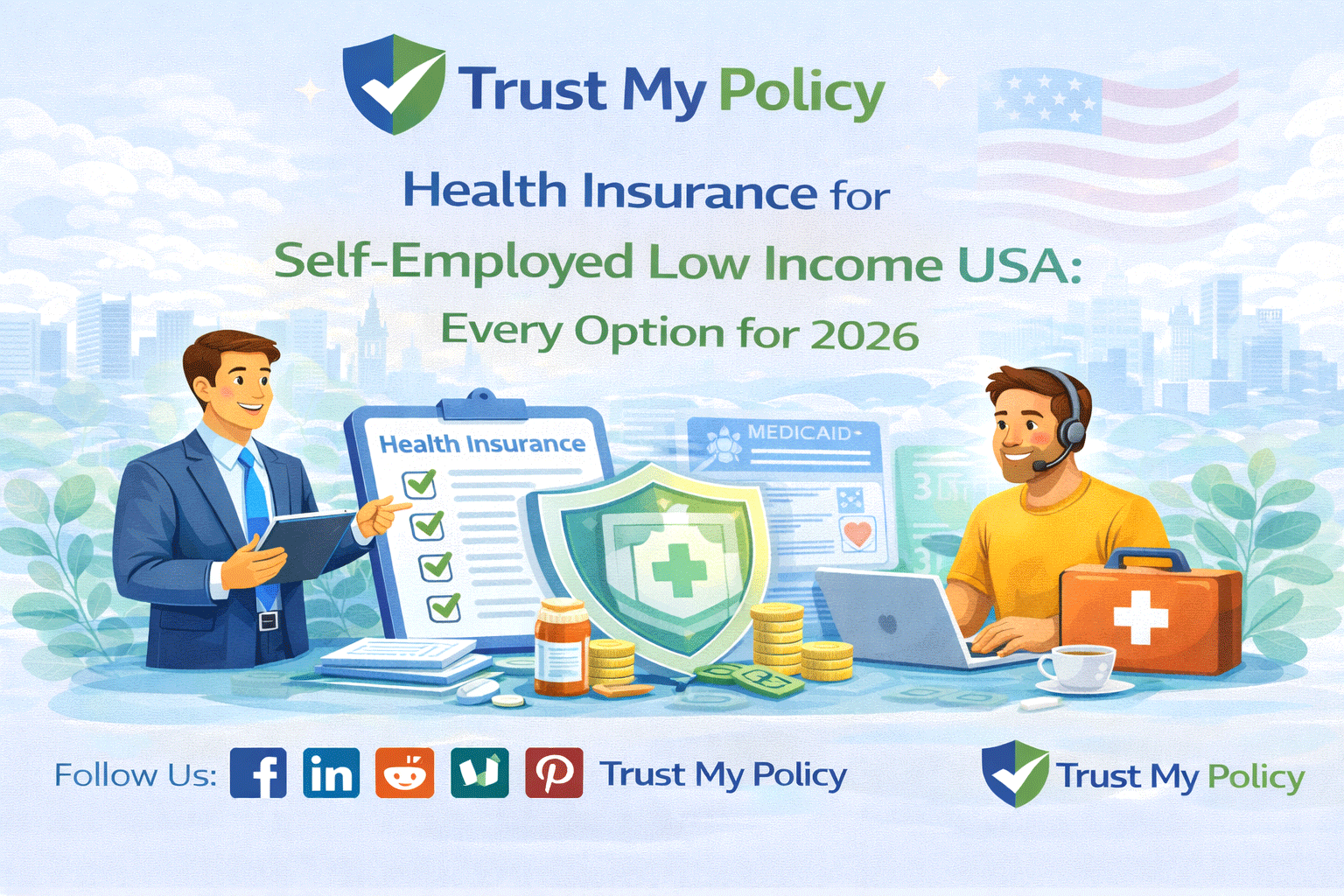
Self-employed Americans with low income have four main options: (1) Medicaid — free or near-free if your income is below 138% of the Federal Poverty Level in expansion states; (2) ACA Marketplace plans with premium tax credits — available for incomes between 100% and 400% FPL in 2026; (3) CHIP — free or low-cost coverage for your children regardless of your immigration status; (4) health sharing ministries or short-term plans as a last resort. Always check HealthCare.gov or your state marketplace first.
Maria, 34, a freelance graphic designer in Texas, earns around $28,000 a year. Her state didn’t expand Medicaid. She assumed health insurance was out of reach — until she logged onto HealthCare.gov and discovered she qualified for a premium tax credit that reduced her Silver plan from $310/month to $47/month. She also qualified for cost-sharing reductions that cut her deductible from $4,500 to $800.
Health insurance for self-employed people with low income in the USA is more accessible than most people realise — but the system changed significantly in 2026 after the enhanced ACA subsidies expired at the end of 2025. This guide explains every option available, what you qualify for based on income, and how to get covered affordably.
There are over 16.2 million self-employed Americans. Most can find meaningful coverage — but the path depends on your income, state, family size, and age. This guide covers all of it: Medicaid, ACA Marketplace plans, CHIP, health sharing ministries, and short-term plans, with real income thresholds for 2026.
| Household Size | Medicaid Limit (138% FPL) | ACA Subsidy Upper Limit (400% FPL) | Subsidy Cliff in 2026 |
| 1 person | ~$20,783/year | ~$62,160/year | No subsidies above $62,160 in most states |
| 2 people | ~$28,208/year | ~$84,600/year | No subsidies above $84,600 |
| 3 people | ~$35,633/year | ~$106,600/year | No subsidies above $106,600 |
| 4 people | ~$43,058/year | ~$128,840/year | No subsidies above $128,840 |
| 5 people | ~$50,483/year | ~$150,680/year | No subsidies above $150,680 |
Note: Figures based on 2025 Federal Poverty Level guidelines used for 2026 coverage eligibility. Medicaid thresholds apply only in states that expanded Medicaid (40 states + DC). In non-expansion states, the lower income limit for ACA subsidies is 100% FPL, not Medicaid.
| ⚠️ IMPORTANT: The 2026 Subsidy Change
The enhanced premium tax credits that were in place from 2021 through 2025 expired on December 31, 2025. In 2026, the pre-2021 rules are back: subsidies only apply to incomes up to 400% FPL (the ‘subsidy cliff’ has returned), and subsidy amounts are smaller than in 2024–2025. Average out-of-pocket premiums have increased by more than $1,000/year for many enrollees. Some states offer additional assistance — check your state marketplace. |
The ACA (Affordable Care Act) Marketplace, also called the Exchange, is the platform where self-employed individuals can purchase ACA-compliant health insurance plans. You access it at HealthCare.gov (federal) or your state’s own marketplace (Covered California, NY State of Health, Connect for Health Colorado, etc.).
All ACA Marketplace plans must cover pre-existing conditions, provide preventive care at $0 out-of-pocket, and include the 10 essential health benefits (including hospitalisation, mental health, and prescription drugs). As a self-employed person, you are not covered by an employer plan — so the Marketplace is your primary route to comprehensive individual health coverage.
Self-employed workers have a significant tax advantage: you can deduct 100% of your health insurance premiums as a business expense from your self-employment income, reducing your adjusted gross income (AGI) and, potentially, your subsidy calculations.
What it is: A free or very low-cost health insurance programme funded by federal and state governments. In expansion states (40 states + DC), anyone with income below 138% FPL (approximately $20,783 for a single person in 2026) qualifies.
What it covers: Comprehensive — doctor visits, hospitalisation, mental health, prescriptions, preventive care. No premiums (or very small ones). Very low or no copays.
What it doesn’t cover: Dental and vision are limited in many states. Long-term care is separate. Eligibility is based on current monthly income, not annual.
States that didn’t expand Medicaid (10 states): Alabama, Florida, Georgia, Kansas, Mississippi, South Carolina, Tennessee, Texas, Wisconsin, Wyoming. If you live in these states and earn between 100% and 138% FPL, you fall into the ‘coverage gap’ — too much for Medicaid, too little for Marketplace subsidies. Check your state’s specific rules or contact a navigator.
What it is: ACA Marketplace plans with income-based subsidies (premium tax credits) that reduce your monthly premium. The credit is applied directly — you pay the subsidised amount each month.
2026 subsidy rules: In 2026, subsidies are available for incomes between 100% and 400% of FPL. The subsidy cliff returned: above 400% FPL, no federal premium tax credit is available. Some states (New Jersey, California) offer additional state-level subsidies above 400% FPL.
Cost-sharing reductions (CSR): If your income is below 250% FPL, and you choose a Silver plan, you also qualify for CSR — which reduces your deductible, copays, and out-of-pocket maximum significantly. A Silver plan at 150% FPL might have a deductible of $0–$500 instead of $4,500. CSR only works on Silver plans — don’t choose Bronze if you qualify.
Tax deduction: Self-employed individuals can deduct 100% of their ACA health insurance premiums from gross income on Schedule SE, reducing both income tax and the MAGI used for subsidy calculation. This is a significant advantage not available to employees.
What it is: The Children’s Health Insurance Program (CHIP) provides free or very low-cost health coverage for children in families who earn too much for Medicaid but can’t afford private insurance. Available in all 50 states.
Income limits: Vary by state. Typically covers children in families earning up to 200%–300% FPL. In some states (California, New York), CHIP covers children up to 400% FPL.
What it covers: Doctor visits, hospitalisations, dental, vision, immunisations, prescriptions. Premiums are zero or very low. Copays are nominal.
How to apply: Apply at HealthCare.gov or directly through your state’s Medicaid/CHIP office. You can apply any time — there’s no enrollment window for Medicaid or CHIP.
Health sharing ministries: Not insurance, but faith-based programmes where members share medical costs. Monthly costs can be lower than ACA plans. However, they are not ACA-compliant, don’t cover pre-existing conditions, and have no guarantee of payment. Use only as a last resort if you fall into the Medicaid gap in a non-expansion state.
Short-term health plans: Designed as a bridge (e.g. between jobs), these are cheaper than ACA plans but don’t cover pre-existing conditions, preventive care, or essential health benefits. They’re not ACA-compliant and can be denied. Maximum duration is typically 3 months federally (though some states allow longer). Do not use as a long-term solution.
State: Texas (no Medicaid expansion). At $28,000, Maria is above 138% FPL but qualifies for ACA subsidies.
Premium tax credit: Her Silver plan costs $310/month. After her PTC, she pays approximately $47–$65/month depending on the plan.
CSR: At $28,000 (~180% FPL), Maria qualifies for CSR on a Silver plan — reducing her deductible from $4,500 to approximately $800.
Verdict: Always choose Silver if you’re below 250% FPL. Never choose Bronze — you lose the CSR benefit, which is worth thousands if you need care.
State: California (expanded Medicaid, called Medi-Cal). James earns below 138% FPL.
Option: Medi-Cal — free comprehensive coverage. No premium, minimal copays. James applies directly through Covered California.
Verdict: In expansion states, anyone below 138% FPL gets Medicaid. James pays $0 for comprehensive coverage. If his income rises above the Medicaid limit, he transitions to a subsidised Marketplace plan during the next enrollment period.
Situation: Family of 3. $52,000 is approximately 210% of FPL for a family of 3.
ACA options: Donna qualifies for a premium tax credit. Her children may also qualify for CHIP, which could provide free or very low-cost coverage for them separately, reducing the family’s overall insurance cost.
Tax deduction: Donna can deduct her own health insurance premiums as a self-employed person, reducing her MAGI for subsidy calculation.
Verdict: Split strategy — CHIP for the kids (free or very cheap), subsidised Silver plan for Donna. This is often the most cost-effective approach for self-employed parents.
State: Florida (no Medicaid expansion). $35,000 is approximately 225% of FPL for a single person.
ACA option: Carlos qualifies for a premium tax credit and CSR (below 250% FPL on a Silver plan). His net premium after subsidy: approximately $80–$110/month for a Silver plan.
Health savings account: If Carlos chooses a Bronze HSA-eligible plan (minimum $1,600 deductible in 2025), he can contribute to a Health Savings Account, reducing his taxable income further.
Verdict: For incomes around 200–250% FPL, the CSR Silver plan is almost always the best value. The deductible reduction alone (from $4,500+ to $700–$1,000) makes Silver worth more than the premium difference vs Bronze.
| Your Situation | Best Option |
| Income below 138% FPL in an expansion state | Medicaid — free, apply at HealthCare.gov or state office any time |
| Income 100%–250% FPL | ACA Silver plan with premium tax credit + cost-sharing reduction |
| Income 250%–400% FPL | ACA plan with premium tax credit; Gold plan worth considering |
| Income above 400% FPL | Full-price ACA plan or off-marketplace plan; deduct premiums as self-employed |
| Children in household (any income below 300% FPL) | Apply for CHIP for kids first — free or very cheap in most states |
| Live in non-expansion state, income below 100% FPL | Contact state Medicaid office; look for local navigator or community health centres |
| Need coverage immediately | ACA Special Enrollment Period triggered by loss of coverage or income change |
| HSA-eligible Bronze plan seeker | Choose HSA-eligible Bronze + contribute to HSA for added tax savings |
| Option | Pros | Cons |
| Medicaid | Free, comprehensive, no deductible | Not available in 10 non-expansion states; income cap |
| ACA Marketplace + PTC | Comprehensive ACA-compliant cover; pre-existing conditions covered | Subsidies smaller in 2026 after enhancement expiry; subsidy cliff at 400% FPL |
| CHIP (children) | Free or very cheap, covers dental and vision | Children only; parents must apply separately |
| HSA + Bronze plan | Low premium + tax savings via HSA contributions | High deductible; can be expensive if you need frequent care |
| Health sharing ministry | Lower monthly cost than ACA plans | Not insurance; no guarantee of payment; no pre-existing condition cover |
| Short-term plan | Cheap; fast to enrol | Not ACA-compliant; no pre-existing cover; max 3 months federal limit |
The ACA premium tax credit can reduce a $400/month plan to under $50/month for a low-income self-employed person. Always run the numbers at HealthCare.gov before assuming coverage is out of reach.
| 💡 TIP: Free Help Is Available
ACA navigators and certified application counsellors are federally funded, free, and available in every state. They help you understand your options, calculate your subsidies, and enrol. Find one at localhelp.healthcare.gov. Brokers listed on HealthCare.gov are also free to work with — they’re compensated by insurers, not by you. |
Cost-sharing reductions only apply to Silver plans. If your income is below 250% FPL and you choose Bronze to save on premiums, you lose thousands of dollars in CSR value. Always choose Silver when you qualify for CSR — the deductible and copay reductions are worth far more than the premium difference.
If you estimate your income too low and receive a larger subsidy than you’re entitled to, you’ll repay the excess at tax time. As a self-employed person with variable income, update your Marketplace income estimate whenever your earnings change significantly during the year.
Self-employed individuals can deduct 100% of their health insurance premiums from self-employment income on Schedule 1 of Form 1040 (as a self-employed health insurance deduction). This reduces your adjusted gross income, potentially qualifying you for higher subsidies in future years. Work with a tax professional to optimise this.
If your income drops (or rises) significantly during the year, you have a Special Enrollment Period to change plans or update your subsidy. Missing this window locks you into your current plan until the next Open Enrollment. Report income changes promptly at HealthCare.gov.
| Income Level | Family Size | Likely Option | Estimated Monthly Cost |
| Below 138% FPL (~$20,783 single) | 1 | Medicaid | $0 (free) |
| 138–200% FPL (~$21k–$30k single) | 1 | Silver ACA + PTC + CSR | $30–$80/month after subsidy |
| 200–250% FPL (~$30k–$38k single) | 1 | Silver ACA + PTC + CSR | $70–$130/month after subsidy |
| 250–350% FPL (~$38k–$53k single) | 1 | Silver or Gold ACA + PTC | $120–$200/month after subsidy |
| 350–400% FPL (~$53k–$62k single) | 1 | ACA + PTC (reduced) | $200–$350/month after subsidy |
| Above 400% FPL (~$62k+ single) | 1 | Full-price ACA or off-marketplace | $400–$700/month (no subsidy) |
| Below 250% FPL, 2 adults + 2 kids | 4 | Silver family ACA + PTC + CSR + CHIP for kids | $150–$300/month family total |
Why: Highest J.D. Power customer satisfaction among national US health insurers. Average Silver plan cost of $595/month before subsidies — $157 cheaper than national average. Integrated care model means one system for insurance and medical care. Low claim denial rate (half the industry average). Available in: California, Colorado, Georgia, Hawaii, Maryland, Oregon, Virginia, Washington DC.
Best for: People who live in Kaiser’s service areas and want seamless, highly rated care at competitive cost.
Why: The BCBS network of local affiliates operates in all 50 states. Most plans are PPO-style, meaning you can see most doctors. Strong ACA Marketplace presence. MoneyGeek reports BCBS offers the most budget-friendly average at $1,442/month for a family — before subsidies. Local affiliates often receive higher satisfaction ratings than national carriers.
Best for: People who need broad provider access, live in rural areas, or travel frequently between states.
Why: Ambetter offers ACA plans in 29 states specifically targeting the budget market. Includes wellness rewards programme and chronic-care management. Popular for Silver plans among low-to-moderate income households. Available in most major states including Texas, Florida, Georgia, and Ohio.
Best for: Cost-conscious self-employed individuals who qualify for subsidies and want a low-premium plan with wellness extras.
Why: Oscar’s app-based, virtual-first care model makes accessing care simple. Offers $0 virtual urgent care visits, easy concierge access, and transparent pricing. Available in 18 states including California, New York, Texas, and Florida. Popular with tech-savvy freelancers and gig workers.
Best for: Young, tech-savvy self-employed individuals who prefer managing healthcare through an app and want virtual-first care at low cost.
Why: Molina specialises in serving low-income and Medicaid-eligible populations. Their ACA Marketplace plans are designed for people transitioning from Medicaid as income rises, with low premiums and minimal administrative friction. Available in 19 states.
Best for: Self-employed people with very low income (just above Medicaid threshold) who need ACA coverage at the most affordable price point.
Yes. In states that expanded Medicaid (40 states + DC), self-employed people earning below 138% of FPL (~$20,783 for a single person in 2026) qualify for free Medicaid. Those earning between 100% and 400% of FPL can get subsidised ACA Marketplace plans with premium tax credits. The size of the subsidy depends on income, family size, and the cost of the benchmark plan in your area.
The ACA premium tax credit (PTC) reduces your monthly Marketplace health insurance premium. In 2026, the enhanced subsidies that were in place 2021–2025 have expired — meaning the subsidy cliff at 400% FPL is back, and subsidy amounts are smaller than in previous years. You apply on HealthCare.gov, the system calculates your credit based on your estimated income, and the credit is applied directly to your monthly premium.
Medicaid is a government-funded programme for people with low income — free or very low cost, no deductible in most cases. ACA Marketplace plans are private insurance plans sold through the exchange — you pay a premium (reduced by subsidies if eligible), and most plans have deductibles. Medicaid eligibility is based on current monthly income; Marketplace subsidy eligibility is based on projected annual income.
Yes — this is one of the most valuable tax benefits for self-employed workers. You can deduct 100% of your health insurance premiums (for yourself, your spouse, and dependants) as an above-the-line deduction from your adjusted gross income using the self-employed health insurance deduction on Schedule 1. This reduces your taxable income, which may also affect your subsidy eligibility for the following year.
In the 10 non-expansion states (Alabama, Florida, Georgia, Kansas, Mississippi, South Carolina, Tennessee, Texas, Wisconsin, Wyoming), if your income is below 100% FPL, you may fall into the ‘coverage gap’ — ineligible for Medicaid and ineligible for Marketplace subsidies. Options include: applying for community health centre care (Federally Qualified Health Centers provide sliding-scale fees), checking for state-specific programmes, or looking into local safety-net hospitals. Contact a free navigator at localhelp.healthcare.gov for help.
CHIP (Children’s Health Insurance Program) provides free or very low-cost comprehensive health coverage for children in families that earn too much for Medicaid but can’t afford private insurance. It covers doctor visits, hospitalisations, dental, vision, and immunisations. Apply at HealthCare.gov or your state’s Medicaid/CHIP office — there’s no enrollment window and applications are accepted year-round.
For families of four looking at comprehensive US health insurance options, our best health insurance for families of 4 USA guide covers all plan types and providers. For UK-based readers, see our insurance for self-employed UK guide instead.
| 📋 Disclaimer
This article is for informational purposes only. Always consult a licensed insurance professional before making coverage decisions. TrustMyPolicy.com does not sell insurance products or represent any insurer. |

Jagadeesh Gutha is the founder of TrustMyPolicy.com, an independent insurance information platform covering life, health, car, home, and business insurance for US and UK readers. He researches insurance products, policy structures, and consumer rights to help everyday people make informed coverage decisions without the jargon. All content on TrustMyPolicy is independently researched, fact-checked, and written to educate — not to sell.


Insurance Guides for UK, USA & Worldwide We are not an insurer or broker.
Reader Comments (0)