
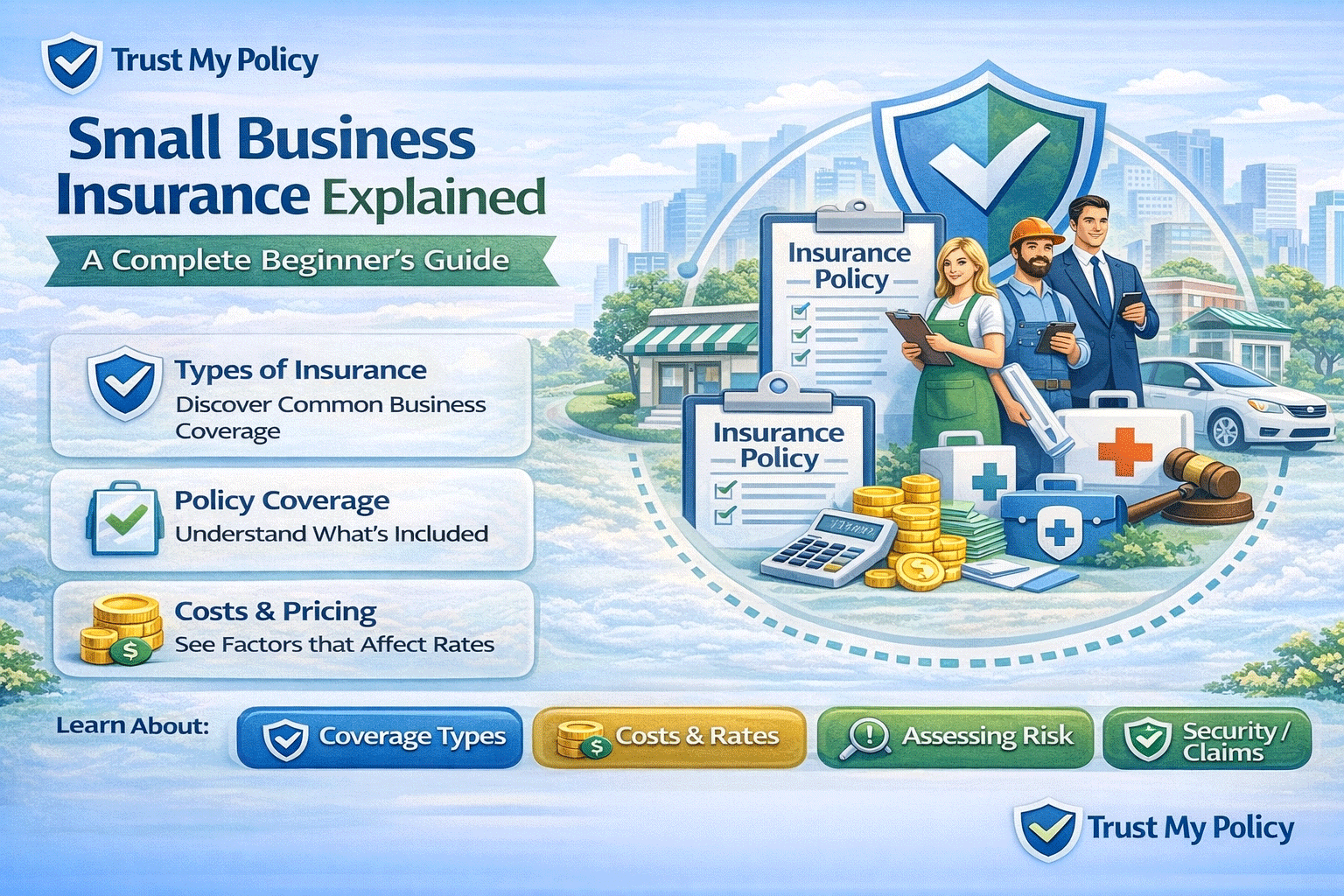
Small business insurance covers at least seven distinct policy types: general liability, commercial property, a business owner’s policy (which bundles the first two), workers’ compensation, professional liability, commercial auto, and business interruption insurance. Most small businesses need general liability and property coverage at minimum, with the remaining types depending heavily on your specific industry and whether you have employees or commercial vehicles.
Theo Ramirez, 44, opened a small auto repair shop in San Antonio and bought a generic small business policy off a quick online search, only to learn during a customer’s injury claim that his policy excluded garage operations entirely, a specific exclusion buried in fine print he’d never read closely. The right policy existed, but he’d bought the wrong type for his exact industry.
Small Business Insurance in 2026 isn’t a single product, it’s a category covering at least seven distinct policy types: general liability, commercial property, business owner’s policies, workers’ compensation, professional liability, commercial auto, and business interruption insurance. Which combination you need depends heavily on your specific industry, whether you have employees, and what physical or professional risks your work involves. This guide breaks down every type in plain language, with real costs by business type.
This article covers every major small business insurance type explained individually, which industries need which combination, real costs broken down by business category, and how to avoid Theo’s exact mistake. By the end, you’ll know exactly which policies actually apply to your specific business.
| Feature | Details |
| What it is | A category of distinct policy types covering different business risks |
| Who needs it | Any small business with customers, employees, premises, equipment, or vehicles |
| Core policy types | General liability, commercial property, BOP, workers’ compensation |
| Industry-specific types | Professional liability, commercial auto, business interruption, garage/contractor-specific policies |
| Typical combined cost | $500–$3,500+/year depending on industry and number of policy types needed |
| Key limitation | Generic policies can contain industry-specific exclusions, as with garage or contractor operations |
| Regulator | State insurance departments (US); Financial Conduct Authority (UK) |
Think of small business insurance like a toolbox rather than a single tool. A hammer (general liability) handles a lot of common jobs, but a plumber, an electrician, and a carpenter each need some different tools beyond that hammer for their specific trade. Buying “a small business policy” without checking which specific tools your industry actually needs is exactly how gaps like Theo’s garage exclusion happen.
Small business insurance is a category, not a single product, encompassing general liability insurance for third-party injury or property damage claims, commercial property insurance for your physical space and equipment, a business owner’s policy that bundles the two affordably, workers’ compensation for employee injuries, professional liability for service-based errors, commercial auto for business vehicles, and business interruption insurance for lost income after a covered disaster. Anyone running a small business needs to identify which specific combination applies to their exact industry rather than buying a generic, one-size-fits-all policy.
| Criteria | Core Coverage (General Liability, Property, BOP) | Industry-Specific Coverage (Professional Liability, Commercial Auto, Specialized Forms) |
| Who needs it | Nearly every small business | Businesses with specific professional, vehicle, or trade-related risks |
| Typical cost | $40–$150/month combined | $30–$200+/month depending on the specific coverage and industry |
| Common gap | Rarely excludes anything universal | Generic policies often exclude specific trades, like garage or contractor operations |
| Pros | Affordable, broadly applicable foundation | Closes specific, often significant gaps generic policies miss |
| Cons | Doesn’t address professional errors or vehicle-related risks | Requires correctly identifying your specific industry’s needs |
We recommend every small business start with general liability and property coverage, then deliberately layer on industry-specific policies matched to their exact trade, rather than assuming a generic policy covers everything.
Scenario 1: Theo, 44, auto repair shop owner in San Antonio. Theo’s generic small business policy excluded garage operations entirely, leaving him exposed during a customer injury claim. Verdict: generic policies often contain industry-specific exclusions that aren’t obvious without careful review. Action: Theo switched to a garage-specific liability policy designed for auto repair businesses.
Scenario 2: A freelance accountant in Leeds providing tax advice to small clients. A client dispute over an alleged calculation error was covered under her professional indemnity insurance, separate from any general liability policy. Verdict: service-based errors require professional liability coverage, not general liability. Action: she increased her professional indemnity limit after taking on larger corporate clients.
Scenario 3: A small bakery in Chicago with three part-time employees. A baker’s repetitive strain injury claim was covered under the business’s workers’ compensation policy, which had been a legal requirement since hiring the first employee. Verdict: workers’ compensation becomes a legal necessity, not an option, once a business has employees. Action: the bakery confirmed its workers’ compensation policy was active before adding any new staff.
Scenario 4: A landscaping business in Florida that lost a month of income after a hurricane destroyed its equipment storage facility. Business interruption insurance covered the lost income and continuing expenses during the rebuild period. Verdict: business interruption coverage addressed a risk that property insurance alone wouldn’t have covered. Action: the business added business interruption coverage specifically after this experience, having previously only carried property insurance.
| Pros | Cons |
| A business owner’s policy (BOP) often bundles core coverage affordably. | Generic policies can contain industry-specific exclusions that aren’t obvious upfront. |
| Industry-specific policies close gaps generic coverage misses entirely. | Identifying every relevant policy type takes real research effort. |
| Workers’ compensation requirements provide clear legal guidance once you have employees. | Comparing coverage across multiple policy types and insurers is more complex than a single quote. |
| Business interruption coverage addresses income loss that property insurance alone wouldn’t cover. | Premiums increase as you layer on more specific coverage types. |
| Professional liability protects service businesses from claims general liability wouldn’t cover. | Many business owners don’t realize they need this until a dispute actually arises. |
⚠️ WARNING: Never assume a generic small business policy automatically covers your specific trade or industry. Always confirm directly with your insurer or broker that your exact type of business isn’t subject to a specific exclusion, as Theo’s garage exclusion demonstrates.
| Your Situation | Our Recommendation |
| You run any small business with customers or premises | Yes — get general liability and commercial property insurance, often via a BOP |
| You have any employees, even part-time | Yes — get workers’ compensation, which is legally required in nearly every state |
| You provide professional services or advice | Yes — add professional liability (errors and omissions) insurance |
| Your business uses any vehicle regularly | Yes — add commercial auto insurance, since personal policies typically exclude business use |
| A disaster could meaningfully halt your income for weeks or months | Yes — add business interruption insurance |
| You’re in a specialized trade like auto repair, contracting, or food service | Yes — confirm your policy includes industry-specific coverage, not just generic terms |
| You assumed your generic policy covers everything in your industry | No — verify this directly, since exclusions for specific trades are common |
💡 TIP: The single golden rule for small business insurance: identify your specific industry’s unique risks first, then build your coverage around those, rather than assuming a generic policy covers everything.
| Scenario | Typical Annual Cost | Notes |
| General liability only, low-risk consulting business | $400–$800/year | Among the lowest-cost small business insurance profiles |
| Business owner’s policy (BOP), retail store | $800–$2,000/year | Bundles general liability and property coverage |
| Workers’ compensation, 3-employee small business | $1,500–$4,000/year | Varies significantly by industry risk classification |
| Professional liability, freelance accountant or consultant | $500–$1,500/year | Varies by claims history and specific service type |
| Commercial auto insurance, single business vehicle | $1,200–$2,500/year | Higher than personal auto due to business-use risk |
| Garage liability insurance, auto repair shop | $2,000–$5,000/year | Industry-specific policy form required, not generic liability |
| Business interruption insurance (add-on to property policy) | $300–$1,000/year | Cost varies based on the income amount covered |
The Hartford and Hiscox (US) — Offer industry-specific small business policies, including specialized trade coverage that generic insurers often exclude. Cost range: competitive small business pricing. Best for: US businesses in specialized trades like auto repair or contracting. Rating: AM Best A.
Next Insurance (US) — Provides fast, industry-tailored small business policies through a streamlined online application. Cost range: competitive small business pricing. Best for: US small business owners wanting a quick, industry-specific quote. Rating: backed by AM Best-rated carrier partners.
Simply Business (UK) — A UK comparison platform specializing in small business insurance across many specific trades and professions. Cost range: free to compare. Best for: UK small business owners wanting industry-specific comparison quotes. Rating: FCA-regulated comparison service.
Hiscox (UK) — Offers professional indemnity and small business liability insurance tailored to UK service-based businesses. Cost range: competitive UK pricing. Best for: UK freelancers and small service businesses. Rating: AM Best A.
Independent insurance brokers — Brokers can identify the specific combination of policy types your exact industry requires, including any specialized forms. Cost range: typically free for the consumer. Best for: any business in a specialized trade unsure which policies apply. Rating: varies by broker, check state or FCA licensing.
We recommend an independent broker as best overall because they can confirm whether your specific industry requires a specialized policy form, exactly the gap that caught Theo’s auto repair business off guard.
Most small businesses need general liability and commercial property insurance at minimum, often bundled through a business owner’s policy, with workers’ compensation, professional liability, commercial auto, or business interruption insurance added based on specific industry needs.
A business owner’s policy bundles general liability and commercial property insurance together, typically at a lower combined cost than purchasing each policy separately.
Yes, in nearly every US state and through the UK’s employers’ liability insurance equivalent, workers’ compensation becomes legally required once a business has any employees.
No. Professional service errors require a separate professional liability (errors and omissions) policy, since general liability typically excludes this type of claim.
Generic policies are written for broadly common risks and often exclude specialized, higher-risk trades like auto repair, contracting, or food service, which require industry-specific policy forms instead.
Yes, in most cases, since personal auto policies typically exclude regular business use, even if the vehicle is also used personally.
Business interruption insurance covers lost income and ongoing expenses if a covered disaster, like a fire or natural disaster, forces your business to temporarily stop operating.
Combined costs typically range from $500 to $3,500 or more per year, depending on your industry, number of employees, and which specific policy types you need.
Ask your insurer or broker directly whether your specific trade, like auto repair, contracting, or food service, requires an industry-specific policy rather than a generic small business form.
Often yes, particularly general liability and property through a BOP, though some industry-specific coverage, like professional liability or commercial auto, may require separate policies.
This guide reflects the latest 2026 insurance data.
This article is for informational purposes only. Always consult a licensed insurance professional before making coverage decisions. Trust My Policy does not sell insurance products or represent any insurer.

Jagadeesh Gutha is the founder of TrustMyPolicy.com, an independent insurance information platform covering life, health, car, home, and business insurance for US and UK readers. He researches insurance products, policy structures, and consumer rights to help everyday people make informed coverage decisions without the jargon. All content on TrustMyPolicy is independently researched, fact-checked, and written to educate — not to sell.



Insurance Guides for UK, USA & Worldwide We are not an insurer or broker.

Reader Comments (0)