
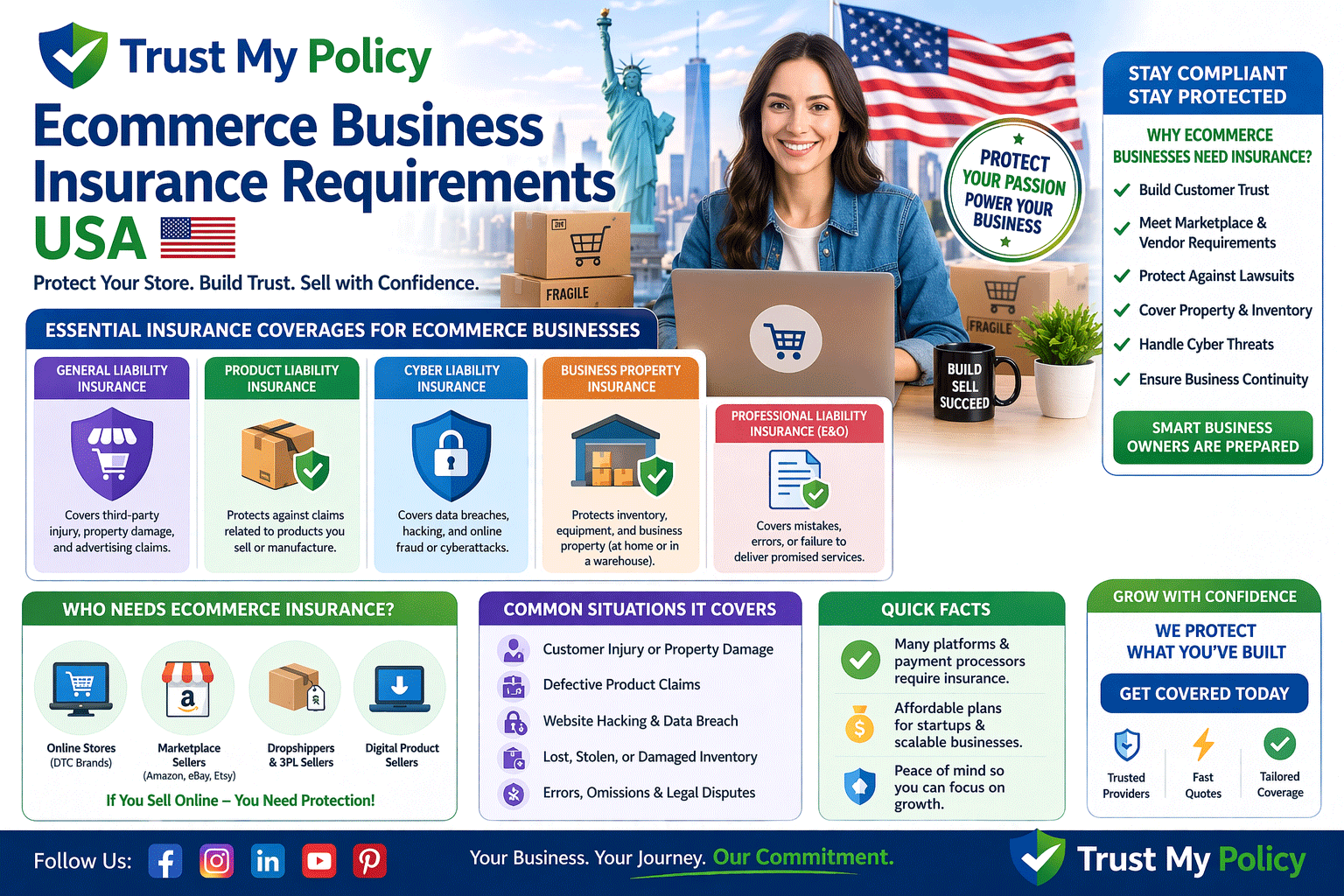
Ecommerce business insurance requirements USA: Amazon and Walmart both require $1M per occurrence / $2M aggregate general liability once you exceed $10,000 in monthly sales (Amazon’s threshold). Workers’ comp is required by most states once you hire an employee. Product liability (included in general liability) is essential for all sellers of physical goods. A BOP at $67–$118/month provides the core coverage stack for most small online retailers. ERGO NEXT and The Hartford both meet Amazon’s pre-approved requirements.
When Marcus hit $10,000 in Amazon sales for the third month running, Amazon sent him a notification: upload proof of commercial general liability insurance within 30 days or face account suspension. He had no idea this requirement existed. He spent three days getting covered — during which Amazon froze his listings. He lost $4,200 in sales during the freeze and paid a rush premium for expedited coverage. All of it was avoidable with $18/month in insurance.
Ecommerce business insurance requirements USA in 2026 are driven by three forces: marketplace platform rules (Amazon, Walmart), state laws (workers’ comp, commercial auto), and the specific risks of selling physical products online — defective goods, data breaches, shipping losses, and cyber fraud. Getting this right protects your revenue, your seller accounts, and your personal finances.
This guide covers every ecommerce business insurance requirement in the USA in 2026 — what Amazon and Walmart specifically require, which coverages protect against the most common online retail risks, what each policy costs, and the best providers for online sellers at every stage.
| Feature | Details |
| What it covers | Product liability, general liability, cyber threats, business property, shipping losses, data breaches |
| Who needs it | All US ecommerce businesses — especially those selling physical products or storing customer data |
| Amazon requirement | $1M per occurrence GL; Amazon listed as additional insured; upload COI within 30 days of hitting $10k/month |
| Walmart requirement | $1M per occurrence / $2M aggregate GL; Walmart listed as additional insured |
| Core coverages | General liability (product liability included), BOP, cyber liability, workers’ comp (if employees) |
| BOP typical cost | $67–$118/month for small online retailers (national average) |
| Workers’ comp | $112/year for low-risk e-commerce operations; required in most states once you hire |
| Regulated by | State insurance commissioners; NAIC model standards; FTC for data breach notification |
Imagine your ecommerce business as a three-layer risk stack: marketplace requirements at the top, state laws in the middle, and your specific product and data risks at the bottom. Each layer has different requirements — and missing any one of them can cost you your seller account, your business, or your personal savings.
Ecommerce business insurance is a set of commercial insurance policies that protect online retailers from financial losses caused by product liability claims, data breaches, shipping incidents, business property damage, and lawsuits from customers, employees, or platform partners. Unlike traditional retail, ecommerce businesses face a unique combination of physical product risks and digital security risks simultaneously.
Who needs it: Every US ecommerce business — regardless of size. Home-based sellers on Etsy, Shopify dropshippers, Amazon FBA sellers, private label brands, and full warehouse operations all face product liability and platform compliance requirements. Many assume that because they don’t have a physical store, they don’t need insurance. This is one of the most expensive mistakes in online retail.
The two largest US marketplace platforms both require sellers to carry commercial general liability insurance once sales reach defined thresholds. These are not optional recommendations — they are policy requirements with account suspension as the consequence for non-compliance.
| Requirement | Detail |
| Sales threshold | $10,000 in sales during three consecutive months triggers the requirement |
| Minimum coverage | $1 million per occurrence general liability insurance |
| Aggregate limit | $2 million aggregate (per policy period) |
| Additional insured | Policy must name: ‘Amazon.com, Inc., and its affiliates and assignees’ |
| Submission deadline | Upload certificate of insurance to Amazon Seller Central within 30 days of hitting the threshold |
| Consequence of non-compliance | Amazon can suspend your seller account and hold your funds |
| Approved provider route | ERGO NEXT and NEXT Insurance are pre-approved — instant certificate download |
| Requirement | Detail |
| Coverage required | $1M per occurrence / $2M aggregate commercial general liability |
| Additional insured | Policy must name: ‘Walmart Inc., its subsidiaries and its affiliates’ |
| Submission | Upload COI to Walmart Seller Center’s insurance section |
| Timeline | Submit within 30 days of reaching sales threshold |
| Product liability | Must be included within the GL policy — standalone product liability is insufficient |
| ⚠️ WARNING: Simply Buying Insurance Is Not Enough
Amazon and Walmart do not just want to know you have insurance — they require the certificate to list them as additional insureds, with their legal entity name spelled exactly as they specify. A certificate naming ‘Amazon’ instead of ‘Amazon.com, Inc., and its affiliates and assignees’ will be rejected. Always verify the exact additional insured wording with your insurer before uploading. ERGO NEXT provides pre-formatted Amazon-compliant certificates. |
General liability insurance is the foundation of every ecommerce insurance stack. Product liability — included within GL for most policies — is the specific coverage protecting you when a product you sold causes injury or property damage. If a customer’s child is injured by a toy you sold, or a supplement causes an allergic reaction, product liability covers the legal defence and compensation costs.
Who needs it: Every ecommerce seller of physical products. Particularly critical for: food and beverage sellers, supplement brands, cosmetics, electronics, children’s products, imported goods from overseas manufacturers.
Cost: $14–$20/month (ERGO NEXT or Simply Business at baseline). Amazon-compliant with correct additional insured wording.
A BOP bundles general liability, commercial property insurance, and business interruption into one cost-effective policy. For ecommerce sellers with inventory, office equipment, or warehouse space, a BOP is almost always better value than buying GL and property separately.
Cost: $67–$118/month for small online retailers with standard BOP limits. Simply Business offers BOP from $21/month at the lowest coverage tier.
Cyber insurance covers data breaches, ransomware attacks, payment card fraud, and the regulatory and notification costs that follow a digital incident. The average data breach costs $4.4 million to resolve. AI-powered ransomware attacks are the fastest-growing cyber threat in 2026. If you store customer data — including just email addresses and shipping addresses — you need cyber insurance. Neither your GL nor your BOP covers cyber incidents.
Cost: $25–$100/month for small ecommerce businesses. Many insurers now offer cyber as a BOP endorsement for an additional $15–$30/month.
If a defective product must be recalled from the market, recall insurance covers the cost of notifying customers, retrieving and disposing of the product, and the revenue lost during the recall period. Standard product liability does NOT cover recall costs — it only covers injury claims after someone is already harmed.
Cost: $30–$80/month depending on product category and sales volume. Essential for food, supplement, cosmetic, and electronic product sellers.
Protects your physical inventory, equipment, and business assets from fire, theft, vandalism, and weather damage. If your warehouse floods or your office is burgled, commercial property insurance covers replacement. If you use a third-party fulfilment centre (Amazon FBA, 3PL), check whether their liability ends where your coverage begins — there is often a gap.
Cost: Included in most BOP policies. Standalone commercial property: $15–$40/month depending on inventory value.
Legally required in almost every US state the moment you hire a W-2 employee. Covers medical bills and lost wages if an employee is injured or becomes ill due to work. Even a warehouse worker who develops a repetitive strain injury can trigger a valid workers’ comp claim. Non-compliance fines can reach $10,000/day in some states.
Cost: $112/year on average for low-risk e-commerce operations. Rises with payroll size and job classification risk.
Covers lost revenue if a covered event — fire, flood, or major equipment failure — forces you to halt operations. Usually included in a BOP. For high-volume ecommerce sellers, even 48 hours of downtime during peak season can mean tens of thousands in lost revenue.
Cost: Included in most BOP policies — typically 20–30% of the BOP premium. Rarely available as a standalone.
| Criteria | BOP (GL + Property + Interruption) | Cyber Liability | Product Liability (within GL) |
| What it covers | Third-party injury, business property, revenue during shutdown | Data breaches, ransomware, regulatory fines, notification costs | Customer injury or property damage from a product you sold |
| Who needs it | All ecommerce sellers with inventory, equipment, or office space | All sellers storing customer data (emails, addresses, payment info) | All sellers of physical products — no exceptions |
| Monthly cost | $67–$118/month | $25–$100/month | Included in GL / BOP |
| Amazon/Walmart | Satisfies marketplace GL requirements when limits are set correctly | Not required by platforms — but essential for business protection | Included in platform-required GL — no separate purchase needed |
| Biggest gap | Does not cover cyber incidents or professional errors | Separate policy — GL and BOP both exclude cyber | Import liability: if you import from overseas, you can be fully liable |
| Winner | BOP is the core coverage — start here | Cyber is the fastest-growing necessity in 2026 | Product liability is non-negotiable for physical product sellers |
Situation: Hit $10,000/month in Amazon sales in month 3. Received Amazon’s insurance notification. Had no coverage. Amazon froze listings for 3 days.
Revenue lost: $4,200 during account freeze + rush premium for expedited coverage.
What insurance costs: ERGO NEXT GL with $1M limit, Amazon listed as additional insured: $18/month.
Verdict: Buy GL with correct additional insured wording before you approach $8,000/month in Amazon sales — not at $10,000 when the freeze hits. ERGO NEXT and NEXT Insurance both provide instant Amazon-formatted certificates. Don’t wait for the notification.
Situation: Sold 2,000 units of a wooden toy set sourced from a Chinese manufacturer. A child choked on a small component. Family sued for $280,000 in medical costs and damages.
No insurance: $280,000 personal liability. Business closed.
With product liability: GL policy at $25/month (Hiscox) covers the claim. Business survives.
Verdict: Importers of children’s products carry maximum product liability risk. If you import from overseas, the US distributor is you — and US courts will hold you fully liable for product defects. Product liability is not optional for imported goods. Buy before your first shipment lands.
Situation: Ransomware attack locked Tom’s system and encrypted 14,000 customer records. Ransom demand: $45,000. Breach notification obligation: all 14,000 customers. Legal fees and regulatory risk: $30,000+.
No cyber insurance: $75,000+ personal liability. Business disrupted for 3 weeks.
With cyber insurance: Cyber policy at $55/month covered ransom negotiation, forensics, breach notification, and legal defence.
Verdict: Every ecommerce business that stores customer data needs cyber insurance. GL and BOP both explicitly exclude cyber incidents. A $55/month policy covers an incident that would cost $75,000+ without it. The cyber insurance market reached $16.3 billion in 2025 — insurers are tightening requirements. Buy now before underwriting becomes stricter.
Situation: Sold natural face cream. A customer developed a severe skin reaction and alleged undisclosed ingredients. Filed a claim for $18,000 in medical costs.
No insurance: $18,000 personal liability + Etsy account suspended pending resolution.
With GL + product liability: Thimble or Insurance Canopy policy from $15/month covers cosmetic product liability. Claim paid. Etsy account reinstated.
Verdict: Handmade cosmetics, food, and supplements sold on Etsy carry significant product liability risk. Many Etsy sellers assume their small scale protects them — it doesn’t. Insurance Canopy specifically covers Etsy, eBay, and Amazon sellers with occurrence-based policies from $15/month.
| Pros | Cons |
| Satisfies Amazon and Walmart marketplace requirements — avoids account suspension and revenue disruption | Adds monthly overhead cost to a business model often operating on thin margins |
| Product liability covers your personal finances from claims that can easily reach $100,000+ | Standard homeowner’s and renters insurance explicitly excludes business activities — creates a false sense of coverage |
| Cyber insurance covers data breach costs averaging $4.4 million — essential for any business storing customer data | Cyber policies increasingly require documented security practices before coverage is granted — adds operational complexity |
| BOP provides business interruption coverage — protects revenue during shutdown periods | Coverage limits must be reviewed and updated as your inventory value and revenue grow |
| Workers’ comp compliance prevents state fines of up to $10,000/day per employee | Platform requirements (additional insured wording) can be missed — invalidating coverage even when a policy exists |
Your physical location is irrelevant to your insurance need. Product liability follows the product — not the store. If you sell physical goods and they cause harm, you are personally liable regardless of whether you operate from a warehouse or your bedroom.
Amazon’s notification arrives only after you’ve already hit the threshold. During the gap between notification and compliance, Amazon can freeze your listings and hold your funds. Buy GL with Amazon as additional insured before you approach $8,000–$9,000 in monthly sales.
Having a GL policy is not sufficient. The certificate of insurance must name the platform with their exact legal entity language. A certificate naming ‘Amazon’ will be rejected — it must say ‘Amazon.com, Inc., and its affiliates and assignees’. Always verify the additional insured wording with your insurer.
Both BOP and GL policies explicitly exclude cyber incidents. A data breach, ransomware attack, or payment fraud incident is not covered by your standard business insurance. You need a separate cyber liability policy or cyber endorsement. This is the fastest-growing coverage gap in ecommerce — and the most expensive when it hits.
Amazon FBA’s storage terms limit their liability for your inventory to $50 per unit in most cases. If a warehouse fire destroys $80,000 in your inventory, Amazon pays a fraction. Your commercial property insurance (within a BOP) covers the rest — but only if your policy specifically extends to third-party storage locations. Confirm this with your insurer.
| Your Situation | Our Recommendation |
| You sell physical products on Amazon and approach $10k/month in sales | Yes — buy GL with Amazon as additional insured immediately. Don’t wait for the notification |
| You sell on Walmart Marketplace | Yes — same GL requirement as Amazon. $1M per occurrence, Walmart as additional insured |
| You import products from overseas manufacturers | Yes — product liability is essential. You are legally the manufacturer in US courts for imported goods |
| You sell on Etsy or Shopify with no marketplace insurance requirement | Yes — product liability protects against customer injury claims regardless of platform requirements |
| You store customer data or process online payments | Yes — cyber liability is essential. GL and BOP both exclude cyber incidents entirely |
| You have employees in a warehouse or fulfilment role | Yes — workers’ comp is legally required in most states. Non-compliance fines are severe |
| You are a dropshipper who never touches inventory | Yes — you still have product liability exposure for the products passing through your store |
| You sell digital products only (e-books, courses, software) | Maybe — product liability is less relevant, but GL covers advertising injury and E&O covers product errors |
| 💡 TIP: Get Your Amazon COI Before You Hit the Threshold
Create calendar alerts when your Amazon sales reach $7,000/month and again at $9,000/month. At $9,000, start the insurance application. You need 3–5 business days to get coverage confirmed and the certificate formatted correctly. Being insured before the threshold means zero business disruption. ERGO NEXT provides Amazon-formatted COI instantly after purchase. |
| Seller Profile | Coverage Type | Monthly Cost | Notes |
| Solo dropshipper, under $50k annual revenue | GL only (ERGO NEXT) | $13–$18/month | Amazon-compliant; instant COI |
| Small Amazon FBA seller, $100k revenue | BOP — GL + property | $67–$80/month | Covers inventory; add cyber as needed |
| Supplement or food brand, 3 employees | GL + product liability + cyber | $120–$180/month | High product liability risk; cyber essential for customer data |
| Electronics seller, $500k revenue | BOP + cyber + workers’ comp | $250–$350/month | Complex risk profile; higher limits needed |
| Children’s product brand (imported goods) | GL + product liability + product recall | $150–$250/month | Import liability; recall cover essential for children’s goods |
| Cheapest possible coverage | GL only (ERGO NEXT) | $13/month | Amazon-compliant minimum; no property or cyber |
| Most expensive full stack ($1M+ revenue) | BOP + cyber + product recall + workers’ comp + EPLI | $500–$800/month | Full enterprise coverage for scaling brand |
Why recommended: Digital-first, instant approval, instant Amazon-formatted COI. Pre-approved for Amazon’s marketplace requirements. GL from $13/month. Available nationally. 24/7 certificate access via app or web portal. Acquired by Ergo Group for $2.6B in March 2025 — backed by major European insurer.
Cost: GL from $13–$18/month; overall average $99/month across all coverage types.
Best for: Amazon FBA and FBM sellers, Walmart marketplace sellers, and e-commerce brands needing instant platform-compliant certificates.
Why recommended: A+ AM Best rating. BOP from $33/month for small businesses. Over 200 years in business with strong claims department. Particularly strong for product-based businesses needing bundled GL, property, and business interruption in one policy. 24/7 claims service.
Cost: BOP from $33/month; professional liability from $64/month.
Best for: Established ecommerce brands with inventory, warehouse or office space, and employees needing comprehensive BOP coverage.
Why recommended: Specialist small business insurer with strong product liability and cyber endorsement options. Online quote in minutes. Rated 4.7/5 by customers. Available in 49 states. Strong for tech-forward ecommerce brands selling via their own Shopify or WooCommerce stores.
Cost: GL + cyber bundle typically $80–$150/month for small e-commerce operations.
Best for: D2C ecommerce brands, Shopify sellers, and online businesses that prioritise product liability and cyber protection together.
Why recommended: Specifically designed for Etsy, eBay, and Amazon sellers. Occurrence-based policies covering product liability, GL, personal injury, and advertising injury. Over 50% of customers pay $1,400 or less per year. Instant online quotes. Highly rated for small handmade and craft sellers.
Cost: Most sellers pay $1,400/year or less. Individual quotes based on product type and sales volume.
Best for: Etsy sellers, handmade product brands, craft businesses, and small marketplace sellers needing affordable occurrence-based product liability.
Why recommended: Cheapest workers’ comp for e-commerce at $6/month average. Also offers flexible short-term policies. Ideal for seasonal sellers or businesses with fluctuating workforce needs.
Cost: Workers’ comp from $6/month; overall average $105/month across all coverage types.
Best for: E-commerce businesses with employees needing affordable workers’ comp, and seasonal sellers needing short-term or part-year coverage.
👉 We recommend ERGO NEXT as the best starting point for most US ecommerce sellers because it provides the cheapest Amazon-compliant GL coverage with instant certificates. Add The Hartford’s BOP as your business grows past $100k in revenue.
US ecommerce businesses typically need: general liability with product liability (required by Amazon, Walmart, and most marketplaces), a Business Owner’s Policy or BOP (bundles GL, property, and business interruption), cyber liability insurance (covers data breaches and ransomware — excluded from GL and BOP), and workers’ comp (legally required in most states once you hire employees). Product recall insurance is recommended for food, supplement, cosmetic, and electronics sellers.
Yes. Amazon requires commercial general liability insurance of at least $1 million per occurrence and $2 million aggregate once you reach $10,000 in sales during three consecutive months. The policy must list ‘Amazon.com, Inc., and its affiliates and assignees’ as an additional insured. You must upload a certificate of insurance to Amazon Seller Central within 30 days. Non-compliance results in account suspension. ERGO NEXT provides instant Amazon-compliant certificates.
No. Homeowner’s and renters insurance policies explicitly exclude commercial business activities. If you suffer a business-related loss — inventory theft, a customer injury claim, or a data breach affecting your business — your home insurance will deny the claim. You need a separate commercial policy. This is one of the most dangerous assumptions in home-based ecommerce.
A complete ecommerce insurance stack costs $100–$350/month for most small to mid-sized online sellers. General liability alone starts from $13/month (ERGO NEXT). A BOP covering GL, property, and business interruption costs $67–$118/month for small retailers. Adding cyber liability costs $25–$100/month more. Workers’ comp averages $112/year for low-risk e-commerce operations.
Product liability insurance covers the legal and compensation costs when a product you sell causes injury or property damage to a customer. It is included within general liability policies for most insurers. Every US ecommerce seller of physical products needs it — including dropshippers and resellers. If you import goods from overseas, US courts treat you as the manufacturer, making product liability essential even if you didn’t make the product yourself.
Cyber insurance is not legally required for most ecommerce businesses — but it is practically essential for any seller that stores customer data. The average data breach costs $4.4 million to resolve. Neither GL nor BOP policies cover cyber incidents. Many payment processors and enterprise wholesale suppliers now require proof of cyber coverage before establishing relationships. The cyber insurance market reached $16.3 billion in 2025 and is tightening underwriting requirements annually.
If you reach $10,000 in monthly sales and don’t upload a certificate of insurance within 30 days, Amazon can suspend your seller account and hold your payouts. During the suspension, your listings are removed and you receive no revenue. Getting coverage during a suspension takes 2–5 business days minimum. ERGO NEXT provides same-day coverage with instant certificates — the fastest solution when an account freeze is active.
Yes. Dropshippers still have product liability exposure — you are the seller of record to the end customer, even if you never touch the product. If a product you sold causes injury, the customer sues you first, not your supplier. General liability with product liability protects you from these claims. Additionally, if you store customer data, cyber insurance is essential regardless of your fulfilment model.
For startups building a complete business insurance stack, see our best small business insurance for startups USA guide. For UK ecommerce sellers needing business insurance, our public liability insurance for freelancers UK article covers equivalent UK policies.
| 📋 Disclaimer
This article is for informational purposes only. Always consult a licensed insurance professional before making coverage decisions. Trust My Policy does not sell insurance products or represent any insurer. |

Jagadeesh Gutha is the founder of TrustMyPolicy.com, an independent insurance information platform covering life, health, car, home, and business insurance for US and UK readers. He researches insurance products, policy structures, and consumer rights to help everyday people make informed coverage decisions without the jargon. All content on TrustMyPolicy is independently researched, fact-checked, and written to educate — not to sell.



Insurance Guides for UK, USA & Worldwide We are not an insurer or broker.

Reader Comments (0)