
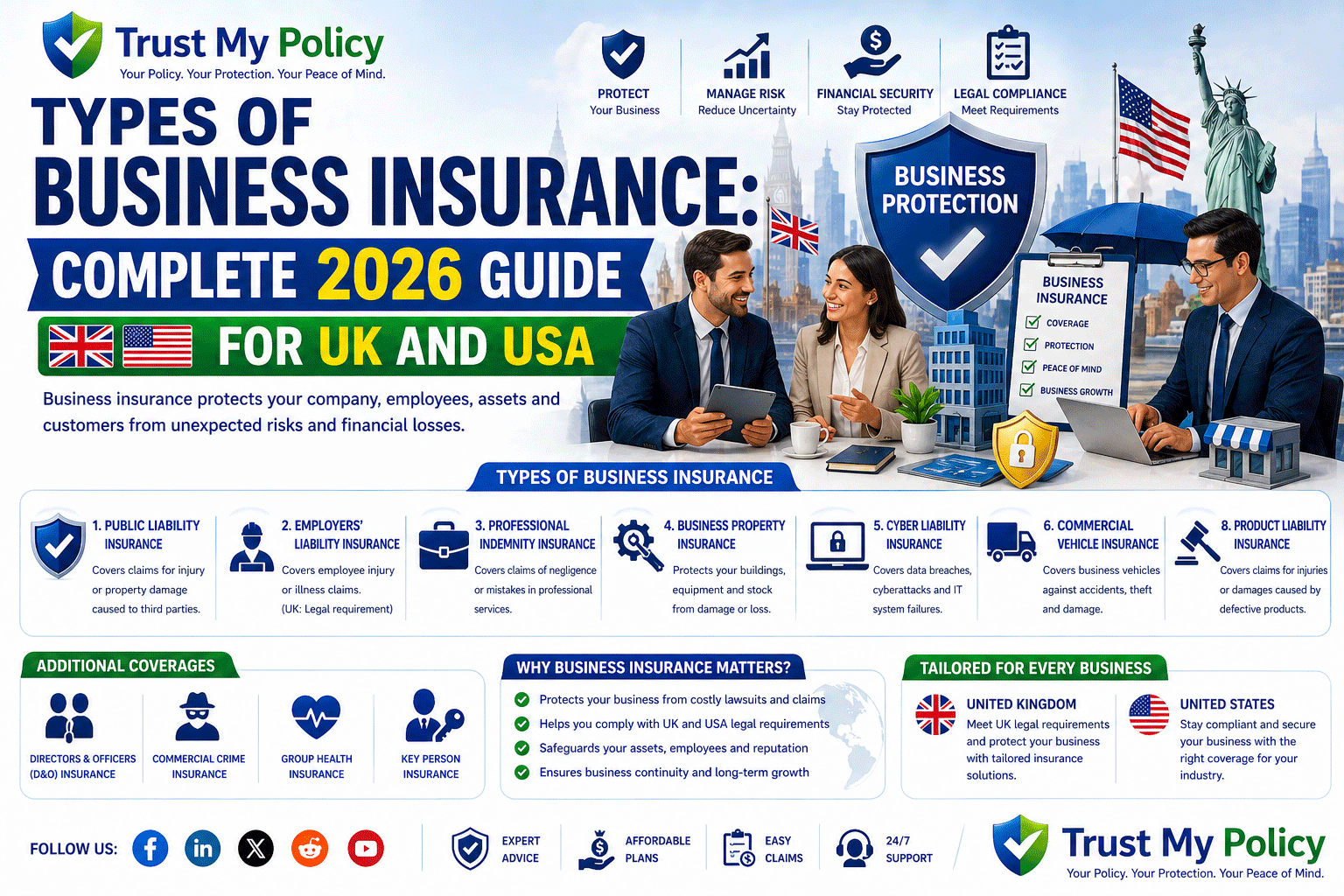
The 12 main types of business insurance: (1) General liability; (2) Professional indemnity / E&O; (3) Employers’ liability (UK — legally required with employees); (4) Workers’ compensation (USA — legally required with employees in most states); (5) Cyber liability; (6) Commercial property; (7) Business owner’s policy (BOP — bundles liability + property); (8) Business interruption; (9) Commercial auto/vehicle; (10) Product liability; (11) Directors & officers (D&O); (12) Employment practices liability (EPLI). Most SMEs need 3–6 of these depending on their business model.
When Jessica’s marketing agency grew from 2 to 12 people in 18 months, she assumed her original £500,000 general liability policy still covered everything. It didn’t. She now had 12 employees requiring employers’ liability by law. Her client contracts required professional indemnity. Her data storage triggered GDPR obligations — requiring cyber insurance. Her office lease required building cover. Four types of insurance she didn’t know she needed. Three of them were legal requirements she was violating.
Types of business insurance cover every risk a company faces — from client lawsuits and data breaches to employee injuries and business interruption. In the UK and USA, some types are legally required; others are practically essential for operating commercially; and some protect specific risks that most businesses don’t consider until they’re facing a claim.
This guide covers all 12 main types of business insurance in 2026 — what each covers, who needs it, what it costs, whether it’s legally required, and how to build the right coverage stack for your specific business.
| Insurance Type | Legally Required? | Who Needs It | Typical Monthly Cost |
| General liability (GL) | No (UK) / No (USA) — but required by most leases and contracts | All businesses with third-party exposure | From £5/month (UK) / $14/month (USA) |
| Professional indemnity / E&O | Regulated professions (UK) / No (USA) | Anyone providing advice, services, or expertise | From £6/month (UK) / $64/month (USA) |
| Employers’ liability | YES — UK law with any employee | All UK businesses with employees | ~£50–£200/month (UK) |
| Workers’ compensation | YES — most US states with employees | All US businesses with employees | Varies by payroll and risk class |
| Cyber liability | No — but increasingly required by clients | Any business storing data or online | $25–$100/month |
| Commercial property | No — but required by most leases | Businesses with physical assets | £15–£100/month (UK) / $30–$200/month (USA) |
| Business owner’s policy (BOP) | No | Most SMEs — bundles GL + property + interruption | From $21/month (USA) / £30/month (UK) |
| Business interruption | No | Businesses that would lose revenue if unable to operate | Often included in BOP |
| Commercial auto/vehicle | YES if company vehicles | Any business owning or using vehicles for work | Varies by fleet and drivers |
| Product liability | No — but required by Amazon/Walmart | Any business selling physical products | Included in GL for most policies |
| Directors & officers (D&O) | No — but required by most VCs | Companies with boards, investors, or significant employee numbers | $333/month+ (USA average for startups) |
| Employment practices liability (EPLI) | No | Businesses with employees facing HR claims risk | ~£100–£200/month (UK) / $125/month (USA) |
General liability (GL) insurance covers third-party claims for bodily injury, property damage, and advertising injury (copyright infringement, defamation). It is the foundational policy for almost every business. Most commercial leases, enterprise vendor contracts, and marketplace platforms (Amazon, Walmart) require proof of GL as a minimum condition.
Cost: From £5/month (Simply Business, UK) / $14/month (ERGO NEXT, USA). Amazon requires $1M per occurrence / $2M aggregate minimum.
Professional indemnity (PI) insurance — called E&O in the USA — covers financial losses a client suffers because of your professional advice, work, or errors. If your software has a bug that causes a client $200,000 in losses, or your architectural plans contain an error that costs extra to fix, PI covers your legal defence and the resulting compensation.
Legally required: In the UK, for regulated professions including solicitors (SRA), architects (ARB), surveyors (RICS), and financial advisers (FCA). Not legally required in the USA, but practically essential for client contracts.
Cost: From £6/month (Simply Business, UK, 10th percentile) / $64/month (The Hartford, USA).
In the UK, employers’ liability (EL) insurance is a legal requirement under the Employers’ Liability (Compulsory Insurance) Act 1969. Every employer with one or more employees must hold a minimum of £5 million of EL cover. The certificate must be displayed in the workplace. Failure to comply carries fines of up to £2,500 per day.
Cost: Typically £50–£200/month depending on number of employees, payroll, and industry risk.
Workers’ compensation insurance is legally required in almost every US state the moment you hire a W-2 employee. It covers medical bills and lost wages if an employee is injured or becomes ill because of work. Non-compliance fines reach $10,000/day per employee in some states. Even remote workers developing repetitive strain injuries can trigger valid workers’ comp claims.
Cost: Varies significantly by industry, payroll, and state. Low-risk office workers: approximately $0.75/$100 of payroll. High-risk construction: $7–$12/$100 of payroll.
Cyber liability insurance covers data breaches, ransomware attacks, payment card fraud, and the regulatory and notification costs that follow a digital incident. The average data breach costs $4.4 million to resolve (IBM Cost of a Data Breach Report 2024). Standard GL and property insurance both explicitly exclude cyber incidents — a separate cyber policy is essential for any business storing customer data.
Cost: $25–$100/month for small businesses. Rising annually as insurers tighten underwriting requirements. Many cyber policies now require documented security controls before coverage is granted.
Commercial property insurance covers your business’s physical assets — buildings, contents, equipment, and inventory — from fire, theft, vandalism, weather damage, and (in some policies) flood. Most commercial leases require tenants to hold contents insurance at minimum. Building insurance is typically the landlord’s responsibility for leased premises.
Cost: £15–£100/month (UK) / $30–$200/month (USA) depending on property value, location, and industry.
A BOP bundles general liability, commercial property, and business interruption insurance into a single cost-effective package — typically at a lower combined cost than buying each separately. The most efficient entry-level business insurance product for most SMEs. Standard BOP does not include professional liability, cyber, workers’ comp, or D&O — these must be added separately.
Cost: From $21/month (Simply Business, USA) / from £30/month (UK). Most small businesses pay $67–$118/month for a standard BOP.
Business interruption (BI) insurance covers lost revenue and ongoing expenses if a covered event (fire, flood, major equipment failure) forces you to halt or significantly reduce operations. It pays your bills and replaces lost income during the period of disruption. Almost always included within a BOP — rarely purchased standalone.
Cost: Typically included in BOP. Standalone BI policies are expensive and rarely cost-effective for SMEs outside the BOP structure.
Commercial auto insurance is legally required for any vehicle used for business purposes in both the UK and USA. Personal car insurance explicitly excludes commercial use. If you or employees use vehicles to visit clients, deliver goods, or travel between work sites, commercial auto coverage is legally required.
UK note: Commercial vehicles delivering goods for payment need hire and reward cover — not just business use. See our guide on car insurance for delivery drivers UK.
Product liability insurance covers claims arising from injury or property damage caused by products you sell or manufacture. In the USA, importers are treated as manufacturers — if you import goods from overseas and sell them in the USA, you bear full product liability even if you didn’t make the product. Included within GL policies for most standard insurers.
Who needs it: Every seller of physical products — including Etsy sellers, Amazon FBA sellers, food producers, supplement brands, cosmetics, electronics, and children’s products. Non-negotiable for any product that enters someone’s body or is used by children.
D&O insurance protects company directors and officers from personal financial liability for decisions made in their professional capacity. Shareholders, employees, regulators, or third parties can sue directors personally — D&O covers legal defence and settlements. Most VC term sheets require D&O as a condition of investment.
Cost: $333/month average for startups under $50M revenue (CoverWallet data). Higher for larger or publicly listed companies.
EPLI covers claims from employees alleging wrongful termination, discrimination, harassment, or retaliation. One HR lawsuit can cost $75,000–$150,000 in legal defence alone — regardless of outcome. Increasingly important as businesses scale past 10 employees.
Cost: ~$125/month for $1M in coverage (CoverWallet data, USA) / £100–£200/month (UK, depending on employee count and industry).
| Business Type | Essential Coverage | Legally Required | Consider Adding |
| Freelancer / consultant (no employees) | GL + Professional Indemnity | PI if regulated profession (UK) | Cyber if you handle client data |
| Self-employed tradesperson | GL + Tools cover | EL if any workers (UK) / Workers’ comp if employees (USA) | Commercial vehicle; income protection |
| E-commerce / Amazon seller | GL with product liability + Cyber + BOP | Workers’ comp if employees | Product recall; D&O if VC-backed |
| Professional services firm (5–20 employees) | BOP + Professional Indemnity + EL/Workers’ comp + Cyber | EL (UK) / Workers’ comp (USA) | D&O; EPLI; group life |
| Tech startup (VC-backed) | BOP + E&O + Cyber + D&O + EPLI | Workers’ comp if employees | Key person; relevant life (UK) |
| Food / restaurant business | GL + Product liability + EL/Workers’ comp + Commercial property | EL (UK) / Workers’ comp (USA) | Product recall; business interruption |
| Construction / trade business | GL + EL/Workers’ comp + Commercial vehicle + Tools | EL (UK) / Workers’ comp (USA) | Key person; EPLI |
| 💡 TIP: Start with a BOP Then Add Specialist Cover
For most SMEs, the right approach is: (1) BOP for the foundation (GL + property + interruption). (2) Professional Indemnity / E&O for client-facing work. (3) EL / Workers’ comp if you have employees (legally required). (4) Cyber if you handle customer data. (5) Specialist additions (D&O, EPLI, product liability) as your business grows. This sequence prioritises legal compliance first, then the risks most likely to cause financial ruin, then operational protection. |
| Insurance Type | Typical Monthly Cost UK | Typical Monthly Cost USA | Notes |
| General liability | From £5/month | From $14/month | Increases with revenue, headcount, and risk |
| Professional indemnity / E&O | From £6/month | From $64/month | Varies dramatically by profession and revenue |
| Employers’ liability (UK) | £50–£200/month | N/A (workers’ comp equivalent in USA) | Legally required in UK with any employee |
| Workers’ comp (USA) | N/A | $0.75–$12 per $100 payroll | Rate varies by industry risk class |
| Cyber liability | £20–£80/month | $25–$100/month | Rising annually; tightening underwriting |
| BOP (bundles GL + property + interruption) | From £30/month | From $21/month | Most efficient entry-level package for SMEs |
| D&O (startup) | £150–£300/month | From $333/month | Required by most VCs before term sheet |
| EPLI | £100–£200/month | From $125/month | Most important for businesses with 10+ employees |
The most important types of business insurance for most SMEs are: (1) General liability — protects against third-party injury and property damage claims; (2) Professional indemnity / E&O — protects against professional errors and client financial losses; (3) Employers’ liability (UK) or workers’ compensation (USA) — legally required with any employee; (4) Cyber liability — covers data breaches and ransomware; (5) Commercial property — protects physical assets. A Business Owner’s Policy (BOP) bundles the first three cost-effectively.
In the UK, employers’ liability insurance is legally required under the Employers’ Liability (Compulsory Insurance) Act 1969 for all businesses with one or more employees — minimum £5 million cover. Commercial vehicle insurance is legally required for any vehicle used for business purposes. Some regulated professions (solicitors, architects, financial advisers, surveyors) must hold professional indemnity insurance. All other types of business insurance are voluntary — but many are practically required by client contracts, leases, and marketplace platforms.
General liability covers physical risks — third-party bodily injury, property damage, and advertising injury (defamation, copyright infringement). Professional liability (E&O) covers financial losses a client suffers due to your professional errors, advice, or omissions. A business needs both: GL covers if a client trips in your office; PI/E&O covers if your advice causes a client to lose money. Different risks, different policies, both essential for professional services businesses.
For startup-specific coverage recommendations, see our best small business insurance for startups USA guide. For e-commerce sellers needing product liability specifically, our ecommerce business insurance requirements USA article covers all platform requirements.
| 📋 Disclaimer
This article is for informational purposes only. Always consult a licensed insurance professional before making coverage decisions. Trust My Policy does not sell insurance products or represent any insurer. |

Jagadeesh Gutha is the founder of TrustMyPolicy.com, an independent insurance information platform covering life, health, car, home, and business insurance for US and UK readers. He researches insurance products, policy structures, and consumer rights to help everyday people make informed coverage decisions without the jargon. All content on TrustMyPolicy is independently researched, fact-checked, and written to educate — not to sell.



Insurance Guides for UK, USA & Worldwide We are not an insurer or broker.

Reader Comments (0)