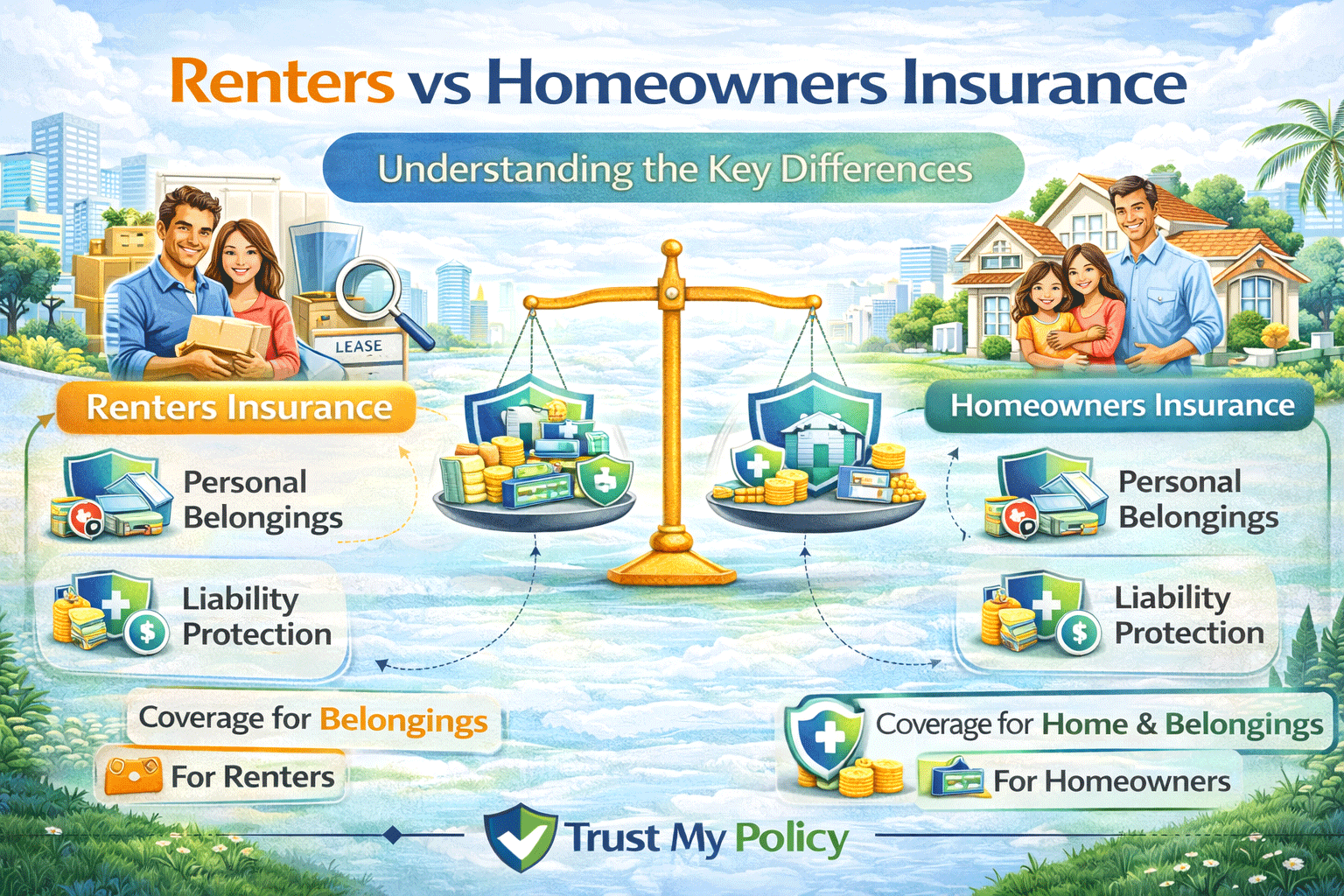
Renters insurance covers your personal belongings, liability, and temporary living expenses if your rented home becomes uninhabitable, typically costing $15–$25 a month. Homeowners insurance covers all of that plus the physical structure of the home itself, typically costing $100–$200 a month. The key difference is that renters never need to insure a building they don’t own.
Olivia Chen, 28, moved from a rented flat in Bristol into her first home and assumed her old renters policy habits would simply carry over to homeownership. Her broker quickly corrected her: homeowners insurance had to cover the building itself, not just her belongings, and skipping that distinction could have left her completely unprotected against structural damage.
Renters vs Homeowners Insurance in 2026 comes down to what’s actually being insured. Renters insurance covers your personal belongings and liability inside a property you don’t own. Homeowners insurance covers the physical structure itself, your belongings, and liability, since you’re responsible for the building. This guide breaks down exactly what each policy includes, what it costs, and which one applies to your living situation.
This article covers the core coverage differences, what each policy actually pays for, real scenarios with dollar figures, and a clear decision framework. By the end, you’ll know exactly what to buy.
Quick Summary Table
| Feature |
Details |
| What it is |
Renters insurance covers belongings and liability; homeowners insurance adds structural coverage |
| Who needs renters insurance |
Anyone renting an apartment, house, or room |
| Who needs homeowners insurance |
Anyone who owns the property they live in, especially with a mortgage |
| Typical cost |
$15–$25/month renters; $100–$200/month homeowners |
| Key benefit |
Both cover belongings and liability; homeowners adds protection for the structure itself |
| Key limitation |
Renters insurance never covers the building’s structure, since the landlord insures that separately |
| Regulator |
State insurance departments (US); Financial Conduct Authority (UK) |
What’s the Real Difference Between These Two Policies?
Think of renting versus owning like borrowing a car versus owning one outright. As a renter, you’re responsible for what’s inside the car — your belongings — but the car itself belongs to someone else, who insures that part. As a homeowner, you own both the car and everything inside it, so your insurance has to cover both.
Renters insurance protects your personal belongings, covers your liability if someone is injured in your rented space, and pays for temporary housing if the unit becomes unlivable. Homeowners insurance covers all of that, plus the structure of the home itself, since you — not a landlord — are financially responsible for rebuilding or repairing it. Anyone renting or owning their primary residence needs one of these two policies.
How These Policies Actually Work — 5 Steps
- You experience a covered loss — fire, theft, water damage, or a liability incident. Both policy types respond to these events, but the scope of what’s covered differs.
- Your personal belongings are assessed for replacement or repair cost. Both renters and homeowners policies cover this, often up to a set limit you choose.
- The structure of the building is assessed, if applicable. Only homeowners insurance covers the physical building, since renters don’t own it.
- Liability coverage applies if someone is injured on the property. Both policy types include liability protection for incidents like a guest’s slip-and-fall.
- Temporary living expenses are covered if the home becomes uninhabitable. Both renters and homeowners insurance typically include this, helping pay for a hotel or short-term rental during repairs.
Comparison: Renters Insurance vs. Homeowners Insurance
| Criteria |
Renters Insurance |
Homeowners Insurance |
| Cost |
$15–$25/month |
$100–$200/month |
| Covers your belongings |
Yes |
Yes |
| Covers the building structure |
No, the landlord’s policy covers this |
Yes |
| Covers liability |
Yes |
Yes |
| Best for |
Anyone renting their home |
Anyone who owns their home |
| Pros |
Very affordable relative to the protection provided |
Comprehensive, covers both structure and contents |
| Cons |
Doesn’t cover the building, only your belongings |
Higher cost, reflecting the larger insured asset |
We recommend renters insurance for every renter without exception and homeowners insurance for every homeowner, since both are inexpensive relative to the financial exposure they remove.
4 Real-Life Scenarios
Scenario 1: Olivia, 28, first-time homeowner in Bristol. Olivia initially assumed her old renters insurance habits applied directly to her new home, until her broker explained she now needed structural coverage too. Verdict: moving from renting to owning fundamentally changes what needs insuring. Action: Olivia bought a comprehensive homeowners policy covering both the structure and her belongings.
Scenario 2: Marcus, 24, renter in Atlanta. Marcus assumed his landlord’s insurance covered his own belongings, until a kitchen fire destroyed $6,000 of his furniture and electronics with zero reimbursement from the landlord’s policy. Verdict: landlord insurance never covers a tenant’s personal property. Action: Marcus signed up for renters insurance the same week at $14 a month.
Scenario 3: A homeowner couple in Leeds without adequate structural coverage. A storm caused £35,000 in roof and structural damage, and they discovered their policy’s rebuild-cost limit was set too low to fully cover repairs. Verdict: homeowners insurance must be set to actual rebuild cost, not just market value. Action: they increased their dwelling coverage limit at their next renewal after a professional rebuild-cost assessment.
Scenario 4: A renter in Houston whose apartment flooded from a neighbor’s burst pipe. Renters insurance covered $4,200 in damaged belongings, while the building’s structural repair was handled entirely by the landlord’s separate policy. Verdict: this is the clearest real-world example of how the two coverage types divide responsibility. Action: the renter confirmed with their insurer exactly which contents were covered before relying on the payout.
Pros & Cons of Each Coverage Type
| Pros |
Cons |
| Renters insurance is extremely affordable for the protection it provides. |
Renters insurance never covers the building structure itself. |
| Homeowners insurance protects your largest financial asset, the home itself. |
Homeowners insurance costs significantly more than renters insurance. |
| Both include liability coverage for injuries occurring on the property. |
Underinsuring the rebuild cost on a homeowners policy can leave major gaps. |
| Both typically cover temporary living expenses during repairs. |
Renters sometimes assume a landlord’s policy covers their belongings, which it doesn’t. |
| Homeowners policies often bundle with auto insurance for a discount. |
Standard homeowners policies often exclude flood and earthquake damage, requiring separate coverage. |
5 Common Mistakes People Make
- Assuming a landlord’s insurance covers a tenant’s belongings. This happens because tenants don’t realize landlord policies only cover the building structure. What to do instead: buy renters insurance regardless of what coverage your landlord carries.
- Underinsuring a home’s rebuild cost rather than its market value. This happens because market value and rebuild cost can differ significantly. What to do instead: get a professional rebuild-cost estimate rather than relying on the home’s sale price.
- Assuming standard homeowners insurance covers flood damage. This happens because flood exclusions aren’t always obvious from the policy name. What to do instead: check specifically whether flood coverage requires a separate policy in your area.
- Skipping renters insurance because belongings feel low in value. This happens because renters underestimate their total replacement cost. What to do instead: add up your actual belongings before deciding the premium isn’t worth it.
- Not updating coverage after major home improvements. This happens because people forget renovations increase a home’s rebuild cost. What to do instead: notify your insurer after any significant renovation to adjust your dwelling coverage limit.
⚠️ WARNING: Never assume your landlord’s insurance protects your personal belongings as a renter. Landlord policies exist specifically to cover the building structure, not anything you personally own inside it.
Decision Table: Which Coverage Do You Need?
| Your Situation |
Our Recommendation |
| You rent an apartment, house, or room |
Yes — buy renters insurance regardless of your landlord’s coverage |
| You own the home you live in |
Yes — buy homeowners insurance with an accurate rebuild-cost limit |
| You live in a flood-prone area |
Yes — check whether you need separate flood coverage on top of your base policy |
| You just completed a major home renovation |
Yes — update your dwelling coverage limit to reflect the new rebuild cost |
| You’re a renter who assumes your belongings are low-value |
Yes — still buy renters insurance, premiums are low relative to most replacement costs |
| You’re a homeowner who hasn’t reviewed your policy in years |
Yes — get a rebuild-cost reassessment at your next renewal |
| You’re moving from renting to owning your first home |
Yes — switch from renters to a full homeowners policy before move-in day |
💡 TIP: The single golden rule for choosing between these two: renters insure what they own, homeowners insure what they own plus the building itself, so know exactly which category you fall into before buying.
Cost Table: What Each Policy Actually Costs
| Scenario |
Cost |
Notes |
| Renters insurance, small apartment |
$12–$18/month |
Among the most affordable core insurance policies available |
| Renters insurance, larger home or higher belongings value |
$20–$30/month |
Still relatively low cost for the protection provided |
| Homeowners insurance, average single-family home |
$100–$160/month |
Varies significantly by home value and location risk |
| Homeowners insurance, higher-value home |
$180–$300/month |
Reflects higher rebuild cost and contents value |
| Separate flood insurance add-on (US) |
$40–$90/month |
Often required separately in designated flood zones |
| UK renters (contents) insurance |
£8–£15/month |
Comparable affordability to the US equivalent |
| UK homeowners (buildings and contents) insurance |
£25–£50/month |
Generally lower average cost than typical US homeowners premiums |
Best Providers to Compare
Lemonade (US, UK) — A digital-first insurer known for fast claims processing on both renters and homeowners policies. Cost range: competitive, especially for renters. Best for: younger renters and homeowners wanting a digital experience. Rating: AM Best A-.
State Farm (US) — One of the largest US insurers for both renters and homeowners coverage with broad agent availability. Cost range: competitive, varies by state. Best for: US households wanting bundled coverage options. Rating: AM Best A++.
Allstate (US) — Offers strong homeowners coverage with flexible rebuild-cost endorsements. Cost range: competitive US pricing. Best for: homeowners wanting customizable structural coverage. Rating: AM Best A+.
Aviva (UK) — A leading UK insurer for both contents and buildings insurance with strong financial backing. Cost range: competitive UK pricing. Best for: UK renters and homeowners wanting a financially stable insurer. Rating: Defaqto 5 Star.
Direct Line (UK) — Known for straightforward home and contents insurance without requiring a broker. Cost range: competitive UK pricing. Best for: UK homeowners wanting a direct-to-consumer option. Rating: Defaqto 4-5 Star.
We recommend Lemonade for renters in both countries and Aviva for UK homeowners as best overall because each combines competitive pricing with fast, transparent claims handling.
Frequently Asked Questions
What is the difference between renters and homeowners insurance?
Renters insurance covers your personal belongings and liability in a home you don’t own, while homeowners insurance covers all of that plus the physical structure of the home itself.
Do I need renters insurance if my landlord has insurance?
Yes. A landlord’s policy only covers the building structure, not your personal belongings, so renters insurance is still necessary to protect what you own.
How much does homeowners insurance typically cost?
Homeowners insurance typically costs $100–$200 a month in the US, varying significantly based on the home’s value, location, and rebuild cost.
Does homeowners insurance cover flood damage?
Usually not. Standard homeowners policies typically exclude flood damage, requiring a separate flood insurance policy in many flood-prone areas.
Is renters insurance worth it if I don’t own much?
Yes. Most renters underestimate the total replacement cost of their belongings, and renters insurance is typically inexpensive relative to that exposure.
What happens if I underinsure my home’s rebuild cost?
You may not receive enough payout to fully rebuild or repair your home after a major loss, which is why a professional rebuild-cost assessment is recommended.
Does renters or homeowners insurance cover liability if someone gets injured?
Yes, both types typically include liability coverage for injuries that occur on the property, regardless of whether you rent or own.
Should I update my homeowners policy after a renovation?
Yes. Major renovations increase your home’s rebuild cost, so notifying your insurer helps ensure your dwelling coverage limit stays accurate.
Can renters insurance cover temporary housing if I’m displaced?
Yes, most renters insurance policies include coverage for temporary living expenses if your rented home becomes uninhabitable due to a covered loss.
How do I switch from renters to homeowners insurance when I buy a home?
Contact your insurer or a broker before your move-in date to set up a new homeowners policy, since renters insurance won’t cover the structure of a home you now own.
Key Takeaways
- Buy renters insurance regardless of what coverage your landlord carries.
- Set your homeowners dwelling coverage to actual rebuild cost, not market value.
- Check whether you need separate flood insurance in addition to standard homeowners coverage.
- Update your homeowners policy after any major renovation to reflect the new rebuild cost.
- Don’t assume low-value belongings make renters insurance unnecessary.
- Confirm liability coverage limits are adequate under either policy type.
- Switch from renters to homeowners insurance before your move-in date when buying your first home.
This guide reflects the latest 2026 insurance data.
This article is for informational purposes only. Always consult a licensed insurance professional before making coverage decisions. Trust My Policy does not sell insurance products or represent any insurer.








Reader Comments (0)