
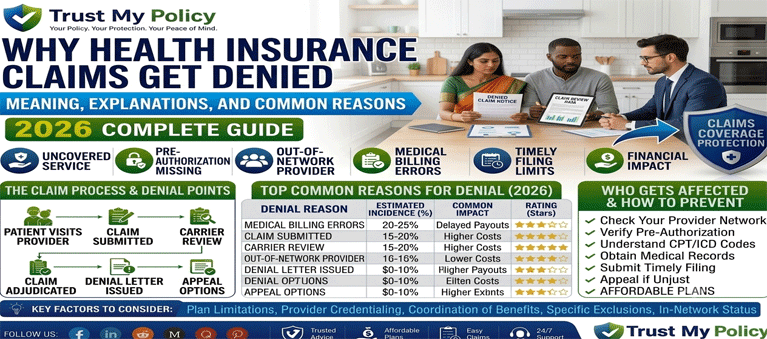
You pay your health insurance premium every month, you visit a doctor covered by your plan, and then a letter arrives saying your claim was denied. It is frustrating, and it happens more often than most policyholders expect. The surprising part is that many denials have nothing to do with whether your plan covers the treatment. They start behind the scenes, with two processes most patients never hear about: medical billing and provider credentialing.
Understanding how these work can help you avoid surprise bills, spot errors faster, and handle the insurance claim process with more confidence.
When you see a doctor, the visit does not end at the front desk. The provider’s office turns your visit into a claim, which is a request for payment sent to your insurer. That claim includes your details, the diagnosis, the services performed, and codes that describe each one.
Your insurer then reviews the claim, checks it against your policy, applies your deductible, copay, or coinsurance, and sends payment to the provider. You receive an Explanation of Benefits (EOB) showing what was billed, what the plan paid, and what you owe.
This is the stage where medical billing matters most. Professional medical billing services handle coding, claim submission, payment posting, and follow-up on behalf of healthcare providers. When this work is done accurately, claims are processed quickly. When it is rushed or incorrect, claims get rejected, delayed, or paid at the wrong amount.
Most billing-related denials come from small, preventable errors:
If you receive a denial, do not assume it is final. Many of these errors can be corrected and resubmitted by the provider’s billing team.
Before a doctor or clinic can join an insurance company’s network, the insurer verifies their qualifications. This process, called credentialing, checks the provider’s medical license, education, board certification, work history, and malpractice record.
It is handled by the provider, not by you. Experienced medical credentialing services help providers complete applications, keep their CAQH profiles up to date, and stay active with each insurance network.
So why does this matter to you as a patient? Because credentialing decides whether a provider is in-network for your plan. In-network providers have agreed rates with your insurer, which usually means lower out-of-pocket costs. If a provider’s credentialing is incomplete, pending, or expired, your insurer may treat the visit as out-of-network, and that can mean higher bills or a flat-out denial.
These two processes are closely linked. A provider can have flawless billing and still see claims denied if their network enrollment is not active. And a provider with perfect credentials can lose money if claims are coded incorrectly.
When both are handled properly, patients benefit in practical ways:
You cannot control how a clinic runs its billing, but you can protect yourself with a few simple steps:
A denial is not the end of the road. Follow these steps:
If you still cannot resolve the issue, many regions have a state insurance department or consumer ombudsman that can review complaints.
When you compare health insurance plans, most people focus on premiums, deductibles, and coverage lists. It is just as important to look at the plan’s network. A plan with a large network of properly credentialed providers can make claims smoother and costs more predictable. If you already have a doctor you trust, check that they are in-network before you enroll or renew.
Health insurance is easier to manage when you understand what happens behind each claim. Medical billing determines whether a claim is submitted correctly, and provider credentialing determines whether the provider is approved to treat patients under your plan. Reliable medical billing and credentialing practices on the provider’s side lead to fewer errors, fewer denials, and a smoother experience for you.
Before your next visit, verify the network status, understand your plan, and review your EOB. A few minutes of preparation can save you hours of frustration and hundreds of dollars.
This article is for general educational purposes and is not financial or legal advice. Always confirm policy details with your insurer or a licensed professional.

Jagadeesh Gutha is the founder of TrustMyPolicy.com, an independent insurance information platform covering life, health, car, home, and business insurance for US and UK readers. He researches insurance products, policy structures, and consumer rights to help everyday people make informed coverage decisions without the jargon. All content on TrustMyPolicy is independently researched, fact-checked, and written to educate — not to sell.




Insurance Guides for UK, USA & Worldwide We are not an insurer or broker.

Reader Comments (0)