
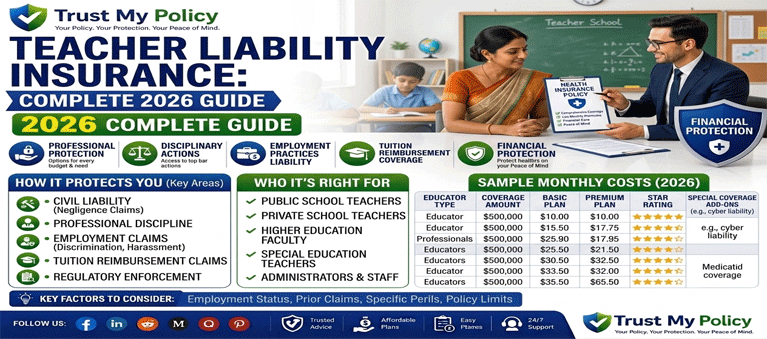
Teacher liability insurance, also called educator liability or professional liability insurance for teachers, covers legal defence costs, settlements, and professional disciplinary proceedings arising from a teacher’s professional conduct. It protects the individual teacher — not the school district — and is typically available through teacher unions or professional associations for $15–$30 a year, or through private insurers for $100–$400 a year with higher limits.
Maria Santos, 34, taught fifth grade in Phoenix and assumed her school district’s liability coverage fully protected her if a parent ever sued over her handling of a student discipline situation. When a parent filed a lawsuit alleging emotional harm from a classroom incident, Maria learned that the district’s legal counsel represented the district’s interests — not hers personally. She had no individual policy and faced the prospect of legal fees that were her own responsibility.
Teacher Liability Insurance in 2026 protects individual educators against lawsuits, disciplinary proceedings, and legal costs that arise from their professional conduct — including situations where a school district’s coverage may not fully extend to the individual teacher or where the district’s attorney is managing the case in the district’s interest rather than the teacher’s. This guide breaks down exactly what teacher liability insurance covers, how much it costs, who provides it, and why a school district policy may leave an individual teacher more exposed than they realise.
This article covers what teacher liability insurance actually protects, how it differs from district coverage, the specific scenarios it responds to, real costs, and where to get it. By the end, you’ll understand exactly the gap that caught Maria off guard.
| Feature | Details |
| What it is | Professional and personal liability coverage protecting individual teachers from lawsuits and proceedings |
| Who needs it | K–12 teachers, tutors, substitute teachers, and other classroom educators |
| Typical cost through union | $15–$30/year (often included in union membership) |
| Typical cost through private insurer | $100–$400/year with higher individual limits |
| What it covers | Legal defence, civil lawsuits, disciplinary hearings, certain criminal charge defence |
| Key gap addressed | School district coverage protects the district — individual teachers need separate personal coverage |
| Regulator | State insurance departments |
Think of the distinction between district coverage and individual teacher coverage like the difference between a company’s legal department and a personal attorney. The company’s lawyers represent the company. If your personal interests diverge from the company’s — even slightly — you need your own representation. A school district’s legal coverage exists to protect the district’s interests, and those don’t always perfectly align with a teacher’s personal interests in a dispute.
Teacher liability insurance is professional and personal liability coverage specifically designed for educators, protecting the individual teacher against legal costs, settlements, and disciplinary proceedings arising from their professional activities. It typically covers civil lawsuits from students or parents, employment disputes, accusations of corporal punishment or excessive discipline, false arrest or imprisonment claims, personal injury allegations within the school environment, and professional disciplinary proceedings before state licensing boards. It does not protect the school district — it protects the teacher personally.
| Criteria | School District Coverage | Individual Teacher Liability Policy |
| Who is protected | The school district | The individual teacher |
| Who the attorney represents | The district’s interests | The teacher’s personal interests |
| Coverage for personal lawsuits | Partial — only when district interests align | Yes, full personal protection |
| Coverage for disciplinary proceedings | Generally no | Yes, including state licensing board hearings |
| Cost to teacher | $0 (provided by district) | $15–$400/year |
| Pros | Free, covers most routine incidents | Protects the individual when district interests diverge |
| Cons | Attorney represents the district, not the teacher | Requires separate purchase and administration |
We recommend individual teacher liability insurance for most readers, since the cost is extremely low relative to the protection it provides, and the gap between district coverage and personal protection is real and well-documented.
Scenario 1: Maria, 34, fifth-grade teacher in Phoenix. A parent’s lawsuit over classroom discipline was handled by the district’s attorney, whose primary obligation was to the district. Maria faced $8,500 in personal legal fees before the case was resolved. Verdict: district coverage doesn’t automatically translate to personal legal representation for individual teachers. Action: Maria purchased an individual policy through her state teachers’ association at $24 a year.
Scenario 2: A physical education teacher in Texas falsely accused of inappropriate physical contact. The accusation triggered both a criminal investigation and a state licensing board proceeding. The teacher’s individual liability policy covered his legal defence in both proceedings. Verdict: criminal charge defence is a specific exposure individual teachers face that district coverage rarely addresses directly. Action: the teacher’s policy paid over $22,000 in legal fees before the investigation was closed with no charges filed.
Scenario 3: A substitute teacher in California who was sued by a parent after a classroom injury. As a substitute employed through a staffing agency, she had less certainty about whether either the district or the agency’s coverage extended to her specifically. Verdict: substitute and part-time teachers often have less clarity about their coverage status, making an individual policy particularly valuable. Action: she purchased a private policy for $180 a year specifically because of her substitute status.
Scenario 4: A private tutor in Florida providing in-home instruction. As a self-employed individual teaching outside a school setting, she had no district coverage whatsoever and needed an individual professional liability policy to cover any claims arising from her tutoring sessions. Verdict: private tutors have no district coverage baseline at all and need individual liability coverage from the first session. Action: she purchased a tutoring-specific liability policy for $220 a year with a $1,000,000 per-occurrence limit.
| Pros | Cons |
| Extremely affordable, especially through union or association membership. | Many teachers don’t realise district coverage may not fully protect them personally. |
| Covers disciplinary proceedings that district coverage typically excludes. | Policy limits vary widely — some union policies may have lower limits than private options. |
| Provides the teacher with an attorney representing their personal interests. | Substitute teachers, tutors, and part-time educators often must research options independently. |
| Available for private tutors and educators outside traditional school settings. | Some policies exclude certain types of allegations — reading exclusions is important. |
| Cancellable and portable — follows the teacher across employers and positions. | Private insurer options with higher limits cost more than union or association options. |
⚠️ WARNING: Never assume your school district’s insurer is representing your personal interests in a legal proceeding. A district attorney’s primary obligation is to the district — if your interests and the district’s interests ever diverge in a case, you need your own representation, which only an individual policy provides.
| Your Situation | Our Recommendation |
| You’re a full-time K–12 public school teacher | Yes — check whether union membership includes it, then add if not |
| You’re a substitute or part-time teacher | Yes — your coverage status is less certain; purchase an individual policy |
| You’re a private tutor working independently | Yes — you have no district baseline coverage at all |
| You’ve been accused of any student interaction complaint | Yes — contact your insurer or union legal service immediately |
| You’re a member of NEA or AFT | Yes — check what educator liability coverage is included in your membership |
| You teach at a private school | Yes — private school district coverage varies more widely than public; confirm your status |
| You’re unsure what district coverage extends to you | Yes — ask HR specifically and document the answer in writing |
💡 TIP: The single golden rule for teacher liability insurance: check whether your union or professional association membership includes educator liability coverage first — it’s often included and many teachers don’t know it.
| Scenario | Annual Cost | Coverage Limit | Notes |
| NEA member liability coverage | Included in NEA membership | $1,000,000 per occurrence | Included automatically for NEA members |
| AFT legal services (member benefit) | Included in AFT membership | Varies by local union | Check local union specifics |
| State teachers’ association policy | $15–$30/year | $1,000,000 per occurrence | Often the most affordable standalone option |
| Private insurer, standard educator policy | $100–$200/year | $1,000,000–$2,000,000 | Broader coverage terms available |
| Private insurer, higher limit policy | $200–$400/year | $2,000,000–$3,000,000 | Appropriate for higher-risk classroom environments |
| Tutoring-specific liability policy | $150–$300/year | $1,000,000 per occurrence | Designed for independent tutoring and instruction |
| Average cost of teacher legal defence without insurance | $8,000–$30,000+ | Not applicable | Typical range for a contested disciplinary or civil case |
National Education Association (NEA) — NEA membership includes educator liability coverage as part of the membership package, protecting members in civil lawsuits and certain disciplinary proceedings. Cost range: included in NEA membership dues. Best for: NEA member teachers wanting baseline coverage at no additional cost. Rating: largest US teachers union, member-funded legal programme.
American Federation of Teachers (AFT) — AFT and its local affiliates provide legal services and liability protection to members through their legal assistance programmes. Cost range: included in AFT membership. Best for: AFT member teachers wanting to understand and use their included legal protection. Rating: major US teachers union.
Forrest T. Jones & Company (US) — A well-established private insurer specialising in educator professional liability with competitive limits and terms. Cost range: $100–$400/year depending on coverage level. Best for: teachers wanting higher coverage limits than union plans provide. Rating: licensed specialty insurer.
Your state teachers’ association — Most state education associations offer affordable member educator liability policies either included in membership or as low-cost add-ons. Cost range: $15–$30/year. Best for: teachers wanting affordable, educator-specific coverage without purchasing a full private policy. Rating: varies by state association.
Hiscox and The Hartford (US) — Both offer professional liability policies that can cover independent tutors and educators working outside traditional school settings. Cost range: $150–$400/year. Best for: private tutors and independent instructors without any school district baseline. Rating: AM Best A.
We recommend checking your union or state association membership first as best overall, since most teacher liability coverage at $0–$30 a year through these channels is the most cost-effective option available.
Teacher liability insurance, also called educator liability insurance, covers individual teachers against legal costs, civil lawsuits, and disciplinary proceedings arising from their professional conduct.
Partially. District coverage may respond to lawsuits naming both the district and the teacher, but the district’s attorney represents the district’s interests — not the teacher’s personal interests.
Through union or state association membership, it’s often included at no extra cost or available for $15–$30 a year. Private insurer options with higher limits typically cost $100–$400 a year.
Yes. NEA membership includes educator liability coverage for civil lawsuits and certain disciplinary proceedings as part of the standard membership package.
Yes, typically. Substitute teachers often have less certainty about district coverage extending to them personally, making an individual policy particularly valuable.
Yes. Private tutors working independently have no school district coverage at all and need their own professional liability policy from the first session.
Most policies exclude intentional criminal conduct, claims arising from incidents outside the scope of professional duties, and some specifically exclude certain categories of physical contact allegations — read the exclusions section carefully.
Yes. Coverage for professional disciplinary proceedings, including state teacher licensing board hearings, is one of the specific benefits that makes individual policies valuable even when district coverage exists.
Consider it if you want higher limits or coverage for scenarios your union’s programme may not fully address, like private tutoring or claims that diverge from the district’s interests.
Contact your insurer or union legal services the moment you become aware of a complaint, allegation, or legal proceeding — early reporting is typically required by the policy terms.
This guide reflects the latest 2026 insurance data.
This article is for informational purposes only. Always consult a licensed insurance professional before making coverage decisions. Trust My Policy does not sell insurance products or represent any insurer.

Jagadeesh Gutha is the founder of TrustMyPolicy.com, an independent insurance information platform covering life, health, car, home, and business insurance for US and UK readers. He researches insurance products, policy structures, and consumer rights to help everyday people make informed coverage decisions without the jargon. All content on TrustMyPolicy is independently researched, fact-checked, and written to educate — not to sell.


Insurance Guides for UK, USA & Worldwide We are not an insurer or broker.
Reader Comments (0)